On 14 November 2025, more than two years after Parliament passed the law that was meant to protect every Indian’s personal data, the government finally switched it on. The Ministry of Electronics and Information Technology, MeitY, notified the Digital Personal Data Protection Rules, 2025 — the operating manual that turns the Digital Personal Data Protection Act, 2023 from a statute on paper into a working compliance regime. For a country with the world’s largest base of internet users and an economy increasingly built on data, this was the missing piece. The Act had been sitting half-asleep since August 2023, waiting for these rules to give it teeth.
And the way the government chose to wake it up matters as much as the rules themselves. Rather than flip a single switch, MeitY built a phased rollout stretching to 14 May 2027 — the housekeeping and the regulator first, the consent plumbing next, and the heavy obligations on consent, breaches and children’s data last. For an aspirant, this is a clean GS2 governance story: a fundamental right being given statutory shape, a new regulator being born, and a sharp public debate about where privacy ends and transparency begins.
Why It’s in the News
The trigger is the notification itself. On 14 November 2025, MeitY published the final DPDP Rules, 2025 in the official gazette, ending a long wait that had stretched through a 2024 consultation and a January 2025 draft. The same notification also brought parts of the parent Act into force and set the phased calendar for the rest. With one stroke, India moved from having a data-protection law that did almost nothing to having a live, dated compliance regime that every company handling Indians’ personal data must now prepare for.
What made the moment land was its scale and its timing. The rules arrived against a backdrop of relentless data breaches, deepfake scares and worries about how platforms harvest information from children. They also followed the Supreme Court’s 2017 Puttaswamy judgment, which held that privacy is a fundamental right under Article 21 — a verdict that effectively ordered the State to build exactly this kind of statutory shield. So the notification is not just a bureaucratic event. It is the long-delayed delivery on a constitutional promise, and that framing is what makes it examinable.
From the DPDP Act, 2023 to the Rules, 2025
To see what changed, you have to start with what was already there. The Digital Personal Data Protection Act, 2023 was passed in August 2023 as India’s first standalone, comprehensive law on personal data. It replaced the thin and ageing data-protection provision of the Information Technology Act, 2000 — the old Section 43A regime — and it did so after a long, messy journey: the Justice B.N. Srikrishna committee report of 2018, a 2019 bill, a 2021 joint-committee version, a withdrawal in 2022 and finally the slimmed-down 2023 Act.
The Act set out the architecture in principle. It defined the key players — the Data Principal (you, the individual whose data is processed), the Data Fiduciary (the company or body that decides why and how your data is processed), and the Data Processor (anyone who processes it on a fiduciary’s behalf). It established the core duties: data may be processed only for a lawful purpose, with notice and consent, and only as much as the purpose needs. It created the Data Protection Board of India as the adjudicator, and it set financial penalties that run up to Rs 250 crore for serious failures such as not preventing a data breach. But the Act left the operational detail blank. How exactly must a notice read? How fast must a breach be reported? Who can be a consent manager? All of that was parked for “rules to be prescribed.”
That is precisely the gap the DPDP Rules, 2025 fill. The rules put numbers, formats and deadlines on the Act’s broad commands. They spell out what a valid consent notice must contain, the duties of a consent manager, the security safeguards a fiduciary must keep, the breach-reporting clock, the mechanics of verifiable parental consent for children, the extra obligations on the biggest data handlers, and the working of the Data Protection Board itself. In short, the Act said what; the rules say how, how fast, and how much. And by attaching a staggered calendar to them, MeitY turned an all-or-nothing law into a managed transition.
The Key Rules and the Phased Rollout
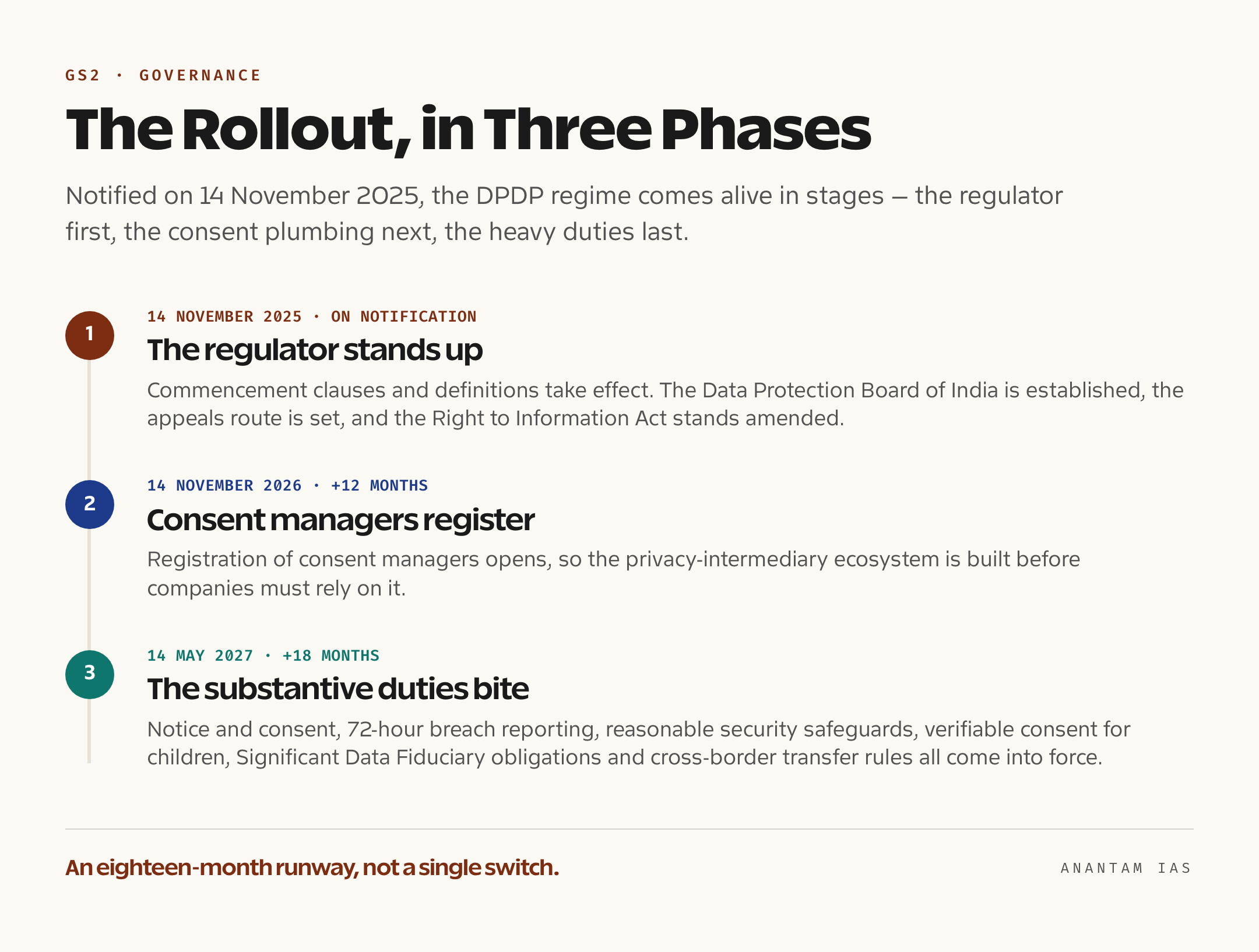
The single most distinctive feature of the rollout is that it comes in three stages, and getting those dates right is the easiest way to sound authoritative. The first stage took effect immediately on 14 November 2025: the commencement clauses, the definitions, the provisions establishing the Data Protection Board of India and its appeals machinery, and — controversially — the amendment to the Right to Information Act. The second stage switches on 12 months later, from 14 November 2026, and covers the registration of consent managers, so the consent ecosystem can be built before companies have to rely on it. The third and biggest stage begins 18 months after notification, from 14 May 2027, and brings in the substantive duties — notice and consent, breach reporting, reasonable security safeguards, verifiable consent for children’s data, the obligations on Significant Data Fiduciaries, and the rules on cross-border transfer. So firms have until mid-2027 to become fully compliant on the hard stuff.
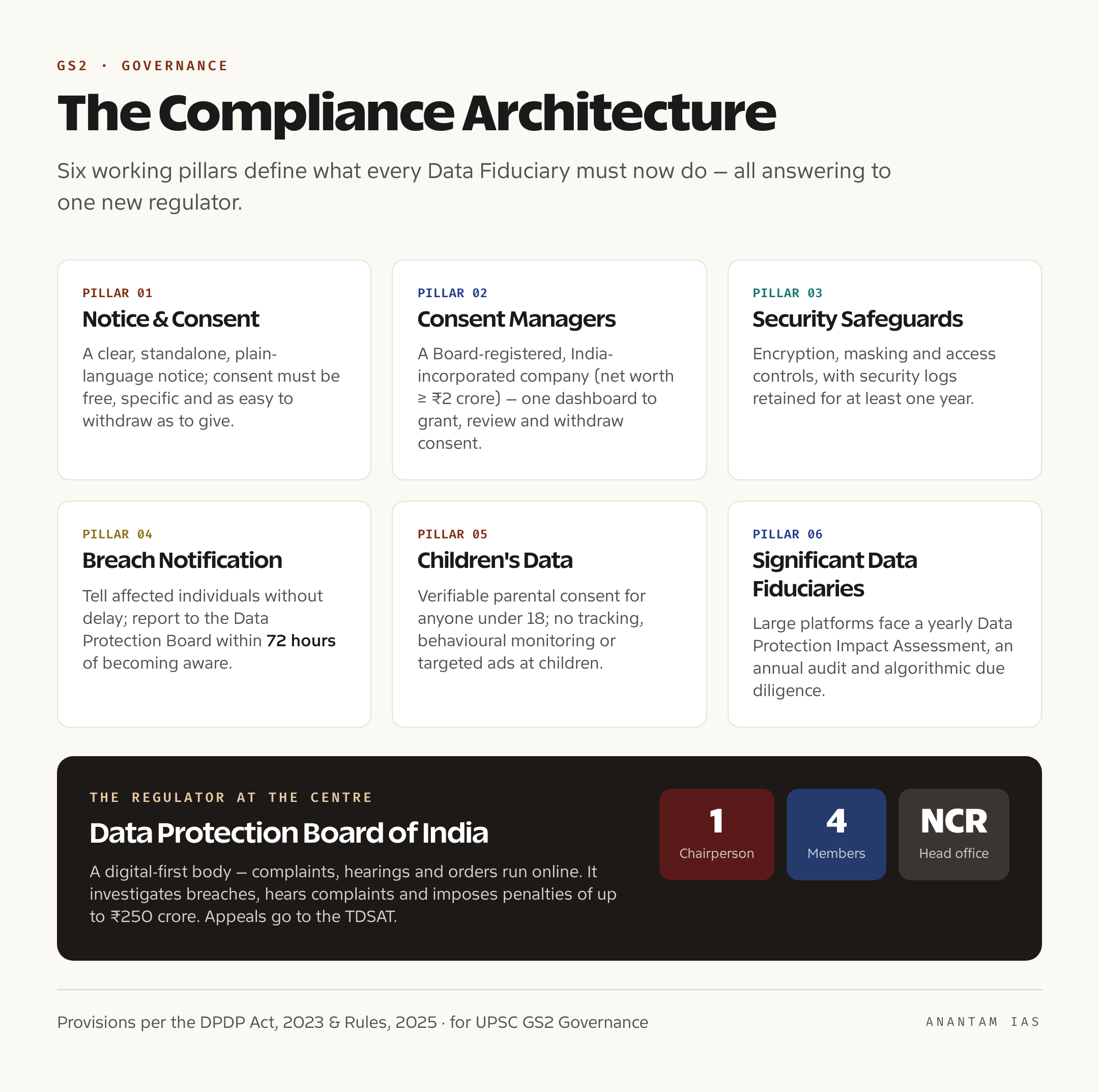
Inside that calendar sit the operative rules. On notice and consent, a Data Fiduciary must give the individual a clear, standalone, plain-language notice listing exactly what data is collected, for what purpose, and how to withdraw consent or complain to the Board. Consent must be free, specific, informed and as easy to withdraw as to give. On consent managers, the rules create a genuinely new institution: a consent manager is a Board-registered, India-incorporated company with a minimum net worth of Rs 2 crore that acts as a single dashboard through which a person can give, review and withdraw consent across many services at once — a privacy intermediary that works for the user, not the platform.
On reasonable security safeguards, every fiduciary must protect personal data with measures such as encryption, masking or tokenisation, access controls, and logging — and must retain those security logs for at least one year so a breach can be detected and investigated. On breach notification, the clock is tight: a fiduciary must inform affected individuals without delay, and must report the breach to the Data Protection Board within 72 hours of becoming aware of it (with a possible extension on request). On children’s data, processing the data of anyone under 18 requires verifiable consent from a parent or lawful guardian, and the law bars tracking, behavioural monitoring and targeted advertising directed at children — a direct response to fears about minors on social media and gaming apps.
On the heaviest handlers, the rules flesh out the category of the Significant Data Fiduciary — large platforms designated by the government on the basis of data volume and sensitivity, risk to electoral democracy, public order and the like. An SDF carries extra burdens: a yearly Data Protection Impact Assessment, an annual independent audit, and due diligence to ensure its algorithms do not harm Data Principals. The rules also set sensible defaults elsewhere — for instance, very large e-commerce, social-media and online-gaming services (broadly, e-commerce and social media with two crore-plus users, gaming with fifty lakh-plus) must erase a user’s personal data three years after the last interaction, unless the law requires them to keep it.
Significance and UPSC Relevance
Step back and the importance is hard to overstate. This is the law that finally operationalises the right to informational privacy that the nine-judge Puttaswamy bench recognised in 2017. For the first time, an ordinary citizen will have enforceable statutory rights over their own data — the right to access it, to correct it, to have it erased, to nominate someone to exercise these rights after death, and to complain to a dedicated regulator. That is a real shift in the citizen-State and citizen-platform relationship, and it slots straight into the GS2 themes of governance, the protection of rights, and the working of statutory bodies.
It also reshapes the digital economy. India processes a colossal volume of personal data — Aadhaar-linked services, UPI, e-commerce, health-tech, ed-tech — and a clear, predictable rule of law on consent and security can build the trust that a data-driven economy needs to grow. A credible domestic regime also strengthens India’s hand abroad: it makes the case for an “adequacy”-style recognition from partners like the European Union easier, smoothing cross-border data flows for the IT and business-process industry. The deliberately light-touch, principles-based design — short statute, phased rules, no blanket data-localisation mandate — is itself a policy choice worth discussing: India opting for an enabling regime over a restrictive one.
For the regulator at the centre of all this, the Data Protection Board of India deserves a paragraph of its own. It is a digital-first body — complaints, hearings and orders are meant to run online — headed by a Chairperson with members appointed by the Central Government, and based in the National Capital Region. It investigates breaches, hears complaints and imposes penalties, with appeals going to the Telecom Disputes Settlement and Appellate Tribunal. How independent this Board turns out to be, given that its members are government-appointed, is one of the live questions the syllabus loves — a classic test of whether a new institution has the autonomy its job demands.
Concerns and the Road Ahead
No law this consequential arrives without a fight, and the criticisms are sharp enough to fill the “way forward” half of any answer. The loudest objection is the breadth of the State exemptions. The Act lets the Central Government exempt its own agencies from the law’s obligations in the interest of sovereignty, security, public order and similar grounds, and critics warn that these carve-outs are wide, loosely worded and short on independent oversight — a gap that sits awkwardly against the very Puttaswamy judgment the law is meant to honour, which demanded that any privacy restriction be necessary and proportionate.
The most contested single change is the amendment to the Right to Information Act. The DPDP Act rewrote Section 8(1)(j) of the RTI Act, 2005 so that “personal information” is broadly exempt from disclosure — and, crucially, it removed the old public-interest override and the test that linked the exemption to public activity. Transparency activists and former information commissioners argue this guts the RTI, because information about a public servant’s assets, qualifications or conduct can now be refused simply by labelling it “personal,” regardless of any larger public interest in exposing corruption. The change has been challenged, and the Supreme Court has issued notice on petitions contending it tilts the balance too far from accountability toward secrecy — a textbook GS2 clash between two competing rights.
Other worries round out the picture. There is no separate, stronger category for sensitive data such as health or biometric information, which many laws treat with extra care. The reliance on verifiable parental consent for under-18s is hard to implement and may simply push platforms toward more identity collection, not less. Penalties bite companies but the law is thinner on remedies for the individual who suffers harm. And the long 18-month runway, while kind to industry, leaves people exposed in the meantime. The road ahead, then, is about execution and balance: standing up a genuinely independent Data Protection Board, narrowing and supervising the State exemptions, restoring a public-interest test to the RTI carve-out, and building the consent and grievance machinery so the new rights are real and not merely on paper.
For Your Mains Answer
This topic is tailor-made for GS Paper 2, which covers the polity, governance, statutory and regulatory bodies, the protection of rights, and government policies for vulnerable groups. It also touches GS Paper 3 on the digital economy, internal security and cyber-security, and it gives the Essay paper a rich case on the tension between privacy, transparency and the State. The skill examiners reward is balance: explain what the rules do, why they matter, and where they fall short — all anchored to Puttaswamy.
How to Build the Answer
Open with the constitutional hook — Puttaswamy (2017) made privacy a fundamental right, and the DPDP Act, 2023 plus the Rules, 2025 are the State’s answer. Then move in a chain: what the Act set up, what the rules added, the three-phase rollout (14 November 2025 to 14 May 2027), the key duties (notice and consent, consent managers, security, 72-hour breach reporting, children’s data, Significant Data Fiduciaries, the Data Protection Board), the significance for rights and the economy, and finally the criticisms — wide State exemptions and the RTI amendment. Close by judging whether the balance is right. That arc fits almost any question on the law.
Common Mistakes to Avoid
Don’t say the law took full effect in November 2025 — only the first phase did; the heavy obligations start in May 2027. Don’t confuse the Data Protection Board (the new regulator) with the appellate route (which goes to the TDSAT). Don’t forget the actors — Data Principal, Data Fiduciary, Data Processor — examiners reward the precise vocabulary. And never present the law as flawless; the RTI amendment and State exemptions are the marks-fetching critique.
A Compact Answer Spine
Puttaswamy (2017): privacy = fundamental right (Article 21) → DPDP Act 2023 sets framework, replaces IT Act Section 43A → Rules 2025 notified by MeitY on 14 November 2025 operationalise it → phased: Board now, consent managers from Nov 2026, substantive duties from 14 May 2027 → duties: notice + consent, consent managers (Rs 2 cr net worth), security safeguards, 72-hour breach report to Board, verifiable parental consent for under-18s, SDF audits/DPIAs → Data Protection Board of India adjudicates, penalties up to Rs 250 crore → concerns: wide State exemptions, RTI Section 8(1)(j) amendment, no sensitive-data tier → way forward: independent Board, proportionate exemptions, restore RTI public-interest test.
Diagram or Flowchart Idea
Draw a simple three-rung ladder of the rollout dates (14 Nov 2025 → 14 Nov 2026 → 14 May 2027) on one side, and on the other a small flow: Data Principal → Consent (via Consent Manager) → Data Fiduciary → safeguards and breach reporting → Data Protection Board. The two together capture both the timeline and the working of the regime at a glance.
A Balanced-Conclusion Line
A line that lands the marks: “The DPDP Rules, 2025 finally give India’s privacy right a working machinery — but their promise will be judged not by the date they were notified, but by whether the Data Protection Board is truly independent and whether the State’s own exemptions, and the RTI it has narrowed, leave accountability intact.”
How to Use Data Without Cramming
You need only a handful of anchors: notified 14 November 2025; full compliance by 14 May 2027 (18 months); breach report within 72 hours; verifiable consent for under-18s; penalties up to Rs 250 crore; the amended Section 8(1)(j) of the RTI Act. Drop those into the right sentences and attribute them plainly — “as MeitY’s November 2025 notification set out” — rather than scattering numbers loosely.
FAQ
When were the DPDP Rules, 2025 notified, and are they fully in force? MeitY notified the Digital Personal Data Protection Rules, 2025 on 14 November 2025, operationalising the DPDP Act, 2023. They are not all in force at once. The rollout is phased: the Data Protection Board and commencement provisions took effect immediately, consent-manager registration starts from 14 November 2026, and the substantive obligations — notice and consent, breach reporting, security safeguards, children’s data and Significant Data Fiduciary duties — begin from 14 May 2027, giving organisations an eighteen-month runway.
Who is a Data Principal, a Data Fiduciary and a consent manager? The Data Principal is the individual whose personal data is being processed — you. The Data Fiduciary is the entity that decides why and how that data is processed, such as a company or government body, and it carries the legal duties. A consent manager is a new, Board-registered, India-incorporated company (minimum net worth Rs 2 crore) that gives a person a single dashboard to grant, review and withdraw consent across many services, acting on the individual’s behalf rather than the platform’s.
How do the rules protect children’s data? Processing the personal data of anyone under 18 requires verifiable consent from a parent or lawful guardian. The rules also prohibit tracking, behavioural monitoring and targeted advertising directed at children. The aim is to shield minors on social-media and gaming platforms, though critics note that verifying a parent’s identity reliably is technically hard and may push platforms toward collecting even more identity data.
Why has the law been criticised, especially over the RTI Act? Two objections dominate. First, the Act gives the Central Government broad powers to exempt its own agencies on grounds like security and public order, which critics call wide and weakly supervised. Second, the DPDP Act amended Section 8(1)(j) of the RTI Act, 2005, making “personal information” broadly exempt from disclosure and removing the earlier public-interest override — a change transparency activists say weakens accountability. The amendment has been challenged before the Supreme Court.
Practice Questions
Prelims MCQs
- With reference to the Digital Personal Data Protection Rules, 2025, consider the following: which authority notified them and when?
(a) NITI Aayog in August 2023
(b) The Ministry of Electronics and Information Technology in November 2025
(c) The Reserve Bank of India in January 2025
(d) The Ministry of Home Affairs in May 2027
Answer: (b) MeitY notified the DPDP Rules, 2025 on 14 November 2025 to operationalise the DPDP Act, 2023. - Under the DPDP framework, the entity that determines the purpose and means of processing personal data is called the:
(a) Data Principal
(b) Data Processor
(c) Data Fiduciary
(d) Consent Manager
Answer: (c) The Data Fiduciary decides why and how personal data is processed and bears the resulting legal obligations; the Data Principal is the individual whose data is processed. - Consider the phased rollout of the DPDP regime.
Which of the following begins last, around 14 May 2027?
(a) Establishment of the Data Protection Board
(b) Registration of consent managers
(c) Notice and consent, breach reporting and obligations of Significant Data Fiduciaries
(d) The amendment to the RTI Act
Answer: (c) The substantive obligations come into force about 18 months after notification, on 14 May 2027; the Board and the RTI amendment took effect immediately, and consent-manager registration from November 2026. - Under the DPDP Rules, 2025, within what time must a Data Fiduciary report a personal data breach to the Data Protection Board?
(a) Within 24 hours
(b) Within 72 hours of becoming aware
(c) Within 7 days
(d) Within 30 days
Answer: (b) Affected individuals must be told without delay, and the Board must be informed within 72 hours of the fiduciary becoming aware of the breach. - Which of the following statements about the DPDP Act’s effect on the Right to Information Act, 2005 is correct?
(a) It repealed the RTI Act entirely
(b) It amended Section 8(1)(j) to broadly exempt “personal information” and removed the public-interest override
(c) It expanded RTI disclosure of personal data
(d) It transferred RTI appeals to the Data Protection Board
Answer: (b) The DPDP Act rewrote Section 8(1)(j), broadly exempting personal information and dropping the earlier public-interest test, a change challenged before the Supreme Court.
Mains Practice Questions
- The Digital Personal Data Protection Rules, 2025 finally operationalise the right to informational privacy recognised in K.S. Puttaswamy (2017). Examine the key features of the rules and their significance for the citizen-State relationship. (15 marks, 250 words)
- “The DPDP framework balances data protection against State interest, but the balance tilts toward the State.” Critically analyse this statement with reference to the exemptions available to government agencies. (15 marks, 250 words)
- Discuss how the DPDP Act, 2023 and the Rules, 2025 reorganise the architecture of data protection in India, distinguishing the roles of the Data Principal, Data Fiduciary, consent manager and the Data Protection Board of India. (15 marks, 250 words)
- The amendment to Section 8(1)(j) of the RTI Act through the DPDP Act has been described as a setback for transparency. Evaluate the competing claims of privacy and the right to information in this context. (10 marks, 150 words)
- A credible domestic data-protection regime is as much an economic asset as a rights guarantee. Assess the implications of the DPDP Rules, 2025 for India’s digital economy and its cross-border data flows. (15 marks, 250 words)
Tell Google you want more of this.
Add Anantam IAS as a preferred sourceOne tap, and this site shows up more often in your own Top Stories, AI Overviews and AI Mode. Remove it any time.