Why in News?
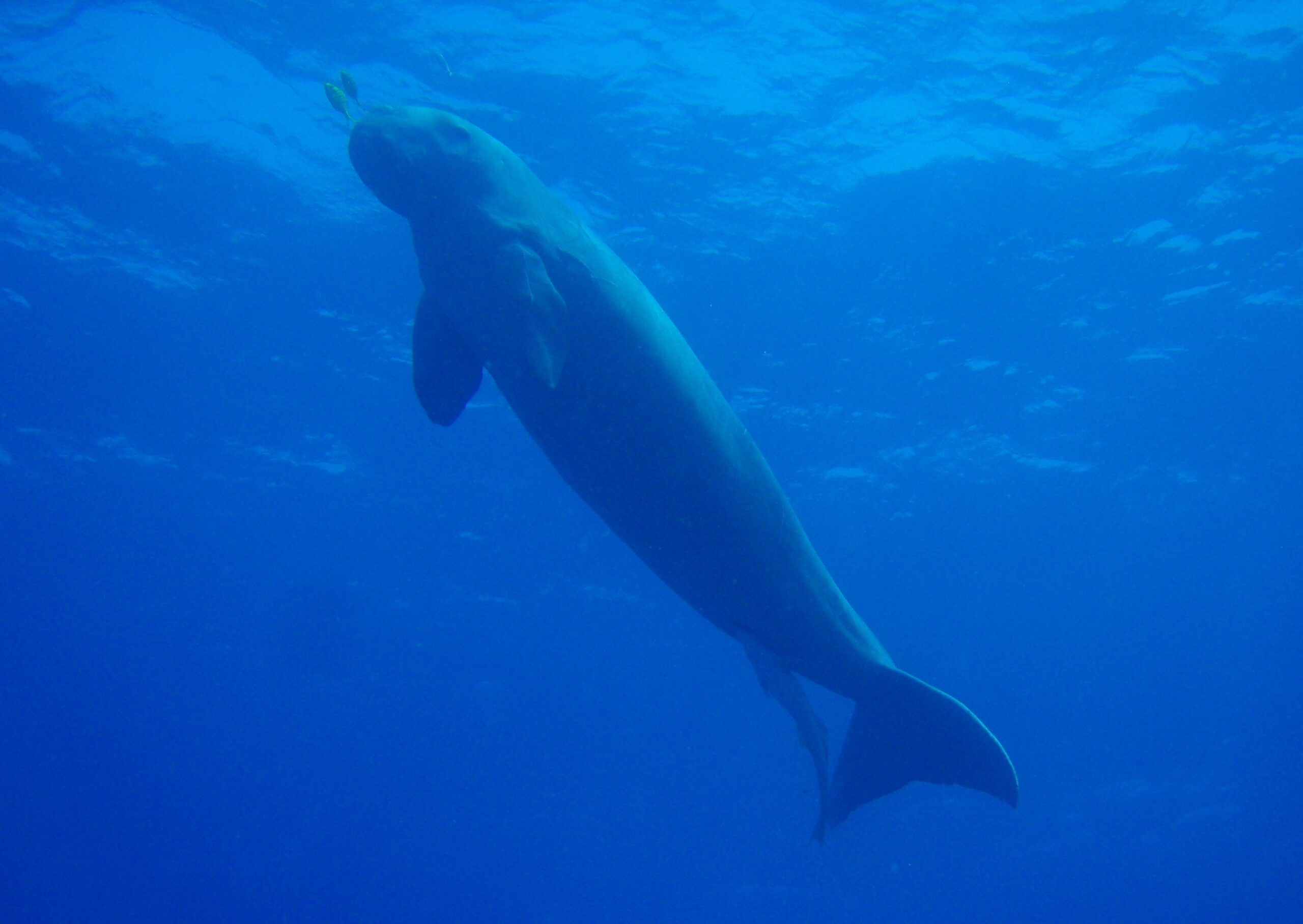
Conservation focus has returned to the dugong (Dugong dugon), India’s only surviving herbivorous marine mammal, after the country anchored its protection around the first dedicated Dugong Conservation Reserve notified in Palk Bay, off the coast of Tamil Nadu.
The gentle, slow-moving ‘sea cow’ now survives in only three Indian pockets — the Gulf of Mannar, the Gulf of Kutch and the waters of the Andaman and Nicobar Islands — making it a textbook case of a flagship marine species clinging to fragmented seagrass meadows.
- India notified its first Dugong Conservation Reserve in Palk Bay, Tamil Nadu, covering roughly 448 sq km of dugong and seagrass habitat.
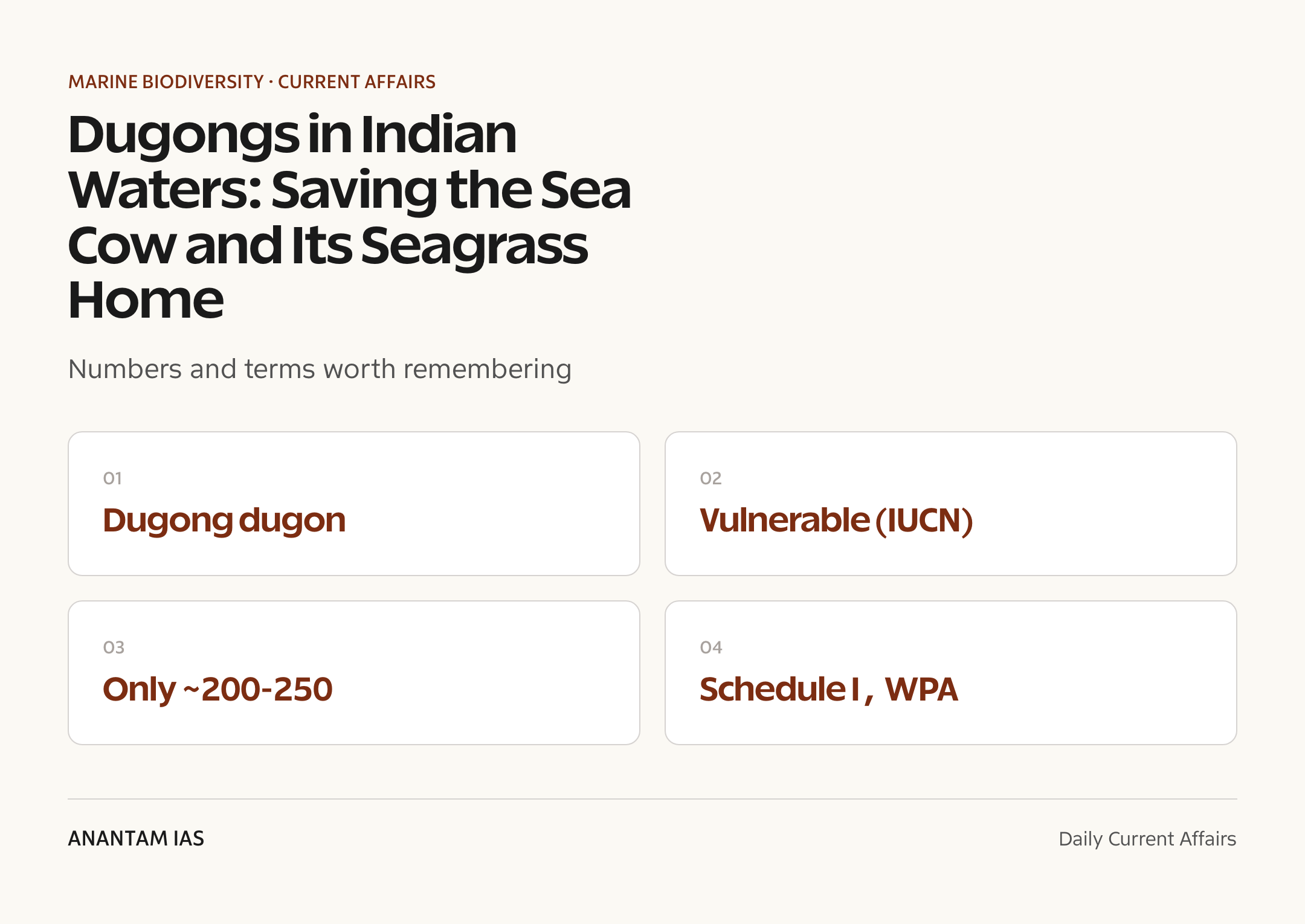
- The dugong is listed as Vulnerable on the IUCN Red List and is protected under Schedule I of the Wild Life (Protection) Act, 1972.
- India’s dugong population is estimated at only around 200-250 animals, concentrated in the Gulf of Mannar and Palk Bay.
- Principal threats are seagrass-meadow loss, accidental gillnet bycatch, and boat and vessel strikes in shallow coastal waters.
- The species is listed on Appendix I of both CITES and the Convention on Migratory Species (CMS), and India is a signatory to the CMS Dugong Memorandum of Understanding.
The development matters in the context of:
- The dugong is an indicator species: a healthy dugong herd signals intact, productive seagrass meadows and clean coastal waters.
- Its decline mirrors the wider stress on India’s coastal blue-carbon ecosystems from fishing pressure, pollution and habitat fragmentation.
UPSC Relevance
Prelims Relevance
- Dugong dugon — the only living member of family Dugongidae; India’s sole herbivorous marine mammal
- Indian range is restricted to the Gulf of Mannar, Gulf of Kutch and Andaman and Nicobar Islands
- IUCN Red List status — Vulnerable; listed on CITES Appendix I and CMS Appendix I
- Protected under Schedule I of the Wild Life (Protection) Act, 1972
- India notified its first Dugong Conservation Reserve in Palk Bay, Tamil Nadu
- Belongs to order Sirenia; its closest relatives are the manatees
- Feeds almost exclusively on seagrass, a flowering marine plant (not seaweed/algae)
- Difference between a conservation reserve, a national park, a wildlife sanctuary and a community reserve
- Seagrass meadows as blue-carbon sinks alongside mangroves and salt marshes
Mains Relevance
GS Paper 3
- Conserving a flagship marine mammal through conservation reserves, the Wild Life (Protection) Act and seagrass-habitat protection.
- Fisheries bycatch and habitat degradation as drivers of coastal marine biodiversity loss.
- Seagrass meadows as blue-carbon ecosystems and their role in climate mitigation and coastal resilience.
GS Paper 2
- International conservation cooperation through the CMS Dugong MoU and CITES for a migratory marine species.
Essay
- Can a single charismatic species protect an entire ecosystem — the promise and limits of flagship marine conservation?
Background and Context
What the dugong is
The dugong is a large, slow-moving marine mammal that grazes seagrass like a cow grazes pasture.
- Dugong dugon is the only living species in the family Dugongidae and India’s sole herbivorous marine mammal.
- It belongs to the order Sirenia — the ‘sea cows’ — sharing ancestry with the manatees of the Atlantic.
- Adults grow to about three metres and live wholly in shallow, warm coastal waters, never venturing onto land.
- It feeds almost exclusively on seagrass, a flowering marine plant, uprooting whole shoots and leaving distinctive feeding trails.
- Slow to breed — females calve only once every few years — so populations recover very slowly from any loss.
Where it survives in India
India holds a small, fragmented share of the global dugong population across just three coastal regions.
- The Gulf of Mannar and adjoining Palk Bay off Tamil Nadu form the country’s most important dugong stronghold.
- The Gulf of Kutch in Gujarat holds a small, isolated western population in its seagrass shallows.
- Scattered animals persist in the lagoons and reefs of the Andaman and Nicobar Islands.
- Total Indian numbers are estimated at only around 200-250 dugongs, well below historic levels.
- These small, disconnected groups are highly vulnerable to local extinction from chance events and habitat loss.
Why it is threatened
The dugong’s Indian decline is driven by pressure on its seagrass habitat and on the animals themselves.
- Seagrass-meadow loss from siltation, coastal pollution, dredging and trawling that scours the seabed.
- Accidental gillnet bycatch, where dugongs drown after becoming entangled in fishing nets.
- Boat and vessel strikes in busy, shallow coastal channels the slow-moving animals cannot escape.
- Historic hunting for meat, oil and ivory-like tusks that drove early population crashes.
- Climate stress and warming that degrades the very seagrass the dugong depends on for food.
Conservation status and legal protection
The dugong sits within an interlocking set of national and international protection frameworks.
- IUCN Red List — classified as Vulnerable across its global range.
- Protected in India under Schedule I of the Wild Life (Protection) Act, 1972, the highest level of legal protection.
- Listed on CITES Appendix I and CMS Appendix I, restricting trade and committing range states to protect it.
- India is a signatory to the CMS Dugong MoU, a non-binding pact coordinating dugong and seagrass conservation across the Indo-Pacific.
- The Wildlife Institute of India runs a dedicated dugong-recovery programme tracking the animals and their seagrass habitat.
The Palk Bay Dugong Conservation Reserve
India’s first dedicated dugong reserve marks a shift toward protecting the species through its habitat.
- Tamil Nadu notified India’s first Dugong Conservation Reserve in Palk Bay, covering about 448 sq km.
- A conservation reserve is a category under the Wild Life (Protection) Act for protecting habitat that links or buffers existing protected areas, often with community involvement.
- The reserve targets the seagrass meadows that anchor the dugong, not just the animal alone.
- It complements the older Gulf of Mannar Marine National Park and Biosphere Reserve next door.
- Crucially, it aims to balance protection with the livelihoods of coastal fishing communities who share the waters.
Flagship value and seagrass blue carbon
The dugong’s worth to conservation goes well beyond its own numbers, anchoring an entire coastal system.
- As a flagship species, the dugong’s appeal draws funding, attention and reserve status that benefit the whole seagrass ecosystem.
- As an indicator species, a thriving dugong herd signals healthy, productive seagrass and clean coastal water.
- Seagrass meadows are powerful blue-carbon sinks, storing carbon in seabed sediments alongside mangroves and salt marshes.
- Those meadows are nurseries for fish, stabilise the seabed and shield coasts — so protecting dugongs underpins coastal livelihoods and resilience.
- The dugong’s fate is a barometer of how well India manages its marine biodiversity and coastal blue-carbon wealth.
Way Forward
Protect and restore the seagrass
- Map and restore degraded seagrass meadows in the Gulf of Mannar, Palk Bay and Gulf of Kutch.
- Regulate trawling, dredging and pollution that smother and uproot seagrass beds.
Cut direct mortality
- Curb gillnet bycatch through gear modification, seasonal no-fishing zones and trained release protocols.
- Enforce boat speed limits and channel rules in shallow dugong waters to prevent vessel strikes.
Engage communities and cooperate
- Build fisher-community stewardship and alternative livelihoods around the Palk Bay reserve.
- Strengthen regional cooperation under the CMS Dugong MoU for this migratory Indo-Pacific species.
Conclusion
The dugong’s Indian story is a reminder that a marine mammal can be globally Vulnerable yet locally on the brink. With only around 200-250 animals left in three shrinking pockets, the species depends entirely on the health of the seagrass meadows it grazes — and on whether India can curb bycatch, vessel strikes and habitat loss in time.
India’s first Dugong Conservation Reserve in Palk Bay signals the right instinct: protect the habitat, not just the animal. Treating the dugong as a flagship for coastal blue-carbon ecosystems means safeguarding seagrass that also stores carbon, nurses fisheries and shields the coast. Keep the meadows intact, and the sea cow stays.
UPSC Practice Questions
Prelims MCQ 1
With reference to the dugong (Dugong dugon), consider the following statements:
- It is India’s only herbivorous marine mammal.
- In India it is found only in the Gulf of Mannar, Gulf of Kutch and the Andaman and Nicobar Islands.
- It is listed as Critically Endangered on the IUCN Red List.
How many of the above statements are correct?
(a) Only one (b) Only two (c) All three (d) None
Answer: (b) Only two
Explanation:
Statements 1 and 2 are correct — the dugong is India’s only herbivorous marine mammal, restricted to the Gulf of Mannar, Gulf of Kutch and the Andamans. Statement 3 is wrong: it is listed as Vulnerable, not Critically Endangered.
Prelims MCQ 2
India’s first Dugong Conservation Reserve has been notified in which one of the following?
(a) Gulf of Kutch, Gujarat (b) Palk Bay, Tamil Nadu (c) Chilika Lake, Odisha (d) Pulicat Lake, Andhra Pradesh
Answer: (b) Palk Bay, Tamil Nadu
Explanation:
India’s first Dugong Conservation Reserve was notified in Palk Bay, Tamil Nadu, covering about 448 sq km of dugong and seagrass habitat.
UPSC Mains Questions
- The dugong is often described as a flagship species of India’s coastal waters. Explain what flagship and indicator species mean, and discuss why conserving the dugong matters for the wider seagrass ecosystem.
- Examine the main threats to the dugong in India and assess how conservation reserves, the Wild Life (Protection) Act, 1972 and habitat protection can together secure its small, fragmented populations.
- Seagrass meadows are increasingly recognised as blue-carbon ecosystems. Critically analyse their ecological and climate significance, and the policy measures needed to protect them in India.
Sources: Ministry of Environment, Forest and Climate Change and Wildlife Institute of India.
Frequently Asked Questions
What is a dugong?
The dugong (Dugong dugon) is a large, slow-moving marine mammal often called the sea cow. It is India’s only herbivorous marine mammal and the sole living member of the family Dugongidae. Belonging to the order Sirenia, it is related to the manatees and feeds almost entirely on seagrass in shallow, warm coastal waters.
Where are dugongs found in India?
In India, dugongs survive in only three regions: the Gulf of Mannar and adjoining Palk Bay off Tamil Nadu, the Gulf of Kutch in Gujarat, and the waters of the Andaman and Nicobar Islands. The total Indian population is estimated at only around 200-250 animals, concentrated mainly in the Gulf of Mannar and Palk Bay.
What is the dugong’s conservation status?
The dugong is listed as Vulnerable on the IUCN Red List. It is protected in India under Schedule I of the Wild Life (Protection) Act, 1972, the highest level of legal protection. It is also listed on Appendix I of both CITES and the Convention on Migratory Species, and India is a signatory to the CMS Dugong Memorandum of Understanding.
Why are dugongs threatened in India?
The main threats are loss of seagrass meadows from pollution, siltation, dredging and trawling; accidental bycatch in gillnets, where dugongs drown after entanglement; and boat or vessel strikes in shallow coastal waters. Historic hunting and climate-driven seagrass degradation add further pressure on the slow-breeding, slow-recovering species.
What is the Palk Bay Dugong Conservation Reserve?
It is India’s first dedicated dugong reserve, notified by Tamil Nadu in Palk Bay and covering about 448 sq km. A conservation reserve is a protected-area category under the Wild Life (Protection) Act, often involving local communities. The reserve protects the seagrass meadows the dugong depends on, complementing the neighbouring Gulf of Mannar Biosphere Reserve.
Why are seagrass meadows important?
Seagrass meadows are the dugong’s only food source and among the most valuable coastal ecosystems on Earth. As blue-carbon sinks, they store large amounts of carbon in seabed sediments, alongside mangroves and salt marshes. They also serve as fish nurseries, stabilise the seabed and protect coastlines, so saving dugongs helps protect coastal livelihoods and climate resilience.
Tell Google you want more of this.
Add Anantam IAS as a preferred sourceOne tap, and this site shows up more often in your own Top Stories, AI Overviews and AI Mode. Remove it any time.