Why in News?
A strengthening El Niño, below-normal July rainfall outlook and delayed kharif sowing have raised the risk that India may need larger imports of vegetable oils, pulses and raw cotton in 2026-27. This is a forward-looking risk, not a realised import record for the current financial year.
The Indian Express reported that India had already imported record quantities of vegetable oils and raw cotton in 2025-26, while pulse imports were near an earlier peak. IMD and NOAA now expect El Niño to strengthen, but both seasonal rainfall and crop output remain uncertain because ocean conditions don’t determine local weather or yields on their own.
- IMD’s 30 June outlook said July 2026 all-India rainfall was most likely to be below normal, or less than 94% of the Long Period Average.
- Weak El Niño conditions were present over the equatorial Pacific, and IMD models indicated likely strengthening during the southwest monsoon season.
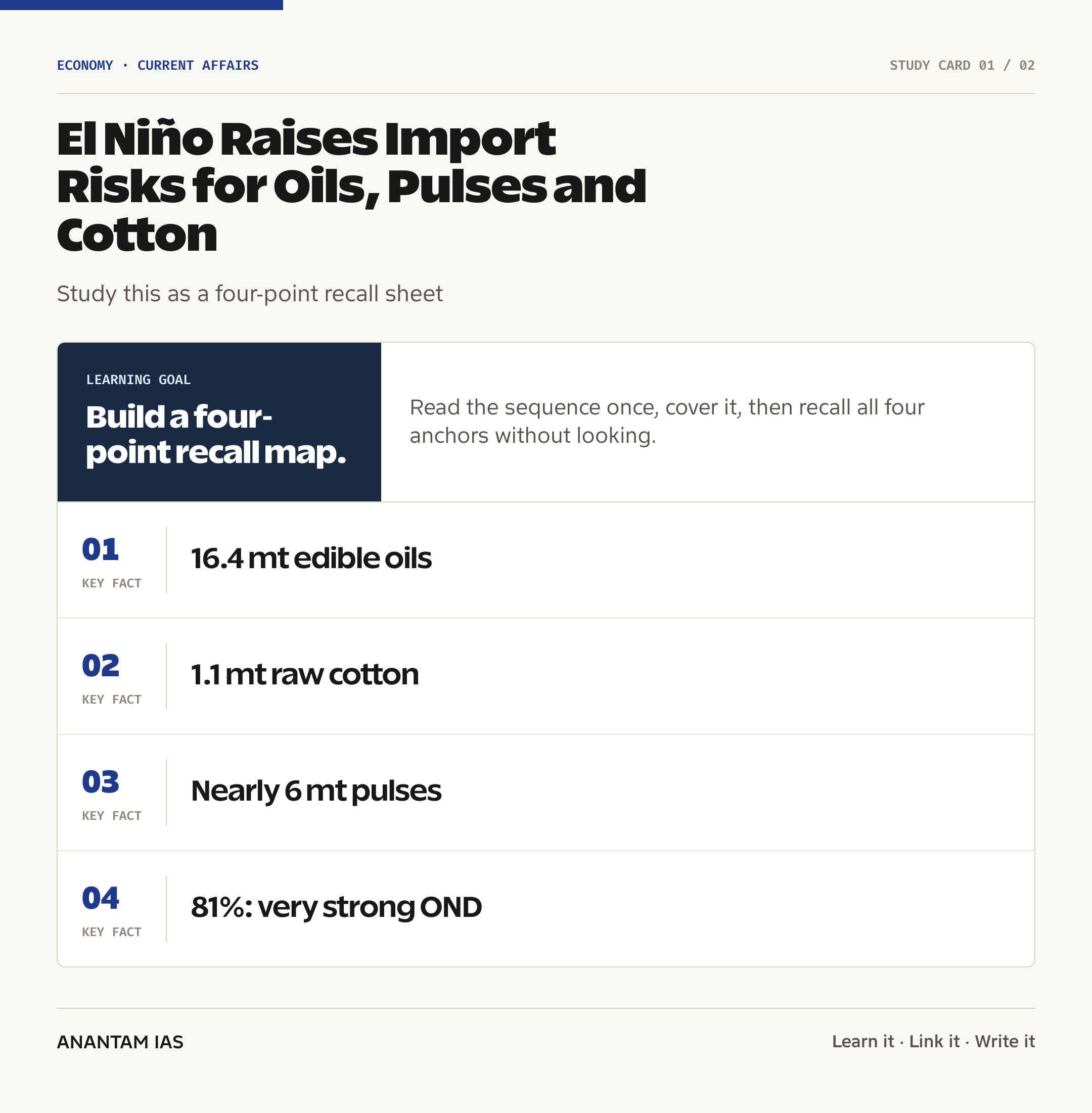
- NOAA’s 9 July advisory assigned an 81% chance of a very strong El Niño during October-December and a 97% chance of persistence into early spring 2027.
- Kharif acreage as of 10 July was reported to be about 16% below the year-earlier pace, with larger lags in pulses and oilseeds.
- Record-import risk concerns vegetable oils, pulses and cotton; it should not be extended automatically to well-stocked cereals such as rice and wheat.
The development matters in the context of:
- Weather risk becomes trade risk when lower output reduces market arrivals and imports fill the domestic gap.
- Rainfed pulses, oilseeds, millets and cotton are especially exposed to rainfall timing and distribution.
- Import dependence links food inflation and the current account to global prices and the exchange rate.
- Sowing data are an early signal; final imports depend on rainfall, yields, stocks, prices and policy.
UPSC Relevance
Prelims Relevance
- El Niño is the warm phase of ENSO, involving sustained warming in the central and eastern equatorial Pacific with coupled atmospheric changes.
- ENSO can alter the Walker circulation and shift tropical rainfall, but it doesn’t produce the same impact in every region or every event.
- Indian Ocean Dipole conditions were neutral in IMD’s July outlook and were forecast to remain neutral during the monsoon season.
- Long Period Average is the climatological benchmark against which IMD classifies seasonal or monthly rainfall.
- Kharif crops are generally sown with the southwest monsoon and include paddy, tur, urad, soybean, groundnut, millets and cotton.
- Vegetable oil imports mainly supplement domestic oilseed output and expose India to palm, soybean and sunflower oil markets.
- Price Support Scheme covers pulses, oilseeds and copra through physical procurement at MSP by designated agencies.
Mains Relevance
GS Paper 3
- Agriculture and food security: transmission of rainfall shocks into acreage, yields, market arrivals, prices and import demand.
- Indian economy: effects of agricultural imports on inflation, the trade balance, the current account and household welfare.
- Climate resilience: irrigation, seed systems, agro-advisories, crop insurance and diversification for rainfed regions.
GS Paper 1
- Physical geography: ENSO, Walker circulation, Indian Ocean Dipole and the spatial variability of the southwest monsoon.
- Human geography: links between climatic variability, cropping patterns, rural livelihoods and regional vulnerability.
Essay
- Self-reliance and interdependence: food security needs domestic resilience as well as dependable international trade.
- Uncertainty in public policy: forecasts should trigger preparation without being converted into deterministic claims.
Background and Context
What El Niño means, and what it does not
El Niño changes the odds of weather outcomes; it isn’t a one-variable explanation for India’s monsoon or harvest.
- Ocean signal: El Niño is associated with warmer-than-average sea-surface temperatures in the central and eastern equatorial Pacific.
- Atmospheric coupling: pressure, winds, convection and the Walker circulation also change, making ENSO an ocean-atmosphere phenomenon.
- Indian association: El Niño often tilts the monsoon toward weaker rainfall, but the relationship is statistical rather than automatic.
- Competing influences: the Indian Ocean Dipole, Madden-Julian Oscillation and synoptic systems can amplify or offset the signal.
- A useful conceptual companion is El Niño’s monsoon transmission channels, which explains why a Pacific anomaly can become an Indian economic risk.
What the latest forecasts actually say
The official outlooks support heightened preparedness, while leaving room for changes in rainfall distribution and crop outcomes.
- IMD assessed weak El Niño conditions over the equatorial Pacific at the end of June and expected them to strengthen during the southwest monsoon season.
- July rainfall was forecast to be below normal nationally, defined in the outlook as less than 94% of the monthly Long Period Average.
- Neutral IOD was observed and forecast to persist, so the outlook didn’t assume a strong positive Indian Ocean Dipole would counter the Pacific signal.
- NOAA placed the chance of a very strong event during October-December at 81% and persistence into early spring 2027 at 97%.
- Probability isn’t destiny: NOAA cautioned that even the strongest events don’t create the typical impact everywhere.
The early monsoon and sowing signals
Rainfall and planting data show current stress, but neither is the same as a final production estimate.
- Rainfall: June was reported 38% below normal and the cumulative gap was still 24% as of 16 July despite an early-July recovery.
- Total kharif sowing as of 10 July was about 16% below the year-earlier pace; planting can still catch up where rainfall and soil moisture improve within crop windows.
- Crop gaps: pulses were reported 23.3% lower, oilseeds 21% lower and cotton 15.3% lower than the year-earlier sowing pace.
- Interpretation: acreage is one production component; yield also depends on rainfall timing, heat, pests, irrigation and crop management.
The import base before the 2026-27 shock
India entered the current season with a large agricultural import bill, so a domestic shortfall would operate on an already high base.
- Import volumes: the Indian Express estimated 16.4 million tonnes of vegetable oils, 1.1 million tonnes of raw cotton and nearly 6 million tonnes of pulses in 2025-26.
- Commerce data: official quick estimates place 2025-26 import values at $19.49 billion for vegetable oil, $1.89 billion for raw cotton and waste, and $3.57 billion for pulses.
- Current-year claim: a fresh record in 2026-27 remains a projection dependent on harvests, stocks, demand, world supply and policy.
- Structural message: persistent dependence also reflects low oilseed yields, demand growth, crop incentives and textile-sector needs.
How a weather shock becomes an import shock
The exam-ready causal chain runs through physical production, markets, prices, policy and external trade.
- Rainfall to output: delayed or poorly distributed rain can reduce acreage or yields and lower market arrivals.
- Supply to prices: tighter availability raises prices unless private stocks, public buffers or imports bridge the gap.
- Prices to trade: import volumes respond to domestic-global price gaps, the exchange rate, freight and policy.
- Trade to macroeconomy: a larger bill can widen current-account pressure while food inflation reduces purchasing power.
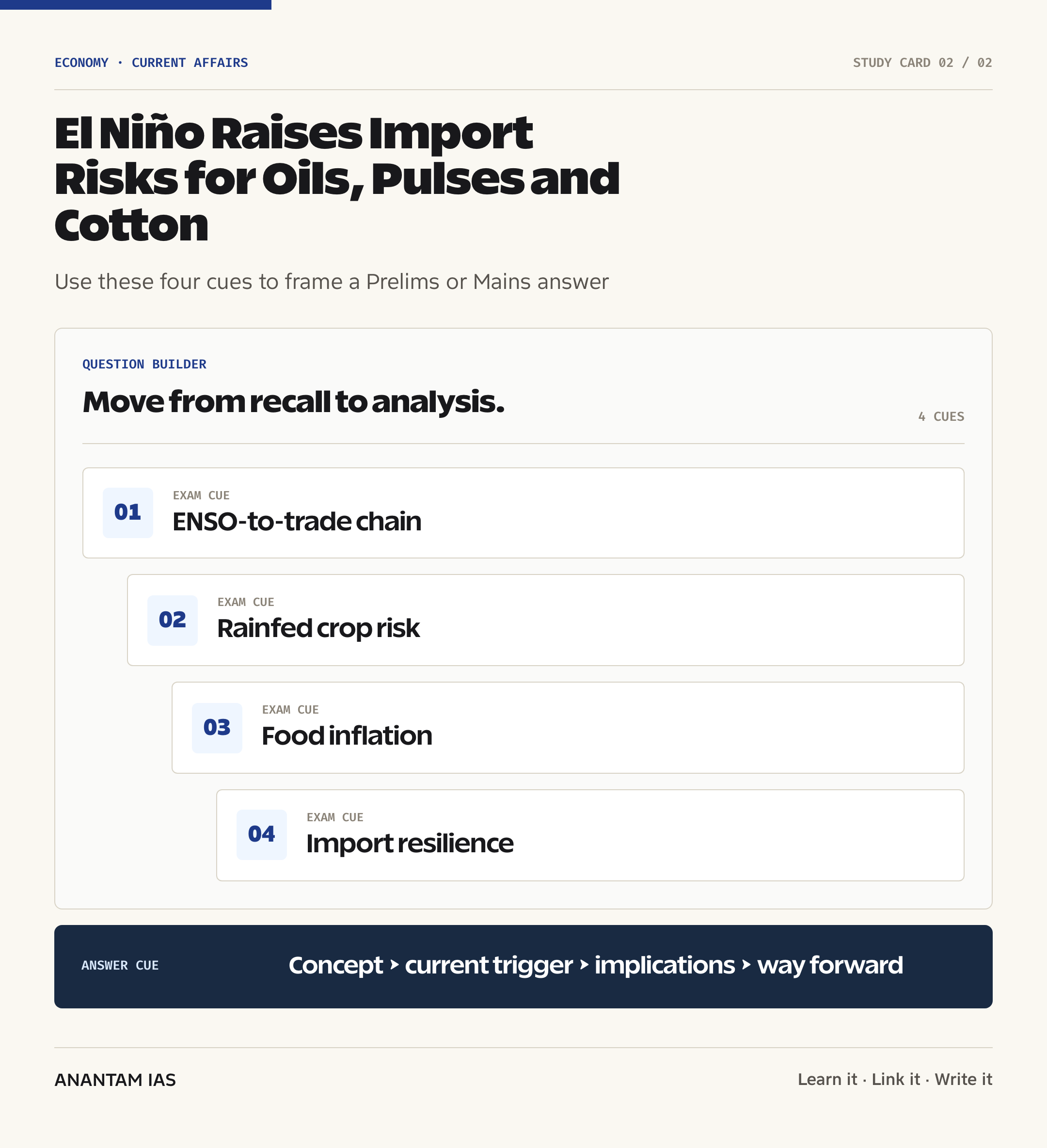
- Answer cue: climate signal → rainfall and heat → acreage and yield → supply and prices → trade and current account → resilience policy.
- The inflation leg should be connected with the recent note on food-led CPI pressure, without assuming every global price increase passes through fully.
Why the three commodities face different risks
Vegetable oils, pulses and cotton share weather exposure but differ in end-use, policy support and global-market transmission.
- Vegetable oils connect oilseed output to household cooking-oil prices; palm, soybean and sunflower oils also face biofuel-linked global demand and currency risk.
- Pulses are central to affordable protein and food inflation; tur, urad and other rainfed crops are sensitive to sowing windows and dry spells.
- Cotton is a commercial fibre; imports reflect output, quality, mill demand and exports, while dry conditions can alter pink bollworm risk.
- Rabi spillover: a strong El Niño may raise the risk of a short or warm winter, but effects on wheat, mustard, gram and lentil remain conditional on temperature and soil moisture.
- Policy distinction: pulses and oilseeds receive MSP-linked procurement, while cotton policy also weighs textile-industry needs.
- See the published explainers on the Price Support Scheme and 2026-27 kharif MSPs.
Cushions that can prevent a crisis
High import risk doesn’t mean India lacks buffers, trade options or scope for a late-season recovery.
- Public stocks of rice and wheat were reported above buffer norms, while pulse stocks could be released to cool prices.
- Global supply was comfortable for several crops, and diversified harvest calendars can reduce concentration risk.
- Rainfall recovery before the end of crop-specific sowing windows can narrow acreage gaps; later rains can still support crop development.
- Limits of buffers: stock releases manage short-term availability, while repeated weather shocks require productivity, water and risk-management reform.
Way Forward
Use forecasts as operational triggers
- District contingency plans should identify alternate crops, short-duration varieties and last viable sowing dates before rainfall gaps become irreversible.
- Agromet advisories should reach farmers in local languages with crop-stage guidance on sowing, irrigation, pests and re-sowing.
- Forecast updates must clearly separate observed rainfall, probabilistic outlooks and scenario-based crop estimates.
Build rainfed-crop productivity
- Oilseed and pulse research should focus on higher yield, heat tolerance, pest resistance and region-specific seed systems.
- Micro-irrigation and water harvesting can protect critical crop stages even where full irrigation coverage is impractical.
- Extension services should pair resilient varieties with soil-moisture conservation and integrated pest management.
Align price and procurement policy
- MSP signals need credible procurement access for pulses and oilseeds so farmers aren’t asked to bear diversification risk alone.
- NAFED and NCCF procurement should be timely, decentralised and accessible to small farmers through transparent registration.
- Buffer operations should use clear release rules that stabilise prices without crowding out normal market arrivals.
Use trade policy predictably
- Import windows should be opened early enough to prevent panic buying but calibrated against the domestic harvest calendar.
- Supplier diversification and sanitary approvals can reduce concentration risk in pulses and edible oils.
- Tariff changes should balance consumer prices, processing needs and farmer returns rather than react to each weekly price movement.
Protect incomes and the macroeconomy
- Crop insurance should settle weather-linked losses quickly and use transparent yield or weather data.
- Inflation management should combine supply measures with targeted support instead of relying only on interest rates against a food-supply shock.
- Import-risk monitoring should track volumes, values, exchange rates, freight and global stocks separately to avoid treating them as one indicator.
Conclusion
The strongest conclusion available on 17 July is a risk assessment: El Niño is strengthening, rainfall and sowing are lagging, and India already has a high import base in vegetable oils, pulses and cotton. A new record in 2026-27 is plausible, but it isn’t yet an observed outcome.
The policy test is to act before uncertainty resolves into scarcity. Better forecasts, resilient rainfed agriculture, credible procurement, smart buffers and predictable trade can break the chain from a Pacific climate shock to domestic inflation and external-account stress.
UPSC Practice Questions
Prelims MCQ 1
With reference to El Niño and the Indian monsoon, consider the following statements:
- El Niño involves warming in the central and eastern equatorial Pacific with coupled atmospheric changes.
- A very strong El Niño invariably produces deficient rainfall in every part of India.
- The Indian Ocean Dipole and intraseasonal systems can modify the monsoon outcome during an El Niño year.
How many of the above statements are correct?
(a) Only one (b) Only two (c) All three (d) None
Answer: (b) Only two
Explanation:
Statements 1 and 3 are correct. ENSO is a coupled Pacific ocean-atmosphere phenomenon, while the IOD and intraseasonal systems can modify India’s rainfall. Statement 2 is wrong because El Niño changes probabilities; it doesn’t guarantee the same rainfall outcome everywhere.
Prelims MCQ 2
Which one of the following best describes the first direct link in the chain from a weak monsoon to higher agricultural imports?
(a) An automatic rise in the policy repo rate (b) A decline in acreage or yield that reduces domestic market supply (c) An immediate appreciation of the rupee (d) A compulsory ban on agricultural exports
Answer: (b) A decline in acreage or yield that reduces domestic market supply
Explanation:
Rainfall stress can first reduce planted area or crop yield. Lower domestic supply may then raise prices and create an import gap, depending on stocks, demand, global prices, the exchange rate and government policy.
UPSC Mains Questions
- A climate forecast becomes an economic issue through agriculture, prices and trade. Trace the transmission of a strengthening El Niño into India’s vegetable-oil, pulse and cotton import dependence, while explaining why the outcome must be expressed probabilistically.
- India’s food security requires both domestic self-reliance and access to global markets. Evaluate how procurement, buffer stocks, crop diversification and predictable import policy can protect consumers without weakening farmer incentives.
- Rainfed agriculture is the critical bridge between monsoon variability and rural vulnerability. Suggest a district-level resilience strategy covering climate services, seeds, water, insurance, market support and crop-specific contingency planning.
Sources: India Meteorological Department and The Indian Express Explained.
Frequently Asked Questions
Is a record import bill certain in 2026-27?
No. Vegetable-oil, pulse and cotton imports may rise if acreage or yields fall, but the final volumes depend on rainfall recovery, output, stocks, demand, global prices, freight, the exchange rate and trade policy. The current claim is a risk projection, not a realised record.
How does El Niño affect India’s monsoon?
El Niño changes tropical Pacific winds and convection and often tilts India’s monsoon toward weaker rainfall. The relationship isn’t one-to-one. The Indian Ocean Dipole, Madden-Julian Oscillation, monsoon depressions and regional weather systems can strengthen, weaken or redistribute the impact nationally.
Why are pulses and oilseeds especially exposed?
Large shares of pulses and oilseeds are grown in rainfed regions, so sowing and yields depend on timely, well-distributed rainfall. Their domestic demand is also large, which means a production gap can move quickly into higher prices, stock releases or imports.
Why is cotton included with food commodities?
Cotton isn’t food, but it is a major rain-sensitive commercial crop and an input for the textile industry. A domestic shortfall can raise raw-cotton imports, affect mill costs and exports, and create a policy trade-off between farmer prices and industrial competitiveness.
Can buffer stocks remove the import risk?
Buffers can moderate a short-term supply shock by releasing cereals or pulses into the market. They can’t fully offset repeated oilseed, pulse or cotton shortfalls, and stock operations have limits of quantity, quality, storage and timing. Long-term resilience needs higher productivity and better water management.
What should a UPSC answer emphasise?
Start with the ENSO forecast and its uncertainty. Trace the chain from rainfall and temperature to acreage, yield, supply, prices, imports and the current account. End with a balanced package: climate services, rainfed productivity, procurement, buffers, crop insurance and predictable trade policy.
Tell Google you want more of this.
Add Anantam IAS as a preferred sourceOne tap, and this site shows up more often in your own Top Stories, AI Overviews and AI Mode. Remove it any time.