Why in news:
India is home to 15 species of wild cats, but most of the attention is focused on larger species like lions and tigers. Smaller, more secretive species like the caracal, rusty-spotted cat, and fishing cat are often overlooked despite facing significant threats.
UPSC Relevance:
Species and species behaviors have been asked in Prelims time and again.
UPSC PYQ 2023:
Which one of the following makes a tool with a stick to scrape insects from a hole in a tree or a log of wood?
(a) Fishing cat
(b) Orangutan
(c) Otter
(d) Sloth bear
The Fishing Cat: A Wetland Specialist:
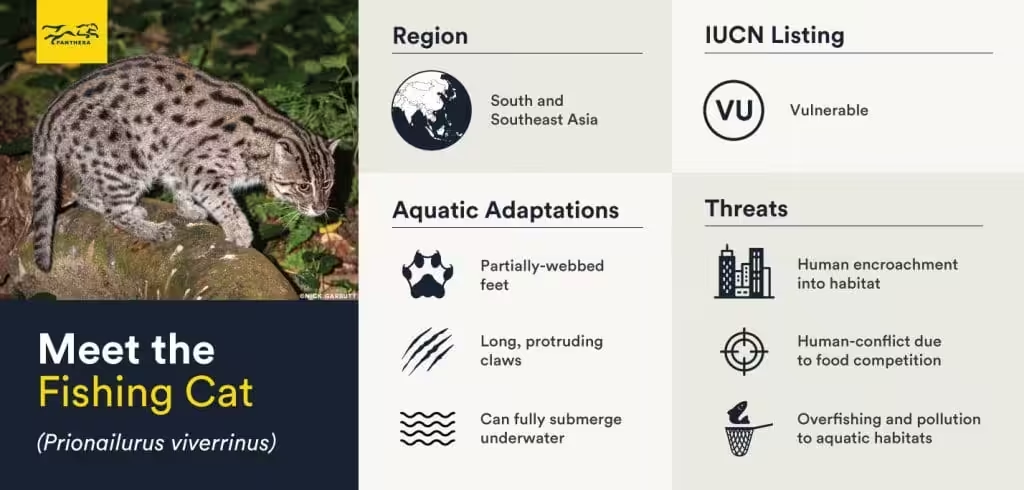
- IUCN Status : Vulnerable (Latest update)
- The fishing cat is a medium-sized feline, about twice the size of a domestic cat, weighing between 7 and 12 kg.
- It has a greyish-brown coat with black spots and is often the apex predator in its territory.
- It thrives in wetlands, which are ecosystems characterized by waterlogged soil, such as river floodplains, mangroves, and swamps.
- The fishing cat has several adaptations for its environment: partially webbed paws, a dense water-resistant coat, and the ability to swim submerged.
- Its claws cannot be fully retracted, which helps it grip slippery surfaces and catch fish.
- While its primary diet is fish, it also preys on rodents, chickens, and other small animals.
- This cat spends about 50% of its hunting time near the water’s edge, but only about 5% of its time is spent submerged.
- Populations are found in scattered locations across India, including the Himalayan terai region, Western India, the Sundarbans, the East coast, and Sri Lanka.
- Researchers use camera traps and GPS collars to survey and track these elusive, nocturnal cats.
- A recent survey in Chilka lake estimated a healthy population of around 750 fishing cats.
- This contrasts with the cats’ declining numbers in the Sundarbans, though they have been sighted again in Rajasthan’s Keoladeo National Park after being thought to be locally extinct.
- The main threats to the fishing cat are habitat loss (30-40% of India’s wetlands have been degraded) and human conflict, as they are often killed for preying on fish ponds and chickens.
- New projects, like one in the Godavari river estuaries, use GPS collars to understand the cats’ movements and interactions with humans to develop better conservation strategies.
Few Small Cat Species Found in India:
| Feature | Malabar Civet | Rusty-spotted Cat | Caracal |
| Geographic Range | Endemic to the Western Ghats of southwest India. | Found in India (northern, central, Western Ghats), Sri Lanka, and Nepal. India holds about 80% of the total population. | Widespread across Africa, the Middle East, Central Asia, and northwestern India. |
| Habitat | Tropical evergreen and moist deciduous forests, as well as cashew and rubber plantations. Prefers wooded lowlands and adjoining hill slopes. | Dry forests, bamboo forests, wooded grasslands, scrublands, and rocky hills. Also adapts to agricultural landscapes. | Arid woodlands, savannas, scrublands, and hilly steppes. Avoids tropical forests and open sandy deserts. |
| Diet | Omnivorous, feeding on small mammals, birds, reptiles, insects, and fruits like jackfruit and figs. | Primarily feeds on rodents, small birds, frogs, insects, and small reptiles. | Strictly carnivorous, preying on small to medium-sized mammals (like rodents, hares, and antelopes) and birds. |
| IUCN Status | Critically Endangered The population is estimated to be fewer than 250 mature individuals. It is one of the world’s rarest mammals. | Near Threatened Faces threats from habitat loss and fragmentation. | Least Concern However, the Indian population is considered locally endangered and is declining. |
| Distinguishing Features | Dog-like appearance with a long body, short legs, and a black dorsal crest (a mane of hair) running from its neck to the tail. It is a member of the civet family, not the cat family. Nocturnal and Elusive Behaviour. | The world’s smallest wild cat. It has a reddish-gray coat with distinctive rusty-colored spots. It’s often mistaken for a baby leopard.Nocturnal and Elusive Behaviour.True Cat | A robust build with a short face, long legs, and a short tail. Its most notable features are the long, black tufts of hair on its ears.Nocturnal and Elusive Behaviour.True Cat |
Tell Google you want more of this.
Add Anantam IAS as a preferred sourceOne tap, and this site shows up more often in your own Top Stories, AI Overviews and AI Mode. Remove it any time.