Why in News?
On 26 October 2026, TDB-DST announced an agreement supporting Manastu Space’s green propulsion programme, including further engineering, integration, testing and validation of an indigenous system.
- The programme seeks to advance from Technology Readiness Level 6 to Level 9; the target has not been reported as achieved.
- The technology uses a hydrogen-peroxide-based propellant with additives, supported by an integrated engine, catalyst and propellant feed system.
- The project includes an ultra-high-temperature ceramic catalyst intended for reliable operation under demanding conditions.
- PIB reports an existing space demonstration, followed by further development for wider deployment in satellite and launch-vehicle applications.
- Propulsion reliability depends on the complete chain from stored propellant to controlled thrust, including materials and operating conditions.
- Green propellant describes an intended improvement over conventional options; it does not establish that a chemical is harmless or that the system is already operational.
UPSC Relevance
Prelims Relevance
- TDB: Technology Development Board under the Department of Science and Technology.
- Catalyst: a material that accelerates a chemical reaction without being consumed overall by that reaction.
- Exothermic decomposition: breakdown of a substance that releases heat.
- Chemical propulsion: produces thrust by accelerating gases generated through reaction or decomposition.
- Technology readiness: evidence of maturity under increasingly representative operating conditions.
Mains Relevance
GS Paper 3
- Indigenous space capability: developing critical subsystems alongside spacecraft and launch vehicles.
- Technology assessment: separating demonstrated feasibility, system reliability and deployment readiness.
- Safety and sustainability: evaluating propellant choices across handling, materials and mission operations.
Background and Context
What the Integrated System Must Do
A useful propulsion system combines a suitable propellant with hardware that can deliver and control its energy reliably.
- The announced propellant formulation is based on hydrogen peroxide with additives. The release does not disclose their identities or proportions, so the formulation should not be described as pure peroxide or reconstructed from assumptions.
- The feed system supplies propellant to the engine. Its compatibility with the liquid and its ability to deliver controlled flow matter because a promising chemical cannot compensate for unreliable delivery to the reaction region.
- The project combines an engine and catalyst system, including a ceramic catalyst intended for demanding temperatures. Catalyst development belongs within the larger engineering task, rather than serving as independent proof that every propulsion function works.
- Scalability means adapting a technology across different propulsion requirements. It does not mean that one unchanged device can serve every spacecraft: flow, thermal loads, structural requirements and mission demands still need appropriate engineering and verification.
- PIB reports that the technology has been demonstrated in space. This establishes an important development milestone, while the announced programme still involves integration, testing and validation before the intended wider deployment can be assessed.
How Peroxide Can Contribute to Thrust
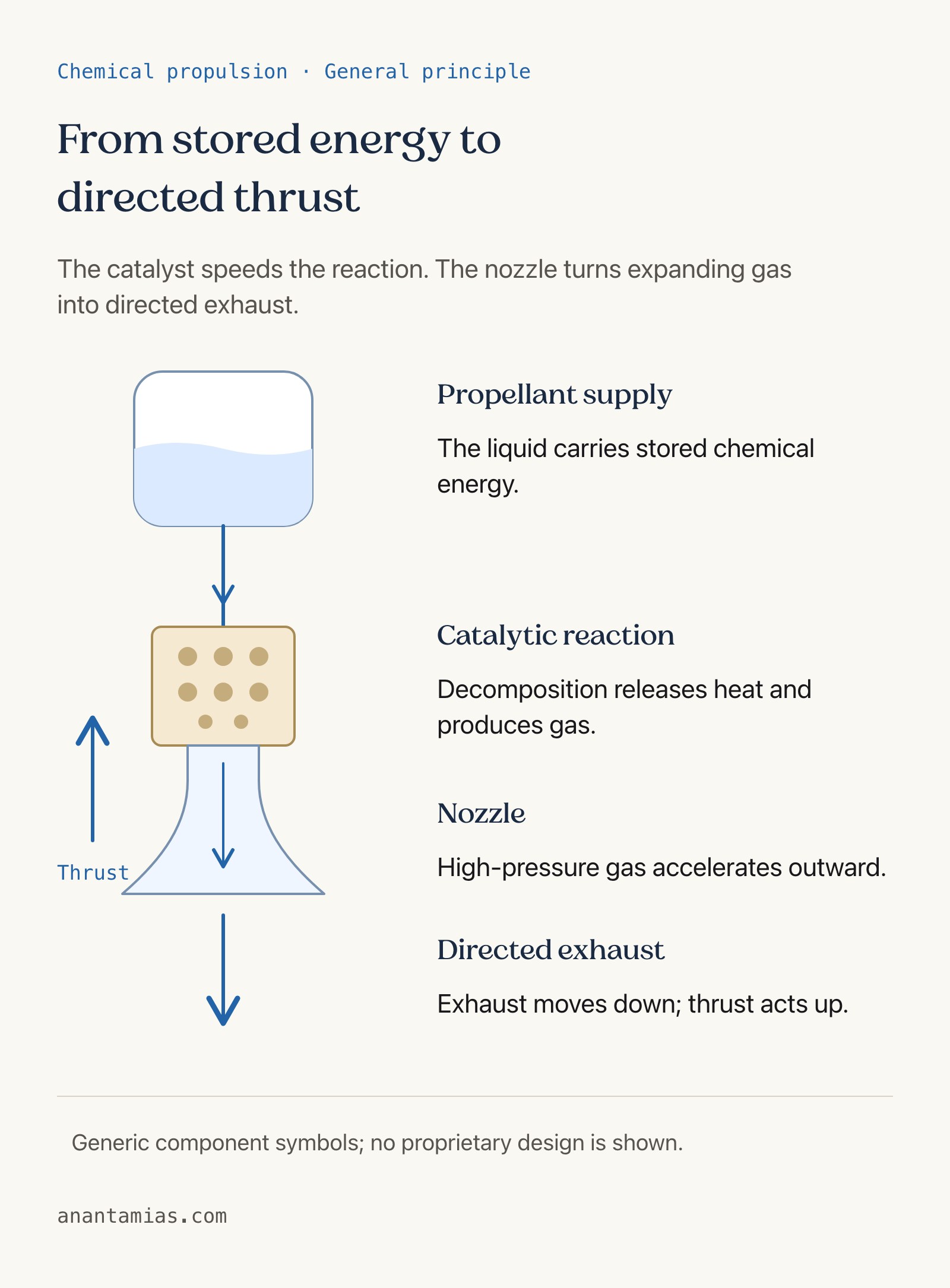
The general chemical mechanism explains the role of the catalyst without revealing the proprietary design of the announced system.
- Hydrogen peroxide can undergo catalytic, exothermic decomposition, as NASA explains. A catalyst accelerates the reaction; the chemical stores the energy released during decomposition, so the catalyst should not be described as the fuel itself.
- In chemical propulsion, combustion or decomposition produces high-pressure gas that accelerates through a nozzle. Expelling that gas generates thrust, linking chemical energy release to the mechanical task of changing a spacecraft’s motion or orientation.
- This general mechanism helps explain why propellant delivery, reaction control and nozzle operation must work together. It does not establish the detailed reaction pathway, geometry or performance of Manastu’s undisclosed additive-containing formulation and hardware.
- Thermal and materials compatibility must be considered together with the reaction. Components exposed to the propellant and hot reaction products need suitable materials; selecting a greener chemical does not automatically qualify an existing propulsion assembly.
- Peroxide handling still requires care. NASA notes that concentrated peroxide can react rapidly with impurities and decompose dangerously if improperly stored or handled, making cleanliness and compatible storage materials part of the safety assessment.
What Counts as Evidence of Readiness
Readiness claims become useful when they identify which system was tested, under what conditions and with what remaining limitations.
- The announced TRL 6 to TRL 9 objective describes intended progression in technology maturity. It must not be converted into a statement that the final level has already been reached or operational deployment completed.
- A component result answers a narrower question than a complete-system test. Successful catalyst behaviour alone cannot establish how feed hardware, engine operation and spacecraft interfaces will perform together during the mission’s required sequence of operations.
- A space demonstration provides evidence under a particular set of conditions. Wider deployment requires examining how representative that experience is of future uses, rather than treating one successful demonstration as an unrestricted guarantee of reliability.
- The term green should be evaluated through the hazards and operational demands actually reduced. Lower toxicity or easier handling relative to conventional alternatives does not remove oxidising behaviour, materials constraints or the need for safety procedures.
- Performance, safety and cost are separate assessment dimensions. An improvement in one does not prove equal progress in the others; transparent test evidence is needed before broad claims about mission suitability or economic advantage are accepted.
Way Forward
Tie Progress Claims to Test Evidence
- Report system-level milestones with the operating conditions, interfaces and remaining limitations needed to interpret the achieved readiness.
- Keep materials compatibility and handling controls within the qualification programme, including the risks associated with concentrated peroxide and contamination.
- Distinguish demonstrated results from deployment targets so procurement and mission planning use verified capabilities rather than the ambitions of a development agreement.
Conclusion
- Green propulsion combines chemistry with demanding systems engineering. The announced programme’s significance lies in developing an integrated indigenous capability and testing whether its components can operate reliably together across the intended applications.
- Readiness is an evidence question. A space demonstration supports further development, while wider deployment requires qualified system performance and credible safety controls. The programme’s target should remain distinct from what has already been verified.
UPSC Practice Questions
Prelims MCQ 1
With reference to the announced green-propulsion programme, consider the following statements:
- The propellant is described as hydrogen-peroxide-based with additives.
- The programme’s TRL-9 objective establishes that operational readiness has already been achieved.
- The project includes an integrated engine, catalyst and propellant feed system.
How many of the above statements are correct?
(a) Only one (b) Only two (c) All three (d) None
Answer: (b) Only two
Explanation:
Statements 1 and 3 follow the official release. TRL 9 is an intended development target, so statement 2 is incorrect; further integration, testing and validation remain part of the programme.
Prelims MCQ 2
Which statement best explains the role of a catalyst in peroxide-based chemical propulsion?
(a) It removes the need for compatible storage materials. (b) It guarantees that the complete propulsion system is flight-qualified. (c) It accelerates a chemical reaction through which the propellant releases energy. (d) It supplies all the energy by being consumed as the fuel.
Answer: (c) It accelerates a chemical reaction through which the propellant releases energy.
Explanation:
A catalyst accelerates the reaction without being consumed overall. Peroxide can decompose exothermically, but catalyst performance alone does not establish storage safety or qualify the complete propulsion system.
UPSC Mains Questions
- Explain why a space demonstration of a propulsion technology does not by itself establish readiness for wider deployment.
- Assess the opportunities and engineering constraints associated with greener propellants in India’s space sector.
Sources: PIB, Department of Science and Technology and NASA, In-Space Propulsion.
Frequently Asked Questions
What is new in the Manastu Space announcement?
TDB-DST announced support for further development, integration, testing and validation of an indigenous green-propulsion system. The programme seeks progression from TRL 6 to TRL 9, building on an existing space demonstration.
Does green propulsion mean hazard-free propulsion?
No. Green alternatives may reduce particular hazards or handling burdens compared with conventional propellants. Concentrated peroxide still requires compatible materials, cleanliness and careful storage because impurities or improper handling can trigger rapid decomposition.
What role does the catalyst play?
A catalyst accelerates the reaction through which the propellant releases energy. The announcement includes an ultra-high-temperature ceramic catalyst, but does not disclose its detailed composition or the proprietary chemistry of the additive-containing propellant.
Has the programme achieved TRL 9?
The official release presents TRL 9 as the programme’s objective. It reports an earlier space demonstration while describing further engineering, integration, testing and validation as work needed to advance readiness for wider deployment.
Tell Google you want more of this.
Add Anantam IAS as a preferred sourceOne tap, and this site shows up more often in your own Top Stories, AI Overviews and AI Mode. Remove it any time.