Why in News?
The 35th meeting of the Working Mechanism for Consultation and Coordination on India-China Border Affairs (WMCC) was held in Beijing, China. Both sides described discussions as “constructive and forward-looking” and agreed to maintain regular diplomatic and military-level exchanges.
India stressed the need for an early meeting of the Expert Level Mechanism on Trans-Border Rivers. Both sides agreed to prepare for the next round of Special Representatives (SR) Talks, to be held in China.
| UPSC Relevance: GS-2 International Relations: Bilateral Relations Mains: India – China bilateral relations: Significance and Challenges |
The India-China Border:
- The India-China border remains un-demarcated and is referred to as the Line of Actual Control (LAC).
- India’s official position places its length at approximately 3,488 km, while China claims it to be roughly 2,000 km. This fundamental disagreement over the very length of the boundary is itself a driver of disputes.
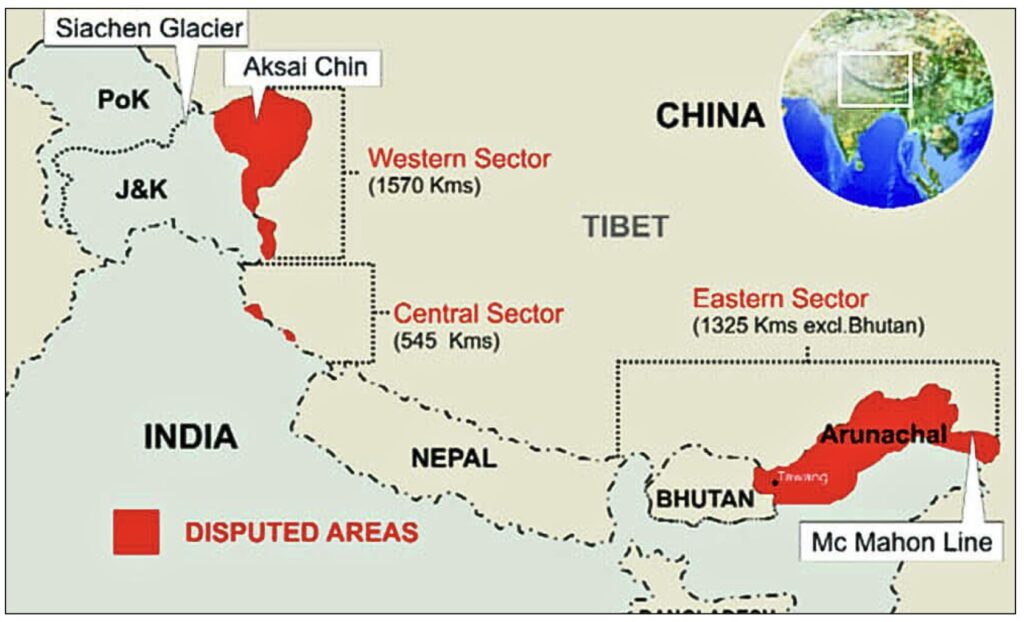
The border is conventionally divided into three sectors:
- The Western Sector (Ladakh, ~1,597 km) is the most disputed, involving Aksai Chin (~38,000 sq. km) under Chinese occupation and the Shaksgam Valley (~5,800 sq. km) ceded by Pakistan to China under the 1963 Sino-Pakistan Boundary Agreement.
- The Middle Sector (Himachal Pradesh and Uttarakhand, ~545 km) is the least contentious, though differences persist near the Barahoti plains.
- The Eastern Sector (Arunachal Pradesh and Sikkim, ~1,346 km) is where China claims approximately 90,000 sq. km of Arunachal Pradesh as “South Tibet” and disputes the McMahon Line.
Historical Trajectory of the Dispute:
The modern boundary dispute has colonial-era roots.
- The 1914 Simla Convention drew the McMahon Line between British India and Tibet. China rejected the line, arguing that Tibet lacked the legal authority to negotiate a bilateral boundary.
- China’s incorporation of Tibet in 1950, and its covert construction of a road through Aksai Chin in the 1950s (which India discovered only in 1957), set the stage for the 1962 Sino-Indian War. The war ended with a Chinese unilateral ceasefire; China retained Aksai Chin but withdrew from its advances in Arunachal Pradesh, leaving the boundary unresolved and relations severely damaged.
- Prime Minister Rajiv Gandhi’s 1988 visit to Beijing (the first by an Indian PM in 34 years) formally reopened dialogue. The subsequent period saw the structured institutionalisation of border management beginning with six rounds of the Joint Working Group (JWG) between 1988 and 1993, and the first direct military-level contact meetings at Bum La (Eastern Sector) and Chushul/Moldo (Western Sector) in 1992. Border trade (suspended for over 30 years) also resumed in 1992, and consulates were reopened in Mumbai and Shanghai in December 1992.
- Border Peace and Tranquillity Agreement (BPTA), 1993 formally introduced the concept of the Line of Actual Control into official bilateral documents for the first time, committed both sides not to use or threaten force, and required each to withdraw forces to their side of the LAC if intrusions occurred. Crucially, it froze the military situation in place rather than resolving the underlying territorial dispute.
- The 1996 Agreement on Confidence-Building Measures added specificity to the BPTA by capping or banning certain categories of weaponry (tanks, artillery, missiles) in border zones, restricting large-scale military exercises near the LAC, and committing both sides to exchange maps for LAC clarification.
- In 2000, maps of the relatively uncontested Central Sector were exchanged. However, a 2002 attempt to exchange Western Sector maps failed immediately, as both sides presented maximalist interpretations. By 2005, efforts to achieve a common understanding of the LAC were abandoned entirely, leaving Depsang, Pangong Tso, Demchok, and Chumar as future flashpoints.
- The 2020 Galwan Crisis: In March-April 2020, the PLA undertook a large-scale forward deployment across multiple friction points in eastern Ladakh (Galwan Valley, Pangong Tso (north and south banks), Gogra, Hot Springs, Depsang, and Demchok). The situation escalated catastrophically in June 2020, when hand-to-hand combat in the Galwan Valley resulted in the deaths of 20 Indian soldiers and an unconfirmed number of Chinese casualties. It was the most serious military confrontation between the two sides since 1967.
- Disengagement was achieved in phases. By 2022, four of the six friction points (Gogra, Hot Springs, and both banks of Pangong Tso) had been de-escalated through a combination of WMCC meetings, Corps Commander-level talks, and diplomatic back-channels. Depsang and Demchok remained deadlocked.
- In 2024, India’s Foreign Secretary announced a patrolling agreement for Depsang and Demchok, restoring pre-April 2020 patrol arrangements.
The Institutional Architecture: WMCC and SR Talks
India and China maintain a layered diplomatic and military architecture for border management.
- At the military level, Corps Commander-level talks are held at Chushul/Moldo (Western Sector), with local Brigade/Division commander meetings for on-ground coordination.
- At the diplomatic level, the WMCC (established in 2012) serves as the primary coordination body for border affairs, meeting roughly quarterly.
- At the strategic level, the Special Representatives mechanism is the highest-level dedicated boundary dialogue, empowered to explore the political framework for a final settlement.
The 35th WMCC meeting specifically discussed: (i) boundary delimitation; (ii) border management; (iii) mechanism building; and (iv) cross-border cooperation.
India’s push for an early meeting of the Expert Level Mechanism on Trans-Border Rivers is particularly significant given concerns about China’s dam construction on the Yarlung Tsangpo (upper Brahmaputra) and the withholding of hydrological data during flood seasons.
Strategic Significance of India-China Stability:
- Economic Interdependence: China is India’s largest trading partner by bilateral trade volume and its third-largest export destination.
- The Indian pharmaceutical sector depends on China for approximately two-thirds of its Active Pharmaceutical Ingredients (APIs).
- Solar modules, rare-earth metals, and tunnel boring machines critical to infrastructure projects are predominantly sourced from China.
- China controls roughly 90% of global rare-earth production, an enormous strategic leverage point over India’s clean-energy and defence-technology ambitions.
- Transboundary River Security: China’s construction of the world’s largest hydroelectric dam on the Yarlung Tsangpo (announced in 2024 and under development) raises serious concerns about India’s downstream water security on the Brahmaputra, and about the potential weaponisation of water flows during a conflict. The Expert Level Mechanism on Trans-Border Rivers, whose early convening India stressed at the 35th WMCC, is the only bilateral platform for sharing hydrological and flood-warning data.
- Energy Geopolitics: As the world’s two largest Asian oil importers, India-China cooperation could substantially improve their collective bargaining position against the so-called “Asian Premium”, the price differential that Asian importers pay over Western buyers for the same crude.
- Multilateral Leverage: China’s support remains consequential for India’s pursuit of permanent UNSC membership and full membership in the Nuclear Suppliers Group (NSG), both of which China has historically blocked or complicated. A stable bilateral relationship also enhances India’s credibility in multilateral forums such as the G20, BRICS, and the Shanghai Cooperation Organisation (SCO), where both are major actors.
Border stability between India and China would prevent future clashes & allow resources to be diverted to developmental priorities.
Persistent Challenges:
- The China-Pakistan Axis: China’s strategic partnership with Pakistan remains the most visceral complication in India-China normalisation. During India’s Operation Sindoor (2025), the China-Pakistan security nexus became acutely visible. Pakistan deployed Chinese-supplied J-10C fighter jets and PL-15 air-to-air missiles. The conflict and China’s role in enabling Pakistan’s capabilities has significantly deepened Indian strategic mistrust of Beijing.
- Taiwan and the One-China Policy: A diplomatic controversy arose when the Chinese readout suggested the Indian EAM had acknowledged Taiwan as part of China. India officially clarified that its long-standing “One China Policy” remained unchanged, and that relations with Taiwan remain economic, cultural, and technological in nature, without formal diplomatic recognition. The gap between Indian and Chinese narratives on this issue illustrates how each side frames diplomatic interactions through domestic political lenses.
- China’s Export Restrictions: India is increasingly alarmed by China’s selective export restrictions on rare-earth materials, tunnel boring machines, and certain fertiliser precursors. Given India’s critical dependence on Chinese rare earths for EV battery production, renewable energy deployment, and advanced electronics, any expansion of such restrictions carries serious supply-chain implications.
- The Brahmaputra Dam: China’s decision to proceed with a mega-dam project on the Yarlung Tsangpo without consulting India or Bhutan raises concerns under international norms of equitable water use for transboundary rivers. The absence of a legally binding water-sharing treaty between India and China means India has no formal legal recourse beyond diplomatic negotiation.
Structural Trust Deficit: Despite the October 2024 disengagement and subsequent diplomatic momentum, India’s strategic community remains cautious. The fundamental question: whether China’s current cooperative posture reflects a genuine strategic recalculation or a tactical pause driven by external pressures (trade friction with the US, post-Operation Sindoor scrutiny of its weapons), is yet to be answered.
Way Forward:
Resolving the India-China boundary question is a generational project requiring simultaneous action across diplomatic, military, legal, and domestic institutional tracks.
- Diplomatic: Pursue the next SR Talks in China with a specific agenda on delimitation in the Western Sector. Use the WMCC format to institutionalise a Trans-Border Rivers agreement before the next monsoon season.
- Military CBMs: Revive the 1996 commitment to exchange and jointly verify LAC maps — starting with the less contentious Middle Sector. Establish a joint incident-prevention hotline at the Corps Commander level.
- Strategic Autonomy: Reduce dependence on Chinese rare earths through the Critical Minerals Mission, acceleration of the India Semiconductor Mission, and deeper engagement with Quad partners on supply-chain resilience.
- Border Infrastructure: Continue investment in the Border Roads Organisation’s target of connecting all villages in Arunachal Pradesh with all-weather roads. Expand forward air bases and ammunition pre-positioning in Ladakh.
- Multilateral Leverage: Use India’s Quad, G20, and SCO platforms to establish a multilateral context that incentivises Chinese restraint, including support for international norms on transboundary rivers, AI in warfare, and export restrictions.
While diplomatic engagement has helped restore stability, the fundamental challenge remains the absence of a mutually accepted boundary. Sustainable peace will require not merely managing incidents along the LAC but addressing the underlying issue of boundary delimitation.
UPSC PYQ 2017:
Q. China is using its economic relations and positive trade surplus as tools to develop potential military power status in Asia. In the light of this statement, discuss its impact on India as her neighbour.
Tell Google you want more of this.
Add Anantam IAS as a preferred sourceOne tap, and this site shows up more often in your own Top Stories, AI Overviews and AI Mode. Remove it any time.