Indian agricultural exports finished 2025-26 with a paradox most analysts did not predict. Despite a sharp escalation in US reciprocal tariffs through 2025 that put roughly USD 5.8 billion of Indian agri shipments at risk, the broader basket held its ground. APEDA-monitored exports posted record agri output and recorded marginal growth in several categories. The India farm exports US tariffs story is therefore not one of collapse; it is one of stress, redirection, and selective relief.
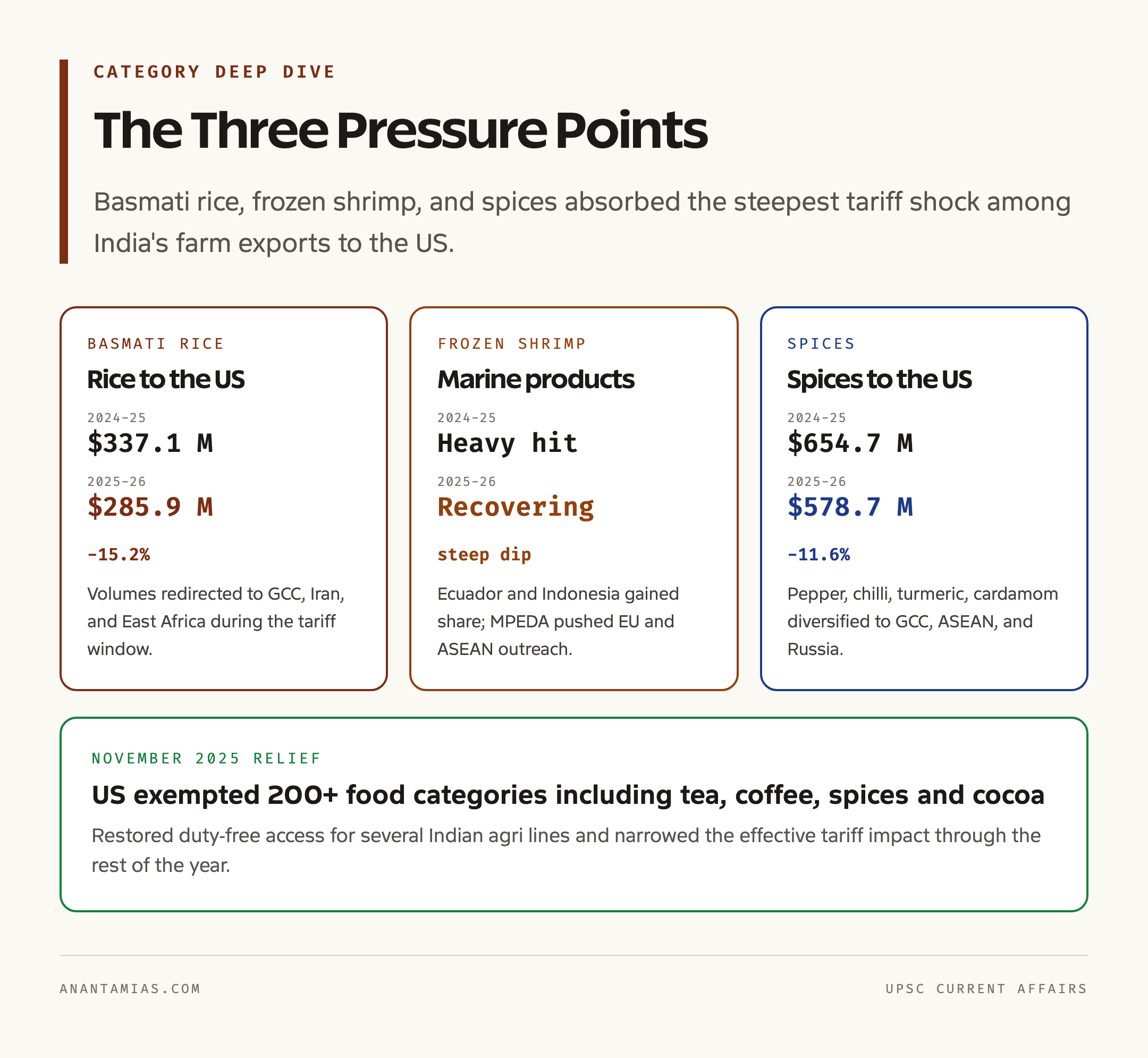
Rice, spices, and seafood, the three pillars that account for the bulk of India’s farm export earnings, each faced a different tariff outcome. Basmati rice shipments to the US dropped from USD 337.1 million to USD 285.9 million. Spice exports to America fell from USD 654.7 million in 2024-25 to USD 578.7 million in 2025-26. Marine product exports to the US slowed, with shrimp absorbing most of the tariff hit. Yet relief arrived in November 2025 through US exemptions for over 200 food categories, including tea, coffee, spices, and cocoa.
This article maps the India farm exports US tariffs landscape one full cycle into the tariff regime: what worked, what cracked, what APEDA did differently, where new destinations absorbed the slack, and what the UPSC aspirant should remember about the policy and trade response.
Quick Facts
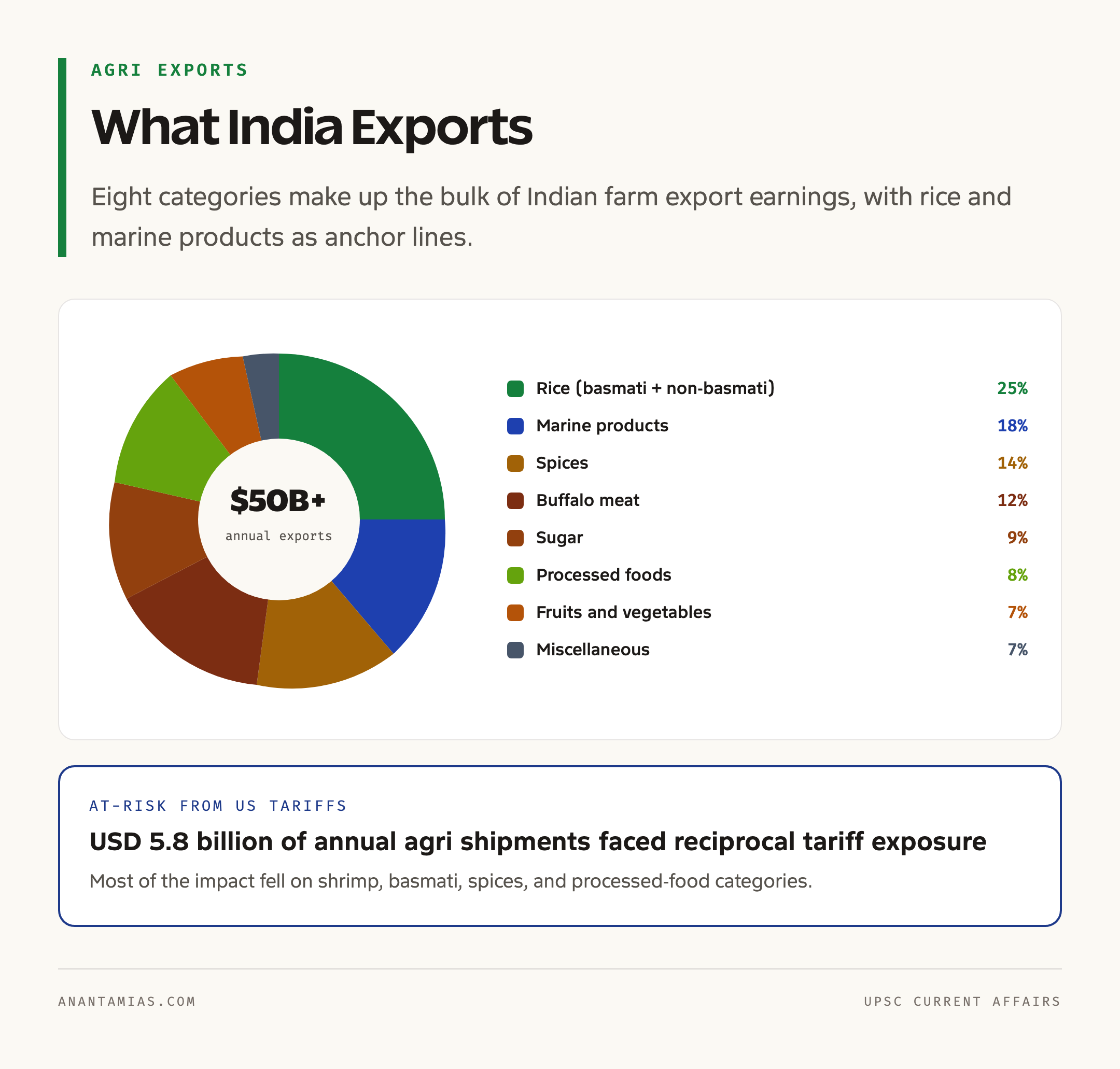
- Total Indian farm exports at risk from US tariffs: approximately USD 5.8 billion annually.
- Basmati rice exports to US: down from USD 337.1 million to USD 285.9 million.
- Spices exports to US: down from USD 654.7 million to USD 578.7 million.
- Marine products to US: USD 2.68 billion category; shrimp the most affected line.
- Relief window: November 2025 US exemption list covered over 200 food categories.
- APEDA: Agricultural and Processed Food Products Export Development Authority, statutory body under Ministry of Commerce and Industry.
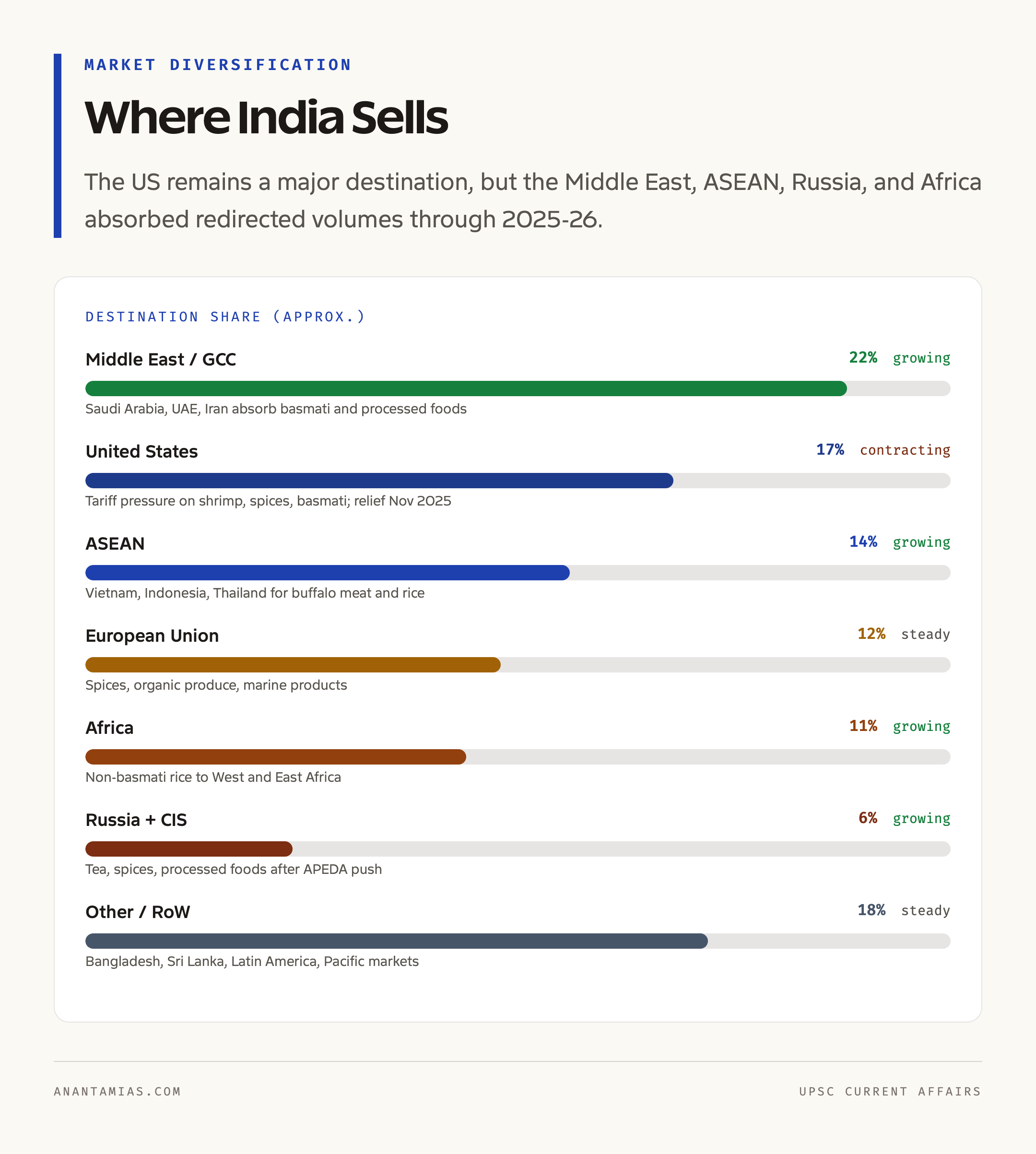
- Key destinations growing: Middle East, ASEAN, Russia, parts of Africa, and Latin America.
What Just Happened
Between mid-2025 and early 2026, the United States rolled out reciprocal tariffs that hit a long list of Indian product lines, including significant slices of agriculture. APEDA Secretary Sudhanshu told industry forums in early 2026 that shrimp, processed foods, spices, rice, guar gum, cashews, and dairy bore the brunt, with lost orders, slim margins, deferred contracts, and short-term job risks across processing hubs in Andhra Pradesh, Gujarat, Kerala, and Punjab.
The Government of India response was layered. Domestically, GST reform on agri inputs and food-processing categories was accelerated to reduce cost pressure. APEDA stepped up trade-fair and buyer-seller meet activity through the AAHAR platform, joha rice promotion missions, and targeted outreach to Gulf Cooperation Council, ASEAN, Russia, and African destinations. Diplomatically, India pushed for, and eventually obtained, a November 2025 US exemption list that included tea, coffee, several spice categories, and cocoa products.
The Operation-style coordination between Department of Commerce, APEDA, Ministry of External Affairs, and state agencies allowed Indian exporters to redirect cargo, renegotiate freight, and recalibrate currency hedging within tight timeframes. By April 2026, several agri categories had absorbed the shock and posted year-on-year growth, even as the US share of certain product lines contracted.
Background and Historical Context
India is among the top five agricultural exporters in the world, a position explored further in our note on agricultural exports as a tool to double farmers’ income and the US-India 50 percent tariff debate. Its farm export story has run on three legs since liberalisation. The first leg is rice, both basmati and non-basmati, with the Middle East and Africa as anchor markets and the US as a premium niche for branded basmati. The second leg is marine products, dominated by frozen shrimp and built around the US, EU, and Japan as core destinations. The third leg is spices, where India holds dominant global market share in pepper, chilli, turmeric, cardamom, and cumin.
Farm exports cross USD 50 billion annually when buffalo meat, sugar, processed foods, fruits and vegetables are included. APEDA, set up under the APEDA Act, 1985, anchors export development for non-commodity agri products, while the Marine Products Export Development Authority, Spices Board, Tea Board, Coffee Board, Rubber Board, and Tobacco Board cover specialised commodities. The Federation of Indian Export Organisations and commodity councils provide private-sector coordination.
The US has been a top-three farm export destination for India for over a decade. The relationship has weathered earlier tariff frictions, including the loss of Generalised System of Preferences benefits in 2019. The 2025-26 tariff round, however, was broader in scope and sharper in execution, forcing a more comprehensive response than past episodes.
Key Provisions of the Indian Response
The India farm exports US tariffs response has rested on five planks. First, market diversification: APEDA missions to Russia, the Gulf, ASEAN, and parts of Africa absorbed a measurable share of redirected volumes. Russian and Gulf demand for basmati rice, joha rice, and processed foods grew through 2025-26. Second, value-chain support: GST rationalisation on agri inputs, expanded warehousing under the Agricultural Infrastructure Fund, and targeted credit through the National Bank for Agriculture and Rural Development.
Third, quality and certification: stepped-up SPS compliance, Codex-aligned residue limits for spices and seafood, and faster Indian Certification of Medical Devices-style approvals for processed-food exports. Fourth, FTA leverage: accelerated negotiations under the India-UK Comprehensive Economic and Trade Agreement, the India-EU FTA pipeline, and operational use of the India-UAE CEPA and India-Australia ECTA for agri lines. Fifth, exporter relief: extended deadlines under the Remission of Duties and Taxes on Exported Products scheme and faster IGST refunds.
The November 2025 US exemption list was the single most important external development. It restored duty-free access for over 200 food categories, including tea, coffee, several spice lines, and cocoa, narrowing the effective tariff impact considerably. Spice exporters in Kochi and Coonoor, tea estates in Assam and the Nilgiris, and coffee growers in Karnataka were the principal beneficiaries.
Why It Matters
Farm exports matter beyond the trade accounts. Roughly 45-50 percent of India’s workforce depends on agriculture and allied activities. Export-oriented farming, contract farming, and food processing absorb labour in coastal Andhra and Tamil Nadu (shrimp), Punjab and Haryana (basmati), Kerala and Tamil Nadu (spices), Maharashtra (sugar and fruits), and Madhya Pradesh (soyabean and pulses). Tariff shocks to any of these segments transmit quickly into rural incomes, wage rates, and migration patterns.
For UPSC GS Paper III, the India farm exports US tariffs episode demonstrates how external trade policy intersects with farm income, food security, and labour. It also tests the country’s capacity to convert FTAs into actual trade gains, to upgrade SPS infrastructure, and to use trade diplomacy as a tool of rural welfare.
For the wider economy, agri exports are a foreign-exchange earner and a hedge against goods-trade volatility. Resilience here softens the impact of services or manufacturing slowdowns and supports a stable current-account profile.
Detailed Analysis: How Rice, Spices and Seafood Coped
Basmati rice took a measurable hit in the US but redirected smoothly to the Gulf, where Saudi Arabia, the UAE, and Iran absorbed additional volumes. Iraq and Iran together remain the largest single market cluster for Indian basmati. Non-basmati rice continued to face export restrictions that pre-dated the tariff round; the partial lifting of restrictions in 2024-25 had already opened African demand from Senegal, Cote d’Ivoire, and Mozambique.
Spice exports diversified faster than rice. Pepper, chilli, turmeric, and cardamom found buyers across the GCC, ASEAN, Russia, and parts of Africa. The November exemption list further restored US flows, and spice exporters by April 2026 were running roughly flat compared with 2024-25. Joha rice, basmati’s geographically protected Assamese cousin, gained traction through APEDA-led promotion under the AAHAR umbrella.
Marine products struggled the most. Shrimp accounts for over 70 percent of India’s marine export value and the US is a dominant destination. Tariffs on Indian shrimp opened a window for competitors like Ecuador and Indonesia. The Marine Products Export Development Authority responded with quality and antibiotic-residue clean-up drives, faster certification, and EU and Southeast Asian outreach. Recovery here is slower than for spices.
Comparative Perspective
Indian fruit and vegetable exports posted growth despite US tariffs, drawing on demand from the Gulf and Southeast Asia. Vietnam, another large agri exporter, faced higher tariffs in the same round, which improved India’s relative competitiveness for several product lines. Brazil and Argentina, large soyabean and beef exporters, gained from US-China frictions but did not directly displace Indian categories.
China’s domestic agricultural protectionism continued to limit Indian access, while Japan, South Korea, and the EU offered selective premium opportunities once SPS compliance and traceability were demonstrated. The lesson from comparable episodes globally is consistent: agri exporters that invest in standards, traceability, and brand storytelling weather tariff cycles better than those that rely on price alone.
Challenges
The India farm exports US tariffs episode exposed three structural challenges. First, concentration risk. Shrimp, basmati, and certain spice categories rely heavily on one or two markets, and any tariff or non-tariff barrier in those markets has outsized impact. Diversification needs to deepen, not just spread thinner.
Second, SPS and traceability gaps. Indian exports continue to face import alerts and consignment rejections on antibiotic residues in shrimp, aflatoxin in spices, and pesticide residues in tea and rice. Without consistent farm-to-port traceability, premium-market access remains fragile. Third, FTA implementation. Even after agreements with the UAE, Australia, and the UK pipeline, utilisation rates of preferential routes by Indian agri exporters remain below potential, often because of certificate-of-origin friction and limited awareness among smaller exporters.
A fourth, more political challenge is volatility itself. Tariff regimes shift with election cycles in importing countries. Long-term contracts, multi-year offtake arrangements, and bilateral safeguard mechanisms inside FTAs are partial answers, but they need to be designed and deployed at scale.
Prelims Pointers
- APEDA was set up under the APEDA Act, 1985, under the Ministry of Commerce and Industry.
- India is the largest exporter of basmati rice globally, with Iran and Saudi Arabia among top buyers.
- Marine Products Export Development Authority (MPEDA) is the nodal agency for seafood export development.
- The Spices Board is a statutory body under the Ministry of Commerce and Industry.
- US Generalised System of Preferences benefits to India were withdrawn in 2019 under a Section 301-related review.
- India-UAE CEPA came into effect in May 2022; India-Australia ECTA in December 2022.
Mains Questions
- The India farm exports US tariffs episode tests India’s resilience as an agri exporter. Examine the structural strengths and weaknesses revealed in 2025-26. (GS Paper III, Indian Economy)
- Discuss the role of APEDA and other commodity boards in agri export promotion. What reforms are needed for a tariff-volatile world? (GS Paper III, Government Policies)
- Critically assess India’s market diversification strategy for agricultural exports beyond the United States. (GS Paper II, International Relations and Trade)
- SPS and traceability gaps continue to limit Indian agri exports to premium markets. Suggest a roadmap for upgrading standards and certification. (GS Paper III, Agriculture)
Way Forward
A durable response to the India farm exports US tariffs cycle requires four shifts. One, accelerate FTA implementation, building on the WTO India playbook and APEDA’s promotional work captured in our piece on India’s agri-export growth, with deeper Rules of Origin engagement so that small and medium agri exporters can actually use preferential routes. Two, invest in farm-to-port traceability with blockchain pilots for spices, marine products, and basmati, building on APEDA’s existing traceability platforms.
Three, expand value addition. Processed-food exports earn higher margins, weather price volatility better, and unlock more rural employment. The Production-Linked Incentive scheme for food processing and the One District One Product framework need to be aligned with export targets. Four, formalise climate-resilience financing for export crops. Climate stress on rice, marine fisheries, and spice belts is rising; tariff resilience without climate resilience is half a strategy. APEDA’s roadmap to 2030 should integrate both, with measurable KPIs by commodity and corridor.
Frequently Asked Questions
How big are India’s farm exports?
India’s agricultural and processed-food exports cross USD 50 billion annually when buffalo meat, sugar, marine products, basmati and non-basmati rice, spices, and processed foods are included.
What is APEDA?
The Agricultural and Processed Food Products Export Development Authority is a statutory body under the Ministry of Commerce and Industry. It was established in 1985 and is responsible for export promotion and development of scheduled agri and processed-food products.
Which Indian farm exports were hit hardest by US tariffs?
Shrimp and other marine products absorbed the steepest impact, followed by basmati rice and several spice categories. Some processed foods, guar gum, and dairy products also faced order cancellations and margin compression.
Did India lose its US agri export market?
No. India retained the US market for most lines but shipped lower volumes in several categories during 2025-26. The November 2025 exemption list restored duty-free access for over 200 food categories, easing the impact.
How did India diversify away from the US?
APEDA-led missions and AAHAR-platform activity intensified outreach to the Middle East, ASEAN, Russia, and parts of Africa. Joha rice, basmati, spices, and fruit and vegetable exports found additional buyers in these regions.
What is the India farm exports US tariffs lesson for FTAs?
FTAs work as a hedge against unilateral tariff shocks only when utilisation rates are high. India’s experience with the UAE CEPA and the Australia ECTA suggests that better awareness, simpler Rules of Origin compliance, and trader-friendly digital portals can lift utilisation.
Are non-basmati rice exports restricted?
Some restrictions were imposed earlier on non-basmati rice for food-security reasons. These were partially lifted in 2024-25, restoring access for African destinations and easing global rice price pressure.
Which agency handles seafood exports?
The Marine Products Export Development Authority (MPEDA) under the Ministry of Commerce and Industry handles export development, quality compliance, and market intelligence for seafood.
What is the role of the Spices Board?
The Spices Board is a statutory body under the Ministry of Commerce and Industry. It promotes Indian spices exports, sets quality standards, runs lab certification, and runs market intelligence and grower-extension programmes.
What should aspirants remember for UPSC?
Remember the structural composition of India’s farm export basket, APEDA’s role, the FTA architecture, the November 2025 exemption episode, the SPS challenges, and the diversification template. Tie it back to rural employment, current-account stability, and India’s trade diplomacy.
Tell Google you want more of this.
Add Anantam IAS as a preferred sourceOne tap, and this site shows up more often in your own Top Stories, AI Overviews and AI Mode. Remove it any time.