Why in News?
Prime Minister Narendra Modi and French President Emmanuel Macron jointly inaugurated Bharat Innovates 2026 at the Palais des Expositions in Nice on 14 June 2026, a deep-tech conclave that opened the first leg of the Prime Minister’s France visit and showcased Indian innovation to European investors.
The two leaders adopted an India-France Innovation Roadmap 2030 and unveiled 13 key outcomes spanning AI, trade, defence, space, education and deep-tech, the most concrete deepening of the Special Global Strategic Partnership since it was elevated in Mumbai in February 2026. The Hindu and Indian Express both reported the outcomes from Nice.
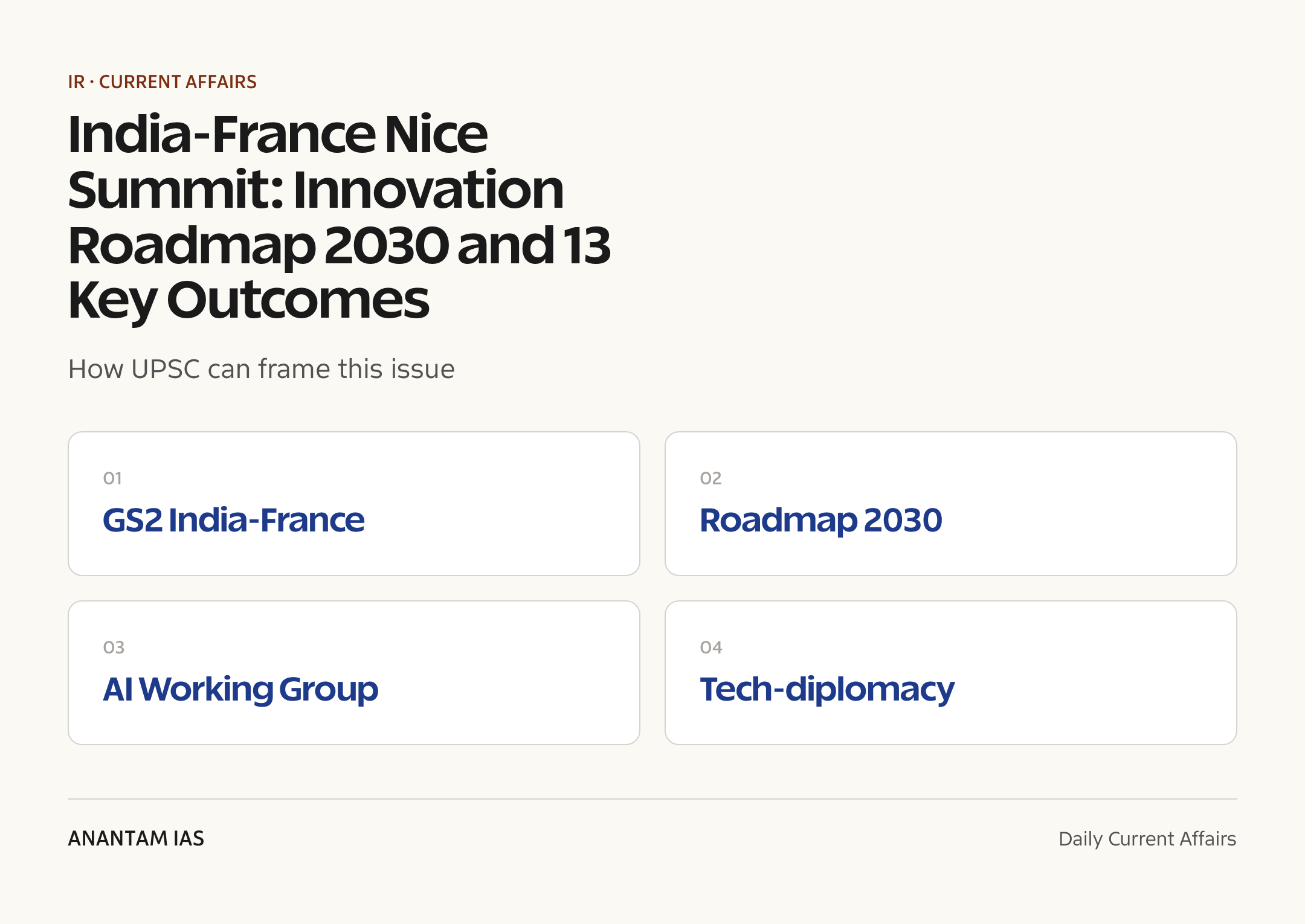
- Bharat Innovates 2026 ran at the Palais des Expositions, Nice, featuring 120 Indian startups, 20+ institutes of excellence and 350+ investors across 13 technology domains.
- Leaders adopted the Innovation Roadmap 2030 and agreed to set up a Joint India-France AI Working Group on AI cooperation and global governance.
- A high-level mechanism was created to double bilateral trade within five years, alongside a new Economic Security Dialogue.
- 19 institutional agreements were signed across the two countries’ innovation ecosystems.
- Cooperation was reinforced in semiconductors, deep-tech, agritech, medtech, renewable energy, space and defence.
The development matters in the context of:
- The Nice meeting builds on the India-France Year of Innovation 2026, launched by both leaders in Mumbai in February 2026.
- It operationalises the long-term Horizon 2047 Roadmap in the technology and economic-security pillars.
- It marks India pitching itself as a provider of frontier technology, not only a consumer.
UPSC Relevance
Prelims Relevance
- Bharat Innovates 2026 venue — Palais des Expositions, Nice (France)
- Innovation Roadmap 2030 — bilateral roadmap for emerging tech and research
- Joint India-France AI Working Group — AI cooperation and governance
- Horizon 2047 Roadmap — adopted in 2023 on the 25th anniversary of the Strategic Partnership
- Special Global Strategic Partnership — elevation announced in Mumbai, February 2026
- UPI in France — first European country to accept India’s Unified Payments Interface
- CNES (France) and ISRO (India) — space-agency cooperation
- Rafale-Marine — 26 jets contract; Scorpene P75 (Kalvari-class) submarines
- SMR/AMR — Small and Advanced Modular Reactors in civil-nuclear cooperation
- IMEC — India-Middle East-Europe Economic Corridor
Mains Relevance
GS Paper 2
- India-France Special Global Strategic Partnership — drivers, the Horizon 2047 framework, and its place in India’s strategic autonomy.
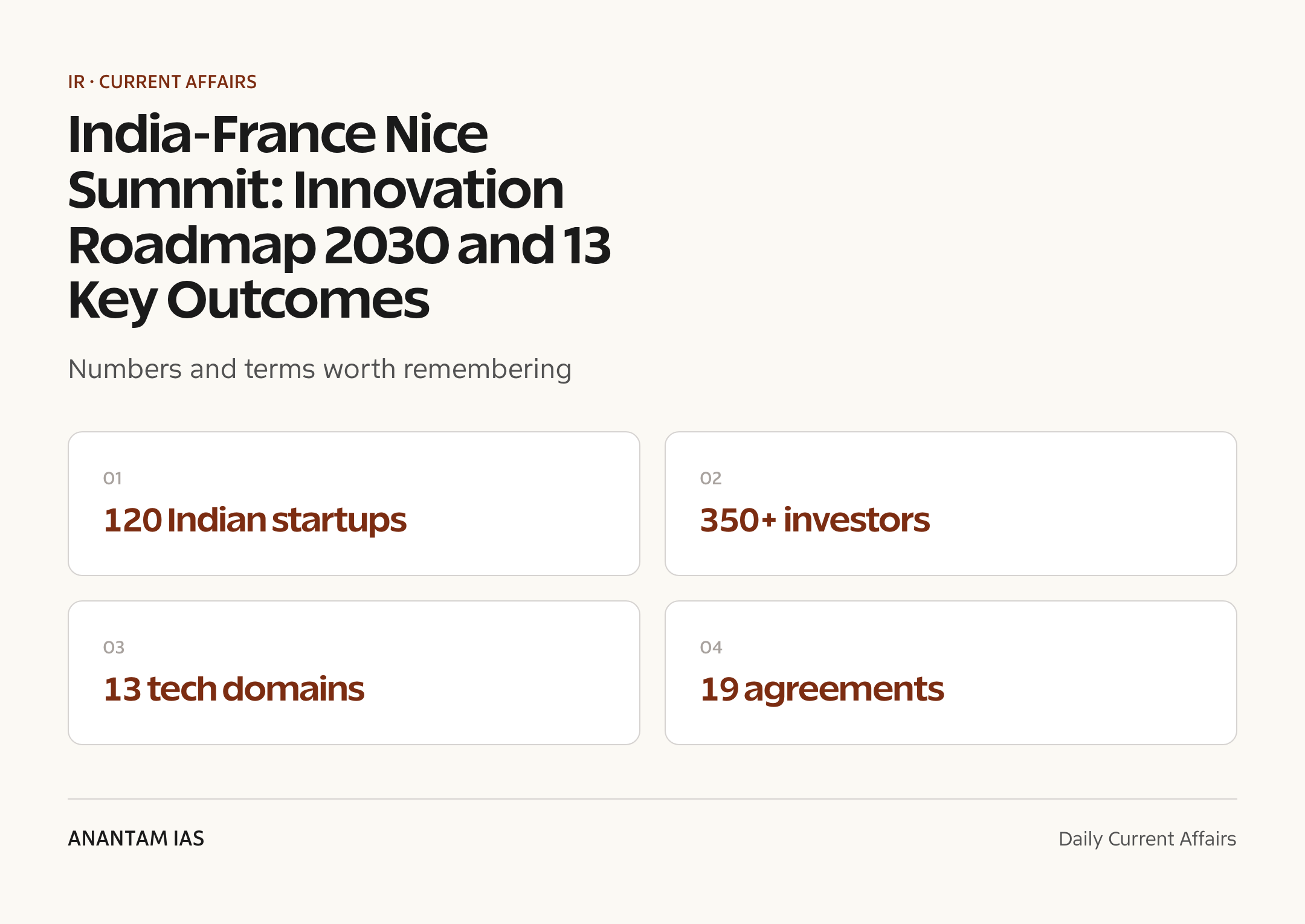
- Tech-diplomacy as a new lever of Indian foreign policy: how innovation conclaves and AI governance shape bilateral partnerships.
GS Paper 3
- India-France cooperation in deep-tech, semiconductors and space — implications for India’s self-reliance and supply-chain resilience.
- Economic security and the goal of doubling bilateral trade: opportunities and structural constraints.
Essay
- Technology as the new currency of diplomacy.
- Strategic autonomy in a multipolar world.
Background and Context
Bharat Innovates 2026 and the Innovation Roadmap 2030
The Nice conclave was the stage for a new long-term technology blueprint between the two countries.
- Bharat Innovates 2026 is a deep-tech and education showcase at the Palais des Expositions, Nice, inaugurated by Modi and Macron on 14 June 2026.
- It assembled 120 Indian startups, 20+ institutes of excellence and 350+ investors across 13 technology domains — quantum computing, semiconductors, biotech, defence, space, medtech, advanced materials and clean energy.
- Leaders adopted the India-France Innovation Roadmap 2030 to give long-term direction to cooperation in emerging technologies and research.
- 19 institutional agreements were signed linking incubators, universities and research bodies of both countries.
- The conclave extends the India-France Year of Innovation 2026 launched in Mumbai in February.
The 13 outcomes at a glance
The summit produced a dense package of deliverables across economy, tech, defence and people-to-people ties.
- Adoption of the Innovation Roadmap 2030; creation of a Joint India-France AI Working Group on AI and its global governance.
- A high-level mechanism to double bilateral trade within five years; a new Economic Security Dialogue.
- 19 institutional agreements; expanded use of India’s UPI in France.
- An Aeronautics skilling centre (National Centre of Excellence) at the NSTI, Kanpur; 10 more Indian startups to be incubated at Station F, Paris.
- A Centre for Digital Sciences between India’s DST and France’s INRIA; an ICCR India Chair on AI, Innovation and Culture at Universite Paris-Saclay.
- A healthcare Letter of Intent between ICMR and France’s Health Data Hub; a Joint Declaration on high-speed railway development in India.
- A General Security Agreement on classified information; an ISRO-CNES Letter of Intent on microgravity research and human spaceflight.
The durable architecture: Horizon 2047 and the Special Global Strategic Partnership
The Nice outcomes sit inside a layered framework that the two countries have built over 25 years.
- India and France marked 25 years of Strategic Partnership in 2023 and adopted the Horizon 2047 Roadmap — a course up to 2047, the centenary of India’s independence.
- In February 2026 the leaders elevated ties to a Special Global Strategic Partnership during Macron’s visit, the official India-France Joint Statement recorded.
- An annual Foreign Ministers Comprehensive Dialogue reviews progress on economic security, global issues and people-to-people exchanges.
- France firmly backs India’s permanent membership of the UN Security Council and reform of the world body — a recurring theme in India’s international relations agenda.
- The partnership is explicitly framed to reinforce both countries’ strategic autonomy and a rules-based Indo-Pacific.
Defence and space spine of the partnership
France is among India’s foremost defence partners, anchored in co-design and co-production.
- Defence ties rest on the Defence Industrial Roadmap (2024) and a new Joint Advanced Technology Development Group for critical military tech.
- The leaders earlier commended the contract for 26 Rafale-Marine fighter jets and the made-in-India Scorpene (P75 Kalvari-class) submarine programme.
- Cooperation on jet engines continues via Safran and HAL, with MRO facilities for LEAP and M-88 engines set up in India.
- In space, the CNES-ISRO partnership is the core; a fresh Letter of Intent covers microgravity research and human spaceflight.
- India confirmed participation in France’s International Space Summit in July 2026.
Economy, trade and civil-nuclear cooperation
Beyond technology, the leaders pushed trade, investment and clean-energy cooperation.
- The Economic Security Dialogue and trade-doubling mechanism aim at resilient supply chains and de-risking.
- The recently concluded India-EU Free Trade Agreement is expected to lift India-France-Europe economic links.
- Civil-nuclear cooperation spans the Jaitapur project and new work on Small and Advanced Modular Reactors (SMR/AMR), backing India’s target of 100 GW nuclear capacity by 2047.
- France is the first European country to accept UPI, now being expanded to more merchants.
- Both sides remain committed to the IMEC (India-Middle East-Europe Economic Corridor).
AI governance and tech-diplomacy
Artificial intelligence has become the connective tissue of the partnership.
- The new Joint India-France AI Working Group follows the India-France Declaration on Artificial Intelligence and the leaders’ co-chairing of the AI Action Summit (Paris, Feb 2025) and AI Impact Summit (India, Feb 2026).
- Both stress secure and trustworthy AI, democratising AI resources and bridging the global AI divide.
- AI is embedded across sectors — an Indo-French centre on AI in health links AIIMS, Sorbonne University and the Paris Brain Institute, part of a wider science and technology push.
- The Innovation Network connects startups, incubators and research bodies digitally.
- For India, hosting deep-tech abroad signals a shift from tech consumer to tech provider.
Way Forward
Operationalise the deliverables
- Convert the 19 agreements and the AI Working Group into time-bound joint projects with milestones, not just MoUs.
- Stand up the trade-doubling mechanism with measurable targets and a clear secretariat.
Build sovereign tech capacity
- Use the semiconductor and deep-tech tracks to anchor manufacturing and IP in India, not only assembly.
- Leverage CNES-ISRO human-spaceflight cooperation for India’s Gaganyaan and beyond.
Sustain the partnership beyond summit headlines by funding the innovation network, scaling startup incubation at Station F, and locking in skilling pipelines so the Roadmap 2030 commitments survive political cycles.
Conclusion
The Nice summit reframes the India-France relationship around innovation and economic security, layering a fast-moving technology agenda on the durable defence, space and civil-nuclear spine of the Special Global Strategic Partnership.
Its real test is execution: whether the Innovation Roadmap 2030, the AI Working Group and the trade-doubling mechanism translate into Indian capability and jobs, or remain a well-staged showcase. For now, it marks India’s confident pivot to tech-diplomacy on European soil.
UPSC Practice Questions
Prelims MCQ 1
With reference to the India-France Nice summit (Bharat Innovates 2026), consider the following statements:
- The leaders adopted the India-France Innovation Roadmap 2030.
- They agreed to set up a Joint India-France AI Working Group.
- A mechanism was created to double bilateral trade within five years.
How many of the above statements are correct?
(a) Only one (b) Only two (c) All three (d) None
Answer: (c) All three
Explanation:
All three were among the 13 outcomes announced at Nice on 14 June 2026 — the Innovation Roadmap 2030, the Joint AI Working Group, and the trade-doubling mechanism alongside a new Economic Security Dialogue.
Prelims MCQ 2
The ‘Horizon 2047 Roadmap’, often cited with India-France ties, refers to:
(a) A bilateral roadmap up to 2047, the centenary of India’s independence
(b) A France-led EU climate-finance plan
(c) An ISRO-CNES Mars mission timeline
(d) A target year for India’s 100 GW nuclear capacity
Answer: (a) A bilateral roadmap up to 2047, the centenary of India’s independence
Explanation:
Adopted in 2023 on the 25th anniversary of the Strategic Partnership, Horizon 2047 sets the course for the relationship up to 2047 — also the centenary of India-France diplomatic relations and 50 years of the Strategic Partnership.
UPSC Mains Questions
- The India-France partnership has shifted from a primarily defence-led relationship to one anchored in innovation and economic security. Critically examine this transition and its significance for India’s strategic autonomy. (250 words)
- Tech-diplomacy is emerging as a central instrument of India’s foreign policy. Discuss with reference to India-France cooperation in AI, semiconductors and space. (250 words)
- Evaluate the durability of summit-level outcomes such as the Innovation Roadmap 2030. What institutional mechanisms are needed to ensure bilateral commitments translate into delivery? (150 words)
Sources: India-France Joint Statement, PM India and The Hindu / Indian Express.
Frequently Asked Questions
What is Bharat Innovates 2026?
It is a deep-tech and education showcase held at the Palais des Expositions in Nice, France, inaugurated by PM Modi and President Macron on 14 June 2026. It assembled around 120 Indian startups, 20-plus institutes of excellence and 350-plus investors across 13 technology domains, opening India’s innovation ecosystem to European partners and capital.
What is the India-France Innovation Roadmap 2030?
It is a long-term blueprint adopted at the Nice summit to direct bilateral cooperation in emerging technologies and research up to 2030. It covers AI, semiconductors, deep-tech, space and startups, and is backed by 19 institutional agreements between universities, incubators and research bodies of both countries.
What are the 13 outcomes of the Nice summit?
They include the Innovation Roadmap 2030, a Joint AI Working Group, a mechanism to double bilateral trade in five years, an Economic Security Dialogue, 19 institutional agreements, wider UPI use in France, startup incubation at Station F, a DST-INRIA digital sciences centre, an ICMR healthcare pact, a high-speed railway declaration, and a General Security and ISRO-CNES space agreement.
How does this link to the Special Global Strategic Partnership?
India and France elevated ties to a Special Global Strategic Partnership in Mumbai in February 2026. The Nice outcomes operationalise that partnership in its technology and economic-security pillars, sitting inside the broader Horizon 2047 Roadmap that charts the relationship to 2047.
What is the Joint India-France AI Working Group?
It is a new bilateral mechanism agreed at Nice to deepen cooperation on artificial intelligence and its global governance. It builds on the India-France Declaration on AI and the two countries’ co-chairing of the Paris AI Action Summit (2025) and India’s AI Impact Summit (2026).
Why does the Nice summit matter for UPSC?
It is a high-yield GS2 case study on India-France relations, strategic autonomy and tech-diplomacy, and a GS3 anchor for innovation, semiconductors, space and economic security. Prelims value lies in the Roadmap 2030, AI Working Group, Horizon 2047 and the defence-space-nuclear specifics.
Tell Google you want more of this.
Add Anantam IAS as a preferred sourceOne tap, and this site shows up more often in your own Top Stories, AI Overviews and AI Mode. Remove it any time.