Why in news:
India’s National Security Council Secretariat (NSCS) hosted delegations of Member countries to discuss the future of the long-delayed India-Middle East-Europe Economic Corridor (IMEC).
UPSC Relevance:
Connectivity Projects have been in focus in UPSC Prelims.
Prelims PYQ 2025:
Question: India is one of the founding members of the International North-South Transport Corridor (INSTC), a multimodal transportation corridor, which will connect
(a) India to Central Asia to Europe via Iran
(b) India to Central Asia via China
(c) India to South-East Asia through Bangladesh and Myanmar
(d) India to Europe through Azerbaijan
Prelims PYQ 2023:
With reference to India’s projects on connectivity, consider the following Statements:
1. East-West Corridor under Golden Quadrilateral Project connects Dibrugarh and Surat.
2. The Trilateral Highway connects Moreh in Manipur and Chiang Mai in Thailand via Myanmar.
3. Bangladesh – China – India – Myanmar Economic Corridor connects Varanasi in Uttar Pradesh with Kunming in China.
How many of the above statements are correct?
a) Only one
b) Only two
c) All three
d) None
About IMEC:
- Launched on the sidelines of the G20 Leaders’ Summit held in New Delhi in September 2023.
- MoU signed by:-
- Germany
- India
- USA
- Saudi Arabia
- UAE
- European Union
- Italy
- France
- The IMEC’s conceptualisation and agreement was a testament to a remarkable period of stability in the Middle East.
- Years of conflict along ideological and geopolitical lines (Qatar-GCC, Iran-Saudi Arabia, Arab states-Israel) had given way to normalisation agreements and rapprochements that prioritised regional economic growth. The Arab normalisation with Israel, which Saudi Arabia was set to join, was yielding enough geo-economic gains for Arab states to overlook the Palestine question and perhaps even explore minilateral arrangements with Israel (on the lines of the I2U2 with India).
- This rare geopolitical window allowed India and its Middle Eastern, American, and European partners to envision a new corridor between India and Europe.
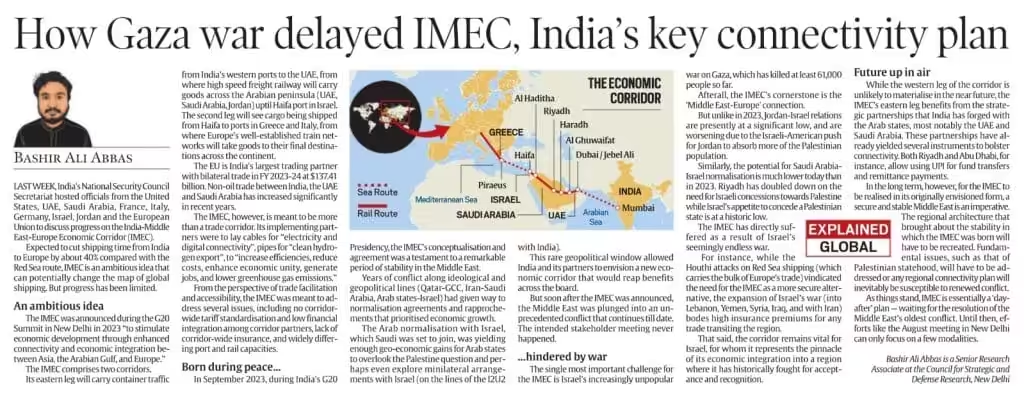
Note : MoU was signed by 8 countries but the IMEC will pass through many other countries like Greece, Jordan, Israel and so on. Please refer to the map.
- 2 Segments:
- The Eastern Corridor: This is a sea corridor connecting India to the Arabian Gulf. It will involve ports in India and the United Arab Emirates (UAE) and Saudi Arabia. Some specific ports mentioned in plans include Mundra and Jawaharlal Nehru Port Trust (JNPT) in India and Fujairah and Jebel Ali in the UAE.
- The Northern Corridor: This segment connects the Arabian Gulf to Europe, primarily by a new railway network. This rail line is planned to traverse the Arabian Peninsula, passing through Saudi Arabia, Jordan, and Israel. From the port of Haifa in Israel on the Mediterranean Sea, goods would then be shipped to ports in Europe.
- The European end of the corridor is a sea route to several European countries. The primary destinations and participating countries include: Italy, France,Germany, Greece (the port of Piraeus has been mentioned as a possible entry point).
- The project is a comprehensive network that includes not only a railway but also infrastructure for:
- Electricity and digital connectivity: This involves laying cables for electricity and high-speed data.
- Clean hydrogen export: The plan includes a pipeline for clean hydrogen.
- An Intergovernmental Framework Agreement (IGFA) was signed between India and the UAE in February 2024 to facilitate cooperation on the corridor’s operation, particularly on the development of a joint logistics platform and a digital ecosystem.
Goals and Benefits:
- Trade and Logistics: The primary goal is to create a seamless, efficient, and cost-effective trade route. It is projected to reduce logistics costs by up to 30% and transportation time by as much as 40% compared to traditional maritime routes like the Suez Canal.
- Economic Integration: The corridor is designed to enhance economic unity, generate jobs, and attract foreign direct investment into infrastructure, logistics, green energy, and digital technologies. It aims for a “transformative integration” of Asia, Europe, and the Middle East.
- For India, it provides a crucial link to its two largest trading blocs, the EU and the Gulf Cooperation Council (GCC).
- Geopolitical and Strategic Importance:
- Counter to China’s BRI: The IMEC is widely seen as a strategic alternative to China’s Belt and Road Initiative, offering a debt-free and transparent model for infrastructure development.
- Supply Chain Security: It aims to secure regional supply chains and reduce reliance on critical maritime chokepoints, such as the Suez Canal.
Challenges and Status:
- Initial Challenges: The project faced “benign modality and sustainability challenges” such as an under-developed cross-Saudi/UAE railway and a lack of a clear financial roadmap. These were considered manageable through commitment and investment from participating nations.
- Geopolitical instability, particularly the conflict in the Middle East, has been cited as a major hindrance to the corridor’s momentum.
- The “Middle East-Europe” connection, vital for the corridor, is now imperiled. Relations between Jordan and Israel are at a low point, and the prospect of Saudi-Israel normalization has diminished significantly due to Israel’s policies toward Palestine.
- Regional Competition: The eastern leg still faces internal hurdles, such as economic competition between Saudi Arabia and the UAE, which complicates the push for a common vision.
- Weakened Economic Benefits:Israel’s expanding conflict throughout the region increases insurance premiums for trade, undermining the corridor’s initial promise as a more secure alternative to the Red Sea route.
Way Ahead:
- Despite the challenges, diplomatic engagement continues, and participating countries have reiterated their commitment to the project, with a call for a credible roadmap for the next 36 months being made at the G7 Summit in June 2024. The recent meeting is a step in the same direction.
- Split Corridor: The western leg of the corridor (involving Israel) is unlikely to proceed soon. However, the eastern leg (connecting India with Arab states) can still move forward due to strong existing partnerships with the UAE and Saudi Arabia.
- The IMEC has effectively become a “day-after” plan, waiting for a resolution to the Israeli-Palestinian conflict. Current efforts can only focus on preliminary aspects like trade facilitation until a lasting peace is achieved. The full realization of IMEC in its original form is contingent on a secure and stable Middle East.
Tell Google you want more of this.
Add Anantam IAS as a preferred sourceOne tap, and this site shows up more often in your own Top Stories, AI Overviews and AI Mode. Remove it any time.