Why in News?
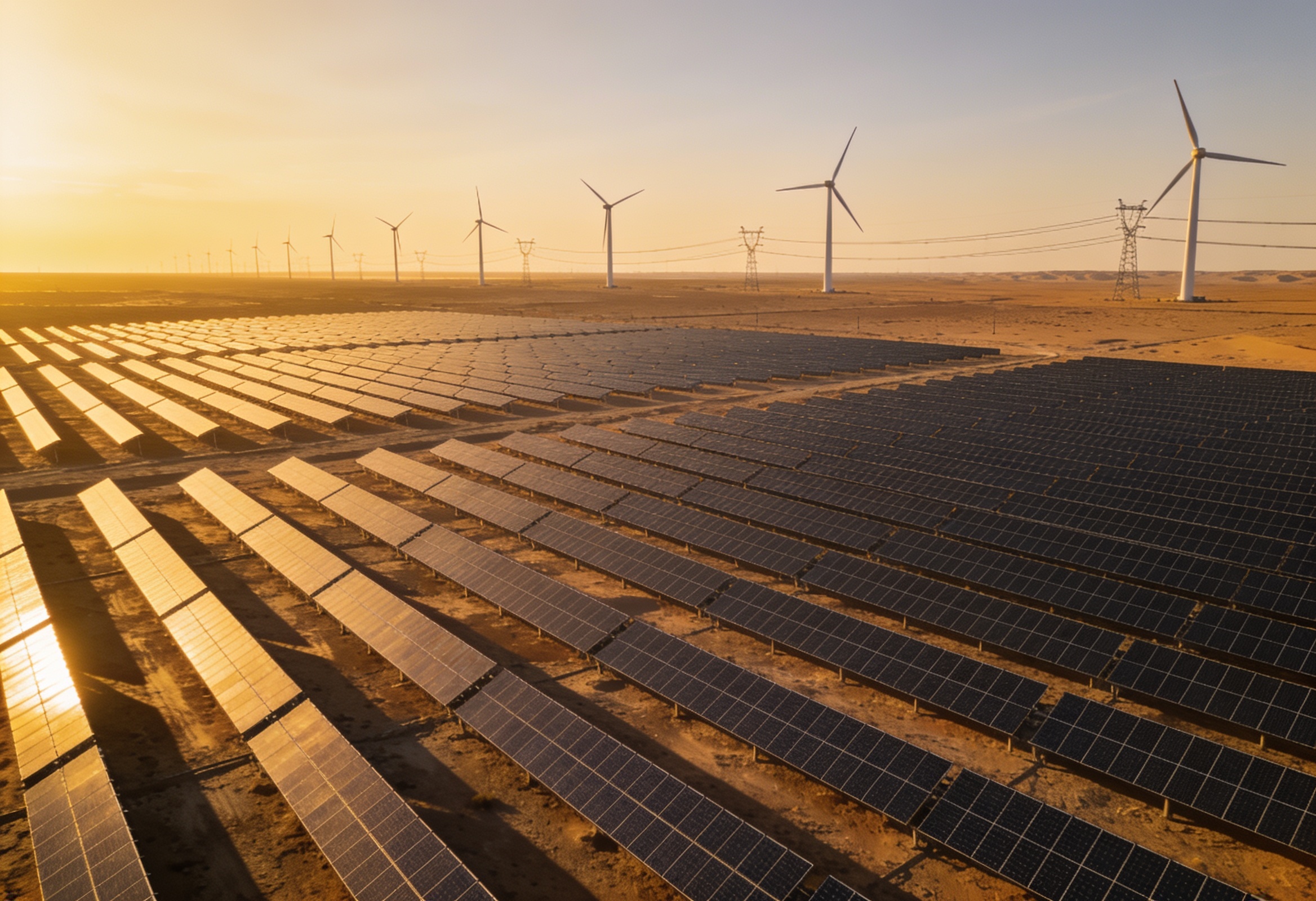
On 14 July 2025, the Ministry of New and Renewable Energy (MNRE) announced that 50% of India’s installed electricity-generation capacity now comes from non-fossil sources — meeting the target set under India’s Nationally Determined Contributions (NDCs) to the Paris Agreement a full five years ahead of the 2030 deadline.
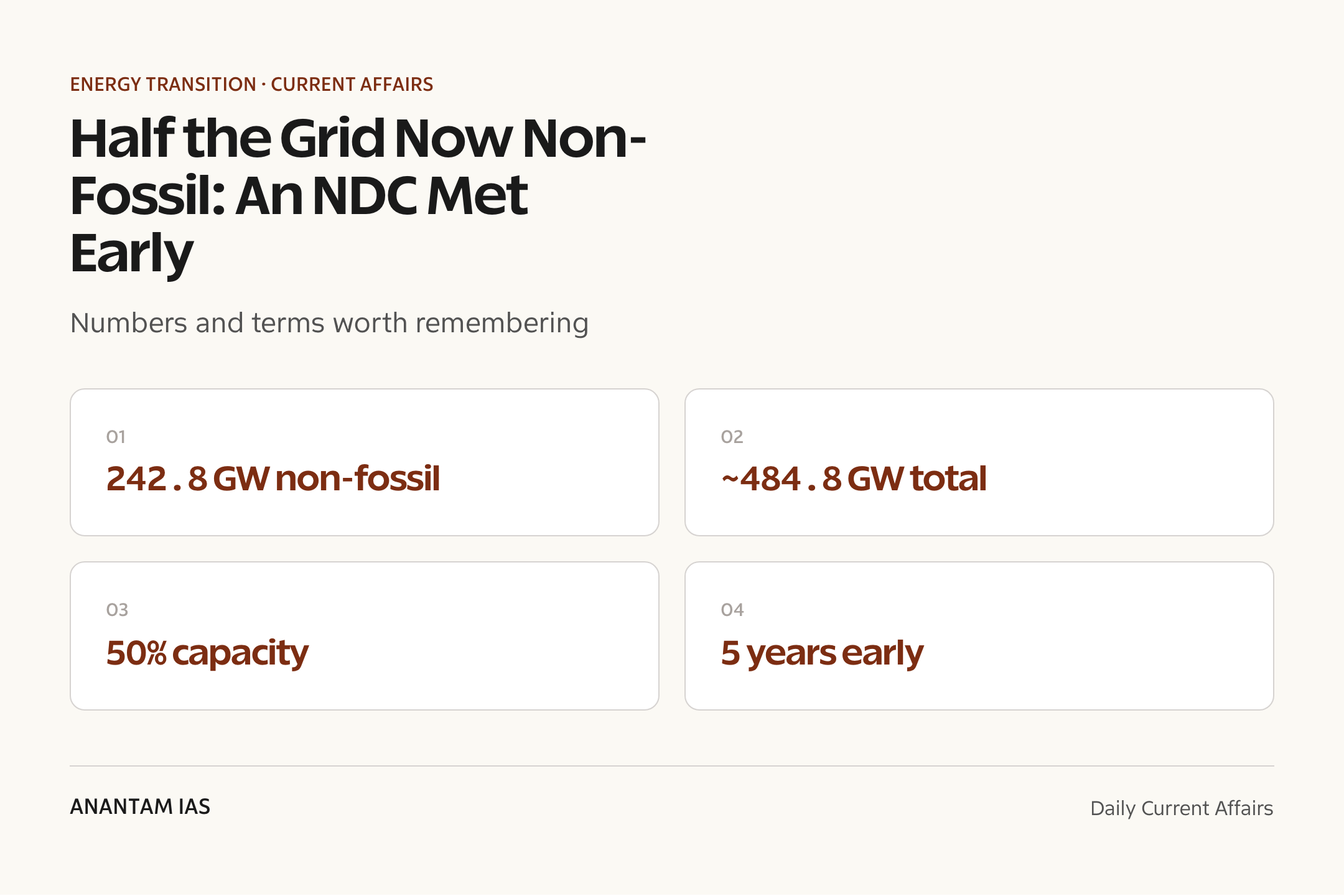
PIB reported that non-fossil capacity stood at about 242.8 GW of a total installed base of roughly 484.8 GW, drawing on solar, wind, large hydro, bioenergy and nuclear. Union Minister Pralhad Joshi called it a ‘proud moment’, saying India was ‘showing the way’ on climate solutions.
- Non-fossil installed capacity reached about 242.8 GW out of a total ~484.8 GW — crossing the 50% mark (data as of 30 June 2025).
- Solar led with roughly 184.6 GW, the single largest non-fossil source.
- Large hydro added about 49.4 GW and nuclear about 8.8 GW; wind and bioenergy made up the rest.
- The NDC target — 50% of cumulative electric-power capacity from non-fossil sources by 2030 — was met in 2025.
- MNRE credited flagship schemes — PM-KUSUM, PM Surya Ghar: Muft Bijli Yojana, solar parks and the National Wind-Solar Hybrid Policy.
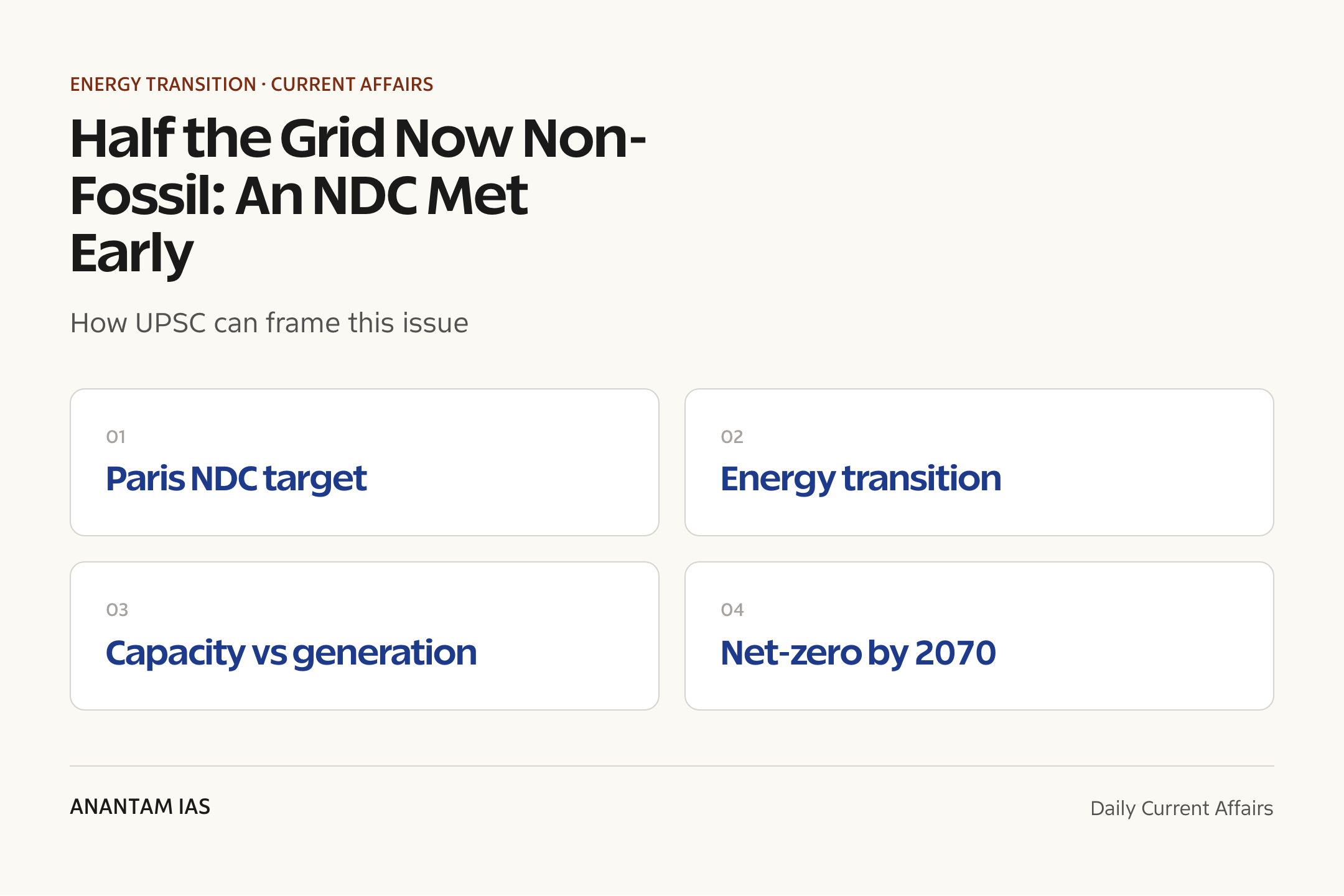
- The next milestone is 500 GW of non-fossil capacity by 2030, on the path to net-zero by 2070.
The development matters in the context of:
- Why it matters: this is a headline Paris Agreement deliverable achieved early, strengthening India’s climate credibility ahead of global stocktakes.
- A key caveat — this is a capacity milestone; fossil fuels (coal especially) still supply the larger share of actual electricity generation because of capacity factors.
UPSC Relevance
Prelims Relevance
- Non-fossil sources — solar, wind, large hydro, small hydro, bioenergy and nuclear; the metric is installed capacity, not generation.
- India’s NDC target: 50% of cumulative installed electric-power capacity from non-fossil sources by 2030 (updated NDC, 2022).
- Updated NDC also targets cutting emissions intensity of GDP by 45% from 2005 levels by 2030.
- Net-zero goal year for India: 2070 (announced at COP26, Glasgow, 2021).
- 500 GW non-fossil capacity by 2030 — the ‘Panchamrit’ commitment.
- PM Surya Ghar: Muft Bijli Yojana — rooftop solar scheme launched in 2024, targeting one crore households.
- PM-KUSUM — solar pumps and feeder solarisation for farmers (Pradhan Mantri Kisan Urja Suraksha evam Utthaan Mahabhiyan).
- National Wind-Solar Hybrid Policy — promotes co-located wind and solar plants to optimise grid use.
- Difference between capacity (installed MW/GW) and generation (actual MWh, shaped by capacity factor).
Mains Relevance
GS Paper 3
- India’s energy transition: renewable scale-up, the capacity-versus-generation gap, and the role of storage and grid balancing.
- Climate-commitment delivery — meeting an NDC target early and what it implies for the credibility of India’s mitigation pathway.
GS Paper 2
- India’s positioning in global climate diplomacy and the principle of common but differentiated responsibilities (CBDR).
Essay
- Development and the environment need not be adversaries — India’s clean-energy rise as proof of concept.
- Climate leadership from the global South: ambition, equity and delivery.
Background and Context
What was actually achieved
The milestone is about the structure of installed capacity, not day-to-day power output.
- Half of India’s installed power capacity — about 242.8 GW of ~484.8 GW — is now non-fossil.
- This includes renewables (solar, wind, small hydro, bioenergy), large hydro and nuclear.
- The figure crosses the 50% NDC threshold set for 2030, reached in 2025 — five years early.
- MNRE released the milestone on 14 July 2025, with figures dated to 30 June 2025.
What India promised under the Paris Agreement
The target sits inside India’s updated NDC submitted under the 2015 Paris Agreement.
- Under the Paris Agreement, each country files Nationally Determined Contributions (NDCs) — self-set climate pledges, ratcheted up over time.
- India’s updated NDC (2022) pledged 50% of cumulative installed electric-power capacity from non-fossil sources by 2030.
- It also pledged to cut the emissions intensity of GDP by 45% from 2005 levels by 2030.
- These flow from the ‘Panchamrit’ pledges announced by PM Modi at COP26 (Glasgow, 2021), which also set 500 GW non-fossil capacity and net-zero by 2070.
The drivers behind the surge
Policy design, falling solar tariffs and decentralised programmes combined to accelerate the build-out.
- Solar parks enabled utility-scale plants at record-low tariffs, making solar India’s largest non-fossil source.
- PM Surya Ghar: Muft Bijli Yojana (2024) drove a rooftop-solar push aimed at one crore households, decentralising generation.
- PM-KUSUM brought solar pumps and feeder solarisation to farmers, opening up agrovoltaics.
- The National Wind-Solar Hybrid Policy co-located wind and solar to use grid infrastructure more efficiently.
- Bioenergy shifted from the margins to a meaningful contributor, supporting circular-economy and rural-livelihood goals.
Capacity is not the same as generation
The crucial nuance an examiner will probe: half the capacity does not mean half the electricity.
- Capacity is the maximum installed output (in GW); generation is the electricity actually produced (in units).
- Solar and wind have lower capacity factors — they run only when the sun shines or the wind blows.
- So coal still supplies the larger share of actual generation, even as its share of capacity shrinks.
- Closing the generation gap depends on energy storage (batteries, pumped hydro) and a flexible, balanced grid.
Why this matters for India's standing
Delivering an NDC target early carries weight beyond the power sector.
- It strengthens India’s argument in climate diplomacy — that a developing economy can grow and decarbonise together.
- It reinforces the equity case under CBDR (common but differentiated responsibilities), with India over-delivering on its pledge.
- It supports India’s pitch as a hub for clean-energy manufacturing and leadership of the International Solar Alliance.
- It builds momentum for the harder next steps — storage, transmission and the 500 GW target.
The road from here
The early win sets up steeper challenges in the second half of the decade.
- Scaling from ~243 GW to 500 GW non-fossil capacity by 2030 needs sustained annual additions.
- Grid integration of variable renewables requires storage, demand response and transmission upgrades.
- Land, finance and supply chains — including domestic solar-module manufacturing — remain binding constraints.
- Shifting the milestone from capacity to actual generation share is the deeper, unfinished task.
Way Forward
Bridge capacity and generation
- Invest in energy storage — battery systems and pumped hydro — so renewable capacity translates into round-the-clock supply.
- Modernise the grid for variable generation: flexible balancing, forecasting and stronger interstate transmission.
Build the manufacturing base
- Deepen domestic solar-module and cell manufacturing to cut import dependence and secure the build-out.
- Sustain financing pipelines and de-risk renewable projects for private capital.
Push toward 500 GW and beyond
- Maintain the policy momentum from PM Surya Ghar, PM-KUSUM and solar parks to reach 500 GW by 2030.
- Keep the focus on equity and just transition so coal-dependent regions are not left behind.
Conclusion
Reaching 50% non-fossil capacity five years early is a genuine achievement and a rare instance of a major economy over-delivering on a Paris Agreement pledge. It vindicates a decade of policy on solar parks, rooftop solar and hybrid renewables, and gives India a stronger hand in global climate talks.
The harder work, though, lies ahead. The milestone is about installed capacity, not the electricity actually flowing through the grid, where coal still dominates. Turning half the capacity into half the generation will hinge on storage, grid flexibility and the long climb to 500 GW — the real test of India’s transition.
UPSC Practice Questions
Prelims MCQ 1
With reference to India’s 2025 announcement on non-fossil power capacity, consider the following statements:
- It means that more than half of India’s electricity is now generated from non-fossil sources.
- The 50% target relates to installed electric-power capacity under India’s updated NDC.
- The target was met ahead of its 2030 deadline.
How many of the above statements are correct?
(a) Only one (b) Only two (c) All three (d) None
Answer: (b) Only two
Explanation:
Statements 2 and 3 are correct — the 50% NDC target is about installed capacity and was met early. Statement 1 is wrong; it is a capacity milestone, not a generation one, and coal still supplies most actual generation.
Prelims MCQ 2
India’s ‘Panchamrit’ climate commitments, announced at COP26 (Glasgow), include which of the following?
(a) Net-zero emissions by 2050 (b) 500 GW of non-fossil capacity by 2030 and net-zero by 2070 (c) 50% of generation from renewables by 2025 (d) Phasing out coal entirely by 2040
Answer: (b) 500 GW of non-fossil capacity by 2030 and net-zero by 2070
Explanation:
The Panchamrit pledges at COP26 (2021) included 500 GW non-fossil capacity by 2030, 50% of capacity from non-fossil sources, and net-zero by 2070 — not 2050.
UPSC Mains Questions
- India met its Paris Agreement target of 50% non-fossil installed power capacity five years ahead of schedule. Examine the policy drivers behind this achievement and the challenges that remain in translating capacity into clean electricity generation.
- Distinguish between installed capacity and electricity generation in the context of India’s energy transition. Discuss why energy storage and grid flexibility are central to making the renewable build-out meaningful.
Sources: PIB, Ministry of New and Renewable Energy and Down To Earth.
Frequently Asked Questions
What did India achieve in July 2025?
On 14 July 2025, the Ministry of New and Renewable Energy announced that 50% of India’s installed electricity-generation capacity now comes from non-fossil sources — about 242.8 GW of a roughly 484.8 GW total. This met India’s Paris Agreement NDC target five years before the 2030 deadline.
What counts as non-fossil capacity?
Non-fossil sources include solar, wind, small hydro and bioenergy (together called renewables), plus large hydropower and nuclear. The metric measures installed capacity in gigawatts, not the electricity actually generated. Solar was the single largest contributor at about 184.6 GW.
Does 50% capacity mean 50% of electricity is clean?
No. This is a capacity milestone, not a generation one. Solar and wind have lower capacity factors because they depend on sunlight and wind, so coal still supplies the larger share of actual electricity generated. Closing that gap needs energy storage and a more flexible grid.
What is an NDC under the Paris Agreement?
A Nationally Determined Contribution is a country’s self-set climate pledge under the 2015 Paris Agreement, reviewed and strengthened over time. India’s updated 2022 NDC promised 50% of installed power capacity from non-fossil sources by 2030 and a 45% cut in the emissions intensity of GDP from 2005 levels.
Which schemes drove this clean-energy growth?
Flagship programmes include PM Surya Ghar: Muft Bijli Yojana for rooftop solar, PM-KUSUM for solar pumps and farm solarisation, large solar parks enabling utility-scale plants, and the National Wind-Solar Hybrid Policy for co-located renewable projects.
What are India’s next clean-energy targets?
Under its COP26 ‘Panchamrit’ pledges, India aims for 500 GW of non-fossil capacity by 2030 and net-zero emissions by 2070. The harder task ahead is integrating variable renewables through storage, demand response and transmission upgrades.
Tell Google you want more of this.
Add Anantam IAS as a preferred sourceOne tap, and this site shows up more often in your own Top Stories, AI Overviews and AI Mode. Remove it any time.