The India-Oman CEPA, effective from 1 June 2026, becomes India’s second Comprehensive Economic Partnership Agreement with a Gulf Cooperation Council member after the India-UAE pact of 2022. The agreement covers trade in goods, trade in services, investment promotion, and regulatory cooperation, and it represents a quiet acceleration of India’s trade strategy in the Gulf. The Gulf matters to India not as a single market but as a layered relationship: an energy supplier, a workforce destination, an investment partner, and increasingly a hub for re-export trade. The CEPA tries to formalize all four strands in one framework.
Oman is not India’s largest Gulf trading partner. It ranks behind the UAE, Saudi Arabia, and Qatar in trade volume. But it is strategically located at the entry of the Persian Gulf, controls one side of the Strait of Hormuz, and has long maintained a balanced foreign policy that gives it a quietly important role in the region. Indian goods that reach the UAE often need Omani logistics. Indian workers who go to Oman often re-route through it to other Gulf countries. The CEPA gives both sides a more predictable framework.
The agreement also lands in a particular moment in Indian trade strategy. The country has stepped back from joining the Regional Comprehensive Economic Partnership but has pushed forward with bilateral CEPAs and trade pacts with the UAE, Australia, EFTA, and now Oman. The India-Oman CEPA fits into that bilateral-first strategy.
Quick Facts
- Agreement: India-Oman Comprehensive Economic Partnership Agreement (CEPA)
- Effective date: 1 June 2026
- Negotiating ministry: Ministry of Commerce and Industry
- Scope: Trade in goods, trade in services, investment, digital trade, customs cooperation
- Counterpart: Sultanate of Oman, Ministry of Commerce, Industry and Investment Promotion
- Tariff coverage: Substantial duty-free access on a defined share of tariff lines for both sides
- Service sectors: IT, healthcare, education, financial services, professional services
- Strategic context: Second CEPA with a GCC member after the India-UAE CEPA (2022)
- Bilateral trade base: Several billion dollars annually, weighted toward energy and chemicals
- Geostrategic location: Oman controls the southern side of the Strait of Hormuz
What Just Happened
The Government of India announced that the India-Oman Comprehensive Economic Partnership Agreement will come into force on 1 June 2026. The agreement was signed earlier and has now completed the domestic ratification process on both sides. From 1 June 2026, duty-free access kicks in on a defined set of tariff lines, with phased reductions on others. Service trade liberalization commitments and investment protection commitments begin in parallel.
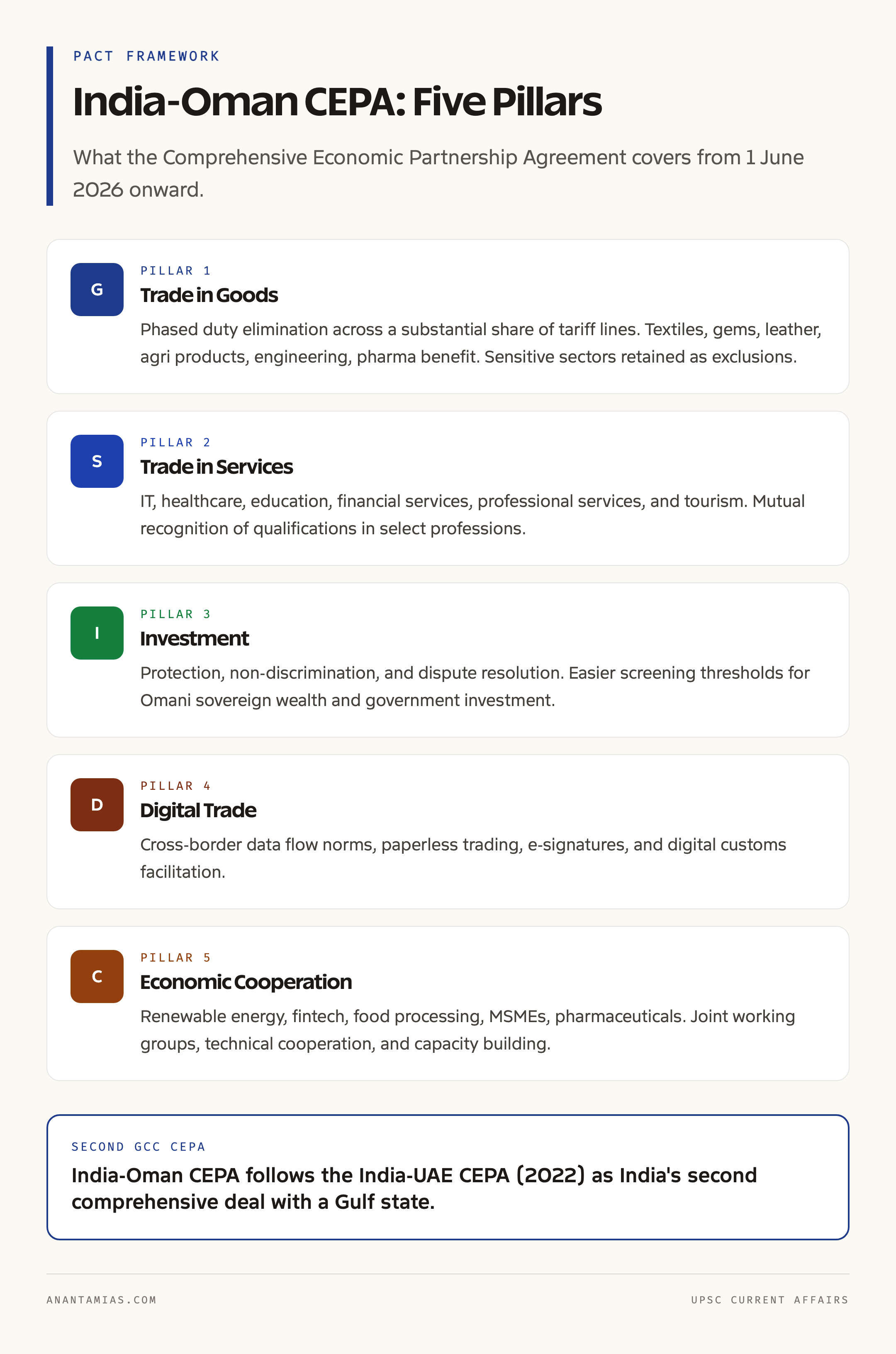
The agreement carries chapters on trade in goods, rules of origin, sanitary and phytosanitary measures, technical barriers to trade, trade in services, digital trade, investment, customs cooperation, intellectual property, and dispute settlement. It also includes a chapter on economic cooperation in areas such as renewable energy, fintech, food processing, and pharmaceuticals.
Background and Historical Context
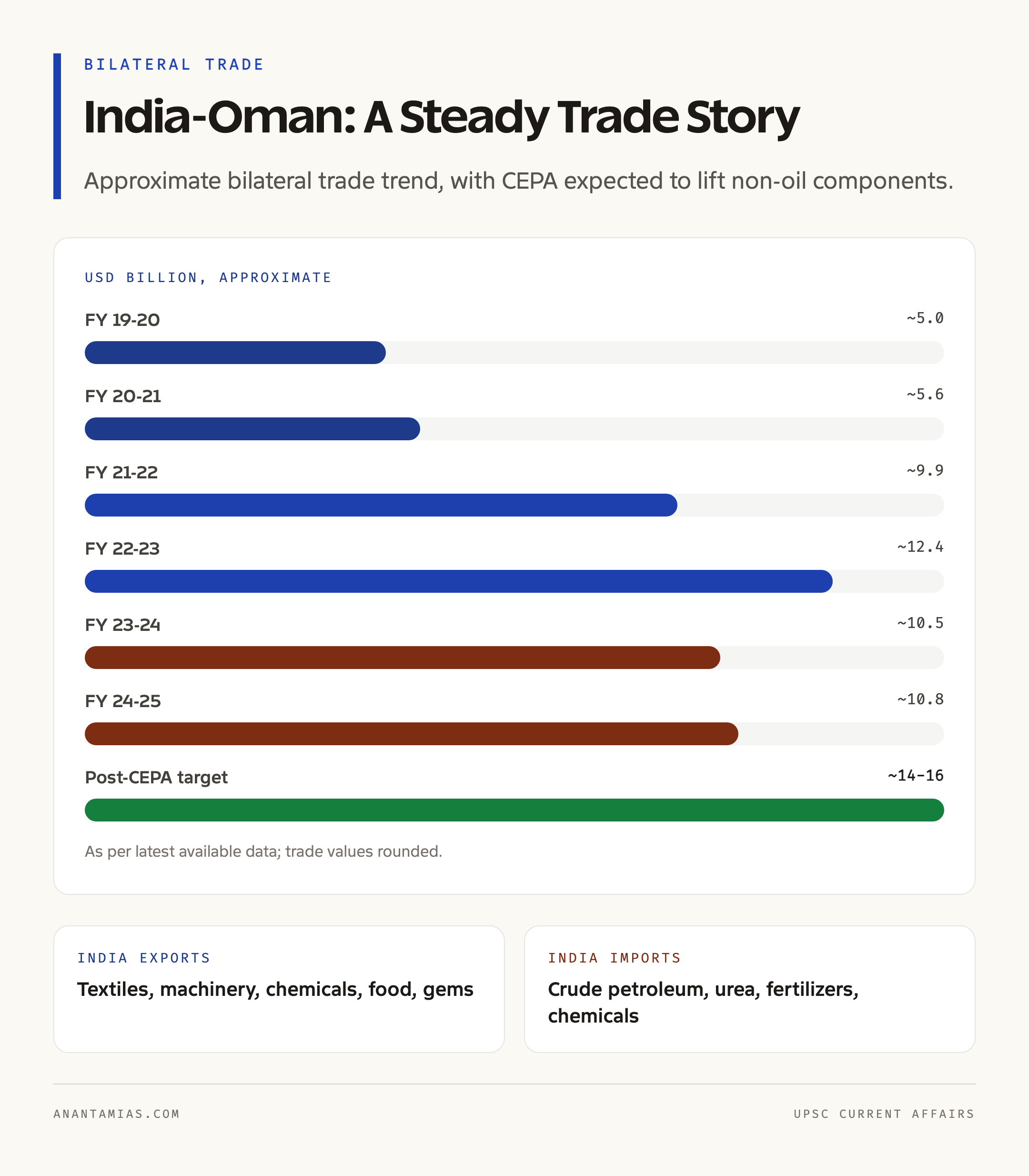
India and Oman have a long maritime and trading history. Oman was a key node in the Indian Ocean trade network for centuries. In the modern era, Oman has been a steady source of crude oil and petroleum products for India, and a long-standing host of the Indian diaspora, particularly from Kerala. Defense cooperation has also been close, with the Indian Navy enjoying access to Duqm port for operational turnaround.
Trade between the two countries has historically been modest and tilted toward energy. India exports textiles, machinery, chemicals, and food products to Oman, while Oman exports crude petroleum, fertilizers, urea, and chemicals to India. The CEPA negotiation began as part of India’s wider engagement with the GCC and was given political momentum after the success of the India-UAE CEPA, which more than doubled bilateral non-oil trade in its first three years.
The CEPA also fits into India’s broader Indo-Gulf strategy, which now includes the India-Middle East-Europe Economic Corridor (IMEC), the I2U2 grouping, energy supply diversification, and increased investment flows from sovereign wealth funds.
Key Provisions of the India-Oman CEPA
The agreement covers ground similar to the India-UAE CEPA but with specific calibrations for Oman’s economic structure. The major chapters include:
- Trade in goods: Phased duty elimination on a substantial share of tariff lines covering textiles, gems and jewellery, leather, footwear, agricultural products, engineering goods, and pharmaceuticals. Exclusions include certain sensitive sectors.
- Rules of origin: Defined value addition and regional content thresholds to prevent re-routing of third-country goods through Oman.
- Services: Liberalization in IT services, healthcare, education, financial services, professional services, and tourism, with mutual recognition of qualifications in selected professions.
- Investment: Investment protection, non-discrimination, and dispute resolution provisions. Lower investment screening thresholds for Omani sovereign wealth and government investment vehicles in defined sectors.
- Digital trade: Provisions on cross-border data flows, paperless trading, and e-signatures.
- Government procurement and competition: Limited but defined market access in government procurement on a non-mandatory basis.
- Cooperation chapters: Renewable energy, fintech, food processing, MSMEs, and pharmaceuticals.
Why It Matters
The India-Oman CEPA matters along three axes.
First, goods trade diversification. Indian exporters get smoother access to a Gulf market that has historically been small but well-positioned for onward distribution. Textile, gems and jewellery, and engineering goods exporters can use Oman as a logistics base.
Second, services and investment opening. The Gulf hosts a large Indian diaspora and an even larger Indian services footprint. A formal services trade framework reduces friction for IT companies, healthcare chains, education providers, and financial firms operating in Oman.
Third, strategic positioning. Oman is a balanced regional actor, an entry point to the Persian Gulf, and a country with deepening interest in Indian investment. The CEPA gives India a stronger institutional anchor in the region beyond the UAE.
There is also a quieter benefit. Two CEPAs with two GCC members create a template that can accelerate negotiations with Saudi Arabia and Qatar. A India-GCC FTA has been stuck for years. Bilateral CEPAs with major GCC members can ultimately function as a backdoor regional opening.
Detailed Analysis
The economic impact of the India-Oman CEPA depends on three things: how fast tariff elimination ramps up, how effective rules of origin enforcement is, and how much new investment the agreement actually unlocks.
On tariff impact, the bigger gains will likely accrue on the Indian export side, since Oman’s effective tariff levels have historically been higher than India’s average effective rate for certain product lines. Indian textiles, gems and jewellery, and processed food can expect competitive gains over Bangladesh, Sri Lanka, and even some Southeast Asian competitors who do not have similar preferential access.
On services, the depth of liberalization will depend on Oman’s national regulations governing professional practice and labor market access. The CEPA can only go as far as domestic regulation in Oman allows. The mutual recognition of qualifications has to be matched by Omani professional bodies actually issuing recognition, which is where the India-UAE CEPA has seen partial progress.
On investment, the bigger flow is likely from Omani capital into India, particularly into infrastructure, ports, and renewable energy. Oman’s sovereign wealth and pension funds have been increasing their India allocation, and the CEPA provides them stronger legal protections.
Comparative Perspective
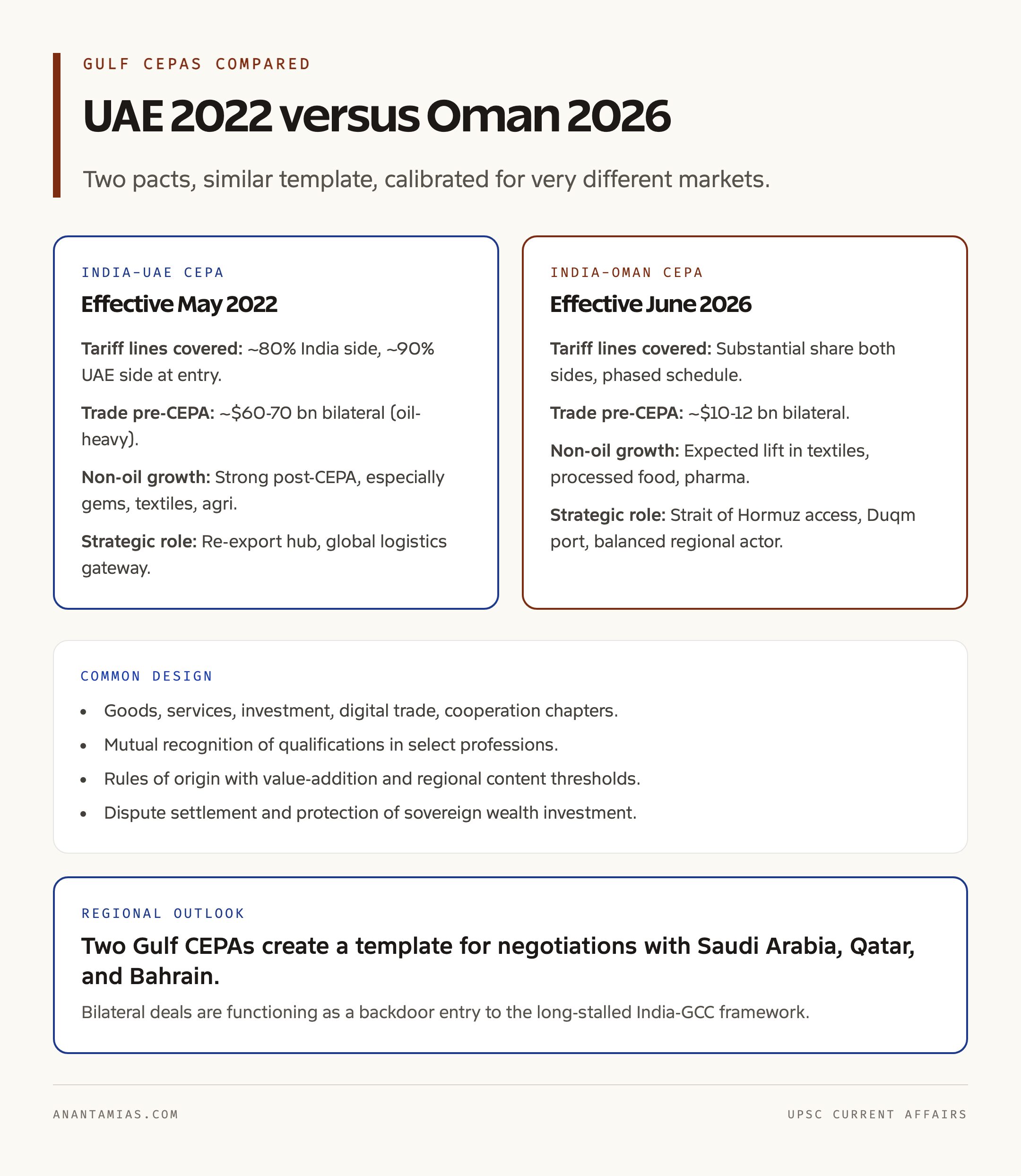
The most relevant comparison is the India-UAE CEPA, which came into force in 2022. That agreement covered around 80 percent of tariff lines on the Indian side and around 90 percent on the UAE side at entry into force, with phased liberalization on the remainder. Non-oil trade jumped substantially in the first two years, with notable gains in gems and jewellery, textiles, and processed food.
The India-Oman CEPA broadly mirrors that template but with calibration for Oman’s smaller market size and different sectoral profile. Oman is less heavily focused on re-export trade than the UAE, so the gains for Indian exporters using Oman as a hub may be more modest. On the other hand, Oman offers a more direct strategic anchor near the Strait of Hormuz and the Indian Ocean rim.
Compared with India’s earlier RTAs, including the India-ASEAN agreement and the India-Korea CEPA, the India-Oman CEPA has cleaner rules of origin, better digital trade provisions, and a more developed services framework. It reflects the lessons India has drawn from earlier trade deal experiences.
Challenges and Concerns
Three issues need attention. Trade imbalance: The bilateral trade balance has historically favored Oman because of energy imports. The CEPA can narrow this only if Indian non-oil exports respond meaningfully, which depends on logistics, branding, and trade promotion. Rules of origin enforcement: Indian customs has to verify that goods claiming preferential origin actually meet value-addition thresholds, which is operationally demanding. Sensitive sectors: Indian dairy, agriculture, and selected manufacturing segments will be watching closely to ensure exclusions hold.
There is also a strategic concern. Tighter Gulf integration means deeper exposure to regional security risks, including disruption around the Strait of Hormuz. The CEPA increases the economic interdependence between India and Oman without altering the underlying security architecture. A serious regional escalation could test how robust the agreement is operationally.
Prelims Pointers
- CEPA: Comprehensive Economic Partnership Agreement
- Effective date for India-Oman CEPA: 1 June 2026
- Counterpart country: Sultanate of Oman
- Predecessor Gulf CEPA: India-UAE CEPA (2022)
- GCC members: UAE, Saudi Arabia, Qatar, Kuwait, Bahrain, Oman
- Strait of Hormuz: Strategic chokepoint where Oman holds the southern side
- Duqm port: Strategic Indian Navy access port in Oman
- IMEC: India-Middle East-Europe Economic Corridor
- I2U2: India, Israel, UAE, and US grouping for economic cooperation
Mains Questions
- GS Paper II (International Relations): Examine the strategic and economic significance of the India-Oman CEPA in the broader context of India’s Gulf policy. (15 marks, 250 words)
- GS Paper III (Economy): Compare the India-UAE CEPA and the India-Oman CEPA in terms of design, sectoral coverage, and expected economic impact. (15 marks, 250 words)
- GS Paper III (Economy and Trade): Critically evaluate India’s shift from regional trade agreements to bilateral CEPAs as a trade strategy. (10 marks, 150 words)
- GS Paper II (International Relations): How does India-Oman economic cooperation complement India’s maritime and security interests in the Indian Ocean Region? (10 marks, 150 words)
Way Forward
For the India-Oman CEPA to deliver, four things need to happen in the first three years. Exporter outreach has to reach MSMEs, not just large firms, so that the tariff gains feed through to a broader trade base. Customs and certification infrastructure has to scale up to handle preferential rules-of-origin verification. Investment promotion has to focus on specific sectors where Omani capital and Indian projects match, particularly in renewable energy, ports, and food processing. And the services chapter has to be operationalized through bilateral mutual recognition agreements rather than just paper commitments.
India should also use the CEPA as a template for ongoing negotiations with other GCC members. A standardized framework reduces the cost and complexity of subsequent agreements. The IMEC corridor adds another layer of opportunity, allowing Indian goods to move through Oman or the UAE toward Europe under preferential terms.
For UPSC aspirants, this CEPA fits a wider story. Pair it with the Bharat Maritime Insurance Pool for shipping context, the Jan Suraksha schemes for financial inclusion architecture, and the Coal Gasification Scheme 2026 for industrial decarbonization strategy.
Frequently Asked Questions
What is the India-Oman CEPA?
It is a Comprehensive Economic Partnership Agreement between India and the Sultanate of Oman covering trade in goods, services, investment, digital trade, and cooperation, taking effect on 1 June 2026.
Is this India’s first CEPA with a Gulf country?
No. The India-UAE CEPA, signed in 2022, was the first. The India-Oman CEPA is the second.
What does CEPA stand for?
Comprehensive Economic Partnership Agreement. It is broader than a free trade agreement and typically covers goods, services, investment, and cooperation.
Which Indian sectors benefit most?
Textiles, gems and jewellery, leather and footwear, processed food, pharmaceuticals, and engineering goods are expected to see the strongest gains on the export side. IT services, healthcare, and education benefit on the services side.
Are sensitive sectors protected?
Yes. Both sides retain exclusions on defined sensitive products and services. The Indian dairy sector, for example, has historically been carved out of similar agreements.
How does this affect India’s trade deficit with Oman?
The trade balance has historically favored Oman because of energy imports. The CEPA can narrow the gap if Indian non-oil exports respond, but the structural energy import will remain.
What is the strategic significance of Oman for India?
Oman controls the southern side of the Strait of Hormuz, hosts a large Indian diaspora, provides Indian Navy access to Duqm port, and maintains a balanced foreign policy that makes it a useful regional partner.
How does the CEPA fit with IMEC?
IMEC is the India-Middle East-Europe Economic Corridor announced in 2023. The CEPA strengthens the economic plumbing of one node in that corridor, even though Oman is not part of the original IMEC route.
What about investment from Omani sovereign wealth?
The investment chapter offers stronger legal protection and dispute settlement, which is expected to encourage Omani sovereign and pension capital to allocate more to Indian infrastructure and renewable energy.
When does duty-free access begin?
Duty-free access on the agreed set of tariff lines begins from 1 June 2026, with phased reductions on remaining lines according to the agreed schedule.
Tell Google you want more of this.
Add Anantam IAS as a preferred sourceOne tap, and this site shows up more often in your own Top Stories, AI Overviews and AI Mode. Remove it any time.