India’s retirement security architecture has quietly become one of the most consequential reform stories of the decade. In May 2026, fresh data from the Pension Fund Regulatory and Development Authority confirmed that the National Pension System now serves over 2.17 crore subscribers, while Atal Pension Yojana enrolments crossed 8.96 crore. Yet a Mercer-CFA Institute assessment in late 2025 found that formal pension coverage still touches less than a quarter of India’s workforce, exposing a structural gap that no single scheme can close.
The India pension landscape sits at a crossroads. On one side, the government is pushing a layered, contributory, market-linked model anchored by NPS, the new Unified Pension Scheme, EPF/EPS, and APY. On the other, several states have flirted with restoring the Old Pension Scheme, raising hard questions about fiscal sustainability, intergenerational equity, and the political economy of guaranteed pensions.
This article unpacks how the India pension landscape evolved, what the multi-pillar framework actually looks like, why the OPS revival debate refuses to die, and what the country must fix before its demographic dividend becomes a retirement liability.
Quick Facts
- Total NPS AUM: approximately Rs 15.95 lakh crore as on 31 March 2026.
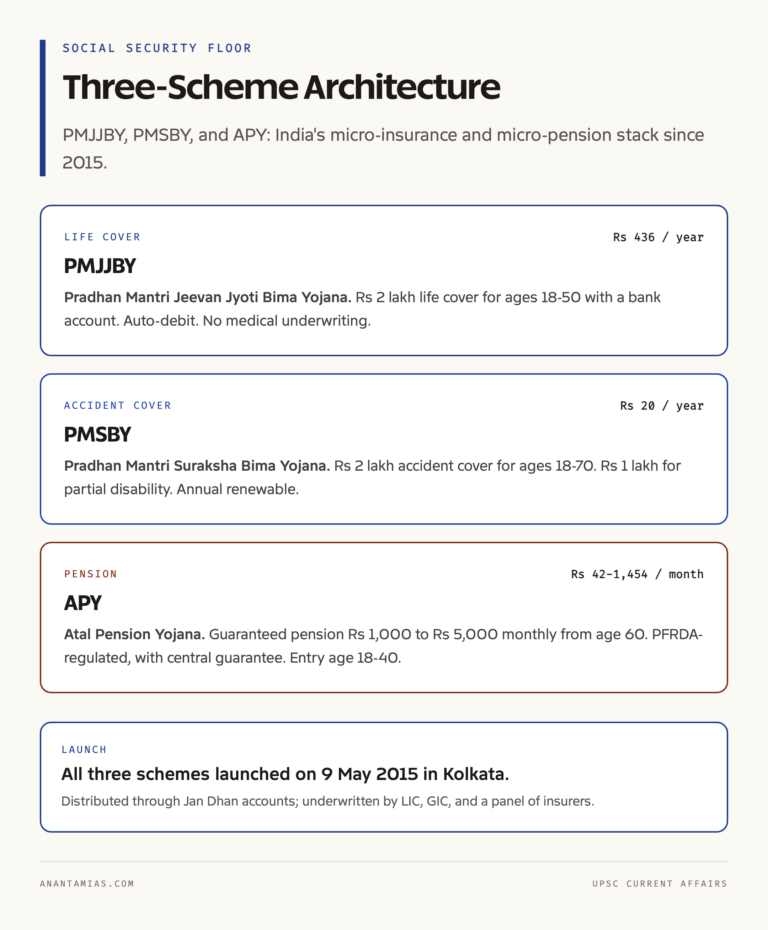
- APY enrolments: 8.96 crore, with the maximum assured pension of Rs 5,000 per month.
- EPS membership: 7.98 crore contributory members under EPFO as of April 2026.
- UPS rollout: operational from 1 April 2025 as an option within NPS for central government employees.
- Coverage gap: roughly 75 percent of India’s workforce remains outside any formal pension scheme.
- Regulators: PFRDA for NPS, UPS, APY; EPFO for EPF and EPS; IRDAI for annuity products.
What Just Happened
A clutch of developments through April and May 2026 has put the India pension landscape back in the spotlight. The Economic Survey 2025-26 flagged that NPS is driving formal pension expansion, but coverage remains shallow because of widespread informality. PFRDA notified an updated NPS charge structure effective July 2026, lowering account-opening and persistency charges to make the scheme cheaper at the front end.
The Unified Pension Scheme, introduced from April 2025, completed its first full year of operation in April 2026. Central government employees who joined after 1 January 2004 can now choose between sticking with pure NPS or opting into UPS, which guarantees 50 percent of the average basic pay drawn in the last 12 months as assured pension after 25 years of service. Several public sector undertakings are studying parallel structures.
Meanwhile, the Mercer-CFA Institute Global Pension Index 2025 ranked India in the lower tier, citing low coverage, modest replacement rates, rigid investment norms, and uneven regulatory oversight. The report became a reference point for parliamentary debate on extending pensions to gig and platform workers under the Code on Social Security, 2020.
Background and Historical Context
India’s retirement-income story falls neatly into three phases. The first was the colonial inheritance: a generous defined-benefit pension for civil servants, military personnel, and railway workers, financed entirely out of current tax revenues. The Old Pension Scheme of post-independence India carried this forward, indexed to the last drawn salary and revised by successive Pay Commissions. The Atal Pension Yojana and the EPFO’s rollout of its e-Praapti portal reflect more recent attempts to widen the base.
Key Provisions of the Multi-Pillar Framework
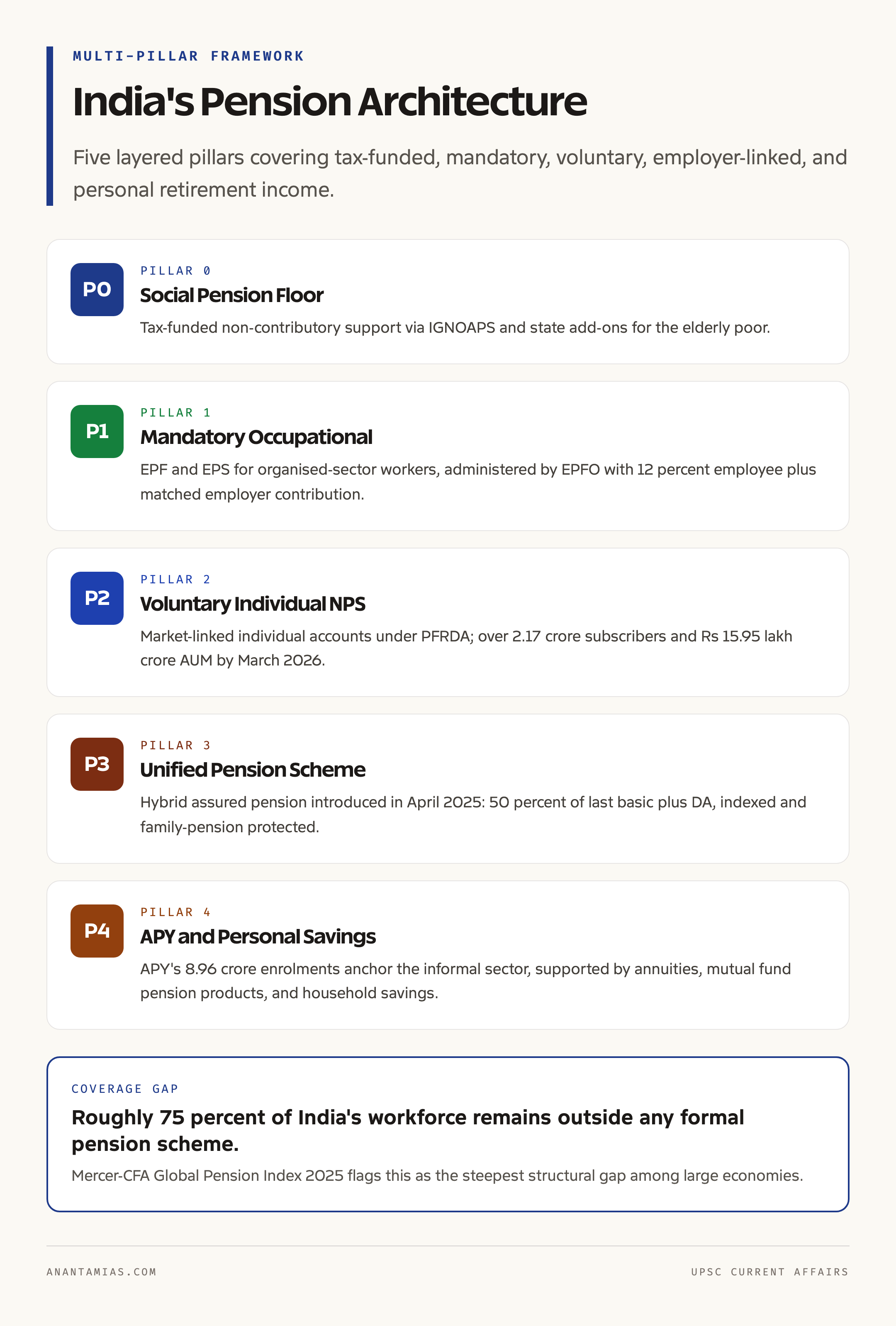
The current India pension landscape borrows from the World Bank’s five-pillar typology but adapts it to local labour realities. Pillar zero is a tax-funded, non-contributory floor for the elderly poor, delivered through the Indira Gandhi National Old Age Pension Scheme and state add-ons. Pillar one is mandatory occupational pension for organised-sector workers, mainly EPF and EPS run by EPFO.
Pillar two is the contributory, individual-account NPS for government and private-sector subscribers. Pillar three is the new UPS, which sits as a hybrid: assured benefit at retirement, but built on contributions and managed market-style during accumulation. Pillar four covers voluntary personal savings, annuities, mutual fund pension products, and the Atal Pension Yojana for the informal sector. Pillar five recognises non-financial support: housing, family transfers, and health insurance such as Ayushman Vay Vandana.
The NPS itself splits into Tier I, the locked-in retirement account, and Tier II, a flexible savings overlay. Subscribers pick fund managers and asset allocation across equity, corporate bonds, government securities, and alternative investments. At exit, at least 40 percent of the corpus is annuitised; the rest can be withdrawn tax-free up to specified limits.
Why It Matters
Pension policy is no longer a niche personnel-ministry concern. With life expectancy at birth crossing 70 years and the share of those above 60 projected to nearly double to 20 percent of the population by 2050, the fiscal and social stakes are enormous. Without deeper coverage, a large cohort of informal workers risks aging into poverty just when health costs climb.
Equally, the cost of pure defined-benefit promises has grown unsustainable. Combined Union and state pension outgo has crossed Rs 7 lakh crore annually and now rivals capital expenditure in some states. The shift to a contributory India pension landscape is partly fiscal arithmetic, partly intergenerational fairness, and partly an attempt to channel long-term household savings into infrastructure and corporate debt markets.
Detailed Analysis: NPS, UPS, EPF and APY in Practice
NPS has delivered solid long-run returns. Equity-tier returns since inception cluster around 12-13 percent CAGR for active subscribers, well above EPF’s 8.25 percent for 2024-25. But the all-citizen NPS suffers from low ticket sizes and patchy persistency outside the central government segment. APY is structurally cheaper to administer but pays only fixed slabs of Rs 1,000 to Rs 5,000 a month, which the Standing Committee on Finance has urged be raised to Rs 10,000 with inflation indexing.
EPF remains the workhorse for the organised private sector, with a contribution split of 12 percent of basic pay by both employee and employer; 8.33 percent of the employer share flows into EPS, capped at a wage ceiling of Rs 15,000. That ceiling, last revised in 2014, is now widely regarded as anachronistic. A revision to Rs 21,000 has been recommended but not notified.
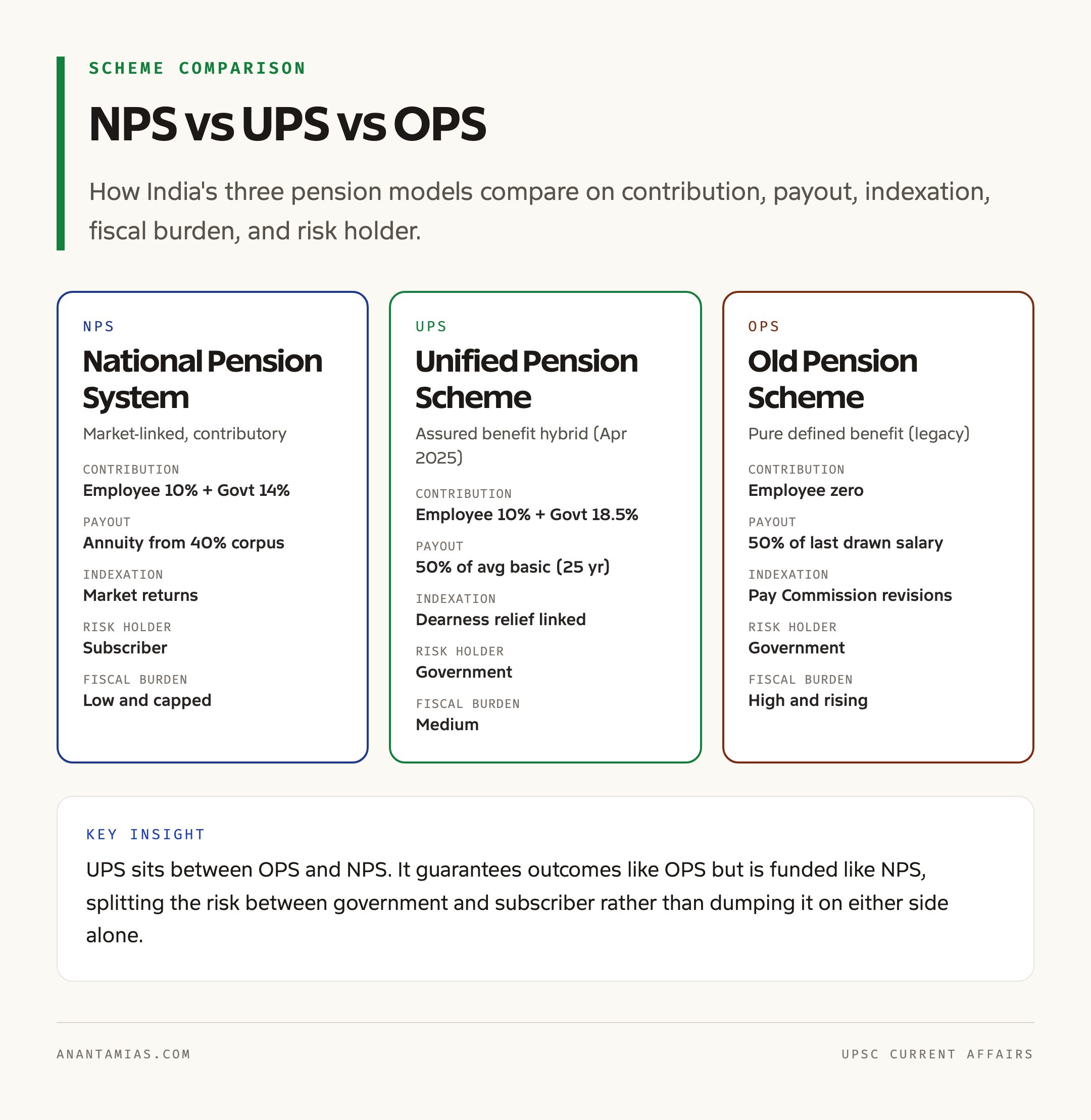
UPS, drawing on the framework explained in our analysis of the Unified Pension Scheme and National Pension Scheme, is the most politically interesting addition. It promises 50 percent assured pension after 25 years of service, a minimum guaranteed pension of Rs 10,000 a month after 10 years, family pension at 60 percent of last drawn pension, and inflation indexation through dearness relief. The catch: employees who opt for UPS contribute 10 percent of basic plus DA, the government contributes 18.5 percent (up from 14 percent under pure NPS), and a separate pool funds the assured top-up. UPS therefore mutes the OPS-vs-NPS binary by blending elements of both.
Comparative Perspective
Globally, multi-pillar systems are now the norm. Chile pioneered mandatory individual accounts in 1981 and inspired NPS, but high fees and low replacement rates triggered a 2022 reform debate. Sweden combines a notional defined-contribution public pillar with a small mandatory funded layer and broad occupational pensions, generating replacement rates above 60 percent. Australia’s superannuation model mandates 11.5 percent employer contributions and has built a USD 2.4 trillion pool.
India’s design is closer to Chile in its individual-account logic, but closer to Sweden in its layered architecture once UPS, EPS, and APY are stacked. The key divergence is coverage: where Sweden, Australia, and the Netherlands cover above 90 percent of workers, India is stuck near 25 percent because the informal economy still employs roughly four in five workers.
Challenges in the India Pension Landscape
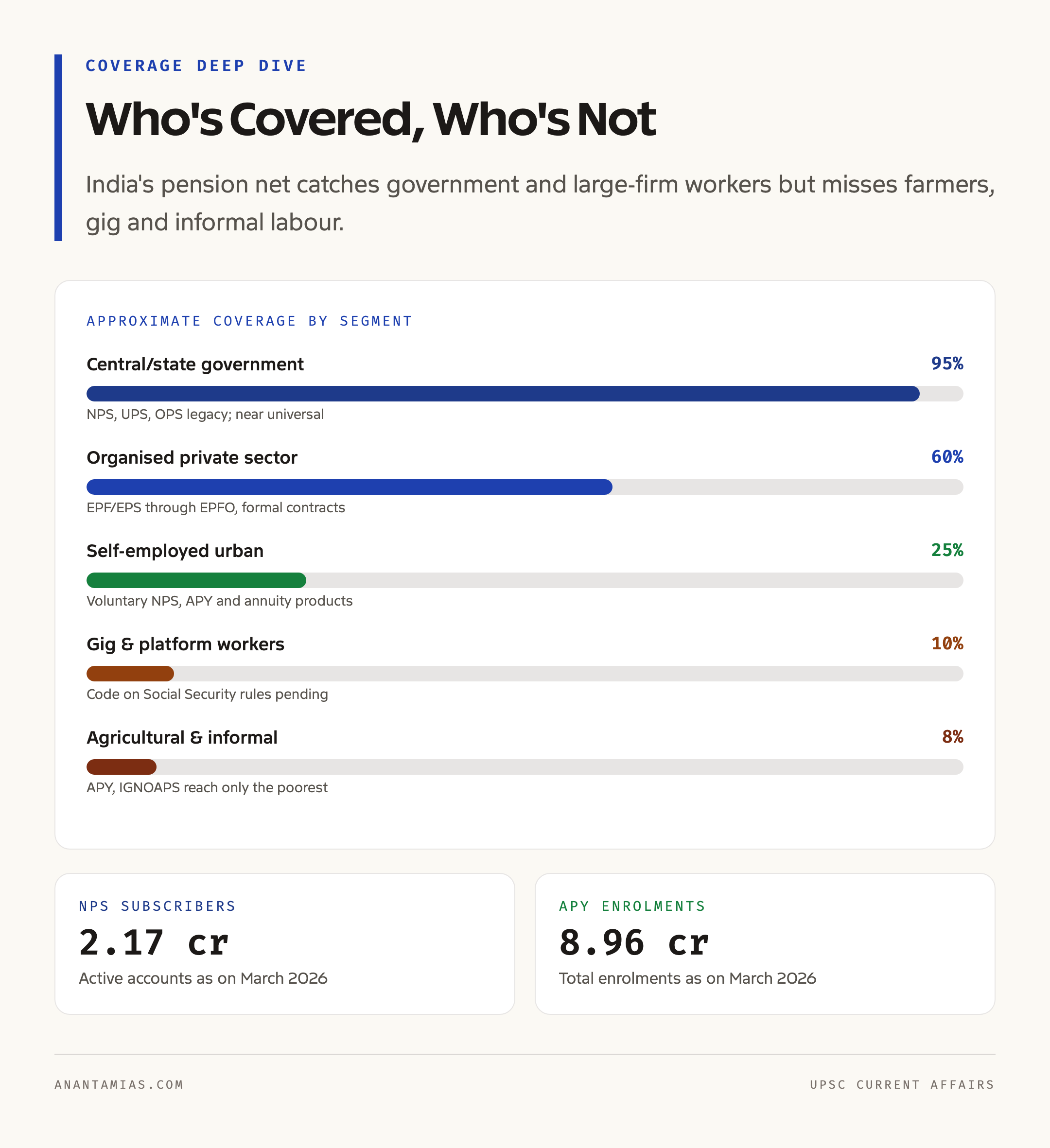
The single biggest challenge is coverage. The India pension landscape currently leaves out most agricultural labour, construction workers, domestic helpers, platform workers, and small-trader self-employed. The Code on Social Security, 2020 envisages a universal social security framework, but implementation rules have lagged and aggregator cess collection is uneven.
Adequacy is the second pain point. APY’s Rs 5,000 ceiling and the EPS-95 floor of Rs 1,000 are inadequate for dignity in old age, especially with healthcare inflation. Portability across schemes is patchy: an EPF subscriber moving to NPS faces friction, and APY subscribers cannot easily shift to the all-citizen NPS once income rises. Tax treatment is fragmented across schemes, and the annuity market is shallow and dominated by a single provider.
State finances pose a separate risk. Five states announced OPS restoration between 2022 and 2024, and a few have begun returning NPS corpus to the consolidated fund. Without funded backing, these promises shift the cost to taxpayers two or three decades hence, when working-age population growth slows.
Prelims Pointers
- PFRDA was established under the PFRDA Act, 2013, and regulates NPS, UPS, and APY.
- NPS started for central government employees joining on or after 1 January 2004; extended to all citizens in 2009 and to NRIs and OCI cardholders later.
- APY is open to Indian citizens aged 18-40 with a savings bank account; pension benefits commence at 60.
- EPS-95 pension formula: pensionable salary multiplied by pensionable service, divided by 70.
- UPS guarantees a minimum pension of Rs 10,000 per month and family pension at 60 percent of last drawn pension.
- Asset allocation under NPS Active Choice caps equity exposure at 75 percent up to age 50, then tapers.
Mains Questions
- Examine the shift in India’s pension architecture from a defined-benefit to a multi-pillar contributory model. What are the equity and efficiency implications of this transition? (GS Paper II, Government Policies)
- The Unified Pension Scheme is presented as a middle path between OPS and NPS. Critically assess whether UPS resolves the fiscal-versus-fairness dilemma in India’s pension reform. (GS Paper III, Indian Economy)
- Pension coverage in India remains below 25 percent of the workforce. Suggest a roadmap for extending retirement security to gig, platform, and informal-sector workers. (GS Paper II, Social Justice)
- Discuss the role of PFRDA and EPFO in regulating India’s pension landscape. How can regulatory coordination be strengthened? (GS Paper II, Statutory Bodies)
Way Forward
A credible reform agenda for the India pension landscape begins with raising the EPF wage ceiling, indexing APY slabs to inflation, and operationalising the Code on Social Security’s gig-worker provisions with predictable aggregator contributions. PFRDA’s auto-enrolment proposal, where new private-sector employees are nudged into NPS unless they opt out, deserves fast-track consideration.
States considering OPS revival should be required to publish actuarial valuations and ring-fence funding through dedicated pension corpuses. The annuity market needs deeper participation, longer-duration government securities, and lower minimum-pension thresholds. Above all, financial literacy on retirement planning must move from urban middle-class campaigns into self-help groups, panchayats, and gig-platform onboarding flows.
Frequently Asked Questions
What does the multi-pillar India pension landscape include?
It includes a tax-funded social pension floor, mandatory EPF and EPS for organised-sector workers, voluntary NPS for all citizens, the new Unified Pension Scheme for central government employees, and APY for the informal sector, supplemented by personal savings and family support.
How is UPS different from NPS?
UPS guarantees 50 percent of average basic pay as pension after 25 years of service plus inflation indexation, while pure NPS pays out a market-linked corpus with a mandatory 40 percent annuitisation at exit. UPS shifts more risk back to the government.
Why is the Old Pension Scheme debate still alive?
OPS offers a guaranteed, salary-indexed pension that many state employees view as more secure than NPS. Several states promised restoration for political reasons, even though OPS imposes large unfunded liabilities on future taxpayers.
Who regulates pensions in India?
PFRDA regulates NPS, UPS, and APY. EPFO administers EPF and EPS for organised-sector private employees. IRDAI regulates annuity providers that pay out the post-retirement income stream.
What is the current EPF and EPS contribution structure?
Employee contributes 12 percent of basic plus DA; employer contributes a matching 12 percent, of which 8.33 percent (capped at Rs 15,000 wage ceiling) flows into EPS and the remainder into EPF.
Are gig workers covered by any pension scheme?
The Code on Social Security, 2020 provides for a social security fund with aggregator contributions, but operational rules are still being finalised. Most gig workers today rely on APY or voluntary NPS.
What is NPS Vatsalya?
A 2024 variant that lets parents or guardians open an NPS account for a minor, with the corpus converting to a regular NPS Tier I account on adulthood.
How does India’s pension coverage compare globally?
Roughly 25 percent of India’s workforce is covered by some formal pension scheme, compared with above 90 percent in Sweden, Australia, and the Netherlands. The Mercer-CFA Global Pension Index 2025 ranked India in the lower tier on the adequacy and coverage sub-indices.
Can I switch from APY to NPS later?
Direct migration is limited. Subscribers usually maintain APY as a floor and add a separate NPS Tier I account voluntarily once income permits.
What happens to my NPS corpus at retirement?
At least 40 percent must be used to buy an annuity from an IRDAI-regulated insurer; up to 60 percent can be withdrawn as a tax-free lump sum, subject to age and corpus conditions.
Tell Google you want more of this.
Add Anantam IAS as a preferred sourceOne tap, and this site shows up more often in your own Top Stories, AI Overviews and AI Mode. Remove it any time.