Why in News?
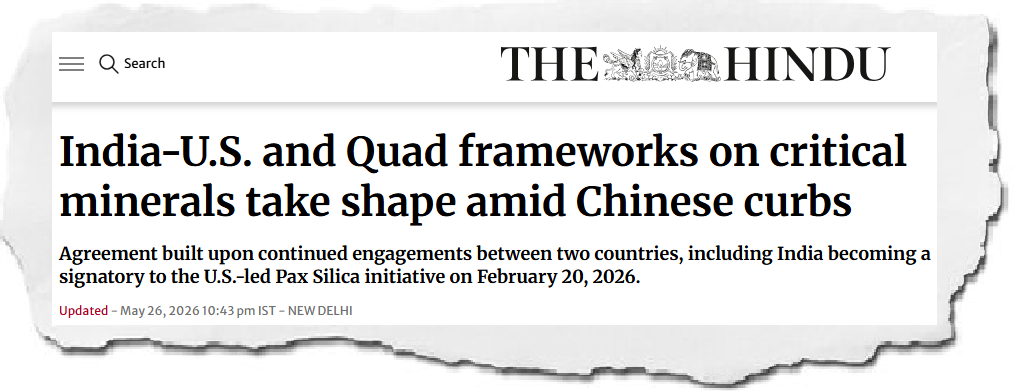
India and the United States recently formalised a framework for cooperation in securing critical minerals and rare earth supply chains on the sidelines of the 11th Quad Foreign Ministers’ Meeting. Simultaneously, a separate critical minerals framework was signed among Quad members — Australia, India, Japan and the United States. The initiatives come amid concerns regarding China’s export controls on Rare Earth Elements (REEs) and strategic metals that are essential for high-technology industries and clean energy transitions.
UPSC Relevance
Prelims: Critical minerals, Rare Earth Elements (REEs), Quad, supply chains, Pax Silica initiative, critical mineral processing and recycling.
Mains:
GS II – Bilateral and multilateral relations, Quad, strategic partnerships;
GS III – Energy security, resource security, technology, industrial policy, critical minerals and economic security.
Background/Context
Critical minerals have increasingly emerged as strategic resources due to their importance in modern technologies and clean energy systems.
They are essential for:
- Electric vehicle batteries, Solar panels, Semiconductors, Defence systems Wind turbines Telecommunications equipment, Artificial intelligence infrastructure
The issue gained prominence after China imposed export controls on Rare Earth Elements and strategic metals in 2025, creating concerns regarding concentrated supply chains.
What are Critical Minerals?
Critical minerals are minerals that are:
- Economically important for industries and national security.
- Vulnerable to supply disruptions.
- Difficult to substitute.
Examples include:
- Lithium, Cobalt, Nickel, Graphite, Copper, Rare Earth Elements (REEs)
Rare Earth Elements (REEs)
Rare Earth Elements are a group of 17 chemically similar metallic elements used in high-end technologies.
Major applications:
- Permanent magnets, Electric vehicles, Defence equipment, Electronics, Space technologies, Renewable energy systems
Despite their name, they are relatively abundant but economically viable deposits are limited.
Why Critical Minerals Matter for India?
Energy Transition Requirements
India’s clean energy targets require large quantities of critical minerals.
These are important for:
- Electric mobility, Battery manufacturing, Green hydrogen infrastructure, Renewable energy systems
National Security Considerations
Critical minerals are important for:
- Missile systems, Radar systems, Aerospace technologies, Defence manufacturing
Industrial Growth
Emerging sectors under initiatives such as:
- Make in India
- Semiconductor manufacturing
- Digital economy
require reliable mineral supply chains.
India–U.S. Critical Minerals Framework
The new framework aims to deepen cooperation across the entire value chain.
Major areas include:
Mining and Exploration
- Identification and development of mineral resources.
- Joint projects and investments.
Processing and Refining
- Developing processing infrastructure.
- Reducing dependence on concentrated suppliers.
Recycling and Circular Economy
- Recovery of minerals from e-waste and industrial scrap.
- Efficient reuse of strategic resources.
Financing Support
- Facilitating investments and funding mechanisms.
Supply Chain Resilience
- Diversification of supply sources.
The initiative builds upon previous engagements including India’s participation in the Pax Silica Initiative.
Quad Critical Minerals Initiative
Quadrilateral Security Dialogue comprises:
- India, Australia, Japan, United States
The Quad framework intends to mobilise approximately $20 billion through public and private sector support.
Major objectives include:
Building diversified supply chains
Reducing excessive concentration of supply sources.
Supporting projects in partner countries
Projects located in Quad countries and operated by Quad-based companies may receive support.
Promoting recycling initiatives
Focus on extraction and recovery of critical minerals from: E-waste, Industrial waste, Scrap materials
Strengthening regulatory harmonisation
Promoting compatible laws and standards across partner countries.
China’s Dominance in Critical Minerals
China occupies a dominant position in global critical mineral supply chains.
Areas of dominance: Rare earth processing, Refining capacity, Permanent magnet production, Battery supply chains
This creates several concerns: Supply disruptions, Strategic vulnerabilities, Geopolitical leverage, Price manipulation risks
What is the Significance for India?
Reduced import dependence
Diversified sourcing can reduce vulnerabilities associated with single-country dependence.
Strengthening manufacturing ecosystem
Secure supplies support:
- Electronics manufacturing, Renewable energy, Semiconductor production
Strategic balancing
Critical minerals have become an important dimension of geopolitical partnerships.
Advancement of Atmanirbhar Bharat
Domestic value addition and technology partnerships can strengthen self-reliance.
Challenges
Limited domestic reserves: India possesses comparatively limited reserves of several strategic minerals.
Processing constraints: Mining alone is insufficient; refining and processing capacities remain weak.
Environmental concerns: Mining operations can create Habitat destruction,Water pollution, Land degradation
Geopolitical competition: Competition over strategic resources may intensify international tensions.
Way Forward for India
1. Fast-Tracking Domestic Permitting
To fully absorb foreign development capital from the Quad’s $20 billion pool, India must fast-track its internal clearance systems. Streamlining environmental and operational mining licenses will make domestic processing plants ready for immediate strategic investment.
2. Scaling Up Urban Mining & E-Waste Processing
India should use the recycling provisions of the Quad framework to build state-of-the-art “urban mining” centers. Upgrading domestic e-waste collection networks will allow India to extract secondary critical minerals locally, reducing its dependence on raw imports.
3. Securing Outpost Assets via Joint Ventures
Using the financial backing of U.S. and Japanese development finance institutions, Indian public sector undertakings (like KABIL) should enter into joint ventures to acquire and operate critical mineral blocks in resource-rich Quad partner states like Australia.
Conclusion
Critical minerals are increasingly becoming the foundation of future economic and strategic power. The India–U.S. and Quad initiatives indicate a shift from traditional energy security concerns towards broader resource security and technology resilience. As global competition over critical resources intensifies, India’s ability to secure diversified supply chains while strengthening domestic capabilities will play a significant role in its long-term economic and strategic objectives.
Practice Questions
Prelims Question 1 (Inference-based)
Consider the following statements with reference to critical mineral cooperation initiatives:
I. Critical mineral partnerships seek to diversify supply chains and reduce excessive dependence on concentrated sources of supply.
II. Quad critical mineral initiatives include cooperation in recycling, financing and supply-chain development.
III. India’s participation in such frameworks is linked to clean energy transition and strategic manufacturing objectives.
Which of the following relationships among the above statements is/are correct?
- Statement II validates the mechanisms through which the objectives mentioned in Statement I may be achieved.
- Statement III extends the rationale of Statement I by connecting supply-chain resilience to broader developmental and strategic goals.
- Statement I contradicts Statement III because strategic partnerships reduce domestic industrial self-reliance.
(a) 1 only
(b) 1 and 2
(c) 2 and 3
(d) 3 only
Answer: (b)
Explanation: Statement II explains operational mechanisms supporting supply diversification mentioned in Statement I. Statement III further extends the purpose into strategic and developmental domains. Statement 3 is incorrect because supply diversification and self-reliance are complementary rather than contradictory.
Prelims Question 2
Consider the following pairs:
| Item | Associated significance |
|---|---|
| 1. Rare Earth Elements | High-technology and clean energy applications |
| 2. Quad | Strategic partnership involving India, Australia, Japan and United States |
| 3. Critical minerals | Resources with high economic importance and low supply risk |
Which of the pairs given above are correctly matched?
(a) 1 and 2 only
(b) 2 and 3 only
(c) 1 and 3 only
(d) 1, 2 and 3
Answer: (a)
Explanation: Pair 3 is incorrect because critical minerals are economically important resources that generally possess significant supply vulnerability rather than low supply risk.
Mains Questions
- Critical minerals are increasingly emerging as strategic assets in international politics. Examine with reference to India’s economic and geopolitical interests.
- Discuss the significance of the Quad and India–U.S. critical mineral initiatives in strengthening resilient and diversified global supply chains.
Tell Google you want more of this.
Add Anantam IAS as a preferred sourceOne tap, and this site shows up more often in your own Top Stories, AI Overviews and AI Mode. Remove it any time.