Why in News?
The Press Information Bureau released a backgrounder on Indiahandmade, the dedicated digital marketplace of the Ministry of Textiles that sells India’s handloom and handicraft products directly to buyers. Developed by the Digital India Corporation, the platform was launched in 2023 as a zero-commission alternative to private e-commerce for craft sellers.
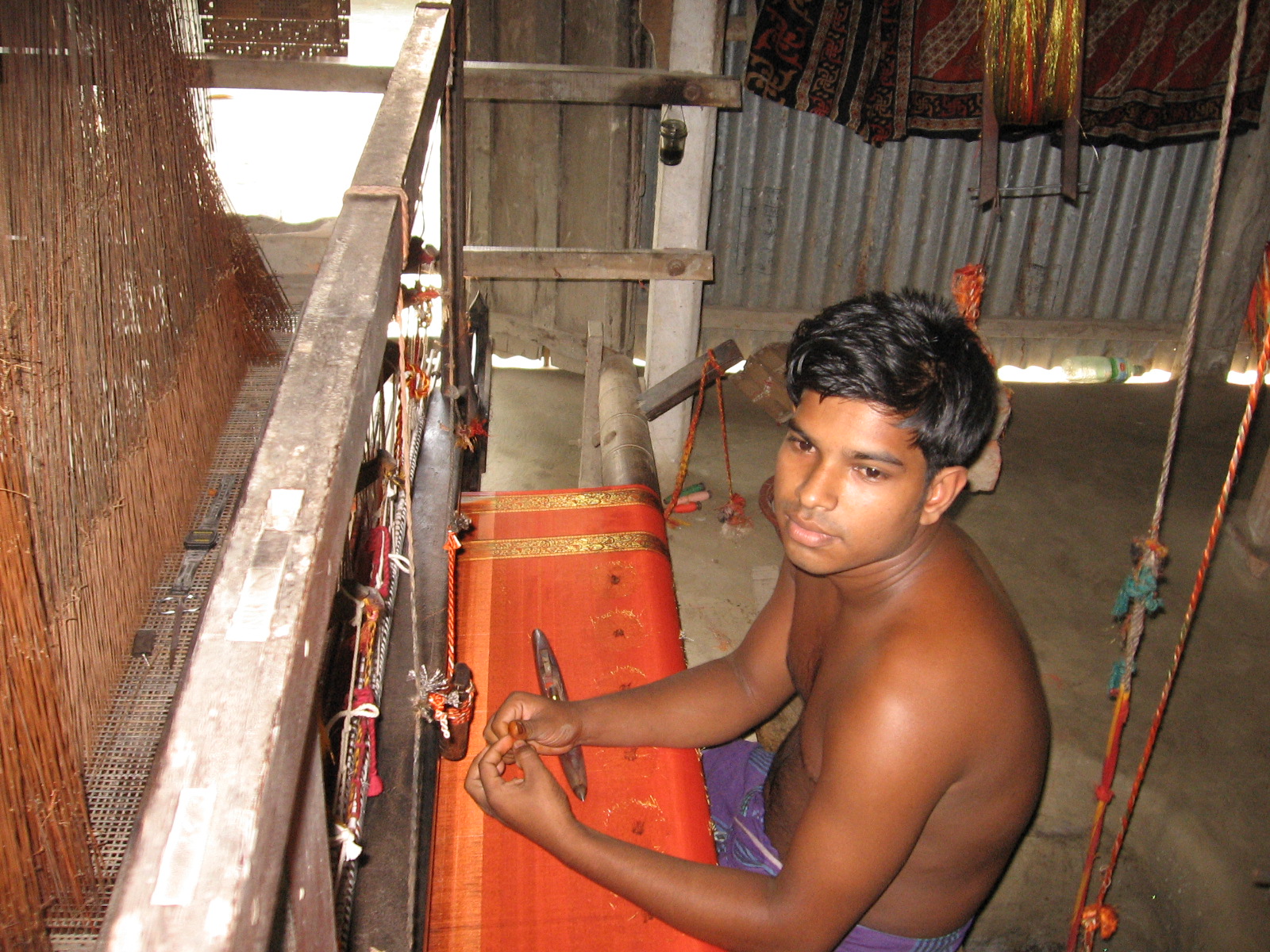
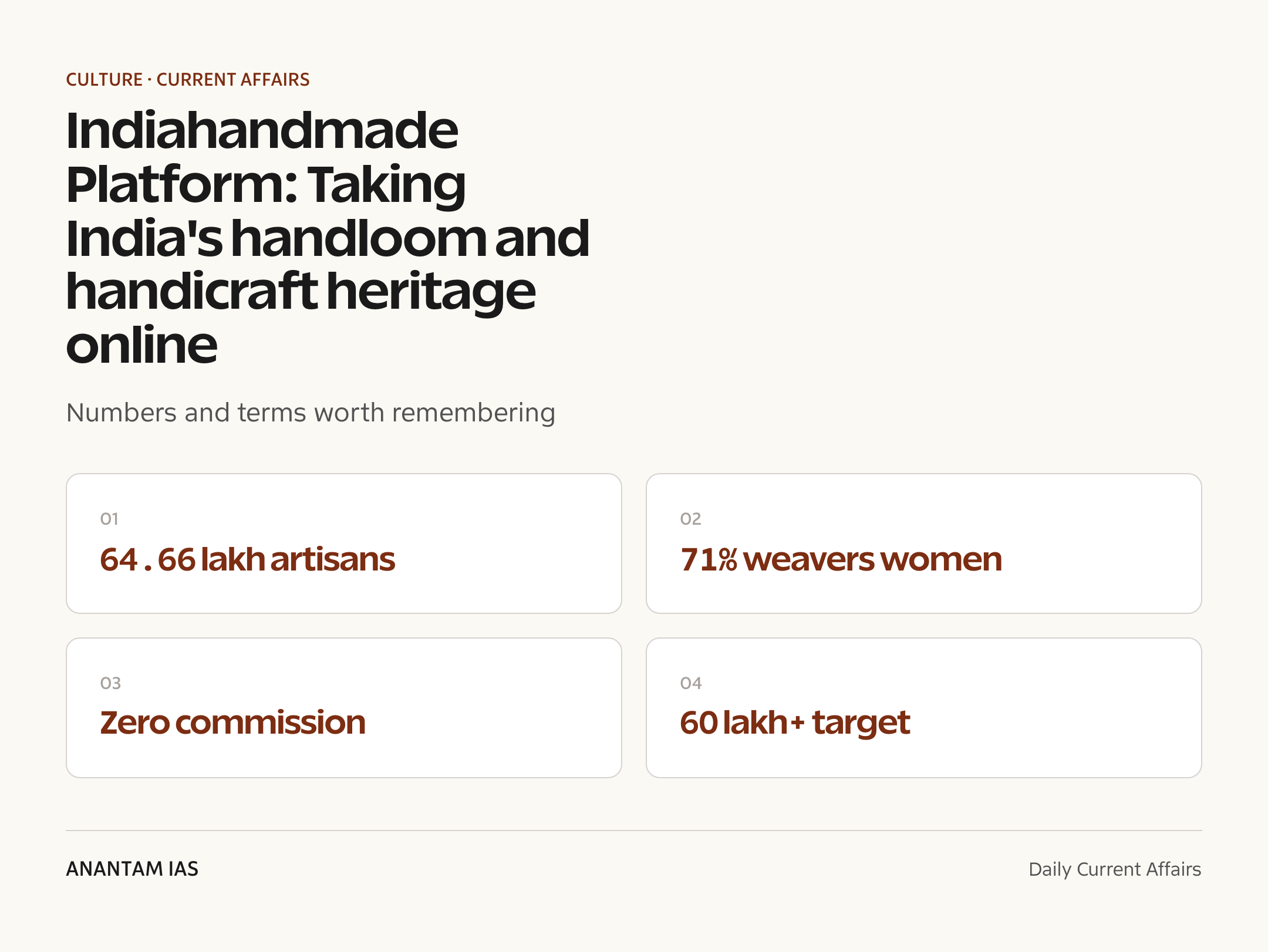
The backgrounder places hard numbers behind the platform: India has an estimated 64.66 lakh handloom and handicraft artisans, and women account for 71 per cent of handloom weavers and 64 per cent of all artisans as of August 2025. The government plans to onboard 60 lakh-plus artisans onto the marketplace.
- PIB confirmed the platform is developed by Digital India Corporation and run under the Ministry of Textiles; it went live in 2023.
- India has an estimated 64.66 lakh handloom and handicraft artisans; women form 71% of handloom weavers and 64% of total artisans (August 2025).
- The marketplace charges zero commission from sellers and offers buyers free shipping, purchase protection and secure payments.
- Sellers without GST registration can join using an Enrolment ID, with sales restricted to their own state — a deliberate door for first-time digital sellers.
- The platform gives shelf space to GI-tagged crafts (Aipan art, Pashmina shawls, Dokra décor) and ODOP products (Banarasi silk, Chanderi, Tangail sarees, terracotta).
- The stated goal is to onboard 60 lakh+ artisans, in line with the Atmanirbhar Bharat vision.
The development matters in the context of:
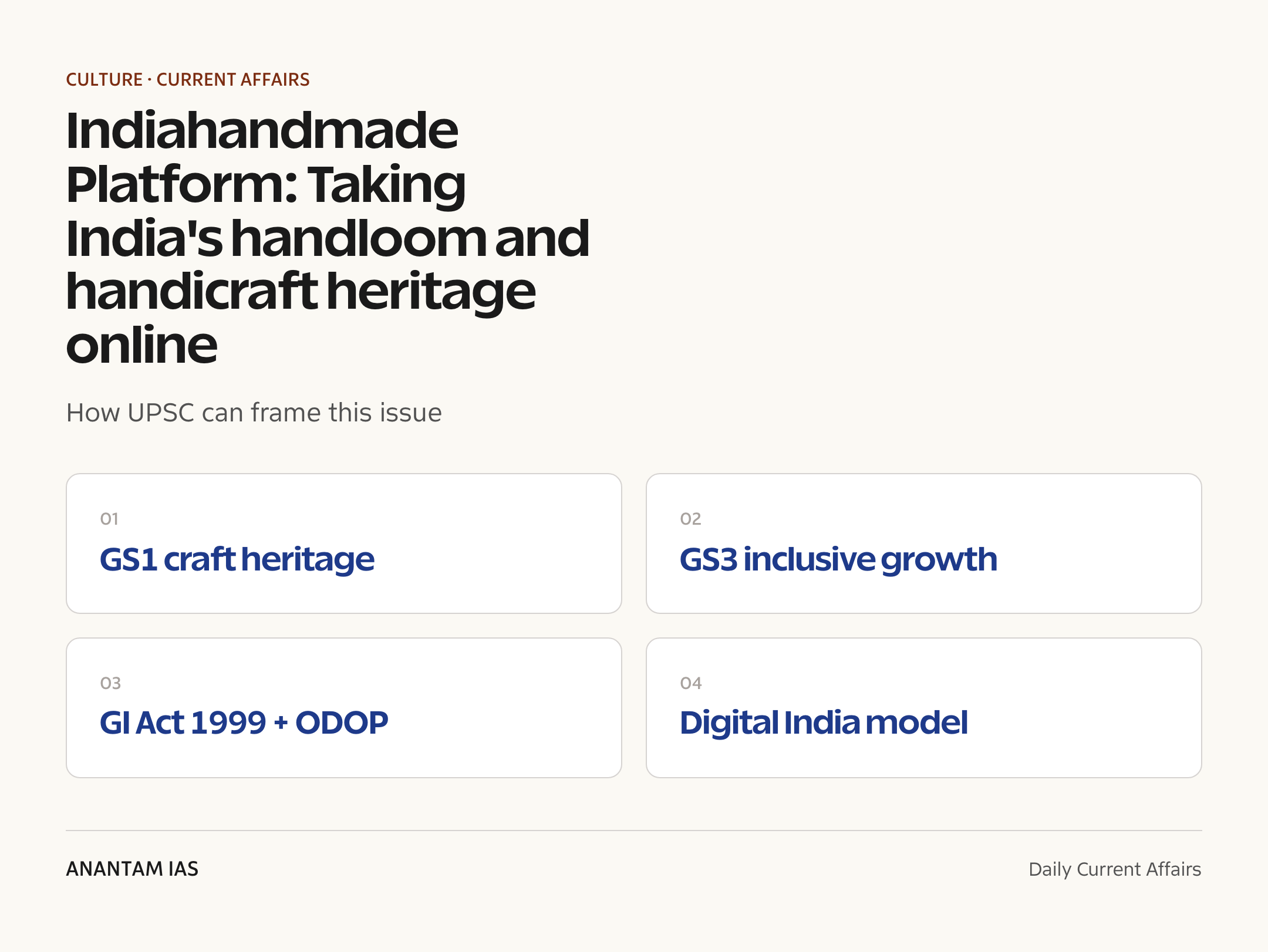
- The platform sits at the junction of two UPSC themes: cultural preservation (GS1 art and culture, GI-protected crafts) and inclusive livelihoods (GS3 economy, informal sector, women’s work).
- It’s a live case study of the Digital India logic — using public digital infrastructure to remove intermediaries in markets where private platforms charge sellers heavily.
- With 71% of handloom weavers being women, the platform doubles as a women’s economic-empowerment intervention in largely rural households.
UPSC Relevance
Prelims Relevance
- Indiahandmade — zero-commission e-commerce marketplace for handloom and handicraft products; launched 2023.
- Developed by Digital India Corporation; administered under the Ministry of Textiles.
- 64.66 lakh estimated handloom and handicraft artisans; women = 71% of handloom weavers, 64% of total artisans (Aug 2025).
- Fourth All India Handloom Census (2019-20): 35.22 lakh handloom workers, about 72% women, 88.7% of weaver households rural.
- GI tags flow from the Geographical Indications of Goods (Registration and Protection) Act, 1999; registry at Chennai.
- ODOP (One District One Product) — identifies one signature product per district to drive balanced regional growth.
- Non-GST sellers can register with an Enrolment ID but may sell only within their own state.
- National Handloom Day — 7 August, commemorating the launch of the Swadeshi Movement (1905).
- GI crafts on the platform: Aipan art (Uttarakhand), Pashmina shawls, Dokra décor, Mundu products.
- ODOP items featured: Banarasi silk, Tangail sarees, Ikat, Tussar silk, Chanderi silk, terracotta.
Mains Relevance
GS Paper 3
- Inclusive growth through digital public platforms: how zero-commission state marketplaces alter the economics of artisan livelihoods versus commission-charging private e-commerce.
- Formalising the informal: the Enrolment ID route as a low-friction bridge for non-GST micro-sellers into digital commerce.
- Market access as a supplement to subsidy-led craft policy — comparing Indiahandmade with ONDC and PM Vishwakarma’s credit-and-toolkit approach.
GS Paper 1
- Safeguarding intangible craft heritage — how market visibility for GI-tagged and ODOP products sustains regional craft identities.
- Women’s work in the handloom economy: 71% of weavers are women — implications for rural social structure and household incomes.
GS Paper 2
- Governance design: a ministry-run marketplace as e-governance for livelihoods — strengths, accountability and the risk of the State competing with private platforms.
Essay
- Tradition and technology need not be adversaries — India’s looms on the internet.
- Digital public infrastructure as the new welfare state: from subsidies to market access.
- The hand that weaves also votes, earns and codes: women at the centre of India’s craft economy.
Background and Context
What exactly is Indiahandmade?
Indiahandmade is a government-run e-commerce marketplace built exclusively for handloom and handicraft sellers.
- It was launched in 2023 and developed by the Digital India Corporation, with the Ministry of Textiles as the administrative anchor.
- The design intent is disintermediation: weavers and artisans list products and sell directly to buyers, cutting out the trader-middleman chain that historically captured most of the margin.
- Unlike private marketplaces, it charges zero commission and no portal fees from sellers — the full sale price flows to the artisan.
- Buyers get free shipping, purchase protection, secure payments and buyer support, addressing the trust deficit that keeps shoppers away from unknown craft sellers.
- The catalogue spans apparel, home décor, furnishings, paintings, furniture, religious items, stationery, musical instruments, jewellery, bags and footwear.
- PIB confirmed the platform aims to eventually onboard 60 lakh+ artisans — effectively the bulk of India’s craft workforce.
The workforce behind the platform
The numbers explain why a dedicated marketplace matters — this is one of India’s largest employment clusters outside agriculture.
- India has an estimated 64.66 lakh handloom and handicraft artisans, per the PIB backgrounder.
- Women account for 71 per cent of handloom weavers and 64 per cent of total artisans as of August 2025 — making craft policy de facto women’s-livelihood policy.
- The Fourth All India Handloom Census (2019-20) counted 35.22 lakh handloom workers — 26.74 lakh weavers and 8.49 lakh allied workers — across 31.45 lakh households.
- About 88.7 per cent of weaver households in that census were rural, which is why market access, not just skill, is the binding constraint.
- Craft earnings are typically low and seasonal; the census flagged widespread part-time work and dependence on master weavers and traders for market linkage.
- Handloom is also India’s proud low-carbon textile sector — largely hand-operated, low-energy and dispersed, giving it a sustainability story that machine-made textiles can’t match.
GI tags and ODOP: the heritage layer
The platform gives dedicated shelf space to two categories that link products to place — GI-tagged and ODOP crafts.
- A Geographical Indication (GI) ties a product to a specific region, quality and reputation under the GI Act, 1999 — the community, not an individual, holds the right. Read the full primer on Geographical Indications and the GI Act.
- GI-tagged crafts featured on Indiahandmade include Aipan art (Kumaon, Uttarakhand), pure Pashmina shawls, Dokra metal-craft décor and Mundu products.
- One District One Product (ODOP) identifies and promotes one signature product from each district to spread growth beyond metros; the platform features Tangail sarees, Banarasi silk, Ikat, Tussar silk sarees, Chanderi silk and terracotta under this banner.
- The commercial logic: a GI or ODOP label converts anonymous handicraft into a branded regional product, letting artisans charge for provenance rather than compete on price alone.
- For a state-wise list of protected products, see the GI Tags of India compilation.
The policy ecosystem it plugs into
Indiahandmade is one node in a wider stack of craft and digital-economy interventions.
- The Digital India programme (2015) supplies the underlying philosophy — public digital infrastructure that brings excluded groups into the formal economy; background at Digital India Programme.
- PM Vishwakarma (2023) covers 18 traditional trades with recognition, collateral-free credit and toolkit support — Indiahandmade supplies the missing market-access leg; details at PM Vishwakarma.
- The National Handloom Development Programme (NHDP) and the Raw Material Supply Scheme handle input-side support — yarn, design, infrastructure — for weavers.
- ONDC attacks the same disintermediation problem economy-wide through an open network rather than a single portal; compare the two models at ONDC explained.
- National Handloom Day (7 August) — instituted in 2015 to mark the 1905 Swadeshi Movement — anchors the sector’s cultural-nationalist framing.
Why the zero-commission design matters
The platform’s economics are its real innovation — each design choice removes a specific barrier that kept artisans offline.
- Private marketplaces typically charge sellers commissions plus fees; for low-margin handmade goods this can wipe out the artisan’s profit. Zero commission changes the unit economics.
- The Enrolment ID route lets sellers without GST registration join and sell within their own state — an on-ramp for micro-sellers the formal GST net hasn’t reached.
- Guided onboarding supports individual artisans, weavers and producer organisations, so cooperatives and self-help groups can sell collectively.
- PIB’s showcased sellers illustrate the range: Dastkar Craft channels the skill of over 500 artisans into cane and bamboo products, while Villages Craft sells handloom cotton towels and gamchas.
- Direct selling also generates data on demand — which crafts sell, where, at what price — that can inform design and raw-material interventions upstream.
The gaps a portal cannot close alone
A fair reading also needs the limits — a marketplace solves discovery, not everything.
- Digital divide: many weaver households lack smartphones, digital literacy or cataloguing skills; onboarding 60 lakh artisans is a far bigger task than building a website.
- Logistics from craft clusters: pickup, packaging and returns from remote rural locations remain costly even when shipping is free for the buyer.
- The intra-state cap on non-GST sellers protects compliance but shrinks the very market access the platform promises to its smallest sellers.
- Handloom competes with cheaper powerloom imitations; an online shelf doesn’t by itself solve authentication, though GI labelling helps.
- Discovery is a chicken-and-egg problem: a government portal must still win buyer traffic against entrenched private platforms with large marketing budgets.
Way Forward
Deepen the seller side
- Pair onboarding with digital-literacy camps in weaver clusters, using Common Service Centres and producer organisations as aggregators.
- Build cluster-level photography, cataloguing and packaging hubs so a weaver’s product page matches private-platform quality.
- Converge with PM Vishwakarma and NHDP so credit, toolkits and market access reach the same artisan as one package.
Grow the demand side
- Push GI-led storytelling — provenance, maker profiles, craft history — as the differentiator no mass-produced competitor can copy.
- List the catalogue on ONDC so Indiahandmade inventory surfaces across buyer apps instead of depending on one portal’s traffic.
- Use government and institutional procurement of handloom gifting to guarantee a demand floor while retail traffic builds.
Conclusion
Indiahandmade is best read as the market-access leg of India’s craft policy: where earlier schemes subsidised inputs, this one restructures the point of sale in the artisan’s favour. Zero commission, direct buyer contact and an Enrolment ID on-ramp are all answers to specific, well-documented failures of the traditional trader chain.
The hard part is scale. Between roughly 64.66 lakh artisans and the target of onboarding 60 lakh of them lies the digital divide, rural logistics and the battle for buyer attention. Whether a state-run marketplace can win that battle — or whether its future is as a trusted supply node on ONDC — is the question worth watching.
For the exam, hold on to the architecture: Ministry of Textiles plus Digital India Corporation, zero commission, GI and ODOP shelves, women at 71 per cent of the weaving workforce, and the census numbers underneath.
UPSC Practice Questions
Prelims MCQ 1
With reference to the Indiahandmade platform, consider the following statements:
- It has been developed by the Digital India Corporation and functions under the Ministry of Textiles.
- It charges zero commission from artisans and weavers selling on the platform.
- Sellers without GST registration are not permitted to sell on the platform.
How many of the above statements are correct?
(a) Only one (b) Only two (c) All three (d) None
Answer: (b) Only two
Explanation:
Statements 1 and 2 are correct: the platform is developed by Digital India Corporation under the Ministry of Textiles and is a zero-commission marketplace. Statement 3 is wrong — sellers without GST registration can register using an Enrolment ID, though they may sell only within their own state.
Prelims MCQ 2
Which one of the following pairs of a craft featured on the Indiahandmade platform and its associated region is correctly matched?
(a) Aipan art — Uttarakhand (b) Dokra metal craft — Kerala (c) Chanderi silk — Gujarat (d) Tangail saree — Rajasthan
Answer: (a) Aipan art — Uttarakhand
Explanation:
Aipan is a GI-tagged ritual folk art of the Kumaon region of Uttarakhand. Dokra metal craft belongs to the tribal belts of West Bengal, Chhattisgarh and Odisha; Chanderi silk is from Madhya Pradesh; and the Tangail saree tradition in India is associated with West Bengal.
UPSC Mains Questions
- Government e-marketplaces like Indiahandmade attempt to solve market failures that subsidy-based craft schemes could not. Examine this proposition with reference to the handloom and handicraft sector, and suggest how such platforms can complement schemes like PM Vishwakarma. (250 words)
- Women constitute over 70 per cent of India’s handloom weavers, yet remain among its lowest-paid workers. Discuss how digital market access, GI protection and producer organisations can together improve their incomes and agency. (250 words)
- Cultural heritage survives only when it pays its practitioners. In the light of the ODOP initiative and GI-tagged crafts, discuss the role of market-linked instruments in preserving India’s craft traditions. (150 words)
Source: PIB Backgrounder, Ministry of Textiles.
Frequently Asked Questions
What is the Indiahandmade platform?
Indiahandmade is a government e-commerce marketplace launched in 2023 for handloom and handicraft products. Developed by Digital India Corporation under the Ministry of Textiles, it connects weavers and artisans directly with buyers, charges sellers zero commission, and showcases GI-tagged and ODOP crafts alongside everyday handmade goods.
Which ministry runs Indiahandmade?
The Ministry of Textiles administers the platform, while the Digital India Corporation built and maintains it. This pairing combines the Textiles Ministry’s artisan networks and schemes with MeitY-ecosystem digital infrastructure, reflecting the Digital India approach of using public technology platforms for livelihood delivery.
How many artisans does the platform serve?
India has an estimated 64.66 lakh handloom and handicraft artisans, and the government plans to onboard over 60 lakh of them. Women dominate the workforce, forming 71 per cent of handloom weavers and 64 per cent of all artisans as of August 2025.
Can artisans without GST registration sell on it?
Yes. Sellers without GST registration can join using an Enrolment ID, but they are permitted to sell only within their own state. This keeps the platform accessible to micro-sellers and first-time digital entrepreneurs while staying within GST compliance rules.
What GI and ODOP products does it feature?
GI-tagged crafts include Aipan art from Uttarakhand, pure Pashmina shawls, Dokra metal décor and Mundu products. Under ODOP, the platform features Tangail sarees, Banarasi silk, Ikat, Tussar silk sarees, Chanderi silk and terracotta — each linked to a specific district or region.
Why does zero commission matter for artisans?
Private marketplaces charge commissions and fees that can erase the thin margins on handmade goods. With zero commission and no portal fees, the full sale price reaches the artisan, making direct online selling viable for low-volume craft sellers who previously depended on trader intermediaries.
Tell Google you want more of this.
Add Anantam IAS as a preferred sourceOne tap, and this site shows up more often in your own Top Stories, AI Overviews and AI Mode. Remove it any time.