
Why in News?
The Union government has notified the Legal Metrology (Indian Standard Time) Rules, 2026, making Indian Standard Time (IST) the common reference for all legal, administrative, commercial and official purposes across India.
The rules will come into force 180 days after their publication in the Official Gazette, allowing government departments, businesses and institutions to align their systems.
| UPSC Relevance: GS-1 Geography; GS-2: Government Policies and e-governance Prelims: IST, UTC, GMT, Indian Standard Meridian |
About Indian Standard Time:
- IST corresponds to UTC+5:30.
- It is historically based on India’s Standard Meridian of 82°30′ East longitude, passing near Mirzapur in Uttar Pradesh.
- CSIR-National Physical Laboratory (NPL), New Delhi, is India’s official timekeeper. It maintains IST through atomic clocks and links it with Coordinated Universal Time.
Why is a Common Time Reference Necessary?
Modern digital systems depend on precise and synchronised timestamps. Even small discrepancies can disrupt the correct sequence, authentication and audit of transactions.
Uniform IST will support:
- Accurate time-stamping of banking and digital-payment transactions
- Coordination among railways, airports and other transport systems
- Synchronisation of telecommunications, Internet and computer networks
- Stable operation of power grids and energy-management systems
- Authenticity of government, judicial and commercial records
- Coordination of defence, emergency and disaster-response services; and
- Investigation of cyberattacks by correlating digital logs across different networks.
Wider Significance:
- Digital and technological sovereignty: Many Indian systems obtain time from foreign satellite-navigation networks or overseas Internet servers. Indigenous dissemination of accurate IST will reduce external dependence and strengthen the resilience of critical infrastructure.
- Cybersecurity and digital evidence: A trusted national time reference helps reconstruct cyber incidents, identify the sequence of unauthorised activities and establish the evidentiary value of electronic records.
- Financial integrity: Stock exchanges, banks, payment platforms and high-frequency trading systems require accurate timestamps to settle disputes, prevent manipulation and maintain reliable audit trails.
Implementation Challenges:
- Upgrading legacy equipment and software may impose costs on smaller institutions.
- Remote areas may lack reliable connectivity for continuous synchronisation.
- Different sectors require different levels of precision: from seconds in administrative records to microseconds or nanoseconds in telecommunications and power systems.
- Systems operating internationally often store time in UTC. Implementation guidelines must preserve global interoperability while ensuring that official records are traceable to IST.
- Strong authentication is necessary to prevent spoofing or manipulation of national time-distribution services.
Two-Time-Zone Debate:
- The rules standardise the reference and dissemination of time; they do not settle the separate demand for a second time zone in northeastern India.
- Advocates argue that earlier daylight hours could improve productivity and energy efficiency, while opponents cite administrative, railway and coordination difficulties.
Way Forward:
- India should establish secure and redundant time-distribution infrastructure through CSIR-NPL and legal metrology laboratories.
- Sector-specific accuracy standards, regular audits, domestic atomic-clock capability and backup terrestrial networks should complement satellite-based dissemination.
Mandatory IST is more than an administrative reform. It creates a trusted national time architecture essential for digital governance, cybersecurity, financial stability and strategic autonomy.
Back to Basics:
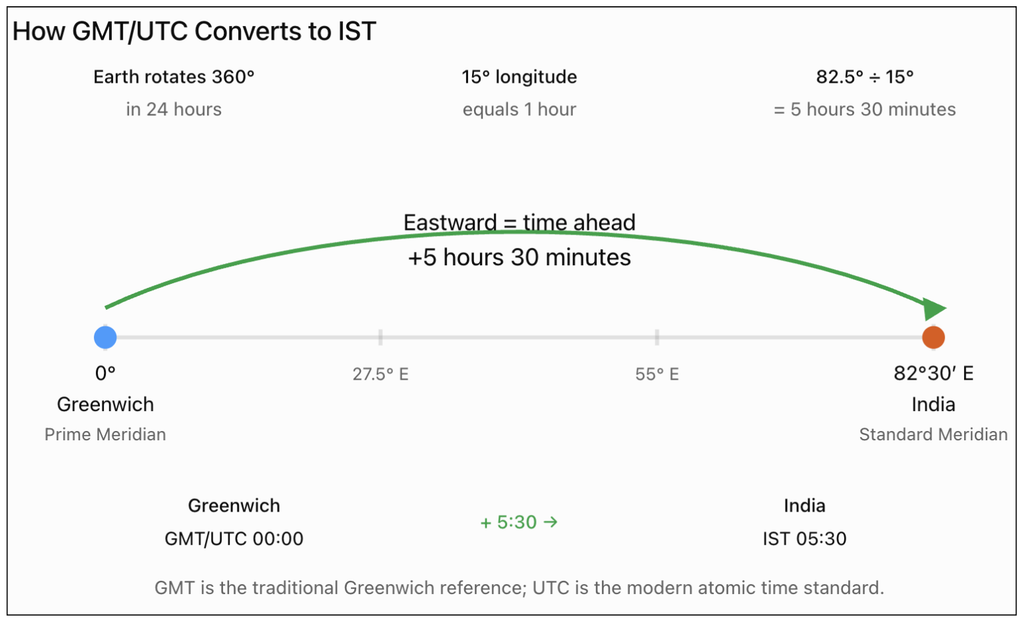
| Basics of GMT: Greenwich Mean Time (GMT) is the mean solar time calculated at the Prime Meridian (0° longitude), which passes through the Royal Observatory at Greenwich, London. The Royal Observatory was established in 1675 to improve astronomical observations and help sailors determine longitude at sea. Since Earth rotates 360° in 24 hours, every 15° of longitude corresponds approximately to a one-hour time difference. Thus, places east of Greenwich are ahead of GMT, while places west of it are behind GMT. |
| Why was Greenwich Chosen? The International Meridian Conference of 1884, held in Washington, D.C., selected the Greenwich Meridian as the world’s Prime Meridian because: British maritime charts were already extensively used by international shipping. The Greenwich-based Nautical Almanac was widely employed for navigation. Britain was the dominant maritime and commercial power of the period. Many railways, telegraph networks and mapmakers already used Greenwich as their reference. Adopting an already widespread meridian reduced the economic and administrative cost of transition. Its opposite meridian (near 180° longitude) passed largely through the Pacific Ocean, making it suitable for locating the International Date Line with relatively limited disruption to populated areas. |
| GMT, UTC and IST: GMT is based traditionally on Earth’s rotation and mean solar time at Greenwich. Coordinated Universal Time (UTC) is the modern international time standard maintained through atomic clocks, with adjustments to remain close to Earth’s rotation. GMT and UTC generally show the same clock time, but UTC is the scientifically precise global standard. India’s Standard Meridian is 82°30′ E. Since it lies 82.5° east of Greenwich. |
Tell Google you want more of this.
Add Anantam IAS as a preferred sourceOne tap, and this site shows up more often in your own Top Stories, AI Overviews and AI Mode. Remove it any time.