Why in News?
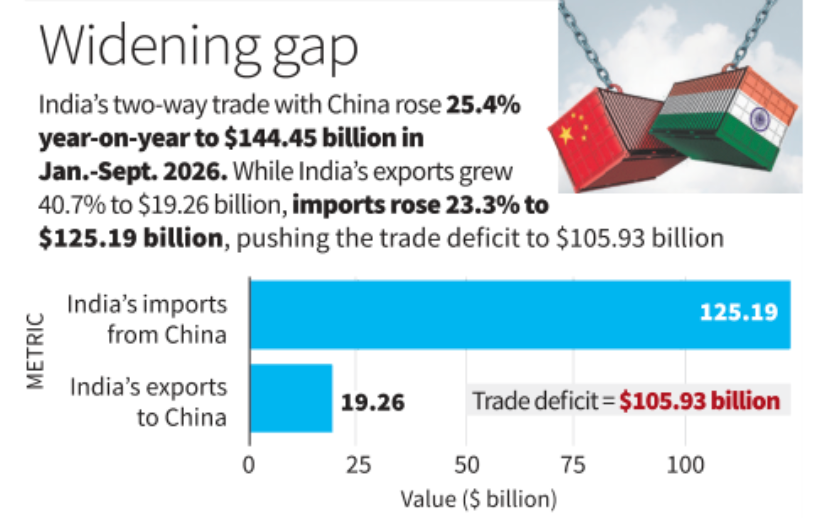
India’s merchandise trade deficit with China reached $105.93 billion during January-September 2026, despite a 40.7% increase in Indian exports. The development highlights the persistent imbalance in bilateral trade and India’s dependence on Chinese industrial supplies.
| UPSC Relevance: GS-3 Economy: External trade, Industrial Policy, Manufacturing sector Prelims: Trade deficit, current account deficit, intermediate goods and non-tariff barriers. |
Key Trends:
Total merchandise trade in FY 2025-26 stood at $151.10 billion (Exports: $19.47 billion; Imports: $131.63 billion), resulting in a deficit of $112.16 billion.
| Parameter | January – September 2026 |
| Total Bilateral Merchandise Trade | $144.45 billion (↑ 25.4% YoY) |
| India’s Exports to China | $19.26 billion (↑ 40.7%) |
| China’s Exports to India | $125.19 billion (↑ 23.3%) |
| Bilateral Merchandise Trade Deficit | $105.93 billion |
Structural Drivers of the Asymmetry:
- Dependence on Industrial Inputs & Capital Goods: India’s import basket is dominated by active pharmaceutical ingredients (APIs), electronics, integrated circuits, heavy industrial machinery, lithium-ion battery cells, and chemical fertilisers. This makes Indian manufacturing structurally reliant on Chinese upstream components.
- Skimpy and Primary-Heavy Export Basket: India’s export profile to China remains skewed toward primary and low-value-added commodities such as iron ore, naphtha, petrochemicals, marine products (shrimp), and castor oil. Conversely, China exports high-technology, capital-intensive, and finished manufactured goods.
- Non-Tariff Barriers (NTBs) and Market Access Hurdles:
- Indian service-sector strengths, particularly IT, ITes, and digital services, do not figure into merchandise trade statistics.
- In goods trade, Indian exports of pharmaceuticals and agricultural items routinely face protracted Chinese regulatory clearances, technical standards, and inspection regimes, a concern regularly flagged by the Embassy of India, Beijing.
- Assembly vs. Component Trap:
- Government-led flagship programs like Production Linked Incentive (PLI) schemes have accelerated domestic assembly (E.g., mobile phones), but deep-tier component manufacturing (display panels, semiconductor fabrication, precision engineering tooling) still lags, causing the import of intermediate inputs to spike alongside assembly growth.
Strategic and Economic Implications for India:
- Supply Chain Vulnerability: High concentration in critical inputs exposes Indian industry to weaponised trade restrictions, maritime choke-point disruptions, or geopolitical flashpoints.
- Squeezing the MSME Sector: Cheap, scaled-up Chinese imports exert deflationary/competitive pressure on domestic micro, small, and medium enterprises (MSMEs) that cannot match economies of scale.
- The Productivity Paradox: A total ban or restriction on Chinese intermediate imports can backfire, crippling Indian export competitiveness in engineering and pharma (since Chinese inputs are often the cheapest and highest-grade available globally).
Way Forward:
- Deepen Domestic Value Addition (DVA): Move beyond “screwdriver assembly” under PLI schemes by building indigenous capability in Tier-2 and Tier-3 component ecosystems, capital goods, and speciality chemicals.
- Strategic Sourcing Diversification: Map critical mineral and electronic supply chains to identify alternative hubs (ASEAN, Latin America, Eastern Europe, or domestic recycling/refining).
- Bilateral & Plurilateral Market Access Advocacy: Leverage diplomatic channels and WTO dispute mechanisms to dismantle opaque phytosanitary, regulatory, and technical NTBs facing Indian pharma and agri-products.
- Calibrated Trade Remedies: Utilise targeted Anti-Dumping Duties (ADD) and Countervailing Duties (CVD) strictly based on empirical DGTR (Directorate General of Trade Remedies) investigations rather than blanket protectionism that hurts downstream domestic users.
- Boost Services and High-Value Integration: Push for formal bilateral frameworks that monetise India’s comparative advantage in IT, digital infrastructure, and professional services to balance the broader economic equation.
The $100+ billion trade deficit with China is a symptom of asymmetrical industrial depth rather than a mere failure of trade policy. The enduring solution lies in strengthening domestic manufacturing depth, moving up the global value chain, and negotiating reciprocal market access.
Prelims Practice MCQ:
Q. Consider the following statements:
- Even if India’s exports to China grow at a significantly faster percentage rate than its imports from China, the absolute trade deficit can still widen due to the asymmetry in the trade base.
- A severe merchandise trade deficit with a single large trading partner like China automatically leads to a corresponding net deficit in India’s overall global Current Account Balance.
Which of the statements given above is/are correct?
(a) 1 only
(b) 2 only
(c) Both 1 and 2
(d) Neither 1 nor 2
Answer: (a)
Explanation:
- Statement 1 is correct: This is a classic demonstration of the base effect asymmetry. Because India’s import base from China is massive (~125+ billion) compared to its smaller export base (~19+ billion), a lower percentage growth rate in imports still translates to a much larger absolute dollar increase than a higher percentage growth rate in exports.
- Statement 2 is incorrect: A bilateral merchandise trade deficit with one nation does not automatically dictate the country’s global Current Account Deficit (CAD). India’s overall current account balance depends on its net trade with all trading partners globally, as well as capital inflows and structural surpluses in “invisible” trade, such as software/IT service exports and foreign inward remittances (where India historically holds a massive global surplus).
Tell Google you want more of this.
Add Anantam IAS as a preferred sourceOne tap, and this site shows up more often in your own Top Stories, AI Overviews and AI Mode. Remove it any time.