Why in News?
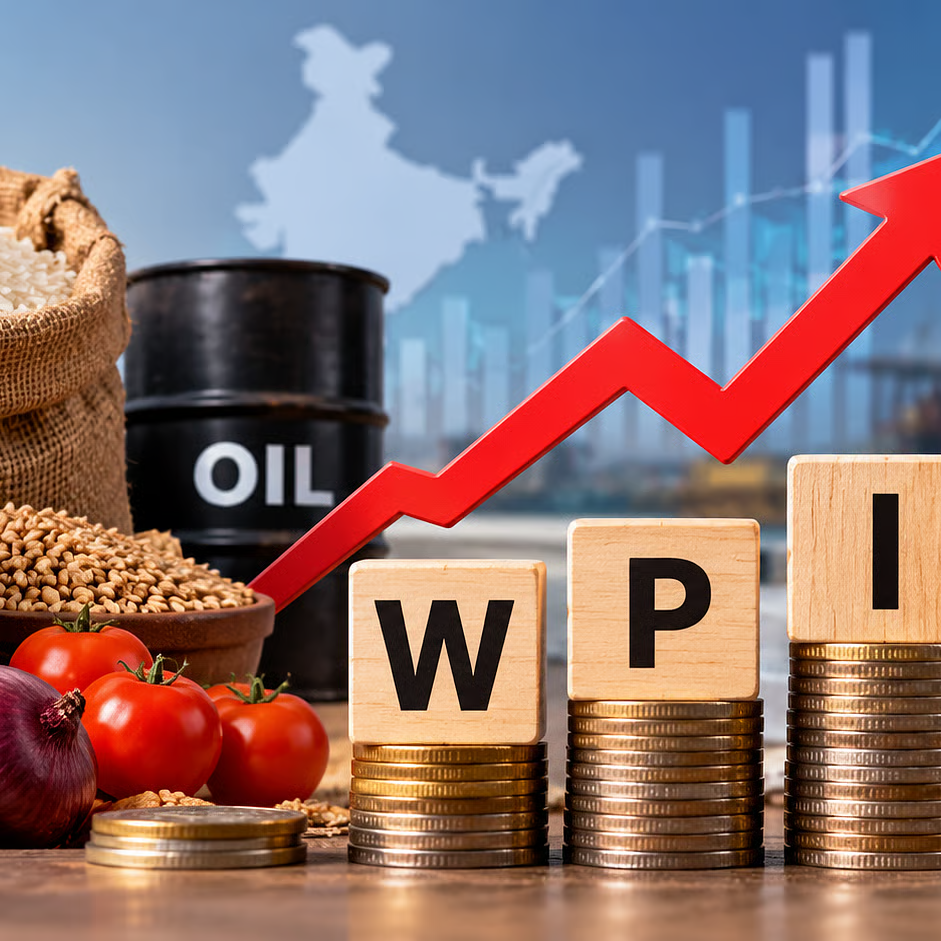
India’s Wholesale Price Index (WPI)-based inflation surged to a series high of 11.39% in September, up from 9.92% in August, driven by rising prices of food, manufactured items, and fuel and power.
| UPSC Relevance: GS-3 Economy: Inflation, Monetary Policy Prelims: Wholesale Price Index (WPI), Consumer Price Index (CPI), Imported inflation, Base Effect |
What is the Wholesale Price Index?
The Wholesale Price Index (WPI) is a key economic indicator that tracks the average change in the price of goods and commodities at the bulk/producer level before they reach the retail or consumer market.
- Released by: Office of the Economic Adviser, Department for Promotion of Industry and Internal Trade (DPIIT), Ministry of Commerce and Industry.
- Frequency: Monthly
- Updated base year: 2022-23, replacing 2011-12. The revised series was launched in June 2026.
- Coverage: Goods only. Services are excluded.
- WPI Food Index: Combines food articles under primary articles with manufactured food products.
- WPI reflects price movements of a basket of goods, including primary articles (food, oilseeds, minerals), fuel and power (petrol, diesel, LPG, electricity), and manufactured products (chemicals, textiles, metals and machinery).
WPI is used to monitor supply-side inflation and is a critical input for industry pricing, taxation and policy-making.
WPI vs. CPI:
| Basis | WPI | CPI- Combined |
| Price stage | Wholesale transactions | Retail purchases by households |
| Coverage | Goods | Goods and services |
| Publishing authority | Office of Economic Adviser, DPIIT | National Statistical Office, MoSPI |
| Current base year | 2022-23 | 2024 |
| Main relevance | Commodity prices and production-chain pressures | Household cost of living |
| Monetary policy | Supplementary indicator | Basis of RBI’s inflation target |
Why is Wholesale Inflation Rising?
- Global Energy Disruptions: The West Asia conflict and disruptions to energy supplies have increased international oil prices, raising India’s imported costs. The impact extends beyond petroleum products to freight, chemicals and other energy-intensive activities.
- Broadening Food-Price Pressures: Higher wholesale food inflation increases costs for food processors, traders and retailers. Agricultural input and transport costs can reinforce these pressures.
- Higher Manufacturing Costs: Price pressures have spread across basic metals, chemicals, textiles, rubber and plastic products, and electrical equipment. This indicates inflation across several production chains.
- Adverse Base Effects: Year-on-year inflation depends on both current prices and prices a year earlier. A low comparison base can amplify the reported inflation rate.
Why does WPI matter when RBI targets CPI?
- Signals cost pressures: It helps identify changes in commodity and industrial input prices.
- Indicates potential retail pressures: Persistent wholesale price increases may eventually affect consumer prices.
- Informs business decisions: Firms use price trends to assess procurement costs, inventories, margins and working-capital needs.
- Supports economic measurement: Relevant wholesale price indices help distinguish changes in nominal output from changes in production volumes.
Related Development:
- India introduced an Output Producer Price Index, a trial Input Producer Price Index, and separate indices for seven services alongside the revised WPI.
- Output PPI tracks prices received by producers, while input PPI tracks prices paid for production inputs. These provide complementary perspectives on production costs and selling prices.
Rising wholesale inflation highlights how global commodity shocks can spread through domestic production chains. The policy response must combine supply-side measures, targeted fiscal support and monetary vigilance, while limiting damage to growth.
UPSC PYQ 2020:
Q. Consider the following statements:
1. The weightage of food in Consumer Price Index (CPI) is higher than that in Wholesale Price Index (WPI).
2. The WPI does not capture changes in the prices of services, which CPI does.
3. The Reserve Bank of India has now adopted WPI as its key measure of inflation and to decide on changing the key policy rates.
Which of the statements given above is/are correct?
(a) 1 and 2 only
(b) 2 only
(c) 3 only
(d) 1, 2 and 3
Answer: (a)
Tell Google you want more of this.
Add Anantam IAS as a preferred sourceOne tap, and this site shows up more often in your own Top Stories, AI Overviews and AI Mode. Remove it any time.