On the morning of 24 December 2025, India’s biggest rocket did something it had never done before. At 8:55 IST, the LVM3-M6 lifted off from the second launch pad at the Satish Dhawan Space Centre in Sriharikota carrying a single, enormous American satellite — AST SpaceMobile’s BlueBird Block-2, weighing about 6,100 kilograms. Roughly fifteen and a half minutes later the spacecraft separated cleanly into a low Earth orbit around 520 kilometres up. It was the heaviest payload the LVM3 has ever placed into low Earth orbit, and ISRO’s chairman called it the heaviest satellite ever lifted from Indian soil on an Indian launcher.
The number is impressive, but the meaning is bigger. This was not a national science mission like Chandrayaan. It was a paid job — a foreign company hiring an Indian rocket to do work that, until very recently, only a handful of countries could offer. The launch lands at the centre of India’s loudest economic ambition in space: to stop being a low-cost niche player and start winning heavy, lucrative commercial contracts in a market that’s about to explode. For a UPSC aspirant, the LVM3-M6 flight is a single, dateable event that ties together India’s heavy-lift engineering, the new commercial architecture built around it, and the global race to put the internet directly onto your phone from orbit.
Why It’s in the News
The headline reason is the record. BlueBird Block-2 — also flown under the name BlueBird 6 — is the largest commercial communications satellite ever sent to low Earth orbit, and at roughly 6.1 tonnes it pushed the LVM3 to the top of its load chart. The satellite carries a phased-array antenna — a flat panel of many small antennas that steers its beam electronically rather than by moving a dish — spanning nearly 2,400 square feet, or about 223 square metres. That’s around three and a half times the size of the company’s first five BlueBird satellites launched in 2024, with roughly ten times the data capacity. AST SpaceMobile described it as the biggest commercial array ever unfurled in orbit.
But the deeper reason it’s in the news is what the contract represents. The launch was a commercial deal struck through NewSpace India Limited, or NSIL — ISRO’s commercial arm — for a US customer. India has flown foreign satellites for decades, but mostly small ones piggybacking on a rocket’s spare capacity. Winning a dedicated launch of a six-tonne flagship satellite for a marquee American firm is a different league. It signals that India’s heaviest rocket is now a credible competitor for the kind of high-value contracts that have long gone to Europe’s Ariane, America’s SpaceX, or Russia. So the story isn’t really about one rocket on one morning. It’s about India trying to convert a respected space programme into a serious space business.
The LVM3 Vehicle, NSIL and the Commercial-Launch Market
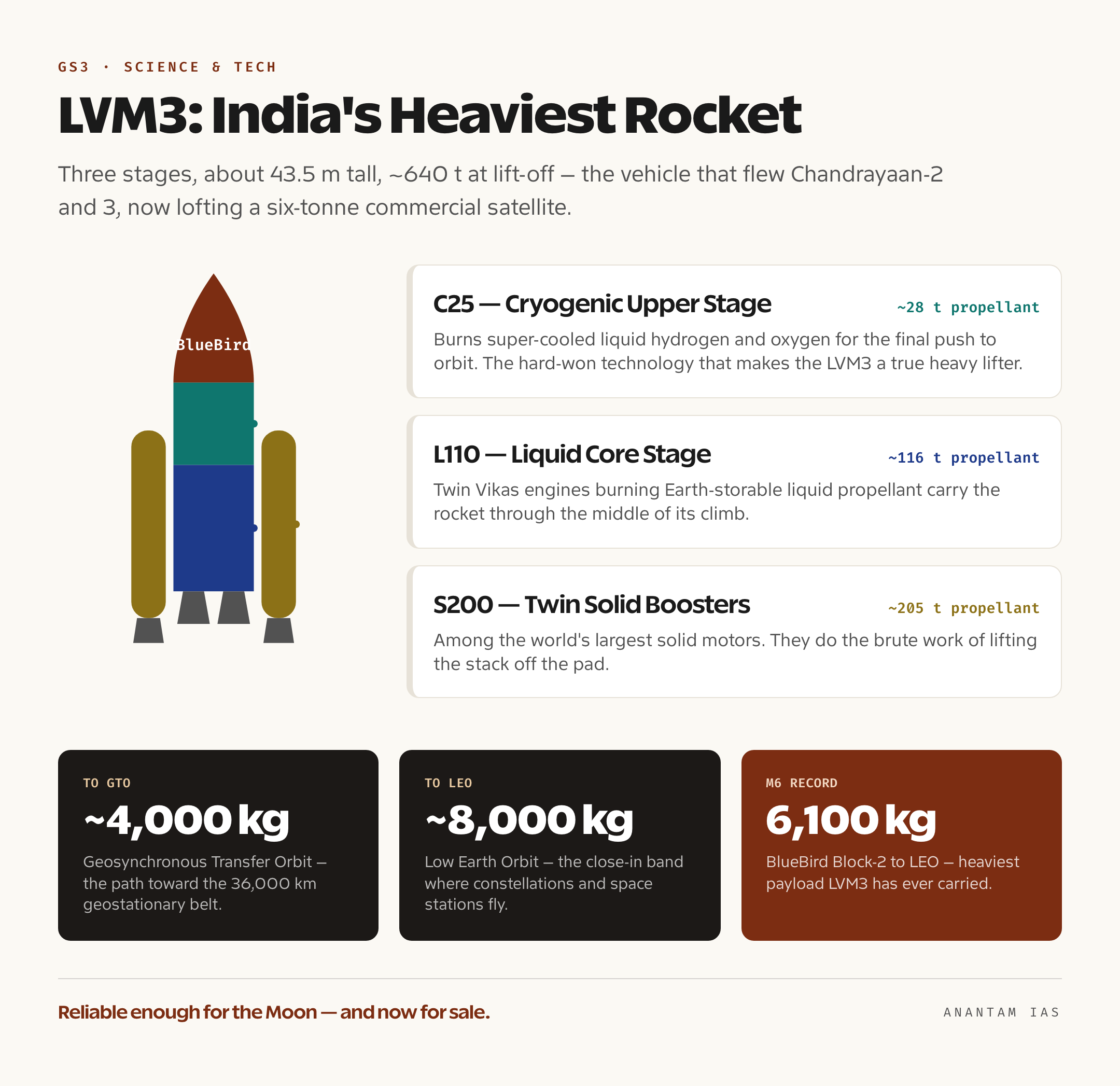
Start with the machine, because everything else rests on it. The LVM3 — Launch Vehicle Mark-3, formerly named the GSLV Mk III — is India’s heaviest operational rocket, standing about 43.5 metres tall with a lift-off mass of roughly 640 tonnes. It’s a three-stage vehicle, and each stage is worth knowing by name. The first stage is a pair of S200 solid-fuel strap-on boosters — among the largest solid motors in the world — carrying about 205 tonnes of propellant between them; they do the brute work of getting the rocket off the pad. The second, the L110, is a liquid core stage holding around 116 tonnes of Earth-storable liquid propellant and burning two Vikas engines. The third is the C25, a cryogenic upper stage with about 28 tonnes of propellant. “Cryogenic” simply means the engine burns super-cooled liquid fuels — here liquid hydrogen and liquid oxygen, chilled to hundreds of degrees below zero — which give far more thrust per kilogram of fuel than ordinary propellants, but are much harder to handle and store. India spent years mastering that cryogenic technology after being denied it by other powers, and it’s the C25 that makes the LVM3 a true heavy lifter.
What the rocket can carry is the headline spec. The LVM3 can place about 4,000 to 4,200 kilograms into Geosynchronous Transfer Orbit, or GTO — the elongated path used to ferry communications satellites toward the high “geostationary” belt about 36,000 kilometres up, where a satellite circles in step with Earth’s rotation and so appears to hang over one fixed spot. To low Earth orbit, or LEO — the much closer band a few hundred kilometres up where space stations and most new internet constellations fly — it can lift around 8,000 kilograms. This is the rocket that carried Chandrayaan-2 in 2019 and Chandrayaan-3 in 2023, and the one ISRO is human-rating for Gaganyaan, India’s crewed mission; the BlueBird flight even marked ISRO’s 100th orbital launch since its first satellite-launch attempt decades ago. A vehicle trusted to send humans to space and a lander to the Moon is, by definition, reliable enough to sell.
Selling it is NSIL’s job. NewSpace India Limited was set up in 2019 as a public-sector company under the Department of Space to act as ISRO’s commercial wing — to market Indian launch services, lease satellite capacity, and transfer ISRO’s technology to private industry. NSIL is the entity that signs the contracts, takes the money, and lets ISRO focus on engineering. Its first big test came with Britain’s OneWeb: NSIL flew 36 OneWeb broadband satellites on an LVM3 in October 2022 — the rocket’s maiden commercial flight — and another 36 in March 2023, completing that constellation. The AST SpaceMobile deal is the natural next step, a single heavy customer rather than a batch of small ones. And it matters because the global launch market is in the middle of a boom: thousands of satellites are being launched every year to build internet-from-space constellations, and demand for reliable, affordable heavy lift far outstrips supply. Every contract India wins is foreign exchange earned, industrial capacity built, and a foothold taken in one of the fastest-growing high-technology markets on Earth.
The Mission and the Satellite
The payload is as interesting as the rocket, because it points at where communications are heading. BlueBird Block-2 is built by AST SpaceMobile, a Texas-based company chasing a single bold idea — “direct-to-cell” connectivity, also called direct-to-device or space-based cellular broadband. In plain terms, it means a satellite that talks straight to an ordinary, unmodified smartphone. Today, satellite phones need bulky special handsets and dish-like antennas. AST’s pitch is that its giant antenna in orbit is sensitive and powerful enough to act like a cell tower in the sky, so the phone already in your pocket can connect to it directly when you wander out of range of any ground network — no new device, no extra hardware. That’s what the enormous 223-square-metre array is for: a tower needs a big antenna, and a tower in space needs a very big one.
The plan is a constellation — a fleet of these satellites circling the Earth so that, between them, they blanket the planet in coverage. BlueBird Block-2 is the first of the company’s next-generation, far larger satellites, following the five smaller BlueBirds it launched in 2024. Its ten-times-greater capacity is meant to carry real broadband — not just text messages but usable mobile data — to the roughly billions of people and vast empty stretches of ocean, desert and mountain that terrestrial mobile networks will never reach economically. For India specifically, the technology is doubly relevant: a country with remote Himalayan valleys, dense forests, long coastlines and frequent disasters has an obvious use for connectivity that works where towers don’t. And the launch delay of forty-one seconds that ISRO built into the countdown — to avoid a close pass with another object already in orbit — is itself a quiet reminder of how crowded LEO is becoming as these constellations multiply.
Significance for India’s Commercial Space
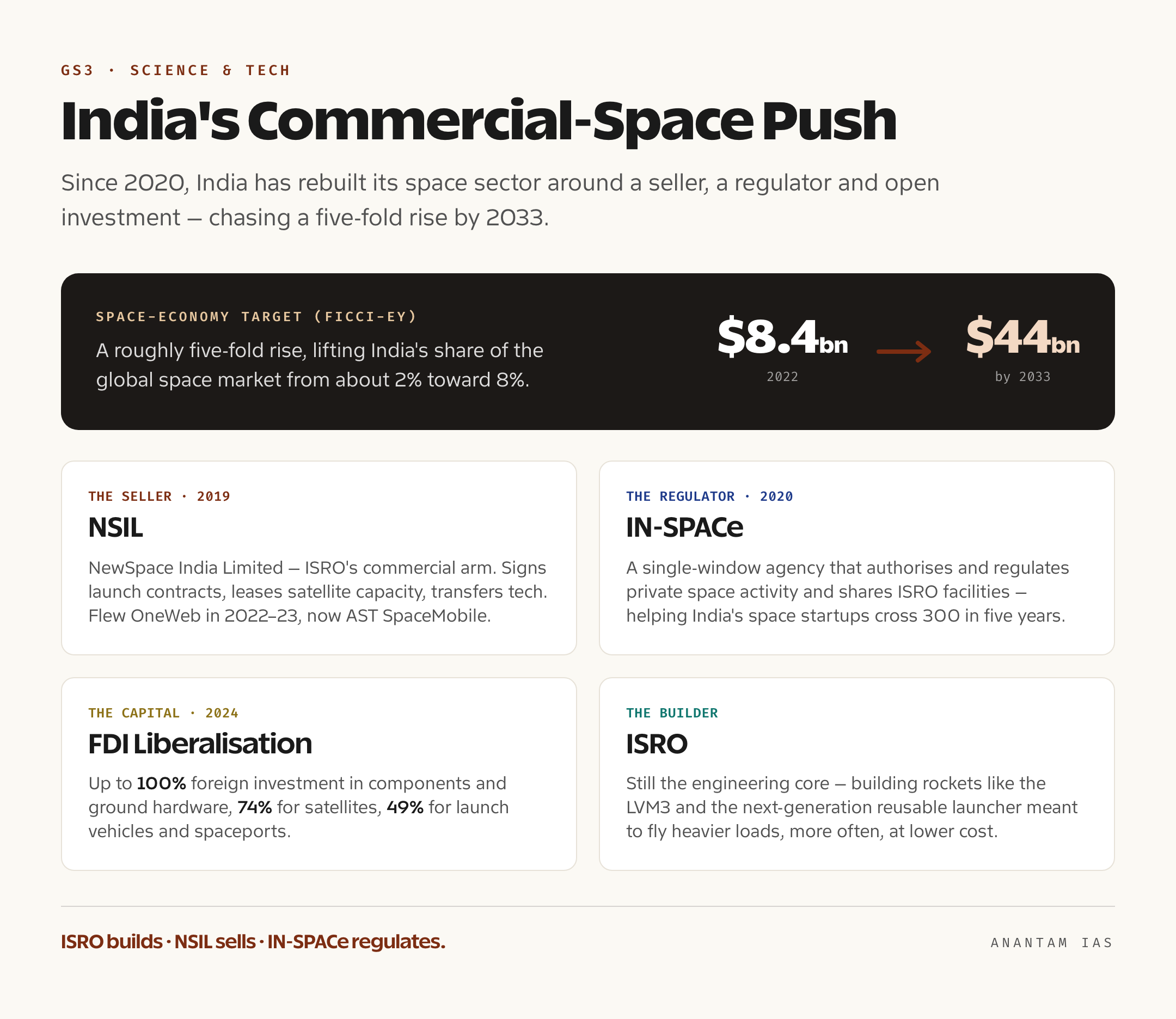
The flight is a showcase for a much larger policy project. Since 2020, India has been deliberately dismantling the old model in which ISRO did everything — research, launches, satellites — as a closed government monopoly. The reform created a new architecture with three moving parts. NSIL, as we’ve seen, is the commercial seller. The bigger structural change is IN-SPACe, the Indian National Space Promotion and Authorisation Centre, set up in 2020 as a single-window agency that authorises and regulates private space activity. Before IN-SPACe, a startup wanting to build a rocket or a satellite had no clear door to knock on; now there’s one nodal body that grants approvals, shares ISRO facilities, and acts as the bridge between the government’s space assets and private players. That single change has helped India’s space-startup count cross 300 in roughly five years.
The third leg is money, and here the decisive move came in 2024, when the government liberalised foreign direct investment, or FDI, in the space sector. The new rules allow up to 100 per cent foreign investment in making satellite components and ground-segment hardware, up to 74 per cent through the automatic route for building satellites, and up to 49 per cent for launch vehicles and spaceports — a sharp opening of a sector that was almost entirely closed to foreign capital before. The aim behind all of this is a number worth memorising: India wants its space economy to grow roughly five-fold, from about $8.4 billion in 2022 to around $44 billion by 2033, lifting its share of the global space market from about 2 per cent toward 8 per cent. As the Union minister for space, Jitendra Singh, has repeatedly framed it, the goal is to turn India into a major commercial space power, not just a scientific one. A high-profile launch like BlueBird Block-2 is exactly the kind of proof point that target needs — a real foreign customer paying real money for India’s heaviest rocket.
Challenges and the Way Forward
So is India about to dominate global launch? Not quite, and a balanced answer has to say why. The first constraint is sheer volume. The LVM3 is reliable, but India launches very few of them a year — a handful at most — while SpaceX alone launches dozens of much larger rockets and has driven prices down with reusability. India’s rockets are still expendable, thrown away after each flight, which caps both how often it can launch and how cheaply. ISRO’s answer is a Next-Generation Launch Vehicle, a bigger, partly reusable rocket meant to carry far heavier loads at lower cost, but it’s still years from flying. Until then, India can win prestige contracts like this one, but it can’t yet compete on raw throughput.
The second set of challenges is structural. India still lacks a dedicated, comprehensive space law — the activities of private firms rest largely on policy and IN-SPACe authorisations rather than a full statute, and a clear Spacecom or space-activities law has been promised but not yet passed. That legal gap creates uncertainty for the long-term investors the $44-billion target depends on. There are softer worries too: a brain drain of skilled engineers to better-paying foreign firms, the need to scale a private manufacturing base that can actually build rockets and satellites at volume, and the growing problem of orbital debris and crowding in LEO that this very mission had to navigate around. The way forward is reasonably clear — fly the next-generation reusable rocket, pass a proper space law, deepen private participation through IN-SPACe, and keep landing flagship commercial deals to build a track record. The BlueBird launch shows the strategy can work. The task now is to do it often enough, and cheaply enough, to matter.
For Your Mains Answer
This is prime material for GS Paper 3, which covers science and technology, developments and their applications, and indigenisation of technology. It fits questions on India’s space programme, the role of the private sector in high technology, achievements of Indians in science, and the economics of strategic sectors. The launch also offers a concrete, dateable example for any answer on self-reliance, dual-use technology, or India’s place in global value chains. The examiner rewards a candidate who can move from a single hard fact — a 6,100 kg satellite on 24 December 2025 — to the policy architecture and the global context around it.
How to Build the Answer
Lead with the event and its record, then widen out in a clear chain: what the LVM3 is and why it can do the job (three stages, cryogenic upper stage, heavy lift) → who sold the launch and to whom (NSIL, AST SpaceMobile) → what the payload does (direct-to-cell broadband) → the policy reforms that made the commercial push possible (IN-SPACe, FDI liberalisation, the $44-billion target) → and a fair verdict on the constraints (low launch cadence, no reusable rocket yet, no space law). That arc — event, capability, business, policy, evaluation — fits almost any “India’s commercial space” question.
Common Mistakes to Avoid
Don’t call this an ISRO science mission — it’s a commercial launch for a foreign customer, and the distinction is the whole point. Don’t confuse the three pillars: ISRO does the engineering, NSIL does the selling, IN-SPACe does the regulating. Don’t overstate India’s position; it’s a rising challenger, not yet a market leader, because launch frequency and reusability still lag. And don’t muddle the orbits — communications satellites usually head for GTO and the geostationary belt, while this constellation flies in LEO precisely because being close to Earth keeps the signal strong enough for an ordinary phone.
A Compact Answer Spine
LVM3-M6 launches BlueBird Block-2 (~6,100 kg, AST SpaceMobile, USA) into LEO on 24 December 2025 — heaviest payload by India’s heaviest rocket → LVM3: three stages (S200 boosters + L110 liquid + C25 cryogenic), ~4,000 kg to GTO / ~8,000 kg to LEO, flew Chandrayaan-2/3 → sold commercially by NSIL (after OneWeb 2022-23) → payload enables direct-to-cell broadband to ordinary phones → backed by reforms: IN-SPACe (single-window regulator, 2020), 2024 FDI liberalisation (up to 100% in components), $44 bn space-economy target by 2033 → challenges: low cadence, no reusable rocket yet, no space law, orbital debris → verdict: a flagship proof point, not yet market dominance.
Diagram or Flowchart Idea
Sketch the LVM3 as a simple labelled rocket — three stacked stages (S200, L110, C25) with payload figures beside the nose — next to a small box diagram of the ecosystem: ISRO (builds) → NSIL (sells) → IN-SPACe (regulates) → private startups, with the $44-billion arrow on top. Two clean visuals carry the engineering and the policy in one glance.
A Balanced-Conclusion Line
A line that earns the marks: “The LVM3-M6 launch shows India can win the world’s heaviest commercial contracts on the strength of its own engineering — but turning a respected space programme into a dominant space business will need cheaper, more frequent, reusable launches and a settled legal foundation to match its ambition.”
How to Use Data Without Cramming
You need only a few anchors: 6,100 kg (the payload), 24 December 2025 (the date), about 4,000 kg to GTO and 8,000 kg to LEO (the rocket’s lift), and $44 billion by 2033 (the target). Attribute them plainly — “ISRO confirmed the BlueBird satellite at about 6.1 tonnes” — rather than scattering figures loose. Four well-placed numbers read as command of the topic; a dozen read as a memory dump.
FAQ
What did the LVM3-M6 mission launch, and when? On 24 December 2025, at 8:55 in the morning IST, ISRO’s LVM3-M6 rocket lifted off from Sriharikota carrying AST SpaceMobile’s BlueBird Block-2 (also called BlueBird 6), a communications satellite of about 6,100 kilograms. It was placed into a low Earth orbit roughly 520 kilometres up about fifteen and a half minutes after lift-off — the heaviest payload the LVM3 has ever carried to low Earth orbit.
What makes the LVM3 special? The LVM3, formerly the GSLV Mk III, is India’s heaviest operational rocket, about 43.5 metres tall with three stages: twin S200 solid boosters, an L110 liquid core, and a C25 cryogenic upper stage. It can lift roughly 4,000 kilograms to Geosynchronous Transfer Orbit and around 8,000 kilograms to low Earth orbit, and it carried Chandrayaan-2 and Chandrayaan-3. Its mastery of cryogenic engine technology — burning super-cooled liquid hydrogen and oxygen — is what makes it a genuine heavy lifter.
What is direct-to-cell connectivity? It’s a system where a satellite communicates directly with an ordinary, unmodified smartphone, acting like a mobile tower in space. Unlike traditional satellite phones, which need special handsets, direct-to-cell lets your existing phone connect to a satellite when it’s out of range of any ground network. BlueBird Block-2 carries a huge 223-square-metre antenna array — the largest commercial array in orbit — to make that possible.
Why does this launch matter for India’s economy? It’s a marquee commercial win, struck through NSIL, ISRO’s commercial arm, for a US customer. It shows India’s heaviest rocket can compete for high-value global contracts, which means foreign exchange, industrial capacity, and credibility. It supports the government’s goal of growing India’s space economy roughly five-fold, from about $8.4 billion in 2022 to around $44 billion by 2033, helped by IN-SPACe as a single-window regulator and the 2024 opening of the sector to foreign investment.
Practice Questions
Prelims MCQs
- The LVM3 launch vehicle, formerly known as the GSLV Mk III, has which of the following stage configurations?
(a) Two S200 solid boosters, an L110 liquid core stage, and a C25 cryogenic upper stage
(b) A single solid booster and two cryogenic stages
(c) Four liquid strap-on boosters and a solid upper stage
(d) Two cryogenic boosters and a single liquid core
Answer: (a) The LVM3 is a three-stage vehicle: twin S200 solid strap-ons, the L110 liquid core, and the C25 cryogenic upper stage. - The BlueBird Block-2 satellite launched by LVM3-M6 in December 2025 belonged to which entity?
(a) The Indian Space Research Organisation
(b) AST SpaceMobile, a US company
(c) OneWeb of the United Kingdom
(d) The European Space Agency
Answer: (b) BlueBird Block-2 (BlueBird 6) is a direct-to-cell communications satellite owned by the US firm AST SpaceMobile, launched commercially through NSIL. - With reference to NewSpace India Limited (NSIL), which statement is correct?
(a) It is the regulator that authorises private space activity
(b) It is the commercial arm of ISRO that markets launch services and satellite capacity
(c) It is a private space-launch startup
(d) It is an autonomous research laboratory under DRDO
Answer: (b) NSIL, set up in 2019 under the Department of Space, is ISRO’s commercial wing; the single-window regulator for private space activity is IN-SPACe. - “Direct-to-cell” or space-based cellular broadband, as demonstrated by the BlueBird constellation, refers to:
(a) Laying undersea cables to connect mobile towers
(b) A satellite communicating directly with an ordinary unmodified smartphone
(c) 5G towers powered by solar cells
(d) Beaming electricity from space to mobile networks
Answer: (b) Direct-to-cell lets a standard smartphone connect straight to a satellite acting as a tower in orbit, without any special handset or antenna. - India aims to grow its space economy to around which figure by 2033, according to government and industry projections?
(a) About $8 billion
(b) About $20 billion
(c) About $44 billion
(d) About $100 billion
Answer: (c) India targets a roughly five-fold rise from about $8.4 billion in 2022 to around $44 billion by 2033, lifting its share of the global space market toward 8 per cent.
Mains Practice Questions
- The LVM3-M6 mission has been described as a milestone for India’s commercial space sector rather than its scientific programme. Examine the distinction and discuss what the launch reveals about India’s heavy-lift capability. (15 marks, 250 words)
- Discuss the institutional architecture India has built since 2020 to commercialise its space sector. How do ISRO, NSIL and IN-SPACe divide responsibilities between them? (15 marks, 250 words)
- “India’s space economy ambitions rest as much on policy reform as on rocket engineering.” In light of the 2024 FDI liberalisation and the $44-billion target, critically analyse this statement. (15 marks, 250 words)
- What is direct-to-cell connectivity, and why is it significant for a country like India? Discuss its potential applications and the challenges it raises. (10 marks, 150 words)
- Despite winning prestige commercial launches, India is not yet a leader in the global launch market. Evaluate the constraints holding it back and suggest a way forward. (15 marks, 250 words)
Tell Google you want more of this.
Add Anantam IAS as a preferred sourceOne tap, and this site shows up more often in your own Top Stories, AI Overviews and AI Mode. Remove it any time.