Why in News?
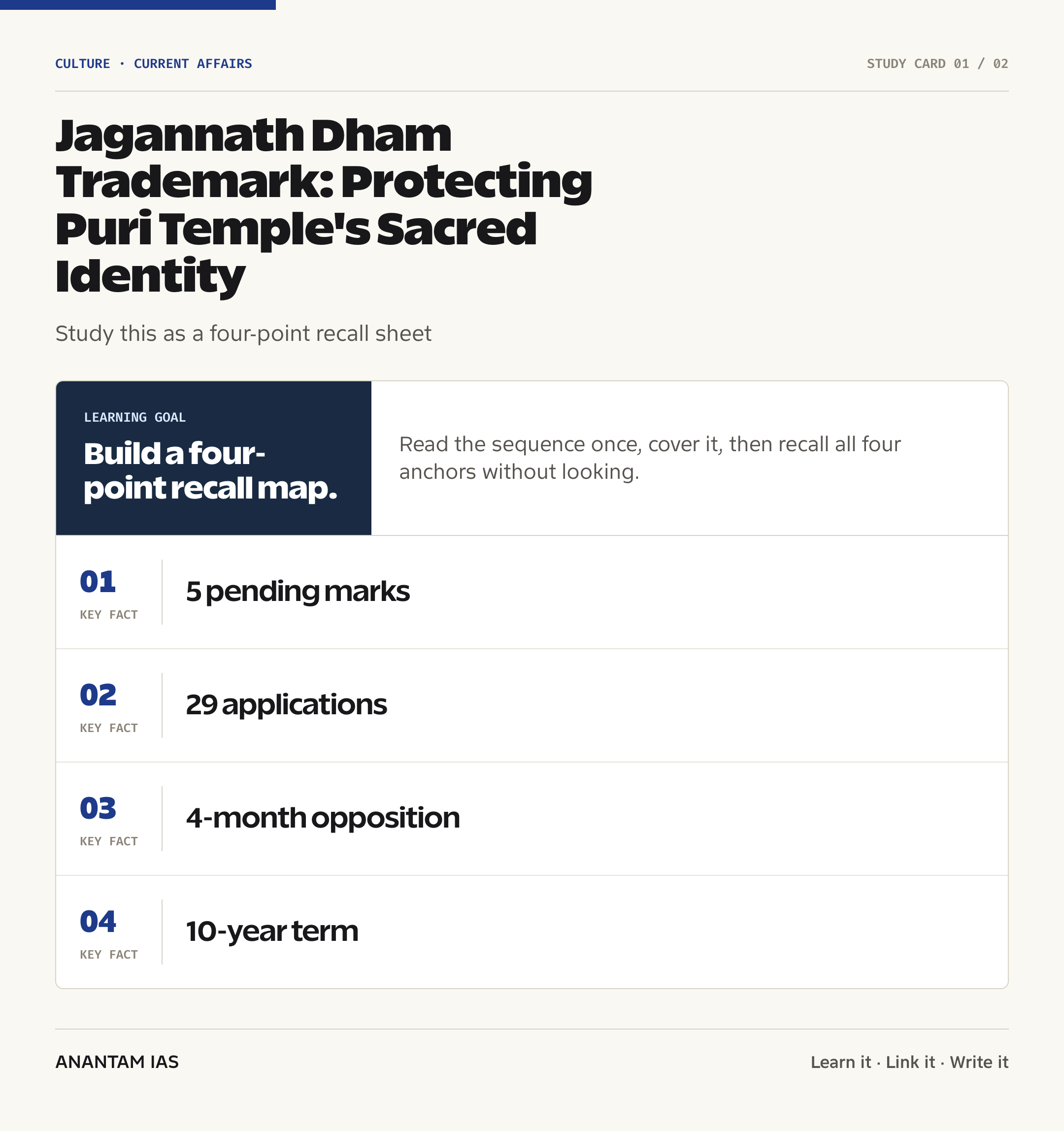
The Indian Express reported on 25 July 2026 that five applications filed by the Shree Jagannath Temple Administration had cleared a second round of examination by the Trade Marks Registry. The marks are Jagannath Dham, Shree Kshetra, Mahaprasad, Nilachakra and Koili Vaikuntha.
The present status is acceptance for publication in the forthcoming Trade Marks Journal, not final registration. Publication opens the statutory opposition stage under the Trade Marks Act, 1999; only after that stage is completed can an eligible application proceed to a registration certificate.
- Five applications have cleared examination for Journal publication.
- SJTA has filed 29 applications covering names, expressions and symbols linked to the Puri temple tradition.
- Three earlier identifiers, Patitapabana, Ananda Bajara and the SJTA Nilachakra logo, were reported as registered in June 2026.
- The latest applications seek protection against unauthorised commercial exploitation, not ownership over worship, belief or ordinary cultural discussion.
- The initiative gained urgency after the 2025 dispute over the use of Jagannath Dham for the temple complex at Digha in West Bengal.
The development matters in the context of:
- The development tests how ordinary intellectual-property law can support the custodianship of a living religious tradition.
- It also shows why an application, Journal advertisement, opposition proceeding and registration are separate legal stages.
- The case raises a governance question: how can a statutory temple body prevent deceptive commerce without claiming a blanket monopoly over shared religious vocabulary?
UPSC Relevance
Prelims Relevance
- The Trade Marks Act, 1999 governs registration and protection of trade marks in India; the Trade Marks Rules, 2017 prescribe procedure.
- A trade mark identifies a commercial connection between particular goods or services and a proprietor; protection is tied to the specification and class in which the mark is registered.
- The Trade Marks Registry functions under the Controller General of Patents, Designs and Trade Marks in the Department for Promotion of Industry and Internal Trade.
- Acceptance and publication in the Trade Marks Journal do not by themselves create a registered trade mark.
- Under Section 21, any person may oppose an advertised application within four months from its advertisement or re-advertisement.
- Section 9 contains absolute grounds for refusal, including lack of distinctiveness and marks customary in current language or established trade practice.
- Section 11 contains relative grounds, including conflict with an earlier mark and likelihood of confusion.
- Section 28 gives a registered proprietor exclusive rights subject to the Act, conditions and the goods or services covered by the registration.
- A geographical indication identifies goods whose quality, reputation or characteristic is essentially attributable to geographical origin; it isn’t the same as a trade mark.
- The Puri temple is administered under a separate state legal framework built around the Shri Jagannath Temple Act, 1955.
Mains Relevance
GS Paper 1
- Living religious heritage, the Jagannath tradition, Kalinga temple architecture and the cultural geography of Puri.
- The relationship between sacred vocabulary, ritual practice and the regional identity of Odisha.
GS Paper 2
- Role of a statutory temple administration, state oversight and institution-based custodianship of cultural assets.
- Balancing regulatory protection, inter-state sensitivities, freedom of expression and legitimate religious use.
GS Paper 3
- Operation of trademark law, opposition, infringement, passing off and the limits of exclusive rights.
- Choosing between trade marks, geographical indications and other tools for protecting cultural and commercial value.
Essay
- Heritage survives through communities, but institutions can protect it from deceptive commercial appropriation.
- Legal ownership and cultural belonging aren’t identical; good governance must respect both.
Background and Context
What has been approved, and what has not
The news concerns a procedural milestone, so the legal status must be stated with precision.
- The Registry has reportedly accepted five applications for publication after a second examination stage; this means the marks are moving into public notice and possible opposition.
- The five marks are Jagannath Dham, Shree Kshetra, Mahaprasad, Nilachakra and Koili Vaikuntha, each associated with Puri’s temple, rituals or sacred landscape.
- An application is a request for statutory protection. It doesn’t carry the same enforceable rights as an entry that is actually on the Register and remains in force.
- After acceptance, the mark is advertised in the Trade Marks Journal. IP India’s official procedure says an unopposed published mark becomes eligible for registration only after the four-month opposition period.
- If a third party files an opposition, the Registrar must decide the contested proceeding after pleadings, evidence and an opportunity of hearing. The certificate isn’t automatic merely because examination has been cleared.
- The news reports an SJTA portfolio of 29 applications. But every application has its own mark, specification, class, evidence and prosecution history; portfolio size doesn’t turn pending claims into registered rights.
How the trademark system works
Trademark law protects source-identifying signs in trade rather than ideas, faiths or historical narratives.
- Under Section 2(1)(zb), a trade mark must be capable of graphical representation and distinguishing one person’s goods or services from those of others.
- A mark may include a word, name, device, label, logo, shape, packaging or combination of colours. A sacred term can enter the system only through the same legal tests applied to other marks.
- The applicant files for identified goods or services. Any eventual exclusive right is bounded by the specification, relevant class, statutory limitations and conditions recorded by the Registrar.
- The Registry first conducts formal and substantive examination. An office objection can require evidence, submissions or a hearing before the mark is accepted for advertisement.
- Journal advertisement serves a public-law function: it lets prior users, proprietors and other persons challenge a mark before registration through Section 21 opposition.
- If registered, the mark is ordinarily valid for 10 years and may be renewed for further ten-year periods. Registration can still face rectification, invalidity or non-use proceedings.
Distinctiveness, opposition and limits
The central legal question is not whether a term is revered, but whether the claimed mark can lawfully distinguish the applicant’s covered goods or services.
- Section 9 can bar a mark that lacks distinctive character, directly describes characteristics of the goods or services, or has become customary in bona fide trade practice.
- Section 11 addresses conflicts with earlier marks and the likelihood that consumers may be confused about commercial origin or association.
- Long historical use can support an acquired-distinctiveness claim, but evidence must connect the sign with the applicant as a source identifier for the relevant specification.
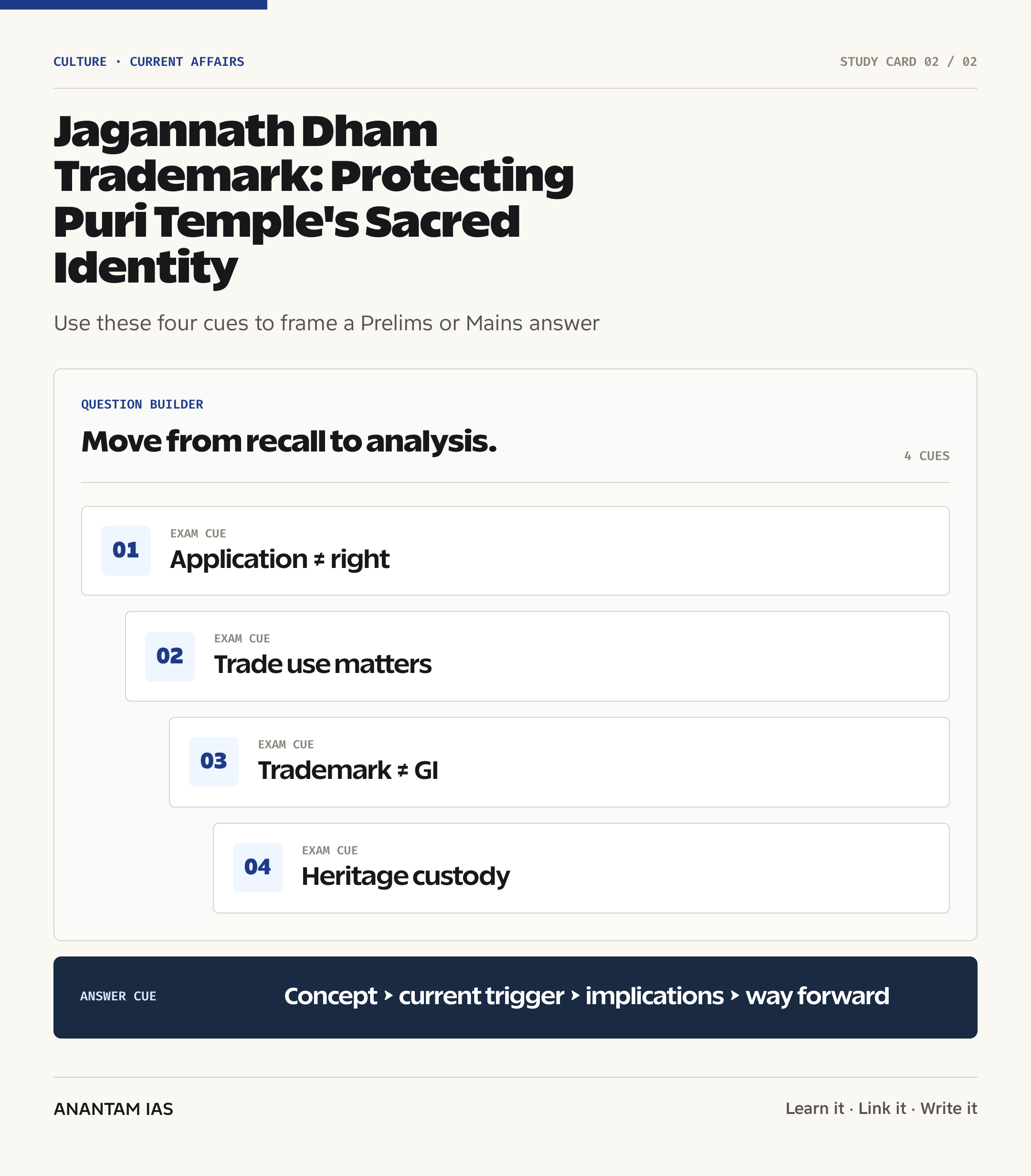
- A registered word mark doesn’t automatically prohibit every spoken, devotional, historical, academic or journalistic use of the words. Infringement analysis focuses on use in the course of trade, similarity, covered goods or services, confusion and reputation.
- Section 30 preserves important limits on a proprietor’s rights, including certain honest and descriptive uses. The precise defence depends on the facts rather than the sacred character of the vocabulary.
- Section 27(2) preserves the common-law action of passing off even for an unregistered mark, but the claimant must prove goodwill, misrepresentation and likely damage.
- For UPSC answers, the safe formulation is that registration can restrain specified deceptive or unauthorised commercial uses; it doesn’t confer ownership of Lord Jagannath, the religion, the city of Puri or the words in every context.
Who is seeking protection
The applicant’s institutional character matters because Puri’s temple administration is rooted in a special statutory arrangement.
- The Shri Jagannath Temple Act, 1955 reorganised the management of the temple and its properties while recognising the importance of established customs, usages, nitis and rituals.
- The Act provides for the Shree Jagannath Temple Managing Committee. Odisha’s Law Department lists the Office of the Shree Jagannath Temple Administration as a subordinate office under its administrative control.
- The management framework includes hereditary, administrative, legal, district and temple-linked representation, reflecting the shrine’s character as both a religious institution and a major public institution.
- The Chief Administrator exercises executive and day-to-day administrative responsibilities under the statutory scheme; the trademark initiative is presented as an act of institutional custodianship.
- This authority still operates within general central law. The SJTA must satisfy the Trade Marks Act before the national Registry like any other applicant.
- A defensible protection strategy should connect enforcement to the temple body’s statutory purpose: authenticity, accountability and prevention of misleading commerce, not control over all cultural participation.
Why the five expressions carry heritage value
Each expression belongs to a wider system of sacred geography, architecture, food and ritual centred on the Puri temple.
- Jagannath Dham and Shree Kshetra are names associated with Puri as a sacred abode. The Puri district administration identifies the city as one of India’s four dhams.
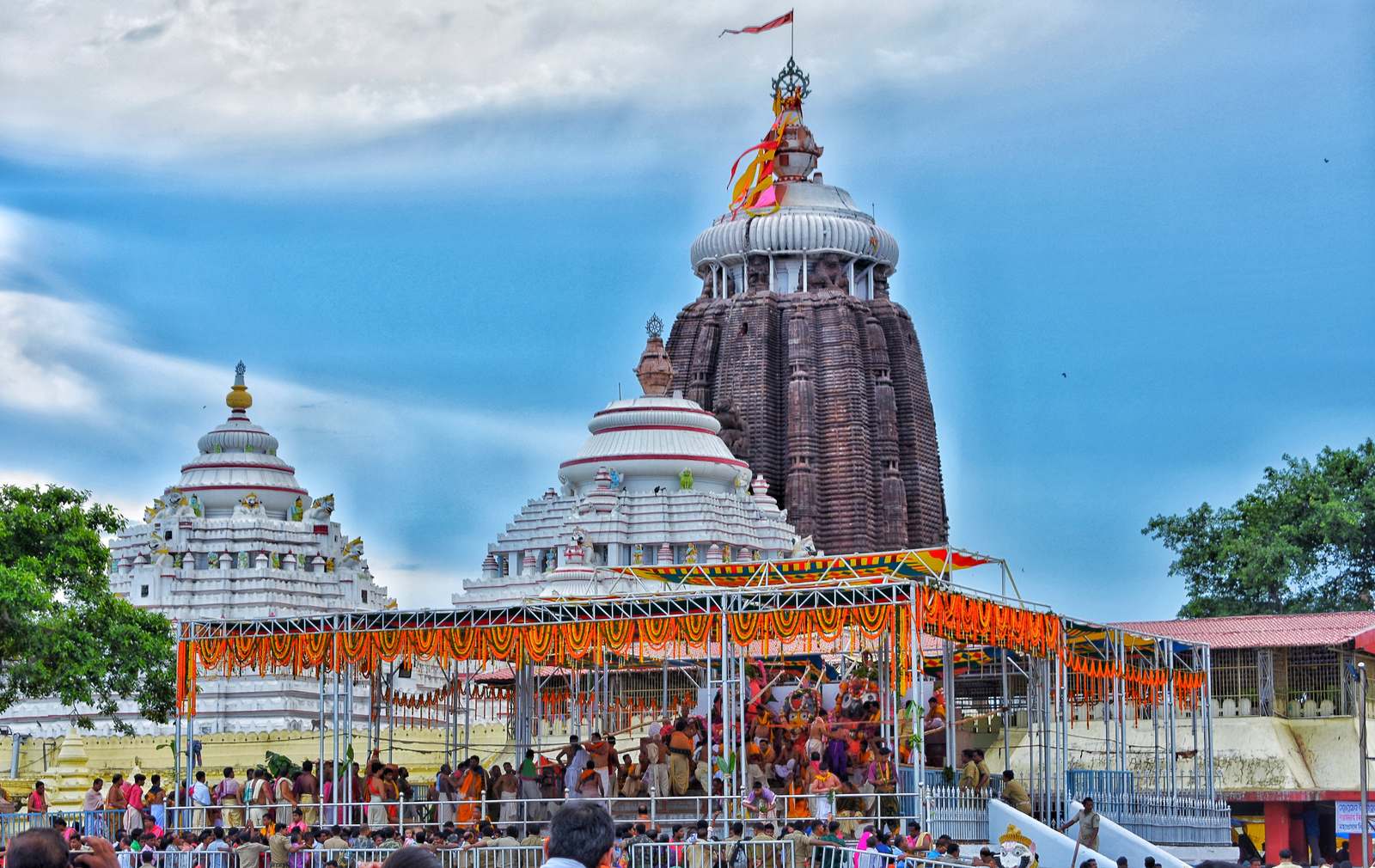
- The present 12th-century temple, associated with the Eastern Ganga ruler Anantavarman Chodaganga Deva, is a major example of Kalinga architecture and the centre of the Jagannath tradition.
- Mahaprasad is the food offered to the deities and distributed through Ananda Bazaar; it carries ritual meaning as well as a substantial everyday economy of preparation and sharing.
- Nilachakra is the sacred wheel crowning the temple’s spire. The current word-mark application must not be confused with the separately reported registration of SJTA’s Nilachakra logo.
- Koili Vaikuntha is the sacred area linked with Nabakalebara, when the wooden forms of the deities are renewed and the old forms are ritually interred.
- The annual Rath Yatra takes the deities into the public realm, making the tradition simultaneously temple-centred and socially expansive.
- The issue can be read alongside India’s efforts to document and protect living artisanal heritage and to interpret major sites through projects such as the Lothal heritage complex.
The Digha dispute as the immediate trigger
A political and cultural disagreement over temple naming pushed a longer-term heritage concern into an intellectual-property strategy.
- The West Bengal government opened a Jagannath temple complex at Digha in April 2025 and used the expression Jagannath Dham, prompting objections from Odisha’s government, temple administration, servitors and devotees.
- Odisha argued that the word Dham in this setting diluted Puri’s distinct sacred identity. The objection combined scriptural tradition, historical association and public sentiment.
- In June 2026, West Bengal’s new government announced that Dham would be removed from the Digha temple’s name, easing the inter-state political dispute.
- That resolution doesn’t itself decide a trademark claim. A political naming decision and the Registry’s assessment under the Trade Marks Act are legally distinct processes.
- The episode shows how cultural symbols can become points of competitive place-branding, tourism promotion and commercial merchandising even when the primary dispute is expressed in religious terms.
- Governments should avoid treating culture as a zero-sum territorial asset. The policy task is to prevent misrepresentation while allowing legitimate worship, scholarship and cultural exchange.
- Comparable heritage disputes, such as the legal and archaeological contest around Bhojshala-Kamal Maula, show why evidence, statutory process and institutional restraint matter.
Trademark protection is not GI protection
Both systems protect reputation, but they answer different questions and create different kinds of rights.
- A trade mark distinguishes the goods or services of one enterprise or proprietor from those of others. It can cover names, logos and other signs used to indicate commercial origin.
- A geographical indication identifies agricultural, natural or manufactured goods whose quality, reputation or other characteristic is essentially attributable to a defined territory, region or locality.
- A GI is a community-linked right: the registered proprietor represents producers, and qualifying producers may seek authorised-user status. It isn’t normally assigned or licensed like private commercial property.
- GI law applies to goods, not a shrine’s identity or religious services in the abstract. A term such as Mahaprasad could raise origin-related questions only through a properly framed goods claim and evidence satisfying the GI Act.
- Trademark registration for temple-linked terms would instead protect the SJTA’s sign within the approved classes and specification. It wouldn’t silently convert the words into a GI for every food, craft or service from Puri.
- The distinction is visible in cases such as Jharkhand’s GI-tagged crafts, where protection turns on identifiable goods, producers, territory and attributable reputation.
- A layered strategy may use trade marks for institutional authentication, GI protection for qualifying products, copyright for original artistic works and consumer law against misleading claims. The legal tool should fit the protected subject.
Way Forward
Complete transparent prosecution
- Publish non-confidential details of each application, class, specification and status so the public can distinguish pending marks from registered ones.
- Respond to Registry objections with archival, statutory and use evidence while respecting the four-month opposition window after Journal advertisement.
- Avoid announcements that describe an accepted application as a completed registration.
Adopt proportionate enforcement
- Prioritise misleading merchandise, fake endorsements, deceptive fundraising and unauthorised commercial licensing that creates a false SJTA connection.
- Issue public brand-use guidelines separating prohibited commercial impersonation from good-faith devotional, descriptive, educational, media and artistic use.
- Use notice, correction and licensing mechanisms before litigation where consumer confusion can be removed without suppressing legitimate cultural expression.
Build a broader heritage protocol
- Create an authenticated digital register of temple-linked names, logos, ritual objects and approved merchandise with records of provenance and authorised use.
- Consult servitors, scholars, local producers, consumer bodies and intellectual-property experts before converting living traditions into licensing categories.
- Assess separately whether particular origin-linked foods or crafts meet the stricter requirements of the GI Act.
Keep federal dialogue open
- Use inter-state consultation for naming disputes involving shared religious traditions instead of allowing tourism promotion to harden into cultural rivalry.
- Frame Puri’s distinctiveness through evidence, public education and authentic institutional marks while respecting the spread of Jagannath worship beyond Odisha.
- Make consumer clarity and heritage integrity the tests for intervention, not political ownership of faith.
Conclusion
The five applications represent a meaningful but incomplete step. Their passage to Journal publication shows that the Trade Marks Registry is willing to expose the claims to public scrutiny; it doesn’t establish that Jagannath Dham and the other expressions are already registered.
A strong heritage policy will use trademark law with precision: authenticate the Puri temple administration, stop deceptive commercial exploitation and preserve evidence of living tradition. It should also leave room for worship, scholarship, fair description and the wider cultural life through which Jagannath heritage endures.
UPSC Practice Questions
Prelims MCQ 1
With reference to trademark registration in India, consider the following statements:
- Publication of an application in the Trade Marks Journal is the same as final registration.
- Any person may oppose an advertised application within four months of its advertisement or re-advertisement.
- A registered trademark’s exclusive right is linked to the goods or services for which it is registered.
How many of the above statements are correct?
(a) Only one (b) Only two (c) All three (d) None
Answer: (b) Only two
Explanation:
Statements 2 and 3 are correct. Journal publication opens the opposition stage; it doesn’t equal registration. Section 21 provides a four-month opposition period, and Section 28 ties the right to the registered mark and covered goods or services.
Prelims MCQ 2
Which option best distinguishes a geographical indication from a trademark?
(a) A GI identifies services of one enterprise, while a trademark protects only agricultural goods. (b) A GI protects every famous place name, while a trademark protects only logos. (c) A GI identifies qualifying goods linked to a geographical origin, while a trademark distinguishes the goods or services of one source from others. (d) A GI and a trademark create identical assignable private rights.
Answer: (c) A GI identifies qualifying goods linked to a geographical origin, while a trademark distinguishes the goods or services of one source from others.
Explanation:
A GI connects qualifying goods and reputation or characteristics to a defined origin and operates as a community-linked right. A trademark identifies commercial source for specified goods or services.
UPSC Mains Questions
- Trademark protection can support heritage custodianship, but it cannot substitute for cultural policy. Examine this statement with reference to the Shree Jagannath Temple Administration’s applications for sacred names and symbols.
- Distinguish trademark protection from geographical-indication protection. Explain how choosing the wrong intellectual-property tool can either leave cultural assets exposed or create overbroad claims over shared heritage.
- How should statutory religious bodies balance authenticity, prevention of commercial misuse and legitimate public use of sacred vocabulary? Suggest a proportionate governance framework.
Sources: IP India, Trade Marks Registry and The Indian Express.
Frequently Asked Questions
Is Jagannath Dham now a registered trademark?
No. The reported status is acceptance for publication in the Trade Marks Journal after examination. Publication gives the public an opportunity to oppose the application. Registration can follow only after the statutory process is completed and any opposition is resolved.
Which five applications cleared examination?
The five reported marks are Jagannath Dham, Shree Kshetra, Mahaprasad, Nilachakra and Koili Vaikuntha. They are linked to Puri’s sacred geography, food tradition, temple symbol and Nabakalebara ritual landscape.
How long is the trademark opposition period?
Under Section 21 of the Trade Marks Act, any person may file opposition within four months from the advertisement or re-advertisement of an application. A shorter news estimate for certificate issuance shouldn’t replace the statutory four-month rule.
Can SJTA stop every use of these words?
No blanket ban follows from an application or registration. Rights depend on the final specification, classes, conditions and facts of use. Trademark infringement generally concerns unauthorised use in the course of trade, while honest descriptive, devotional, educational or referential use may fall outside infringement or within statutory limits.
How is a trademark different from a GI?
A trademark distinguishes one source’s goods or services. A geographical indication identifies qualifying goods whose reputation, quality or characteristic is linked to a defined place. GI protection is community-linked and producer-oriented; it isn’t a general title over a temple name.
Why is Puri temple culturally significant?
The 12th-century Shree Jagannath Temple is a major Kalinga-style shrine and one of India’s Char Dham pilgrimage centres. Its Rath Yatra, wooden deities, Mahaprasad tradition, Nilachakra and Nabakalebara rituals make it a living institution rather than only an archaeological monument.
Tell Google you want more of this.
Add Anantam IAS as a preferred sourceOne tap, and this site shows up more often in your own Top Stories, AI Overviews and AI Mode. Remove it any time.