The JANANI Platform launched by the Ministry of Health and Family Welfare on May 7, 2026 marks a new chapter in India’s maternal and child health architecture. JANANI stands for Journey of Antenatal, Natal and Neonatal Integrated Care, and the platform is built to follow every pregnant woman and newborn through a single digital record from conception to six weeks postpartum. It replaces a patchwork of paper cards, separate registers, and siloed scheme data with one unified record.
The launch is significant for two reasons. First, India still loses too many mothers and newborns to causes that are largely preventable. The maternal mortality ratio has dropped sharply over two decades but lags behind the SDG-3 target of 70 per lakh live births by 2030. Second, the JANANI Platform pulls together QR-enabled cards, automated risk alerts, scheme convergence, and ABDM linkage in a way that earlier flagship programmes did not.
For UPSC aspirants, this is a GS Paper II topic that blends governance, social-sector schemes, health policy, and digital public infrastructure. The JANANI Platform is also a useful case study for essays on the right to health and on the use of technology in public service delivery.
Quick Facts
- Full form: Journey of Antenatal, Natal and Neonatal Integrated Care
- Launched by: Ministry of Health and Family Welfare, Government of India
- Launch date: May 7, 2026
- Coverage: All states and UTs, public health facilities first, private later
- Anchor scheme links: Janani Suraksha Yojana, Janani Shishu Suraksha Karyakram, Pradhan Mantri Surakshit Matritva Abhiyan
- Integration: Ayushman Bharat Digital Mission (ABDM), eSanjeevani, RCH portal
- Core features: QR-enabled care cards, automated risk alerts, ANC-to-PNC tracking
- SDG anchor: SDG-3, Target 3.1 (maternal mortality) and 3.2 (newborn and under-5 mortality)
What Just Happened
The Ministry of Health and Family Welfare on May 7, 2026 launched the JANANI Platform in New Delhi. The platform is a unified digital system that follows every pregnant woman and newborn through her entire care journey. Each beneficiary gets a QR-enabled card linked to her Ayushman Bharat Health Account (ABHA) number. Health workers scan the card at every visit, the system flags high-risk pregnancies automatically, and the data flows back to district and state dashboards in real time.
The platform replaces the Mother and Child Protection Card in digital form and integrates with the Reproductive and Child Health (RCH) portal that ANMs and ASHAs already use. The Ministry has rolled it out first in 100 high-priority districts identified by maternal and neonatal mortality data, with national rollout planned over the next 18 months.
The JANANI Platform is being run by the National Health Authority in partnership with the Ministry of Health. It draws on the Ayushman Bharat Digital Mission framework that already underpins ABHA, the Healthcare Professionals Registry, and the Health Facility Registry.
Background and Historical Context
India’s maternal and child health architecture has evolved over four decades. The first major intervention was the Child Survival and Safe Motherhood Programme in 1992. The National Population Policy 2000 set explicit MMR and IMR targets. The Reproductive and Child Health programme came in two phases, RCH-I in 1997 and RCH-II in 2005. The National Rural Health Mission was launched in 2005 and folded into the National Health Mission in 2013.
Two demand-side schemes anchored the next phase. Janani Suraksha Yojana, launched in 2005, gave cash incentives for institutional delivery. Janani Shishu Suraksha Karyakram, launched in 2011, made all maternal services free at public facilities. Pradhan Mantri Surakshit Matritva Abhiyan, launched in 2016, set the ninth of every month aside for free, comprehensive antenatal care at public facilities. LaQshya, launched in 2017, focused on labour-room quality. SUMAN, launched in 2019, brought together rights-based service delivery for mothers and newborns.
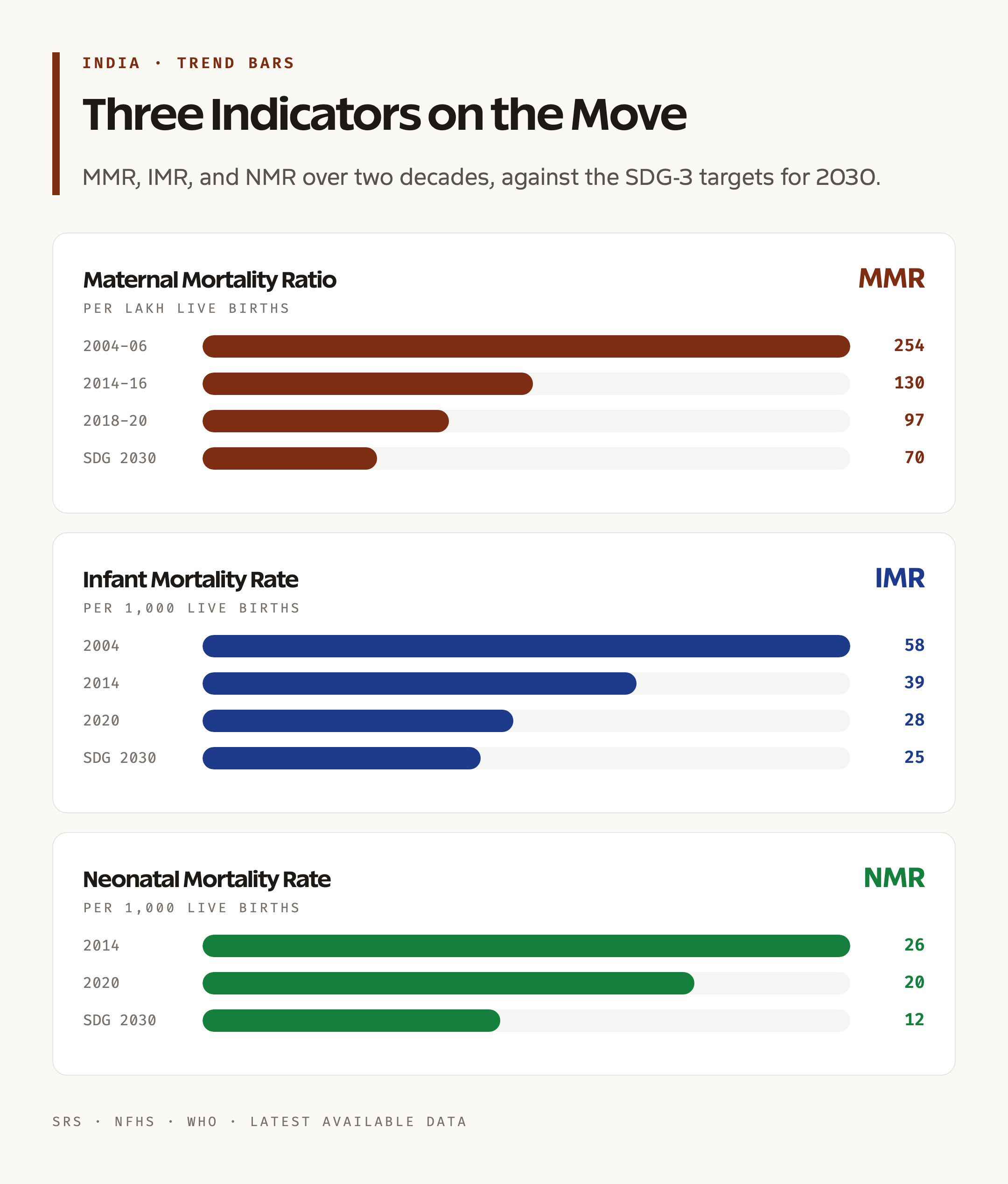
Despite these schemes, India’s MMR stood at 97 per lakh live births in 2018-20 and IMR at 28 per thousand live births in 2020, as per the latest SRS and NFHS data. Both are well above the global average and lag the SDG-3 targets. The JANANI Platform is meant to close the data and accountability gap that has held back faster progress.
Key Features of the JANANI Platform
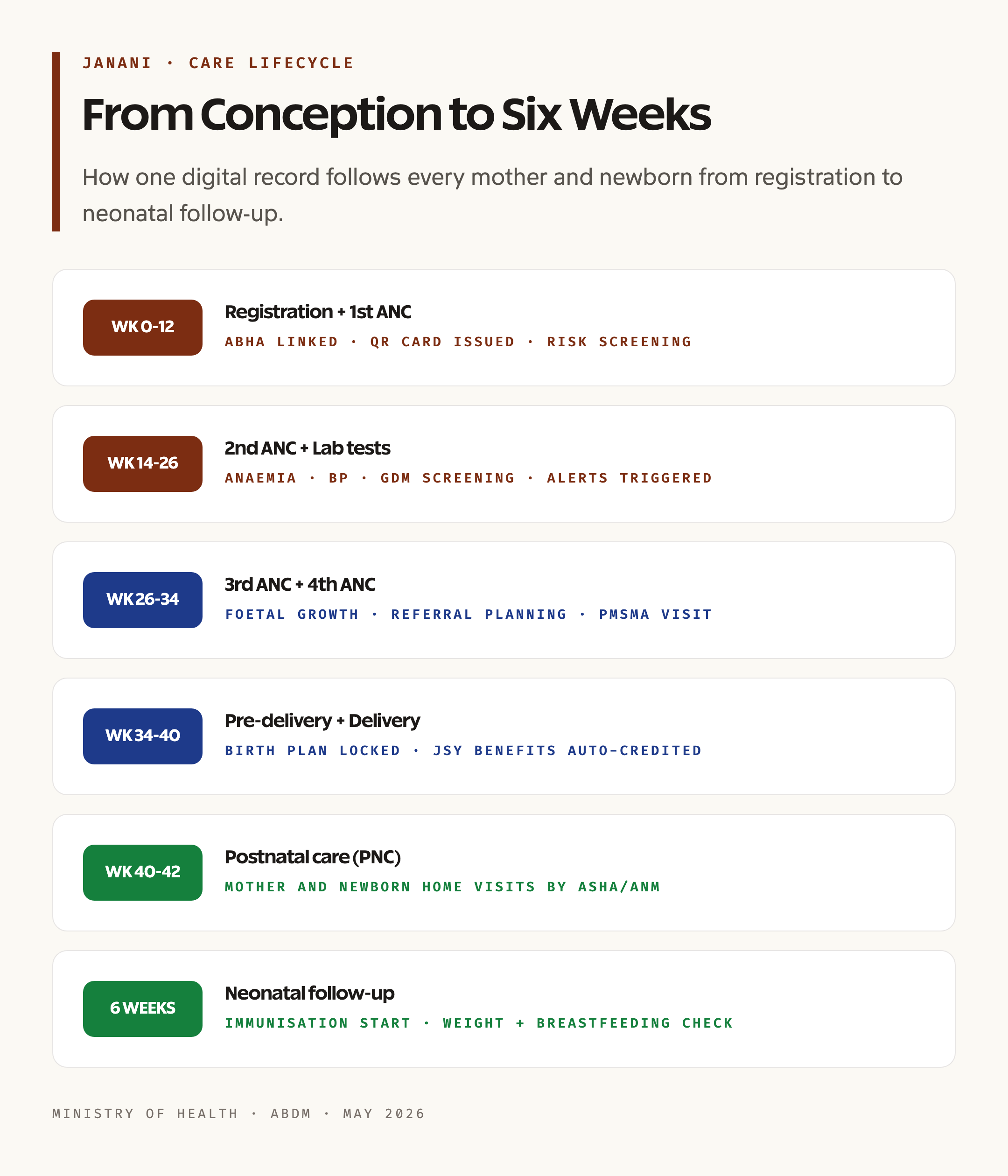
The platform brings five capabilities together in one digital record.
- QR-enabled care card: Every pregnant woman gets a QR card linked to her ABHA number; the card is scanned at every visit.
- Automated risk alerts: Anaemia, hypertension, gestational diabetes, and other high-risk markers trigger alerts to the ANM, the medical officer, and the FRU.
- End-to-end tracking: The record follows the woman from registration through ANC visits, delivery, PNC visits, and the first six weeks of newborn care.
- Scheme convergence: JSY benefits, JSSK entitlements, PMSMA visits, and POSHAN Abhiyaan supplementation all surface in one place.
- Real-time dashboards: District and state officials see live coverage data, missed visits, and high-risk follow-ups.
The platform also includes a referral module that connects sub-centres and primary health centres to first referral units, district hospitals, and tertiary centres for complicated cases. eSanjeevani tele-consultations are embedded for high-risk follow-up where in-person review is hard.
Why It Matters
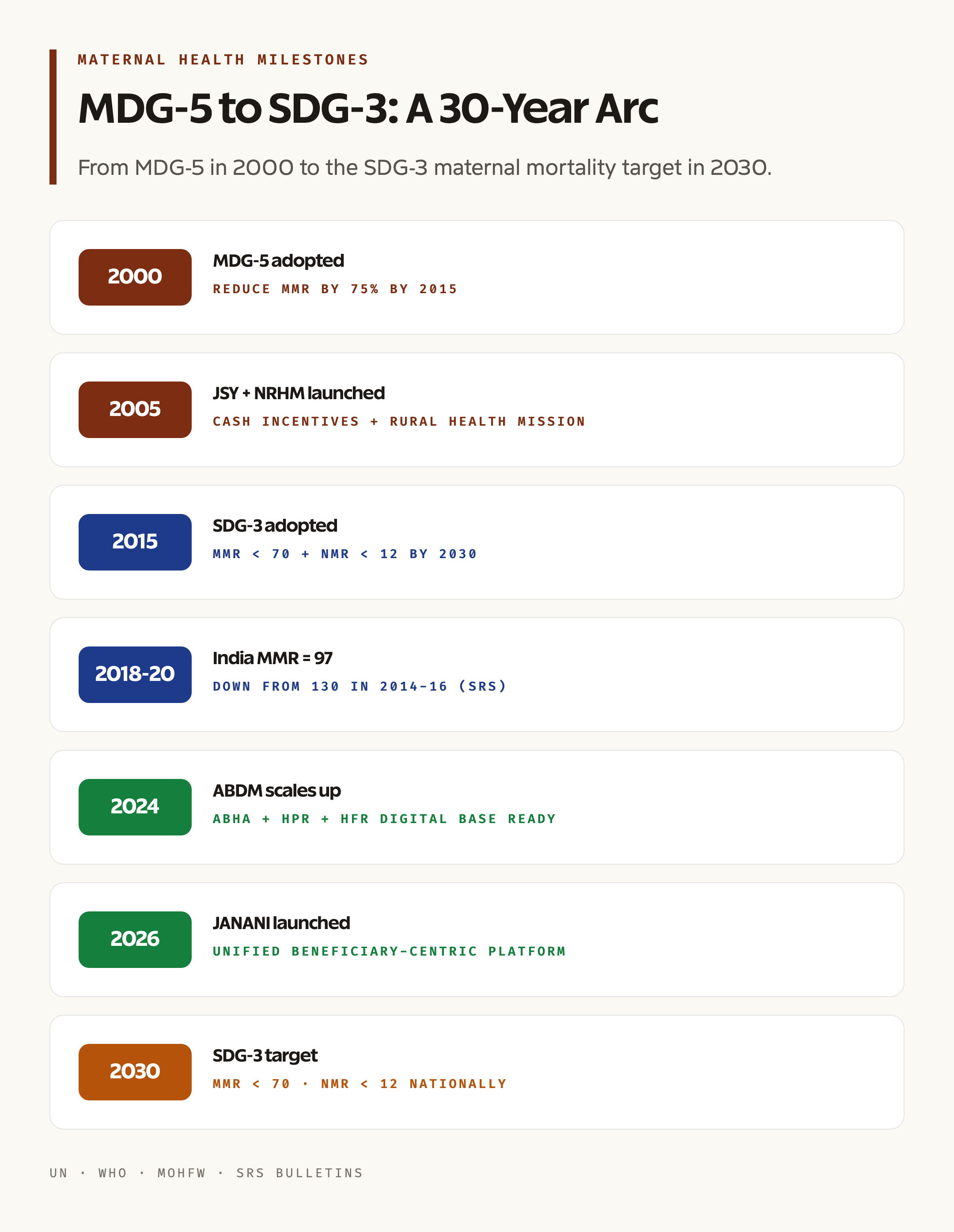
India’s maternal and neonatal indicators have improved but unevenly. The MMR has fallen from 130 in 2014-16 to 97 in 2018-20. The IMR has fallen from 39 in 2014 to 28 in 2020. But state variance is sharp. Kerala has an MMR below 20, while Assam, Madhya Pradesh, and Uttar Pradesh still hover well above 150. The neonatal mortality rate, the toughest indicator to move, has fallen slowly.
The JANANI Platform matters because it tackles the data and accountability gap that scheme-based interventions have struggled to fix. Cash incentives raised institutional delivery rates but did not always translate into quality care. The platform gives the supervisor at every level a real-time view of who needs the next visit, who is high-risk, and where the system is failing.
It matters at the SDG level because SDG-3 targets 3.1 and 3.2 commit India to an MMR below 70 by 2030 and a neonatal mortality rate below 12 by 2030. Hitting these targets without faster gains in the laggard states is impossible.
Detailed Analysis: How JANANI Changes the Care Pathway
The platform reorganises the care pathway around the beneficiary rather than the facility. Earlier, each facility kept its own register and the woman carried a paper card. If she moved during pregnancy, her record didn’t move with her. Under JANANI, the record sits in the cloud and follows her wherever she goes.
Four design choices stand out. The first is that the QR card lives on the woman’s phone or as a printed card with the same QR code, so even feature-phone households are covered. The second is that the automated risk alerts run on objective clinical markers rather than provider judgement alone. The third is that scheme entitlements are auto-calculated, which reduces the leakage and delays that JSY beneficiaries have historically faced. The fourth is that the platform is built on the ABDM framework, which makes it interoperable with hospital information systems and lab systems.
The implementation challenge is non-trivial. ANMs and ASHAs need devices, training, and data connectivity. Health facilities need stable internet and basic equipment. District officials need to act on the dashboards rather than treating them as performance theatre.
Comparative View: Maternal Health Systems Worldwide
Several countries have built similar digital maternal-health platforms with varied success.
| Country | Platform | Key feature |
|---|---|---|
| Rwanda | RapidSMS | SMS-based risk alerts via community health workers |
| Bangladesh | OpenMRS-based MNCH | Open-source mother-child health record |
| Indonesia | Posyandu app | Village-level integrated mother-child monitoring |
| Brazil | e-SUS APS | Primary care record covering pregnancy and child |
| India (2026) | JANANI Platform | ABDM-linked end-to-end digital care |
What distinguishes JANANI from comparable systems is its tight integration with the broader ABDM stack. ABHA, HPR, HFR, and the Unified Health Interface all sit underneath the platform. This means JANANI is not a standalone vertical but a building block in a larger digital health infrastructure.
Challenges and Implementation Risks
Five risks need close watching.
- Connectivity in tribal and remote blocks: Where ANMs and ASHAs operate without stable internet, syncing is intermittent.
- Device availability: Field workers need tablets or smartphones with active SIMs. Many states still rely on personal devices.
- Privacy and consent: Pregnancy and clinical data is sensitive. The DPDP Act 2023 sets the floor, but operational SOPs need careful design.
- Quality versus coverage: Dashboards can incentivise data entry over actual care. Independent audits are needed.
- Private-sector linkage: Half of India’s deliveries happen in the private sector. Until private facilities upload data to JANANI, the picture remains partial.
The Ministry has acknowledged these risks and committed to a phased rollout, with audits by NHSRC and NITI Aayog at the six-month, one-year, and 18-month marks.
Prelims Pointers
- JANANI: Journey of Antenatal, Natal and Neonatal Integrated Care
- Launched by: Ministry of Health and Family Welfare, May 2026
- Anchor framework: Ayushman Bharat Digital Mission (ABDM)
- ABHA: Ayushman Bharat Health Account number
- Janani Suraksha Yojana (JSY): 2005, cash incentive for institutional delivery
- Janani Shishu Suraksha Karyakram (JSSK): 2011, free maternal services
- Pradhan Mantri Surakshit Matritva Abhiyan (PMSMA): 2016, ninth of every month
- SUMAN: 2019, rights-based maternal and newborn care
- LaQshya: 2017, labour-room quality
- MMR target SDG-3.1: Below 70 per lakh live births by 2030
- NMR target SDG-3.2: Below 12 per 1,000 live births by 2030
- Latest India MMR: 97 per lakh live births (SRS 2018-20)
- Latest India IMR: 28 per 1,000 live births (SRS 2020)
Mains Questions
- The JANANI Platform marks a shift from scheme-based interventions to a beneficiary-centric digital architecture for maternal and child health. Critically examine its design and implementation challenges. (GS Paper II, 15 marks)
- Discuss the role of the Ayushman Bharat Digital Mission in transforming public health service delivery in India. Use the JANANI Platform as a case study. (GS Paper II, 15 marks)
- India’s progress on SDG-3 targets for maternal and neonatal mortality has been uneven. Suggest a roadmap to close the state-level gap by 2030. (GS Paper II, 10 marks)
- Examine the role of frontline health workers, especially ASHAs and ANMs, in the success of digital maternal-health platforms like JANANI. (GS Paper II, 10 marks)
Way Forward
The most durable response to maternal and neonatal mortality runs along three tracks. The first is platform completion — the JANANI Platform must reach 100 percent of public facilities and onboard private facilities through ABDM. The second is workforce — every sub-centre must have a fully trained and equipped ANM, and every village an active ASHA. The third is equity — high-MMR states need extra fiscal and capacity support under the National Health Mission flexipool.
Beyond these tracks, three structural shifts will accelerate progress. Comprehensive abortion care, addressed in the MTP Act amendments of 2021, must be available without stigma. Adolescent reproductive health, addressed under RKSK, must be expanded. And nutrition for women of reproductive age, addressed under POSHAN Abhiyaan, must be tightly linked to ANC visits.
Three companion reads on Anantamias deepen this analysis. See our explainer on the Ayushman Bharat Digital Mission, the National Health Mission and POSHAN Abhiyaan for the larger health policy arc.
Frequently Asked Questions
What is the JANANI Platform?
JANANI stands for Journey of Antenatal, Natal and Neonatal Integrated Care. It is a unified digital platform launched by the Ministry of Health and Family Welfare on May 7, 2026 that tracks every pregnant woman and newborn through a single record from registration to six weeks postpartum. It uses QR-enabled cards, automated risk alerts, and real-time dashboards.
How does the JANANI Platform integrate with ABDM?
The platform is built on the Ayushman Bharat Digital Mission framework. Every beneficiary gets an ABHA number, the platform plugs into the Healthcare Professionals Registry and the Health Facility Registry, and records can flow across facilities using the Unified Health Interface. This makes the JANANI Platform interoperable rather than a stand-alone silo.
Which schemes does the JANANI Platform link?
The platform converges five major schemes: Janani Suraksha Yojana, Janani Shishu Suraksha Karyakram, Pradhan Mantri Surakshit Matritva Abhiyan, LaQshya, and SUMAN. Entitlements under each scheme are calculated and tracked automatically through the beneficiary’s record.
What is India’s current maternal mortality ratio?
India’s maternal mortality ratio stood at 97 per lakh live births according to the SRS bulletin 2018-20. It has fallen from 130 in 2014-16 but remains above the SDG-3 target of 70 per lakh live births by 2030. State variance is sharp, with Kerala below 20 and several northern states still above 150.
What is India’s current infant mortality rate?
India’s infant mortality rate stood at 28 per 1,000 live births in 2020, as per the latest SRS. The neonatal mortality rate has been the slowest to move, and it dominates the IMR figure. The SDG-3 target is to bring NMR below 12 per 1,000 live births by 2030.
Who runs the JANANI Platform?
The platform is operated by the National Health Authority in partnership with the Ministry of Health and Family Welfare. State health departments are responsible for rollout on the ground. The platform is funded through the National Health Mission budget.
How does the QR-enabled card work?
Every beneficiary gets a QR-enabled care card linked to her ABHA number. The card can be printed or held on a phone. Health workers scan the QR code at every visit, which pulls up the woman’s complete record, including ANC visits, lab results, scheme entitlements, and risk alerts. The same card follows her if she moves states.
What automated risk alerts does the platform send?
The platform triggers alerts when clinical markers cross threshold values. Severe anaemia, gestational hypertension, gestational diabetes, prior obstetric history, and several other conditions activate an alert. The alert goes to the ANM, the medical officer at the PHC, and the first referral unit so referrals can be planned in advance.
Does the platform cover the private sector?
Initially, the platform covers public facilities, where most JSY and JSSK beneficiaries are tracked. Private facilities will onboard in phases through the ABDM framework. Until private-sector data is integrated, the platform sees only part of the maternal and neonatal care picture in India.
How does the JANANI Platform help India reach SDG-3?
The JANANI Platform addresses the data and accountability gap that has slowed progress on MMR and NMR targets. Real-time dashboards, automated risk alerts, and scheme convergence allow district and state officials to focus on the highest-risk pregnancies and the slowest-improving blocks. Hitting SDG-3 targets by 2030 needs faster gains in laggard states, and the platform is the operational instrument for that push.
Tell Google you want more of this.
Add Anantam IAS as a preferred sourceOne tap, and this site shows up more often in your own Top Stories, AI Overviews and AI Mode. Remove it any time.