Why in News?
The Indian Express Explained has published a walk-through of Jharkhand’s tribal land-protection regime, timed to the anniversary of the Santhal Hul of 1855 — the revolt in the Damin-i-Koh region of present-day eastern Jharkhand that erupted over 170 years ago against British officials, zamindars and moneylenders. That uprising produced one of India’s earliest protective tenancy laws for Adivasi land.
The top-line finding is sobering: despite three stacked layers of protection — the Chotanagpur Tenancy (CNT) Act, 1908, the Santhal Parganas Tenancy (SPT) Act and the PESA Act, 1996 operating under the Fifth Schedule — one of India’s most mineral-rich states keeps losing adivasi land to mining overrides, land banks, fraudulent transfers and weak restoration machinery.
- The Santhal Hul (revolution) of 1855, which some accounts date to the first week of July, led the British to enact the SPT Act of 1876 to check land alienation and exploitative moneylending; it was consolidated after Independence as the Santhal Parganas Tenancy (Supplementary Provisions) Act, 1949.
- The CNT Act, 1908 was itself the outcome of Birsa Munda’s Ulgulan (1899-1900) — both of Jharkhand’s core land laws were won through tribal revolt.
- A 1996 amendment to Section 49 of the CNT Act expanded permissible land transfers from religious, educational and charitable purposes to industrial and mining purposes, subject to the Deputy Commissioner’s sanction.
- Researchers quoted by the Indian Express say central laws such as the MMDR Act, 1957 and the Coal Bearing Areas (Acquisition and Development) Act, 1957 routinely override tribal tenancy laws in the name of ‘public interest’.
- During a 2016 aerial survey for mineral exploration, tribal common lands used for grazing, threshing and festivals were marked as wasteland and diverted to land banks and compensatory afforestation.
- Section 71A of the CNT Act mandates restoration of illegally transferred tribal land, but enforcement is sporadic; mafia-backed transfers are disguised as dan patra (gift deeds) or badlanama (exchange deeds).
The development matters in the context of:
- Jharkhand sits at the heart of India’s tribal-land question: Scheduled Tribes make up about 26.2% of its population (Census 2011), and the state’s coal, iron ore and bauxite belts overlap almost exactly with its Fifth Schedule areas.
- The episode is a live case study of the classic UPSC tension between development and displacement — how resource extraction, afforestation targets and industrial land pooling collide with constitutional guarantees of tribal self-governance.
- It also revives the relevance of the Samatha judgment (1997), in which the Supreme Court voided mining leases of government land in Scheduled Areas to non-tribals.

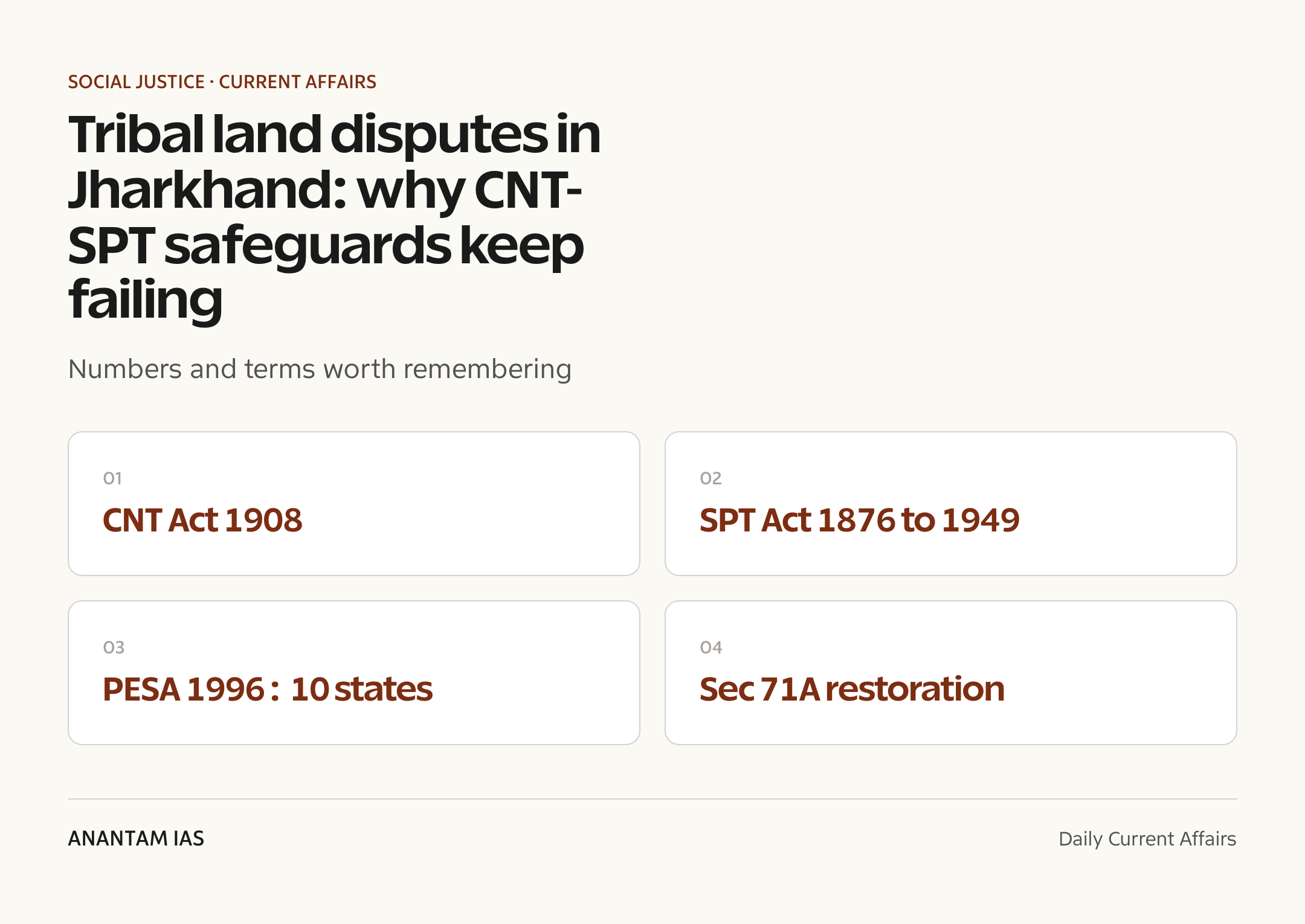
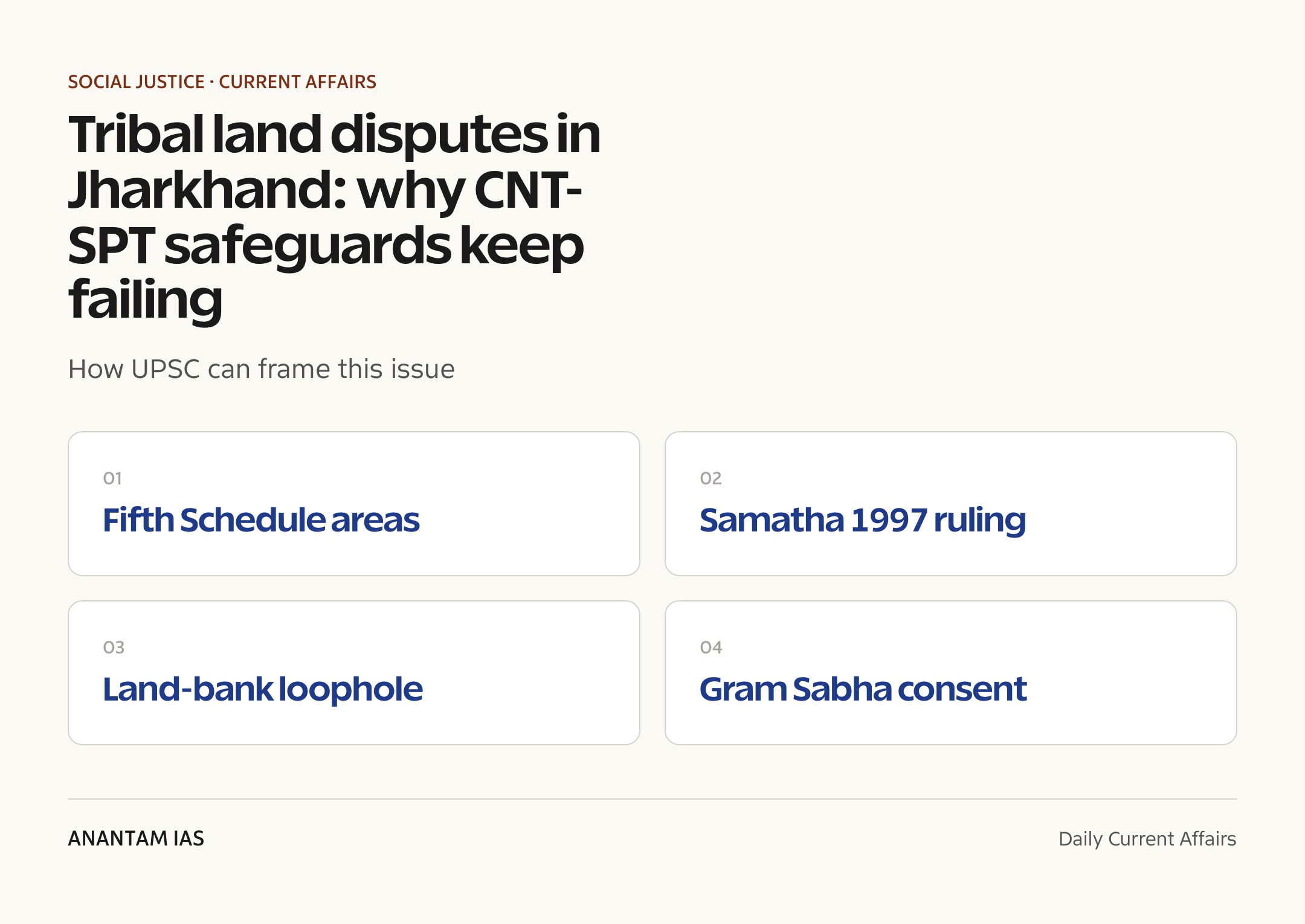
UPSC Relevance
Prelims Relevance
- Santhal Hul, 1855 — Santal revolt in the Damin-i-Koh region led by Sido and Kanhu Murmu against the British, zamindars and moneylenders; precursor of the SPT Act.
- SPT Act — enacted 1876, consolidated as the Santhal Parganas Tenancy (Supplementary Provisions) Act, 1949; prohibits transfer of Adivasi land (urban or rural) to non-Adivasis; land passes only by inheritance under the Act.
- SPT Act covers the six Santal Pargana districts: Dumka, Deoghar, Godda, Pakur, Sahibganj and Jamtara.
- CNT Act, 1908 — followed Birsa Munda’s Ulgulan; allows Adivasi-to-Adivasi transfers within the same police station and Dalit transfers within the same district, with the District Collector’s approval.
- CNT Act applies to the North Chotanagpur, South Chotanagpur and Palamau divisions — districts such as Ranchi, Hazaribagh, Palamu, Khunti and Gumla.
- PESA Act, 1996 — extends Part IX of the Constitution (Panchayats) to Fifth Schedule areas; recognises Gram Sabha control over natural resources; notified in 10 states, including Jharkhand.
- Fifth Schedule (Article 244(1)) — Scheduled Areas and Scheduled Tribes in states other than Assam, Meghalaya, Tripura and Mizoram; Governor’s report and Tribes Advisory Council.
- Samatha v State of Andhra Pradesh (1997) — SC held leases of government land in Scheduled Areas to non-tribals void; mining only via the state mineral corporation or tribal cooperatives.
- Section 71A, CNT Act — power to restore illegally transferred tribal land; Section 49 — transfers for industrial/mining purposes after the 1996 amendment.
- Land bank — a government pool of land parcels held for future allotment; in Jharkhand it has absorbed tribal commons recorded as ‘wasteland’.
Mains Relevance
GS Paper 1
- Tribal uprisings (Santhal Hul, Ulgulan) as the origin of protective land legislation — resistance shaping colonial policy.
- Land alienation as a driver of tribal marginalisation, cultural erosion and distress migration in central India.
GS Paper 2
- Fifth Schedule, PESA and Gram Sabha consent — the gap between constitutional design and administrative practice.
- Mechanisms for the protection of vulnerable sections: why restoration provisions like Section 71A fail without enforcement capacity.
- Centre-state and law-vs-law conflicts: central mining statutes overriding state tenancy protections.
GS Paper 3
- Mineral-led growth vs inclusive development: land banks, compensatory afforestation and the displacement-employment mismatch.
Essay
- Development that displaces is not development — the ethics of extraction in tribal India.
- Laws are only as strong as the administration that enforces them.
Background and Context
From Hul to statute: how revolt wrote the SPT Act
Jharkhand’s oldest land protections were conceded by the colonial state only after armed tribal resistance.
- In the Hul of 1855, Santals in the lush Damin-i-Koh region rose against economic and social oppression by the British, upper castes, zamindars and moneylenders.
- An enduring outcome was the SPT Act of 1876, designed to protect Adivasi communities from land alienation and exploitative moneylending; after Independence it was consolidated as the Santhal Parganas Tenancy (Supplementary Provisions) Act, 1949.
- The law prohibits the transfer of Adivasi land — urban or rural — to non-Adivasis; land can only be inherited as per the Act, preserving the Santals’ right to self-govern their land.
- It covers the six present-day Santal Pargana districts: Dumka, Deoghar, Godda, Pakur, Sahibganj and Jamtara.
- The Santhal tribe remains India’s largest Adivasi community — background on the community and the 1855 rebellion is at Santhal Tribe: culture and the 1855 rebellion.
The CNT Act, 1908: Birsa Munda's legislative legacy
The second pillar of Jharkhand’s land regime also traces to an uprising — the Ulgulan.
- The Chotanagpur Tenancy Act, 1908 was enacted by the British as a direct result of the Birsa Munda movement of 1899 (the Ulgulan, or ‘Great Tumult’).
- It permits land transfers within the same caste and specified geographical limits, with the District Collector’s approval — Adivasis may transfer to Adivasis of the same police station, Dalits to Dalits of the same district.
- The Act restricts the sale of both Adivasi and Dalit land, and applies to the North Chotanagpur, South Chotanagpur and Palamau divisions, covering districts such as Ranchi, Hazaribagh, Palamu, Khunti and Gumla.
- Section 71A gives authorities the power to restore illegally transferred tribal land — on paper, a self-correcting mechanism.
- A profile of the leader whose movement forced the law is at Birsa Munda: Ulgulan and legacy.
The constitutional layer: Fifth Schedule and PESA
Above the tenancy Acts sits a constitutional architecture meant to guarantee tribal self-rule.
- The Fifth Schedule, under Article 244(1), governs Scheduled Areas and Scheduled Tribes in most mainland states, with the Governor empowered to modify laws and a Tribes Advisory Council to advise — details at Scheduled Areas under the Fifth Schedule.
- The PESA Act, 1996 extends Part IX of the Constitution (Panchayats) to Scheduled Areas, mandating self-governance through Gram Sabhas and recognising community rights over natural resources — see PESA Act 1996 explained.
- PESA has been notified in ten states: Andhra Pradesh, Chhattisgarh, Gujarat, Himachal Pradesh, Jharkhand, Madhya Pradesh, Maharashtra, Odisha, Rajasthan and Telangana.
- In Samatha v State of Andhra Pradesh (1997), the Supreme Court held that leasing even government land in a Scheduled Area to non-tribals for mining is void; mining there may proceed only through the state mineral development corporation or tribal cooperatives.
Leak one: mining laws that trump tenancy laws
The first and largest loophole is structural — central extraction statutes sit above state protections.
- Researchers told the Indian Express that central laws like the Mines and Minerals (Development and Regulation) Act, 1957 and the Coal Bearing Areas (Acquisition and Development) Act, 1957 often override tribal laws in the name of public interest.
- The Judicial Academy Jharkhand’s Handbook on Land Laws records that Section 49 of the CNT Act originally allowed transfers only for religious, educational and charitable activities; a 1996 amendment widened it to industrial and mining purposes with the Deputy Commissioner’s sanction.
- Mining leases are issued under overlapping mining, environmental, forest and land-acquisition laws, creating running conflicts with PESA and the Fifth Schedule over which law prevails; state authorities frequently prioritise industrial policy over local self-governance.
- PESA is also gamed at the ground level: it applies to minor minerals (sand, clay, gravel), and companies sometimes obtain minor-mineral permissions while actually extracting major minerals, a Ranchi-based lawyer told the paper.
Leak two: land banks, 'wastelands' and afforestation
The second leak converts tribal commons into state inventory through classification.
- Land banking — the state acquiring land to redistribute or allocate later — often sweeps in parcels of tribal land.
- Tribal villages hold common lands not actively farmed but used for cattle grazing, threshing, crop storage, community gatherings and festivals; during the 2016 aerial survey for mineral exploration, many such commons were recorded as wasteland.
- These ‘wastelands’ were then used for compensatory afforestation — itself criticised for planting non-native species that fail to replicate traditional forests.
- After plantation, land is often transferred to the Forest Department, extinguishing the community’s traditional access to forest land and produce — a pattern that sits uneasily with the Forest Rights Act, 2006.
Leak three: fraud deeds and a restoration clause that sleeps
Even where the law is clear, transfers slip through disguised paperwork and thin enforcement.
- Section 71A of the CNT Act mandates restoration of illegally transferred tribal land, but enforcement is sporadic.
- Research on Jharkhand’s land transactions (Niranjan Baghwar, ‘Land, Law and Power’) finds mafia-backed transfers disguised as dan patra (gift deeds) or badlanama (exchange deeds), bypassing scrutiny through procedural loopholes.
- The human cost compounds the legal one: as Ranchi-based researcher Akriti Lakra put it, communities aren’t against development, but displaced Adivasis end up in low-paying, low-skilled jobs with little presence in decision-making — losing land without gaining economic security.
Why Jharkhand is the crucible
Geography and geology make the state the sharpest test of India’s tribal-land promise.
- Jharkhand is among India’s most mineral-rich states — coal, iron ore, bauxite and mica — and its richest seams lie under Fifth Schedule land.
- Scheduled Tribes form roughly 26.2% of the state’s population (Census 2011), among the highest shares in mainland India.
- Every instrument in the protective stack — CNT, SPT, PESA, the Fifth Schedule, Samatha — is tested here first and hardest, which is why Jharkhand’s failures are national lessons.
Way Forward
Close the statutory gaps
- Harmonise central mining statutes with PESA and state tenancy laws so that Gram Sabha consent isn’t nullified by ‘public interest’ acquisition; the Samatha principle should guide leasing in all Fifth Schedule states.
- Review the 1996 amendment to Section 49 of the CNT Act and tighten the industrial/mining transfer route with time-bound, reasoned, appealable sanads.
- Audit land banks in Scheduled Areas and de-notify tribal commons wrongly classified as wasteland, restoring recorded community uses.
Make restoration real
- Convert Section 71A into a functioning remedy: special restoration benches, digitised record-of-rights, and proactive scrutiny of gift and exchange deeds involving tribal land.
- Strengthen Gram Sabha capacity — legal aid, survey access and mandatory prior consultation records — so consent is informed, not performed.
- Tie mining approvals to verifiable local employment and benefit-sharing, addressing the displacement-without-development grievance directly.
Conclusion
Jharkhand’s land laws are monuments to resistance — the SPT Act to the Hul of 1855, the CNT Act to Birsa Munda’s Ulgulan. But a protection regime that can be amended toward mining, out-classified by wasteland surveys and out-papered by fake gift deeds protects less than it promises.
The lesson for administrators and aspirants alike is the same: tribal land security fails not for want of law but for want of enforcement, harmonisation and good faith. Until restoration works as reliably as acquisition does, the disputes will outlive every statute written to end them.
UPSC Practice Questions
Prelims MCQ 1
With reference to tribal land laws in Jharkhand, consider the following statements:
- The Chotanagpur Tenancy Act, 1908 was enacted in the aftermath of Birsa Munda’s Ulgulan.
- The Santhal Parganas Tenancy Act permits the transfer of Adivasi land to non-Adivasis with the Deputy Commissioner’s approval.
- The PESA Act, 1996 extends Part IX of the Constitution to Scheduled Areas and has been notified in ten states.
How many of the above statements are correct?
(a) Only one (b) Only two (c) All three (d) None
Answer: (b) Only two
Explanation:
Statements 1 and 3 are correct. The SPT Act prohibits the transfer of Adivasi land (urban or rural) to non-Adivasis altogether — such land passes only by inheritance under the Act — so statement 2 is wrong.
Prelims MCQ 2
In Samatha v State of Andhra Pradesh (1997), the Supreme Court held that:
(a) The PESA Act applies to Sixth Schedule areas as well (b) Leases of government land in Scheduled Areas to non-tribals for mining are void (c) Gram Sabha consent is not required for minor mineral extraction (d) Fifth Schedule protection lapses once land is classified as wasteland
Answer: (b) Leases of government land in Scheduled Areas to non-tribals for mining are void
Explanation:
Samatha (1997) voided mining leases of land — including government land — in Scheduled Areas granted to non-tribals, holding that mining there may proceed only through the state mineral development corporation or cooperatives of tribal people.
UPSC Mains Questions
- Jharkhand’s protective tenancy laws were born out of tribal revolts, yet adivasi land alienation continues. Identify the legal and administrative loopholes in the CNT-SPT framework and suggest measures to make land restoration effective. (250 words)
- The PESA Act, 1996 promised self-governance in Scheduled Areas, but its spirit is routinely defeated by mining policy, land banks and compensatory afforestation. Critically examine with reference to Jharkhand. (250 words)
Sources: Indian Express Explained and India Code, Santhal Parganas Tenancy (Supplementary Provisions) Act 1949.
Frequently Asked Questions
What is the Santhal Hul of 1855?
The Hul (revolution) was the Santal uprising of 1855 in the Damin-i-Koh region of present-day eastern Jharkhand, directed against oppression by the British, upper castes, zamindars and moneylenders. It forced the colonial state to enact the SPT Act of 1876 protecting Adivasi land from alienation and exploitative moneylending.
What does the SPT Act prohibit?
The Santhal Parganas Tenancy Act prohibits the transfer of Adivasi land, urban or rural, to non-Adivasis; the land can only be inherited as provided in the Act. It covers six Santal Pargana districts — Dumka, Deoghar, Godda, Pakur, Sahibganj and Jamtara — and was consolidated post-Independence by the 1949 Supplementary Provisions Act.
How is the CNT Act, 1908 different?
The Chotanagpur Tenancy Act, enacted after Birsa Munda’s Ulgulan, restricts sale of Adivasi and Dalit land but allows limited transfers — Adivasi to Adivasi within the same police station, Dalit to Dalit within the same district — with the District Collector’s approval. It applies to the North and South Chotanagpur and Palamau divisions.
What is Section 71A of the CNT Act?
Section 71A mandates the restoration of tribal land that has been illegally transferred. In practice enforcement is sporadic: fraudulent transfers are disguised as gift deeds (dan patra) or exchange deeds (badlanama), and restoration proceedings are slow, so alienated land is rarely returned to Adivasi owners.
Why does PESA fail to stop land alienation?
Central mining and land-acquisition laws often override PESA in the name of public interest, and overlapping mining, forest and environmental clearances blur which law prevails. Companies also exploit the minor-minerals window — taking permissions for sand or gravel while extracting major minerals — and states prioritise industrial policy over Gram Sabha consent.
What did the Samatha judgment decide?
In Samatha v State of Andhra Pradesh (1997), the Supreme Court held that leasing land in a Scheduled Area — even government land — to non-tribals for mining is void. Mining in such areas may be carried out only by the state mineral development corporation or cooperatives of tribal people, reinforcing Fifth Schedule protections.
Tell Google you want more of this.
Add Anantam IAS as a preferred sourceOne tap, and this site shows up more often in your own Top Stories, AI Overviews and AI Mode. Remove it any time.