Why in News?
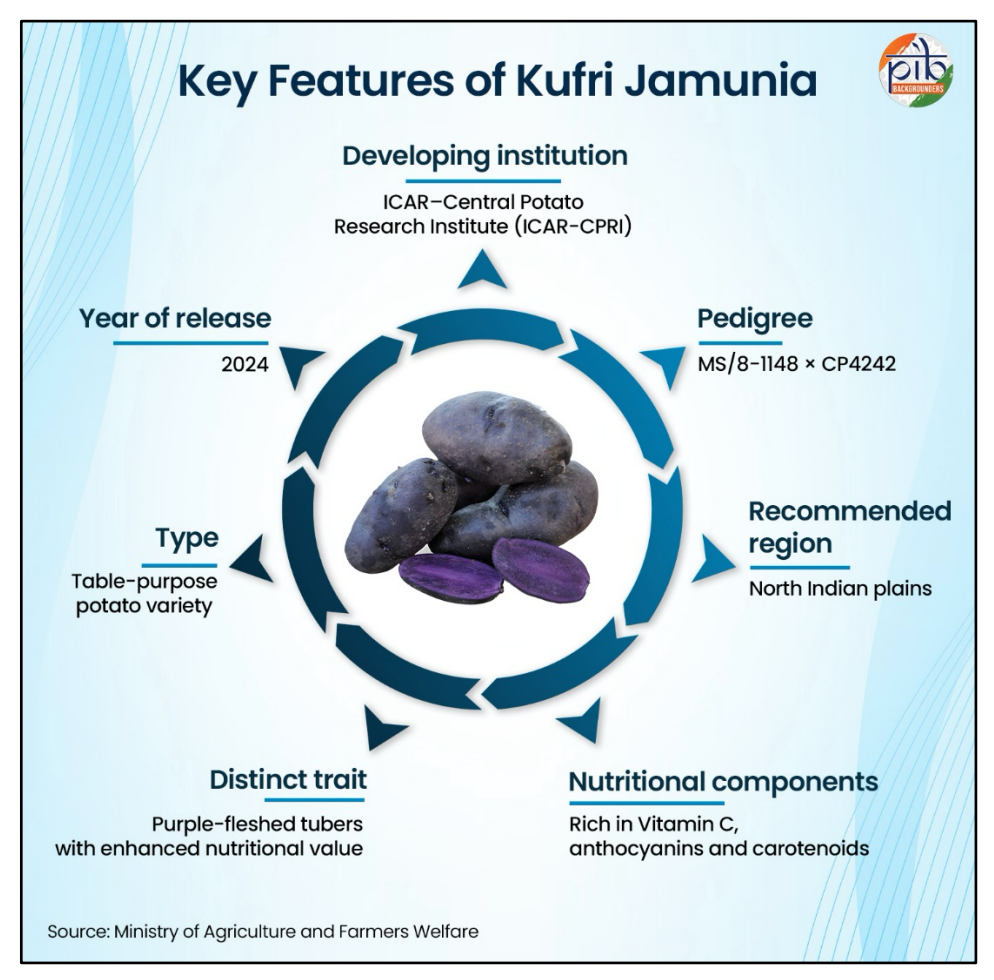
Kufri Jamunia is a biofortified, purple-skinned and purple-fleshed potato variety developed by the ICAR-Central Potato Research Institute (CPRI).
Approved & Officially notified in 2024, it is being promoted by the government to tackle hidden hunger: a form of malnutrition where individuals consume adequate calories but lack vital micronutrients.
| UPSC Relevance: GS-2 Social Justice: Health, Hunger, GS-3 Science and Technology: Biotechnology Prelims & Mains: Food Fortification; Kufri Jamunia |
Nutritional Profile of Kufri Jamunia:
Developed by crossing two potato lines MS/8-1148 (high vitamin C) and CP4242 (purple skin and flesh), Kufri Jamunia accumulates higher levels of specific compounds compared to regular white or yellow potato varieties:
- Vitamin C: ~42.75 mg per 100g (vs. ~23.15 mg in regular potatoes)
- Anthocyanins: ~42.05 mg per 100g (potent antioxidants responsible for the purple pigment, also found in jamun and blueberries)
- Iron: ~3.22 mg per 100g (vs. ~0.57 mg in regular potatoes)
- Zinc: ~2.28 mg per 100g (vs. ~0.28 mg in regular potatoes)
- Carotenoids: Varies widely by region, ranging from 15.6 µg (Kanpur) to 298.4 µg (Raipur) per 100g in multi-location trials.
Comparison with other CPRI varieties: It contains slightly less zinc than Kufri Neelkanth and slightly less iron than Kufri Manik.
Potential to Combat Hidden Hunger:
- High Nutrient Density: Provides significant quantities of iron, zinc, vitamin C, and antioxidants directly through an affordable vegetable base.
- Culinary Versatility: CPRI researchers note that its mealy texture makes it adaptable for everyday Indian dishes like curries, parathas, soups, baked goods, and dehydrated flours.
- Short Maturity Cycle: Plants mature in roughly 90 days and yield 10-12 tubers per plant, fitting well into existing crop rotations.
- Initial Consumer Acceptability: In small-scale sensory panels, the variety scored high on general acceptability (95% rated it good to excellent).
Why Claiming it a “Proven Solution” is Premature?
- Inconsistent Dietary Consumption: Traditional biofortification targets universal staples consumed daily throughout the year (e.g., rice, wheat, iodised salt). Potatoes are consumed less consistently and vary sharply across regional and seasonal diets.
- Cooking and Processing Losses: Micronutrients and anthocyanins degrade depending on preparation methods. Studies on purple potatoes show that steaming or microwaving preserves nutrients better than stir-frying, yet specific data for Kufri Jamunia under diverse Indian cooking styles is lacking.
- Yield and Economic Viability:
- Multi-location trials recorded an overall mean yield of 31.96 tonnes per hectare (lower than varieties like Kufri Neelkanth at 36.61 t/ha).
- Marketable yield sits around 29.19 t/ha versus 33.48 t/ha for Kufri Neelkanth, meaning farmers may require a ~15% price premium over standard wholesale potatoes (~₹17/kg) to maintain equal revenue.
- Disease Susceptibility: While showing moderate resistance to late blight in labs, it has proven susceptible in field conditions, requiring higher fungicide input costs.
- Colour and Market Friction: Purple skin and flesh deviate from traditional consumer expectations, and small trial cohorts (e.g., 64 people) are insufficient to generalise nationwide market adoption.
Way Forward:
To make biofortified crops like Kufri Jamunia effective policy tools, a multi-pronged strategy is required:
- Targeted Distribution: Instead of open-market reliance, integrate Kufri Jamunia into public welfare schemes like the Mid-Day Meal Scheme or Anganwadi feeding programs where nutritional intake can be tracked.
- Seed Subsidies: Since seed potato costs account for 40-50% of cultivation expenses (₹60,000-75,000/hectare), government seed-multiplication programs must subsidise quality planting material for smallholders.
- Cooking & Bioavailability Research: Conduct localised studies on how traditional Indian cooking (pressure-cooking, deep-frying, prolonged boiling) impacts iron and zinc bioavailability.
- Awareness Campaigns: Use Farmer Producer Organisations (FPOs) and Krishi Vigyan Kendras (KVKs) to educate consumers on the health benefits of colored functional foods.
Practice Prelims MCQ:
Q. Consider the following statements regarding ‘Kufri Jamunia’, recently in the news:
- It is a biofortified potato variety developed by the ICAR-Central Potato Research Institute.
- Its purple colour and high antioxidant properties are attributed to the presence of carotenoids exclusively.
- It contains significantly higher levels of iron and zinc compared to regular commercial potato varieties.
Which of the statements given above is/are correct?
(a) 1 and 2 only
(b) 1 and 3 only
(c) 2 and 3 only
(d) 1, 2, and 3
Answer: (b)
Explanation: Statement 2 is incorrect because the purple colour and antioxidant properties of Kufri Jamunia come primarily from anthocyanins, not carotenoids exclusively (though it contains carotenoids as well).
Mains Practice Question:
Q. “Biofortification of staple and regional crops offers a promising decentralised route to combat hidden hunger.” Examine this statement in the context of the newly notified Kufri Jamunia potato variety.
Tell Google you want more of this.
Add Anantam IAS as a preferred sourceOne tap, and this site shows up more often in your own Top Stories, AI Overviews and AI Mode. Remove it any time.