Why in News?
A recent The Hindu op-ed framed the fight against childhood lead exposure as a “seven-point IQ opportunity” for Indian children — arguing that removing lead from everyday products and environments could lift the average child’s cognitive ability by several points, with large gains in lifetime productivity.
The piece spotlights lead as a silent, preventable neurotoxin that damages developing brains, and reframes the issue from a niche pollution problem into a question of human capital and India’s demographic dividend.
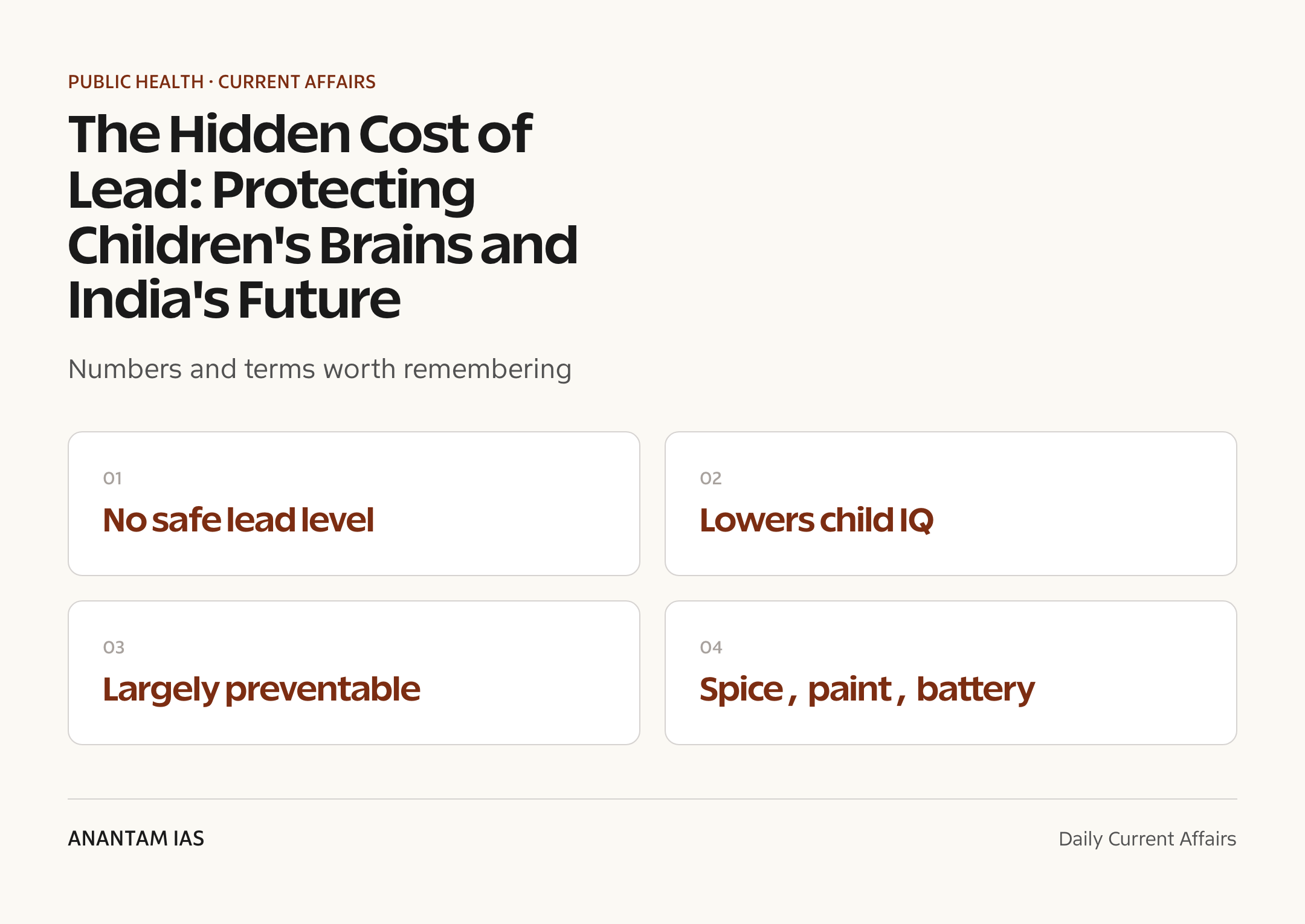
- Lead is a cumulative neurotoxin with no known safe blood level, per the World Health Organisation (WHO).
- Major exposure routes flagged: adulterated spices and turmeric, lead-based paint, informal lead-acid battery recycling, adulterated cosmetics (kajal/surma, sindoor), and contaminated water.
- Children absorb a far larger share of ingested lead than adults and are most vulnerable in the first years of brain development.
- Cutting exposure is presented as a high-return public-health investment — small per-child spending against large gains in IQ, schooling and earnings.
The development matters in the context of:
- Lead exposure is largely preventable, yet remains under-measured because it shows no obvious symptoms.
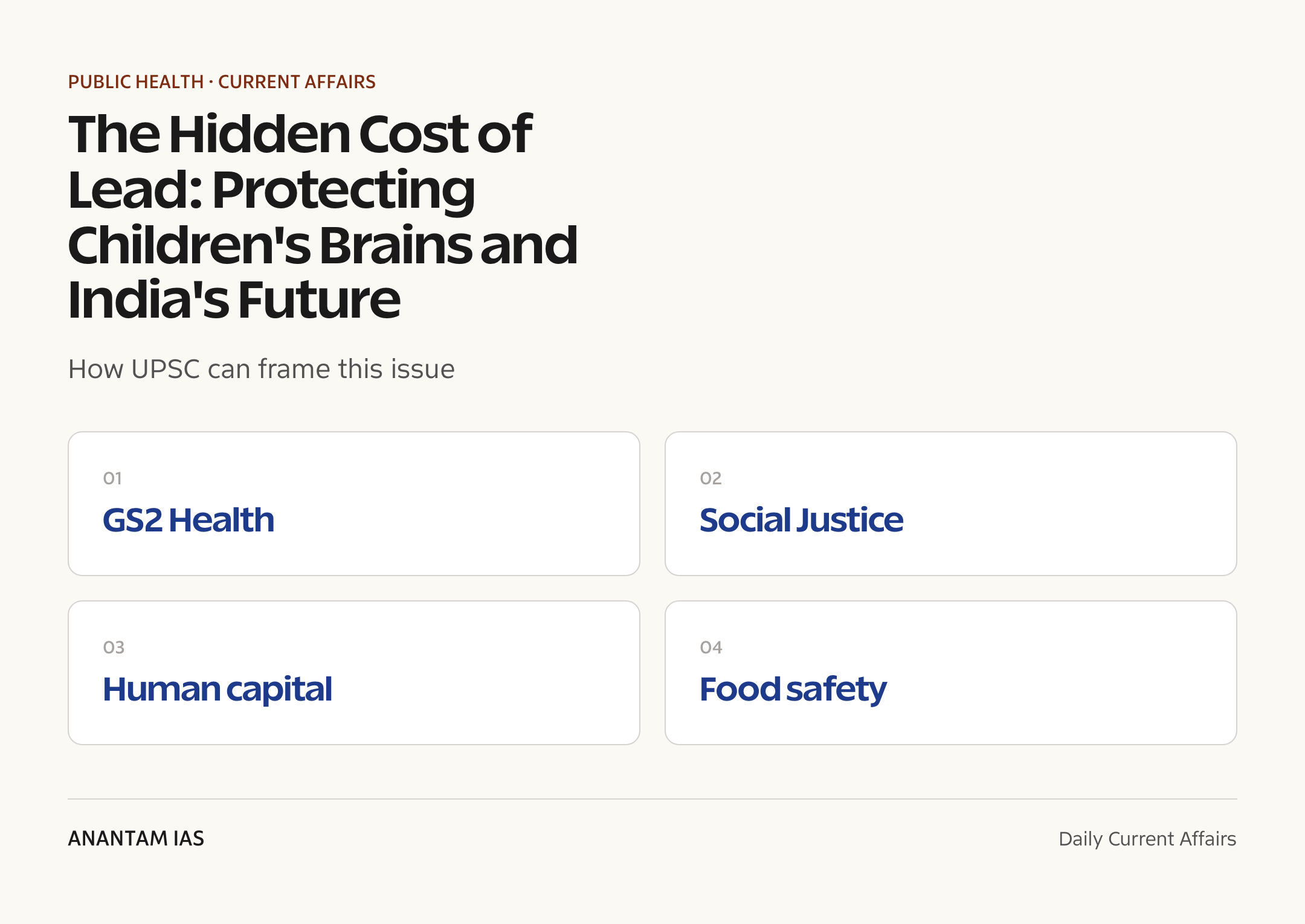
- It links environmental health, food safety and child-protection policy — a classic GS2 governance challenge cutting across ministries.
UPSC Relevance
Prelims Relevance
- Lead (Pb) — heavy metal, cumulative neurotoxin; no safe blood-lead level (WHO)
- Blood Lead Level (BLL) — measured in micrograms per decilitre (µg/dL)
- WHO — UN specialised agency for global public health
- BIS (Bureau of Indian Standards) — regulates lead content in paints
- FSSAI — Food Safety and Standards Authority of India; food/spice contamination
- NEERI — National Environmental Engineering Research Institute (CSIR)
- ICMR — Indian Council of Medical Research
- Lead-acid battery recycling as an informal-sector exposure source
- Demographic dividend — growth potential from a young working-age population
- Hazardous and Other Wastes (Management) Rules, 2016 — govern battery/lead waste
Mains Relevance
GS Paper 2
- Issues relating to the development and management of the health sector; preventive public health as a governance priority.
- Welfare of vulnerable sections (children); role of regulators (FSSAI, BIS) and inter-ministerial coordination.
GS Paper 3
- Environmental pollution and its human-health impacts; informal-sector recycling and hazardous-waste management.
- Conserving human capital as an input to economic growth and the demographic dividend.
Essay
- Health is wealth: why prevention beats cure for a young nation.
- Invisible harms: protecting children from what we cannot see.
Background and Context
Why lead is uniquely dangerous to children
Lead is a cumulative poison that targets the developing brain, and children are far more exposed than adults.
- The WHO states there is no known safe blood-lead level — harm can occur even at low concentrations (see our explainer on lead pollution in India).
- Children absorb a much larger fraction of ingested lead and retain more of it in growing tissues and bone.
- Effects include lower IQ, shorter attention span, behavioural problems and impaired learning — often irreversible.
- Because symptoms are usually silent, exposure goes undetected without deliberate blood-lead screening.
- Damage in early childhood compounds over a lifetime, lowering educational attainment and future earnings.
Where the lead comes from
Exposure in India is driven by everyday consumer and industrial sources rather than any single factory.
- Adulterated spices and turmeric — lead chromate added to brighten colour; part of a wider food-adulteration concern for FSSAI.
- Lead-based paint on walls, toys and furniture, shedding dust that young children ingest.
- Informal lead-acid battery recycling — backyard smelting that releases lead into soil, air and water.
- Adulterated cosmetics — traditional kajal/surma and some sindoor can carry high lead content.
- Contaminated drinking water from old pipes, solder and fittings; and contaminated soil near recycling sites.
The regulatory and institutional landscape
Several Indian bodies already hold mandates over lead, but coverage is fragmented across food, products and waste.
- BIS sets the permissible lead-in-paint limit and product standards for household paints.
- FSSAI regulates contaminants in food, including heavy metals in spices and processed items.
- NEERI (under CSIR) and ICMR conduct environmental and health research on lead.
- The Hazardous and Other Wastes (Management) Rules, 2016, govern the collection and recycling of used batteries.
- Enforcement gaps persist in the informal sector, where most unsafe battery recycling occurs outside formal oversight.
The economics: a human-capital argument
The op-ed’s central insight is economic — reducing lead is among the cheapest ways to raise national productivity.
- Even a few points of lost IQ across a cohort translate into large aggregate losses in earnings and output.
- Cutting childhood exposure could lift the average child’s IQ by several points — the “seven-point” framing.
- Prevention costs little per child compared with the lifetime cost of impaired learning and lower wages.
- Healthy young brains are the foundation of India’s demographic dividend; protecting them protects future growth.
- This reframes leads from an environmental nuisance into a core human-capital investment question.
Why the problem stays invisible
Lead exposure is under-recognised because it is silent, diffuse and rarely measured.
- No routine national blood-lead surveillance means the true burden is poorly mapped.
- Sources are scattered across food, paint, cosmetics and recycling — no single villain to regulate.
- Low public awareness of household sources, such as kajal/surma and old paint.
- Informal recycling is hard to police and often invisible in official pollution data.
- Without symptoms or screening, affected children are never identified as harmed.
Way Forward
Measure the burden
- Build routine blood-lead surveillance in children, anchored in ICMR and state health systems.
- Map high-risk clusters around informal recycling and contaminated water.
Tighten and enforce standards
- Strictly enforce BIS lead-in-paint limits and FSSAI contaminant rules for spices.
- Formalise and regulate lead-acid battery recycling under the 2016 waste rules with extended producer responsibility.
Inform and protect
- Run public-awareness campaigns on household sources — paint dust, adulterated turmeric and traditional cosmetics.
- Integrate lead screening and counselling into child-health and immunisation touchpoints.
Conclusion
Lead exposure is a textbook case of a preventable harm hiding in plain sight — silent, scattered across everyday products, and rarely measured, yet capable of quietly draining a child’s potential for life.
Treating it as a human-capital investment, not just a pollution problem, lets India convert a low-cost intervention into large, durable gains in IQ, schooling and earnings — strengthening the very demographic dividend the country is counting on.
UPSC Practice Questions
Prelims MCQ 1
With reference to childhood lead exposure in India, consider the following statements:
- The World Health Organisation recognises a safe lower threshold of blood-lead level below which no harm occurs.
- The Bureau of Indian Standards prescribes permissible limits for lead content in household paints.
- Informal recycling of lead-acid batteries is a recognised source of environmental lead contamination.
How many of the above statements are correct?
(a) Only one (b) Only two (c) All three (d) None
Answer: (b) Only two
Explanation:
Statement 1 is wrong — the WHO holds that there is no known safe blood-lead level. Statements 2 (BIS lead-in-paint limits) and 3 (informal battery recycling) are correct.
Prelims MCQ 2
Which one of the following bodies is primarily responsible for regulating heavy-metal contaminants such as lead in food items, including spices, in India?
(a) Bureau of Indian Standards (BIS)
(b) Food Safety and Standards Authority of India (FSSAI)
(c) National Environmental Engineering Research Institute (NEERI)
(d) Indian Council of Medical Research (ICMR)
Answer: (b) Food Safety and Standards Authority of India (FSSAI)
Explanation:
FSSAI sets and enforces limits for contaminants in food, including heavy metals in spices. BIS handles product standards like paint, NEERI does environmental research, and ICMR conducts health research.
UPSC Mains Questions
- “Reducing childhood lead exposure is one of the highest-return public-health investments available to India.” Discuss this claim in the context of human capital and the demographic dividend. (250 words)
- Childhood lead exposure in India is driven by everyday consumer and informal-sector sources. Examine the regulatory gaps and suggest a coordinated way forward. (250 words)
- Why does lead poisoning remain an under-recognised public-health challenge in India despite being largely preventable? Critically analyse. (150 words)
Sources: The Hindu and The Hindu.
Frequently Asked Questions
Why is lead dangerous for children?
Lead is a cumulative neurotoxin that damages the developing brain. Children absorb and retain more of it than adults, and the WHO holds there is no known safe blood-lead level. Exposure can lower IQ, shorten attention span and impair learning, with effects that are often permanent and rarely show visible symptoms.
What are the main sources of lead exposure in India?
The leading everyday sources are adulterated spices and turmeric, lead-based paint, informal lead-acid battery recycling, adulterated cosmetics such as kajal or surma, and contaminated drinking water from old pipes or solder. Soil near recycling sites can also be heavily contaminated, exposing children who play outdoors.
What is the “seven-point IQ opportunity”?
It is the argument that cutting childhood lead exposure could raise the average child’s IQ by several points. Because even small IQ gains across a whole cohort translate into large lifetime gains in schooling and earnings, removing lead is framed as one of the cheapest, highest-return investments in human capital a young nation can make.
Which Indian bodies regulate lead?
Responsibilities are split: BIS sets lead-in-paint and product standards, FSSAI regulates lead in food and spices, and the Hazardous and Other Wastes (Management) Rules, 2016 cover battery recycling. NEERI and ICMR carry out environmental and health research. The gaps lie mainly in enforcement within the informal sector.
How is lead linked to the demographic dividend?
India’s growth hopes rest on a large young population. If many of those children grow up with lead-impaired brains, their learning and earning potential falls, weakening the dividend. Protecting young brains from lead is so a way of protecting the country’s future productivity and economic growth.
Can lead poisoning be prevented?
Yes — it is largely preventable. Routine blood-lead surveillance in children, strict enforcement of BIS and FSSAI standards, formalising battery recycling, and public-awareness campaigns on paint, turmeric and traditional cosmetics can sharply cut exposure. Integrating screening into existing child-health services makes prevention low-cost and scalable.
Tell Google you want more of this.
Add Anantam IAS as a preferred sourceOne tap, and this site shows up more often in your own Top Stories, AI Overviews and AI Mode. Remove it any time.