Leaf Spot Disease arecanut is one of those agricultural stories that sits below the headlines but reshapes rural economies in real ways. Arecanut (the betel nut palm, Areca catechu) is not a niche crop in India. Karnataka alone runs an arecanut economy worth roughly ₹13,000 crore. Kerala and Assam both depend on arecanut for substantial farmer livelihoods. And the leaf spot complex, driven primarily by fungi like Phyllosticta arecae and Colletotrichum species, has been quietly eroding plantation health for years.
A new management demonstration project announced in late April 2026 has put Leaf Spot Disease arecanut back into policy conversation. For UPSC, this is a useful intersection of agricultural science (GS-III), plantation economics, federal-state coordination on agriculture, and the broader theme of crop-specific climate-amplified disease pressure. It’s also one of those topics that doesn’t show up in standard textbooks but rewards anyone who reads the agriculture-section dailies.
This piece covers the pathology, the geography of arecanut cultivation in India, the economic stakes, the management strategies that work and don’t, the comparative picture with other plantation crop diseases, and the policy gap that keeps recurring across India’s commercial crops.
Quick Facts at a Glance
- Crop affected: Arecanut (Areca catechu), the betel nut palm
- Disease: Leaf spot complex
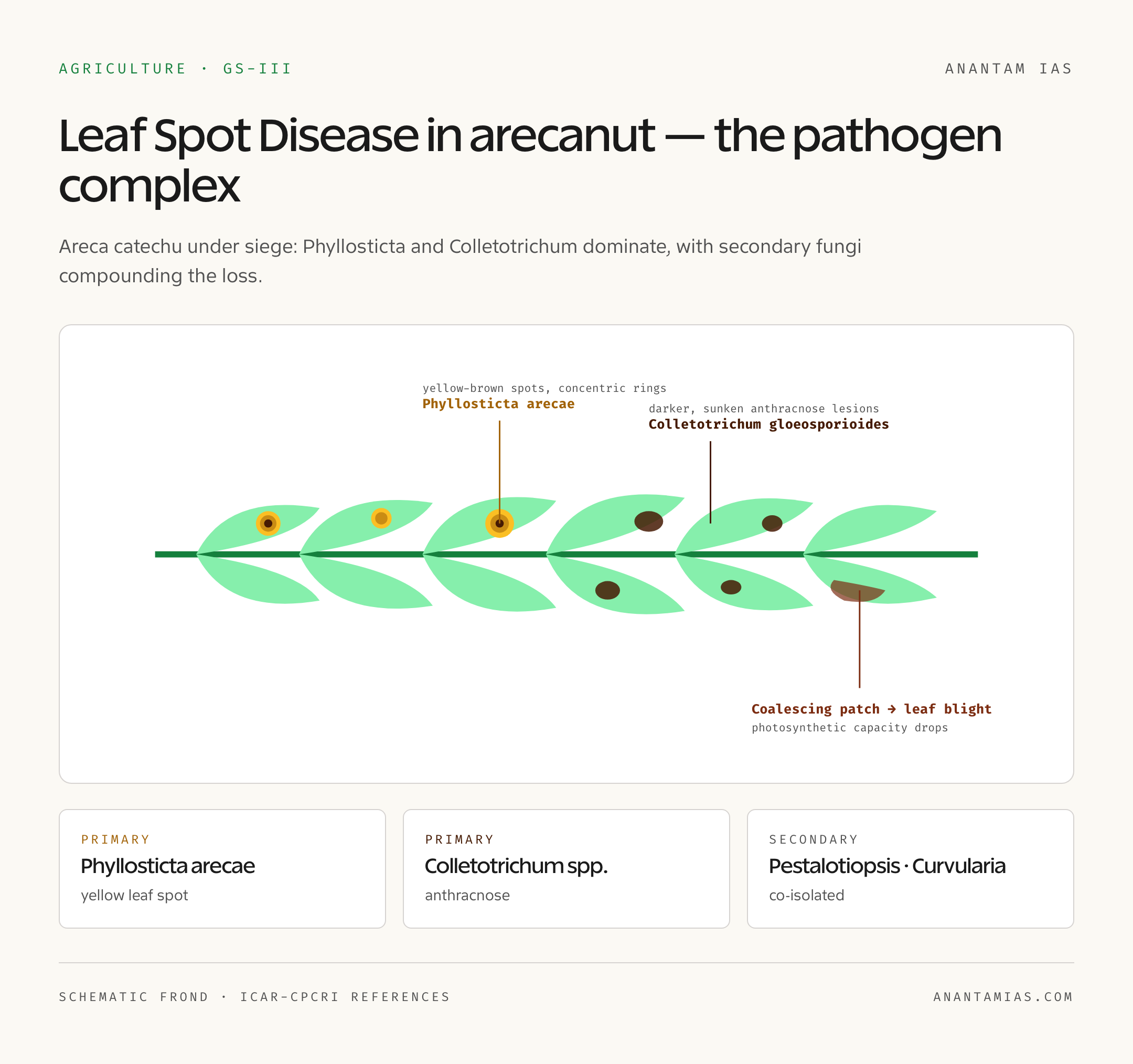
- Major pathogens: Phyllosticta arecae (yellow leaf spot), Colletotrichum gloeosporioides / Colletotrichum arecae (anthracnose-type spots), and other secondary fungi
- Symptoms: Small yellow to brown spots on leaves, often with concentric rings; coalescing spots cause leaf blight; reduced photosynthesis and yield
- Major affected states: Karnataka, Kerala, Assam, Tamil Nadu, Meghalaya
- Karnataka arecanut economy: Approximately ₹13,000 crore as per latest available data
- India’s share of global arecanut production: Largest producer globally
- Key research institute: ICAR-Central Plantation Crops Research Institute (CPCRI), Kasaragod, Kerala
- Management project: Demonstration project announced April 2026 to scale integrated disease management
What Just Happened: Why Leaf Spot Disease Arecanut Is in News
A management demonstration project for Leaf Spot Disease arecanut entered active rollout in late April 2026, focused on integrated pest and disease management practices in Karnataka and Kerala. The project pulls together fungicide protocols, plantation hygiene measures, drainage improvements, and farmer training, with the goal of demonstrating sustainable yield protection in disease-prone gardens.
The news matters because arecanut prices have been volatile, the crop faces simultaneous pressure from fruit rot (yellow leaf disease), root grub, and the leaf spot complex, and farmer suicides linked to crop failures have made this a politically sensitive issue in Karnataka’s areca-growing belt. The state government has been active on this front, with the central ICAR system providing technical backing.
Background and Historical Context
How Leaf Spot Disease Took Hold in Indian Plantations
Arecanut has been cultivated in India for over two thousand years. The crop is part of the cultural and economic fabric of southern and northeastern India, with the leaves used as plates, the nut consumed in pan, and the fiber and shell used in various applications. Plantation-scale cultivation expanded significantly in the post-independence period, especially in Karnataka, where supportive prices and a growing pan masala market drove area expansion.
As plantations scaled, so did disease pressure. Leaf spot symptoms have been recorded in Indian arecanut for over a century, but the severity and spread have intensified over the past few decades. Researchers point to several drivers: monoculture intensification (large contiguous areas of a single crop create disease highways), changes in rainfall patterns that favor fungal sporulation, planting in poorly drained soils, and reduced canopy management.
The Phyllosticta and Colletotrichum complex is now well-documented across all major arecanut-growing regions. The disease alone rarely kills a palm, but it reduces photosynthetic capacity, weakens the palm against secondary stresses, and contributes to yield decline that compounds over multiple seasons.
Geographic Setting and Key Features
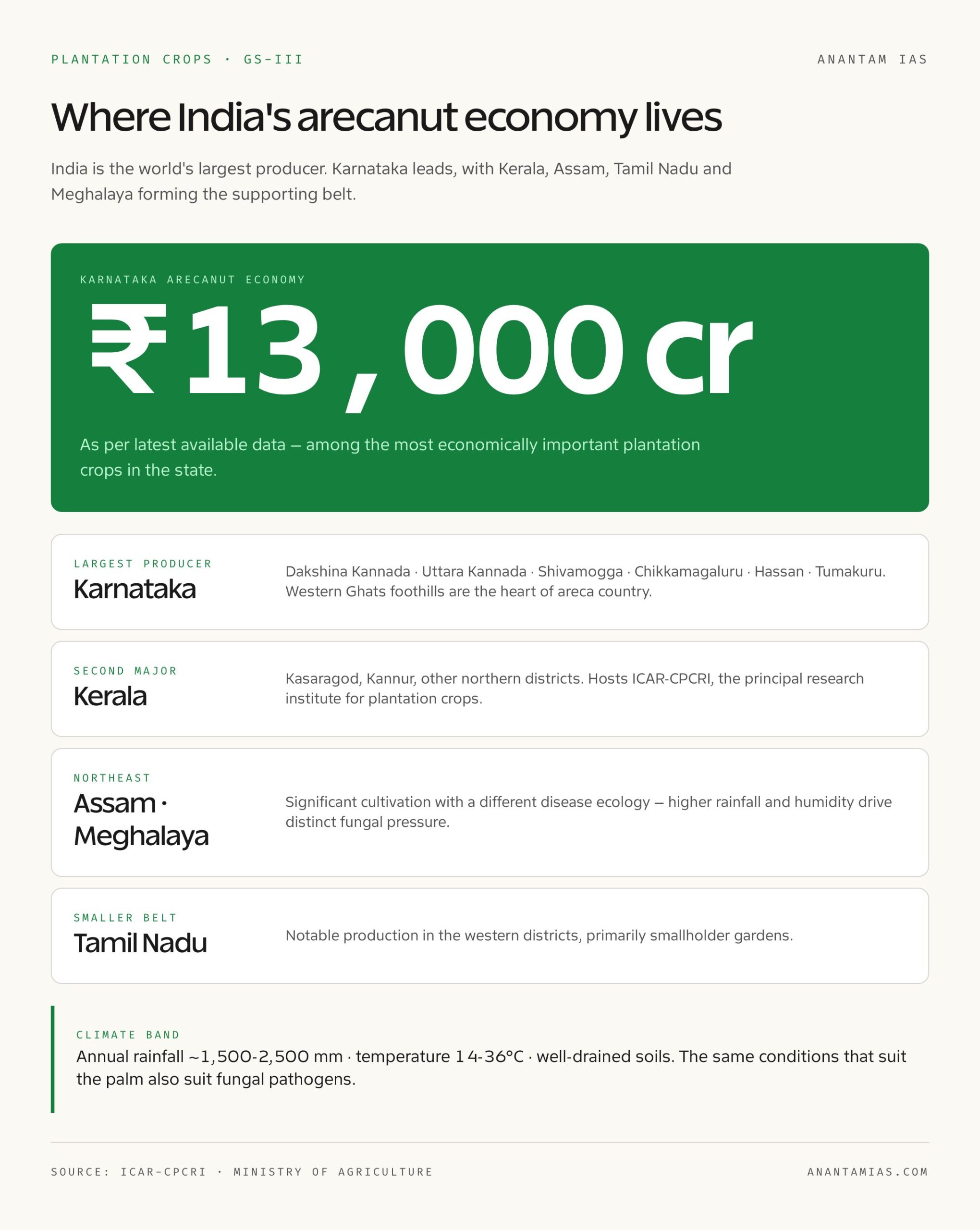
Arecanut in India is grown across a band of states with humid tropical and subtropical climates, suitable elevation, and adequate but not excessive rainfall.
Karnataka: The largest producer, with major arecanut belts in Dakshina Kannada, Uttara Kannada, Shivamogga, Chikkamagaluru, Hassan, and Tumakuru districts. The Western Ghats foothills are the heart of Karnataka arecanut country.
Kerala: Second major producer, with cultivation concentrated in Kasaragod, Kannur, and other northern districts.
Assam and Northeast India: Significant cultivation in Assam, Meghalaya, and other northeastern states, with a different disease ecology shaped by higher rainfall and humidity.
Tamil Nadu: Smaller but notable production in the western districts.
Climate requirements: Arecanut thrives in well-distributed annual rainfall of around 1500-2500 mm, average temperatures of 14-36°C, and well-drained soils with good organic content. The same humid conditions that suit the palm also suit fungal pathogens, which is why disease pressure is structural in Indian arecanut.
Why Leaf Spot Disease Arecanut Matters
Three reasons. First, the economic stakes are large. Karnataka’s arecanut economy alone runs into thousands of crores, and similar significance attaches to Kerala and Assam at smaller absolute scales. Second, arecanut is largely a smallholder crop. The typical garden is owned by a marginal or small farmer, and disease-driven yield loss translates directly into household income loss. Third, the disease complex is not just leaf spot. Yellow leaf disease (a phytoplasma-driven systemic disorder), fruit rot, basal stem rot, and root grub all affect arecanut, and managing one in isolation is rarely sufficient.
Detailed Analysis
The Pathogens
Phyllosticta arecae is one of the principal causal organisms of leaf spot in arecanut. It produces small, irregular, yellow to light brown spots on leaves, often with darker margins. As infection progresses, spots coalesce, and large patches of leaf tissue die back. The fungus survives in fallen leaves and infected debris, sporulates in humid conditions, and spreads through rain splash and wind.
Colletotrichum gloeosporioides and related Colletotrichum species cause anthracnose-type lesions. Colletotrichum is a famously broad host-range pathogen, affecting numerous tropical fruits and plantation crops. In arecanut, it typically produces darker, more sunken spots and can also affect inflorescences and young nuts.
Secondary fungi including Pestalotiopsis and Curvularia are often co-isolated from diseased leaves, contributing to the overall complex.
Symptoms and Yield Impact
The classic field symptoms include yellow to brown spots with concentric rings (a hallmark of Phyllosticta), darker sunken anthracnose lesions (Colletotrichum), and progressive leaf blight as infections spread. Photosynthetic capacity drops as infected leaf area increases. In severe cases, premature leaf shedding accelerates the yield decline.
Yield loss estimates vary widely depending on severity, age of plantation, and concurrent disease pressures, with field studies reporting losses ranging from a few percent in well-managed gardens to substantial double-digit reductions in heavily infected plantations as per latest available data.
Management Strategies
A working integrated management approach combines several elements:
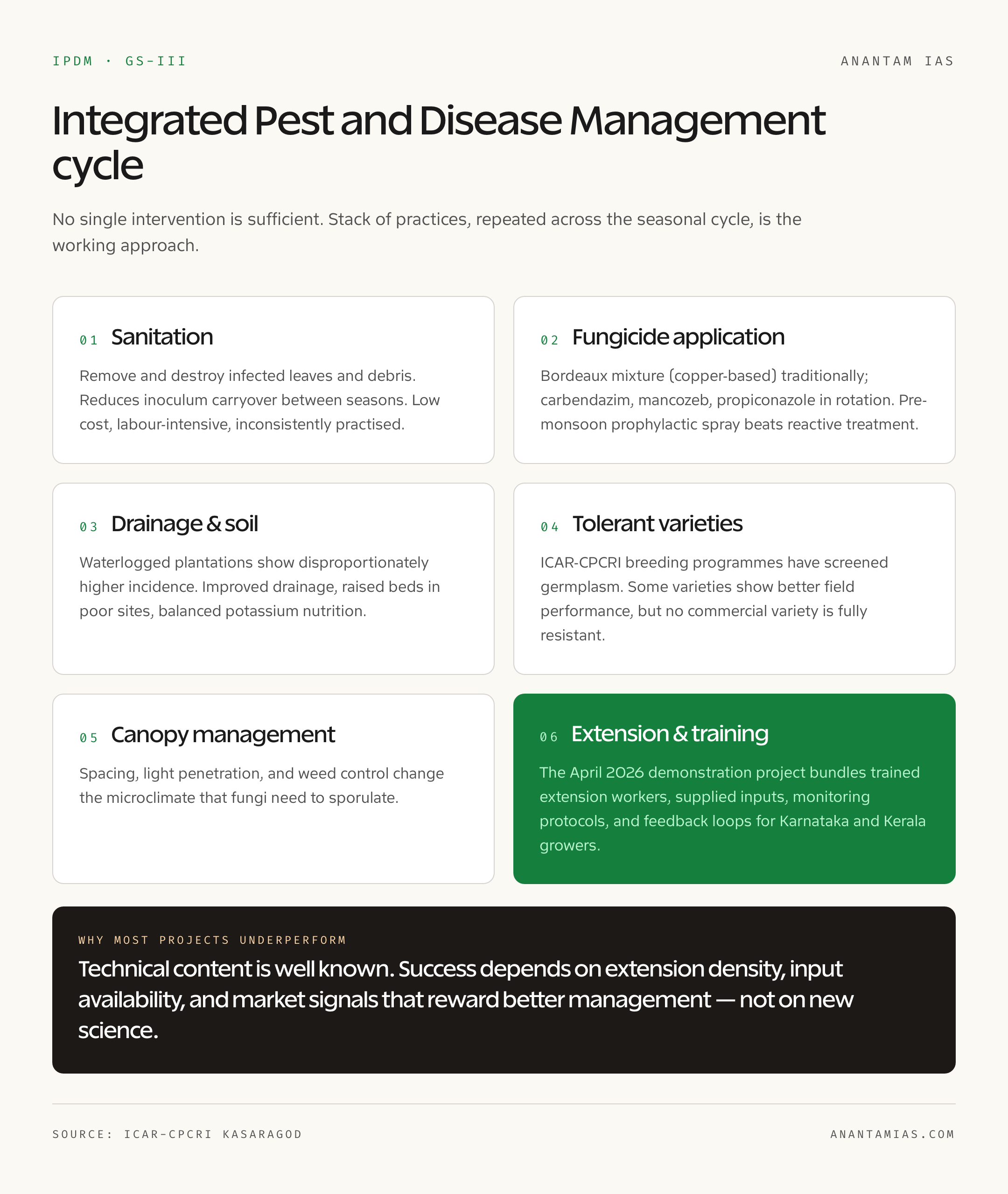
Sanitation: Removing and destroying infected leaves and debris reduces inoculum carryover between seasons. This is low-cost but labor-intensive and inconsistently practiced.
Fungicide application: Bordeaux mixture (a copper-based formulation) has been the traditional recommendation, with newer systemic fungicides like carbendazim, mancozeb, and propiconazole used in rotation. Timing matters: pre-monsoon prophylactic spray is generally more effective than reactive treatment.
Drainage and soil management: Waterlogged plantations show disproportionately higher disease incidence. Improved drainage, raised beds in poorly drained sites, and balanced nutrition (especially potassium) all reduce vulnerability.
Resistant or tolerant varieties: Breeding programs at ICAR-CPCRI and partner institutions have screened arecanut germplasm for tolerance, with some varieties showing better field performance, though no commercially deployed variety is fully resistant.
Canopy and plantation management: Spacing, light penetration, and weed control all influence the microclimate that fungi need to sporulate.
The Demonstration Project
The April 2026 demonstration project bundles these elements into a farmer-facing package: trained extension workers, supplied inputs, monitoring protocols, and feedback loops. This is the standard playbook for technology transfer in Indian agriculture, and its success usually depends less on the technical content (which is well known) and more on extension density, input availability, and market signals that reward better management.
For more on Indian agricultural policy themes, our piece on conservation agriculture covers related ground, and our explainer on biotechnology in agriculture discusses crop improvement approaches.
Comparative Perspective: Other Plantation Crop Diseases
Leaf Spot Disease arecanut sits in a familiar pattern across India’s plantation crops.
Coconut: Root wilt disease in Kerala has affected millions of palms over decades, requiring systematic replanting programs and vector management. Similar to arecanut in being a long-cycle plantation crop with smallholder ownership.
Coffee: Coffee leaf rust (Hemileia vastatrix) globally and in India’s coffee belt requires ongoing fungicide use and resistant variety deployment.
Tea: Blister blight (Exobasidium vexans) is a chronic concern in Indian tea estates with climate-sensitive outbreaks.
Black pepper: Foot rot (Phytophthora capsici) is the major plantation threat in Kerala and Karnataka.
Cardamom: Mosaic virus and rhizome rot.
The common pattern: humid tropical plantation crops face structural disease pressure, and management depends on a stack of practices rather than a single intervention.
You can also see related coverage in our piece on the PM Kusum Scheme which discusses agricultural support mechanisms, and the E-NAM platform of platforms which addresses farm-gate market access.
Challenges and Critiques
Three structural challenges show up across plantation disease management. First, extension density is thin. There aren’t enough trained agricultural officers to provide consistent, timely guidance to thousands of small areca growers. Second, fungicide use can be misapplied — wrong product, wrong timing, wrong dose — which builds resistance and wastes money. Third, market structure matters. Areca prices are influenced by pan masala demand, cross-border trade dynamics, and intermittent regulatory action against gutka. When prices crash, farmers cut input use, which worsens disease pressure.
Critics also point out that India’s arecanut sector faces a longer-term policy uncertainty: arecanut consumption (especially in pan masala) is associated with significant public health concerns, including oral cancer. Any future regulatory tightening could reshape the demand side dramatically, which has implications for how much investment in disease management is economically justified.
UPSC Prelims Pointers
- Arecanut (Areca catechu) is the betel nut palm, cultivated extensively in India
- Major Leaf Spot Disease pathogens: Phyllosticta arecae and Colletotrichum gloeosporioides / arecae
- Phyllosticta typically produces yellow to brown spots with concentric rings; Colletotrichum produces darker sunken anthracnose lesions
- Major arecanut-producing states: Karnataka, Kerala, Assam, Tamil Nadu, Meghalaya
- India is the largest producer of arecanut globally
- Karnataka arecanut economy estimated at approximately ₹13,000 crore
- Key research institution: ICAR-Central Plantation Crops Research Institute (CPCRI), Kasaragod
- Bordeaux mixture (copper-based) is a traditional fungicide; newer options include carbendazim, mancozeb, propiconazole
- Yellow leaf disease (a phytoplasma-driven disorder) is a separate but co-occurring threat in arecanut
- Arecanut is largely a smallholder crop, with most plantations owned by marginal or small farmers
Mains Practice Questions
- GS Paper III: “Plantation crop disease management in India is constrained more by extension and market structure than by scientific knowledge.” Discuss with reference to Leaf Spot Disease in arecanut. (250 words)
- GS Paper III: Discuss the economic and social significance of arecanut cultivation in Karnataka and Kerala. How does plant disease pressure threaten smallholder livelihoods, and what policy interventions are needed? (250 words)
- GS Paper III: Explain how integrated pest and disease management (IPDM) differs from conventional fungicide-led management. Use Leaf Spot Disease arecanut as a case study. (250 words)
- GS Paper II: Critically examine the public health concerns associated with arecanut and pan masala consumption. How should policy balance farmer livelihoods with health regulation? (150 words)
Way Forward
Three priorities. First, expand extension density and farmer training, ideally pairing each areca-growing cluster with a dedicated plantation crop extension officer. Second, support locally adapted IPDM packages that combine sanitation, drainage, balanced nutrition, and judicious fungicide use, rather than fungicide-led approaches. Third, accelerate breeding for tolerance to the leaf spot complex, with active collaboration between ICAR-CPCRI, state agricultural universities, and progressive farmer networks.
The demonstration project model is useful but won’t scale on its own. It needs to be paired with structural reforms in plantation crop research funding, output market stability, and access to weather and disease forecasting tools at the village level.
Leaf Spot Disease arecanut is also a reminder that India’s agricultural policy conversation is dominated by cereals, while plantation crops that anchor entire regional economies receive much less institutional attention. For UPSC, the topic is a useful concrete example of GS-III agriculture themes — disease management, farmer livelihoods, extension — rather than abstract policy. Pair it with our broader agriculture and rural economy coverage for context.
Frequently Asked Questions
What causes Leaf Spot Disease in arecanut?
The disease is caused primarily by fungal pathogens, with Phyllosticta arecae and Colletotrichum gloeosporioides (and related Colletotrichum species) being the most important. Secondary fungi like Pestalotiopsis and Curvularia often contribute to the complex.
Which states are most affected by arecanut leaf spot?
Karnataka, Kerala, Assam, Tamil Nadu, and Meghalaya are the major arecanut-producing states and all face leaf spot pressure to varying degrees.
How big is Karnataka’s arecanut economy?
Karnataka’s arecanut economy is estimated at approximately ₹13,000 crore as per latest available data, making it one of the most economically important plantation crops in the state.
What are the typical symptoms of arecanut leaf spot?
Symptoms include small yellow to brown spots with concentric rings, darker sunken anthracnose-type lesions, coalescing spots that cause leaf blight, and progressive reduction in photosynthetic capacity that translates into yield loss.
How is arecanut leaf spot managed?
Management involves an integrated approach: plantation sanitation (removing infected leaves), fungicide application (Bordeaux mixture, carbendazim, mancozeb, propiconazole), drainage and soil improvements, balanced nutrition, and use of tolerant planting material where available.
Which institute leads arecanut research in India?
The ICAR-Central Plantation Crops Research Institute (CPCRI) at Kasaragod, Kerala, is the principal research institution for arecanut, coconut, and related plantation crops.
Is arecanut cultivation profitable?
Profitability varies sharply with prices, disease pressure, and management. In good years, arecanut is among the higher-value plantation crops. In bad years, with low prices and heavy disease, smallholders can face significant losses, which has been linked to farmer distress in Karnataka’s areca belt.
What is the difference between Leaf Spot Disease and Yellow Leaf Disease in arecanut?
Leaf Spot Disease is a fungal complex caused mainly by Phyllosticta and Colletotrichum, producing localized leaf lesions. Yellow Leaf Disease is a separate, phytoplasma-driven systemic disorder that causes broader yellowing and yield decline. Both threaten arecanut but require different management approaches.
Tell Google you want more of this.
Add Anantam IAS as a preferred sourceOne tap, and this site shows up more often in your own Top Stories, AI Overviews and AI Mode. Remove it any time.