Why in news?
The 7th AgriVoltaics World Conference (AWC) 2026, commenced on October 21, 2026, at Bharat Mandapam, New Delhi. This marks a monumental occasion as it is the very first time the premier global summit is being hosted in the Global South.
| UPSC RelevanceGS II: Governance and International bodies;GS III: Environment, Agriculture and related government initiatives. |
What is Agrovoltaics?
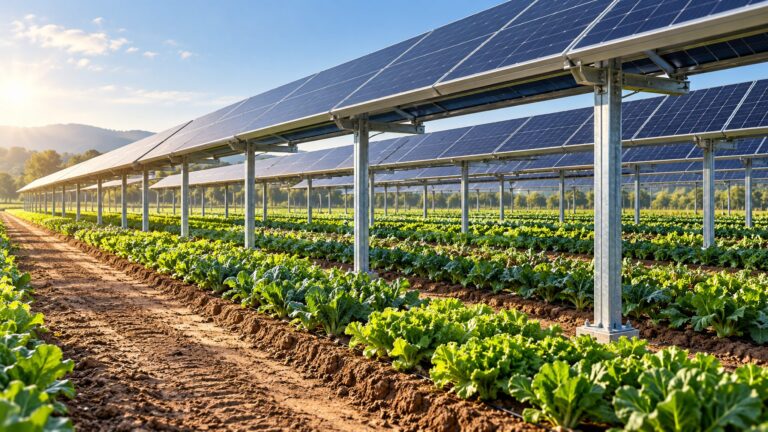
Agrivoltaics (AgriPV) refers to the simultaneous and dual use of a single parcel of land for both solar photovoltaic (PV) power generation and agricultural crop cultivation. Rather than clearing green fields or displacing farms to install conventional ground-mounted solar arrays, agrivoltaics integrate solar panels into the farming ecosystem by mounting them on elevated, spaced structures (typically 2 to 3 meters high) to allow crops to thrive and machinery to operate underneath.

What is the potential of Agrovoltaics in India?
As per a report of TERI,
- 47.5 million hectares, roughly 30% of India’s 160 million hectares of arable land, is technically suitable for agrivoltaics.
- Converting just 10% of this suitable land (around 4.75 million hectares) into operational agrivoltaic systems can generate enough clean energy to fulfill India’s entire projected power demand for 2050.
Benefits of Agrovoltaics
- Income Diversification and Stability: Agriculture employs roughly 43% of the Indian workforce but remains vulnerable to seasonal changes. AgriPV creates a reliable, regular financial cushion by allowing farmers to sell surplus power back to regional distribution companies (DISCOMs) or earn steady leasing revenues.
- Microclimate Optimization & Yield Enhancements: The partial shade cast by elevated panels limits intense direct sunlight and shields crops from extreme weather anomalies like hailstorms and heatwaves.
- According to pilot data, high-value shade-loving plants, leafy vegetables, fruits, and medicinal herbs record 10% to 20% increases in crop yields.
- Substantial Water Conservation: Shading directly curtails soil moisture evaporation and crop evapotranspiration, yielding an average of 30% water savings.
- Mutually Improved Efficiencies: Solar PV panels typically experience a drop in energy generation efficiency as ambient temperatures rise. The transpiration of the crops growing underneath releases ambient moisture, cooling the panels from below and boosting solar cell conversion efficiency.
Challenges
| Dimension | Key Structural Bottleneck / Challenge |
| Capital Expenditures (CapEx) | Elevated panel designs require reinforced stilt structures to withstand wind loads and permit farm machinery below. This structural modification makes installation 25% to 30% more expensive than standard ground-mounted systems. |
| Tariff Disparities | Energy generated via AgriPV costs roughly ₹3.20 to ₹3.30 per unit, compared to ₹2.50 to ₹2.60 per unit for standard ground installations, requiring economic bridging mechanisms to become market-viable. |
| Financial Inclusivity | Small and marginal farmers make up over 86% of India’s agricultural landholdings. These segments encounter severe constraints in securing low-cost, long-term credit to clear high upfront setup costs. |
| Regulatory Ambiguities | Current frameworks lack clear, uniform criteria on dual-use land reclassification, grid-interconnection standards for distributed farms, and ironclad long-term lease protections to protect farmers from corporate land exploitation. |
| Agronomic Constraints | Agricultural data on AgriPV remains confined to roughly 50 small-scale regional pilots. Mainstream dietary staples like paddy and wheat which dominate India’s minimum support price (MSP) chains are largely untried and may suffer under prolonged panel shading. |
Way Forward
- Formulating Standardized Technical Codes: India needs specific regulatory guidelines like Germany to ensure that any agrivoltaic installation strictly prioritizes agricultural yield.
- Aggregated Implementation via FPOs: Financial risks can be diluted by routing agrivoltaic projects through Farmer Producer Organizations (FPOs) and agricultural cooperatives.
- Targeted Agronomic R&D: The Indian Council of Agricultural Research (ICAR) must collaborate with state agricultural universities to map region-specific crop matrices. Transitioning focus toward high-value shade-resilient crops (e.g., onions, chilies, leafy greens, and medicinal plants) will help maximize land-use efficiency and boost total farm revenues.
Prelims Practice Question
Q1. With reference to Agrivoltaics (AgriPV), consider the following statements:
- It involves the dual use of land where solar power generation and crop cultivation occur simultaneously on the same parcel of land.
- The transpiration from under-canopy crops lowers the ambient temperature of solar panels, thereby increasing their energy conversion efficiency.
- Shading from the elevated solar arrays reduces crop evapotranspiration, leading to a net saving in irrigation water.
- Implementing Agrivoltaics requires a mandatory legal reclassification of agricultural land to commercial land across all Indian states.
Which of the statements given above are correct?
(a) 1, 2 and 3 only
(b) 2 and 4 only
(c) 1 and 3 only
(d) 1, 2, 3 and 4
Correct Answer: (a) 1, 2 and 3 only
Explanation:
- Statements 1, 2, and 3 are correct: AgriPV is a symbiotic dual-use system. Crop transpiration creates a cooling microclimate that improves solar panel efficiency, while panel shade protects soil moisture, reducing water consumption by roughly 30%.
- Statement 4 is incorrect: Regulatory ambiguity and lack of uniform guidelines for land reclassification are major bottlenecks. There is currently no mandatory nationwide framework; in fact, the goal of AgriPV policy is to avoid permanent commercial land conversion so that farmers can retain agricultural benefits and land rights.
Mains Practice Question
Q. “Agrivoltaics (AgriPV) sits at the critical intersection of India’s water, energy, and food security. However, transitioning from isolated pilot projects to a macro-scale climate strategy requires overcoming steep structural and socioeconomic bottlenecks.” Critically analyze. (15 Marks, 250 Words)
Tell Google you want more of this.
Add Anantam IAS as a preferred sourceOne tap, and this site shows up more often in your own Top Stories, AI Overviews and AI Mode. Remove it any time.