Why in News?
The Hindu reported on 23 September 2026 that rhinos frequently crossing from Manas into Bhutan have prompted calls for stronger joint conservation of the shared landscape.
- A conservation scientist associated with rhino translocation reported repeated movement into Bhutan and called for a joint conservation mechanism.
- Manas in Assam adjoins Royal Manas National Park in Bhutan, placing wildlife within a connected landscape across an international boundary.
- Forest officials supported broader landscape cooperation; the report describes a call for stronger coordination, not a newly signed treaty.
- A recovered rhino population creates management needs beyond releasing animals: protecting their movements, habitat and survival across jurisdictions.
- Existing cross-border cooperation provides a foundation; the new issue is how to strengthen it for animals moving through the shared landscape.
UPSC Relevance
Prelims Relevance
- Manas: a protected landscape in Assam adjoining Bhutan.
- Royal Manas National Park: the contiguous protected area on the Bhutan side.
- Greater one-horned rhinoceros: the rhino discussed in the current movement report.
- Reintroduction: returning a species to an area from which it disappeared.
- Transboundary conservation: cooperation across political borders to manage connected habitats and wildlife.
Mains Relevance
GS Paper 3
- Landscape conservation after wildlife reintroduction.
- Shared monitoring, habitat connectivity and local community participation.
GS Paper 2
- India-Bhutan cooperation for managing an ecologically connected border landscape.
Essay
- Ecological relationships often extend beyond the boundaries used to govern them.
Background and Context
Why rhino recovery changes the management challenge
The Manas story has moved beyond bringing rhinos back: managers must now protect a recovering population whose movements do not stop at a national boundary.
- The greater one-horned rhinoceros had disappeared from Manas amid unrest and poaching. The Hindu describes its subsequent return through reintroduction, making protection of an established population the present concern rather than initial release alone.
- Reintroduction restores animals to a former range, while a self-sustaining population continues through survival and breeding. These are different conservation achievements; returning animals is an intervention, whereas persistence is a longer-term biological outcome.
- An official quoted in the report describes a breeding, self-sustaining population and credits community support. This assessment should be attributed; the report does not establish a fresh census total for the current year.
- The scientist’s account of frequent crossings into Bhutan raises a coordination problem even when recovery is successful. A rhino moving beyond one jurisdiction still needs protection, monitoring and suitable habitat on the other side.
- Movement alone does not prove overcrowding or a failed recovery programme. The report does not establish why each animal crosses; explaining the management response does not require inventing a cause or migration timetable.
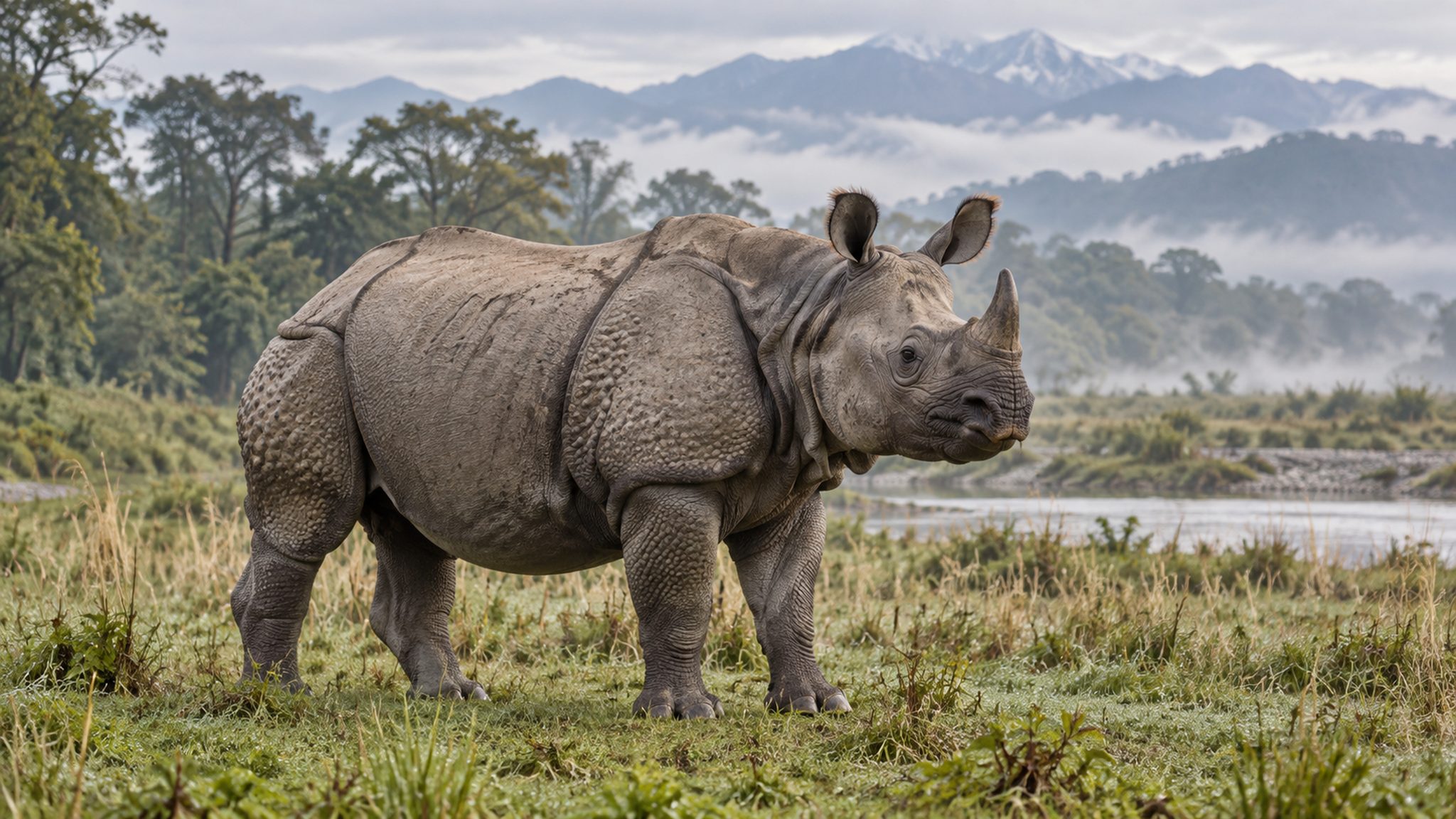
A connected habitat spans separate jurisdictions
An international boundary separates administrative responsibilities, but the adjoining Manas protected areas remain part of an ecological landscape through which animals can move.
- The UNESCO Manas profile places the sanctuary in Assam’s Himalayan foothills, with alluvial grasslands and tropical forests. Its continuity with Bhutan’s Royal Manas makes cooperation relevant to habitat protection beyond one park.
- Habitat connectivity means animals can use connected areas instead of being confined to isolated patches. Here, adjoining protected landscapes explain why management must consider the surrounding ecological system rather than only an individual reserve.
- Separate jurisdictions can hold different observations of the same moving animal. Coordinated monitoring helps managers interpret sightings across the boundary instead of treating each country’s records as a complete account of the population.
- Carrying capacity concerns how many animals habitat can sustain under prevailing conditions. It cannot be inferred merely from a reserve’s area or a sighting across the border; habitat condition and resource availability also matter.
- UNESCO’s 2026 conservation decision encourages continuing field-level cooperation. This is evidence that cooperation already exists; the current call seeks to strengthen coordination rather than create the first contact between the two sides.
What stronger joint management should achieve
The practical question is how shared information and compatible protection measures can follow wildlife across the landscape while retaining each country’s own administrative responsibilities.
- Shared monitoring should help distinguish an animal’s movement from disappearance or a new population record. That is an analytical management priority, not a claim that a new common database has already been established.
- Coordinated protection can address risks across an animal’s range rather than only inside one reserve. Stronger cooperation need not mean merged park administration; the report calls for a mechanism without announcing its legal design.
- Habitat management should consider connected grasslands and forests alongside wildlife protection. Preserving animals without maintaining the landscape they use would leave the ecological basis of recovery vulnerable, even if immediate poaching risks were controlled.
- Local participation matters because people living around Manas are credited with supporting recovery. The report links this support partly to tourism expectations; benefits should be examined locally rather than assumed to reach every household equally.
- People-to-people conservation is raised alongside bilateral cooperation in the report. It can complement official coordination, but should not be confused with a signed agreement, newly notified corridor or completed international conservation programme.
Way Forward
Follow the animal across the landscape
- Strengthen field-level information exchange so sightings and threats can be understood across the adjoining protected areas.
- Assess habitat condition and movement patterns before drawing conclusions about carrying capacity or prescribing additional translocations.
- Support community participation and examine who receives conservation-linked benefits, while keeping proposed cooperation distinct from measures actually implemented.
Conclusion
- Manas rhino recovery illustrates why conservation must continue after reintroduction. A population moving through a connected India-Bhutan landscape needs management that recognises ecological continuity alongside separate national responsibilities.
- The durable lesson is landscape-scale cooperation, not a new treaty or census claim. Shared monitoring, habitat protection and local support must reinforce recovery wherever the animals move.
UPSC Practice Questions
Prelims MCQ 1
With reference to Manas and transboundary conservation, consider the following statements:
- Manas in Assam adjoins Royal Manas National Park in Bhutan.
- An international boundary necessarily prevents wildlife from moving between adjoining habitats.
- UNESCO has encouraged continuing field-level cooperation in the Manas landscape.
How many of the above statements are correct?
(a) Only one (b) Only two (c) All three (d) None
Answer: (b) Only two
Explanation:
Statements 1 and 3 are correct. The current report describes rhinos crossing into Bhutan, demonstrating that political boundaries need not prevent ecological movement.
Prelims MCQ 2
Which is the most appropriate inference from repeated rhino movement from Manas into Bhutan?
(a) Reintroduction must have failed. (b) The reserve has necessarily exceeded its carrying capacity. (c) Monitoring and protection should account for the connected landscape across jurisdictions. (d) A new bilateral treaty has already entered into force.
Answer: (c) Monitoring and protection should account for the connected landscape across jurisdictions.
Explanation:
Movement creates a coordination need. It does not, by itself, establish overcrowding, programme failure or a newly concluded legal agreement.
UPSC Mains Questions
- Successful species reintroduction creates continuing management responsibilities beyond a protected area. Discuss with reference to rhinos in the Manas landscape.
- Examine how field-level cooperation and local participation can strengthen transboundary conservation between India and Bhutan.
Sources: The Hindu and UNESCO, Manas Wildlife Sanctuary.
Frequently Asked Questions
Why are Manas rhinos relevant to India-Bhutan conservation?
The Hindu reports frequent rhino movement into Bhutan from Manas. Because Manas adjoins Royal Manas National Park, monitoring and protection must account for a connected landscape across separate jurisdictions.
Has a new rhino-conservation treaty been signed?
The current report describes calls for a stronger joint conservation mechanism, not a newly signed treaty. Existing field-level cooperation already provides a foundation for further coordination across the landscape.
Does crossing into Bhutan show that Manas is overcrowded?
No. Movement alone does not establish that a habitat has exceeded its carrying capacity. The causes require evidence on habitat conditions, resources and animal behaviour rather than assumptions based on crossings.
How is reintroduction different from a self-sustaining population?
Reintroduction returns animals to a former range, while a self-sustaining population persists through survival and breeding. Protection and suitable habitat remain necessary after release for recovery to continue over time.
Tell Google you want more of this.
Add Anantam IAS as a preferred sourceOne tap, and this site shows up more often in your own Top Stories, AI Overviews and AI Mode. Remove it any time.