Why in News?
The Master Plan for Delhi 2047 (MPD-2047) has been notified as a 20-year framework for managing Delhi’s housing, transport, redevelopment and economic expansion. It seeks to accommodate a population projected to reach approximately 3.2 crore by 2047.
Prepared by the Delhi Development Authority (DDA) under the Delhi Development Act, 1957, the plan envisages more than 40 lakh additional affordable houses.
| UPSC Relevance: GS-1 Indian Society: Urbanisation; GS-2 Polity and Governance: Urban governance; GS-3 Economy: Infrastructure; GS-3 Environment: Sustainable cities Prelims: Master Plan for Delhi 2047 Mains: Planned Urban development (Need, Challenges, Govt schemes) |
Major Provisions:
- Transit-Oriented Development: High-density, mixed-use development within 500 metres of Metro corridors and around Regional Rapid Transit System (RRTS) and railway stations.
- Higher FAR: Maximum Floor Area Ratio (FAR) under transit-oriented development (TOD) increased from 300 to 500, permitting built-up area up to five times the plot area.
- Vertical development: Maximum height restrictions for buildings of all kinds, including residential and commercial, have been removed across most of the national capital, except in areas including the Lutyens’ Bungalow Zone, Civil Lines Bungalow Area, Connaught Place, the Yamuna floodplains, the Ridge, land pooling and low-density areas, and locations subject to restrictions imposed by the Archaeological Survey of India and the National Monuments Authority.
- Land pooling: Nearly 200 sq. km of planned urban expansion, providing about 12 lakh homes and about 600 km road network.
- Redevelopment: Minimum plot size for group housing redevelopment has been reduced from 40,000 sq. m to 3,000 sq. m.
- Affordable housing: Approximately 18 lakh houses proposed in TOD zones, along with in-situ slum rehabilitation and rental housing.
- Economic diversification: Data centres, start-up hubs, co-working spaces, warehousing and integrated industrial parks permitted.
- Regulatory simplification: Land-use categories reduced from 133 to 45, with online single-window approvals.
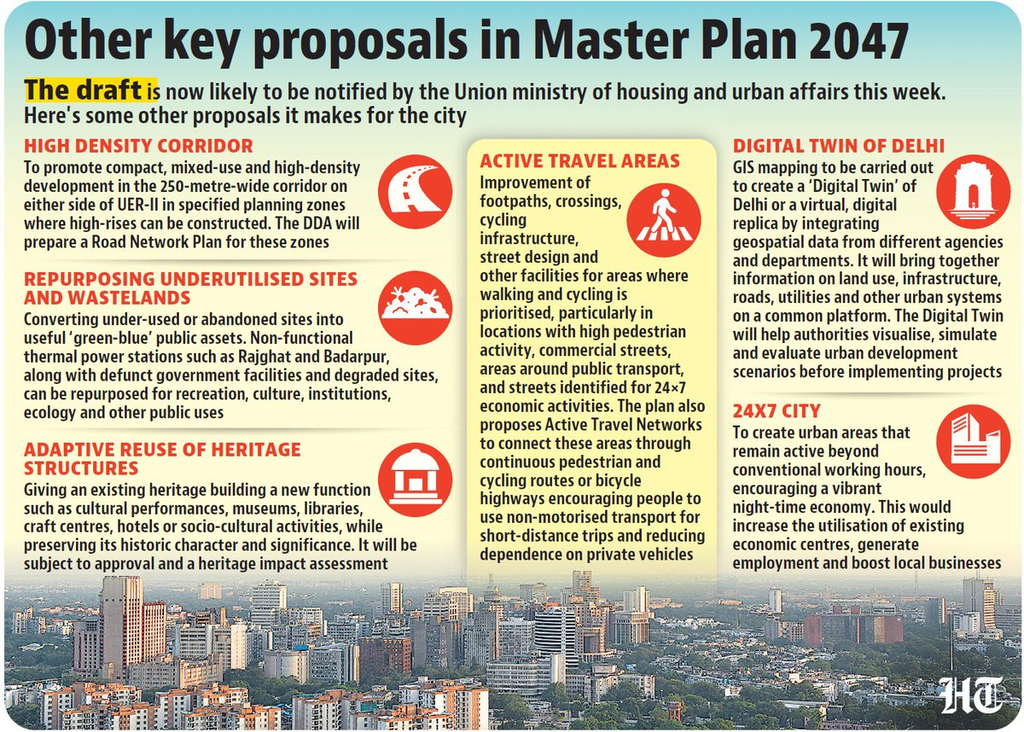
- Green-blue infrastructure: Restoration of approximately 1,700 hectares of Yamuna floodplains, cycle tracks, rainwater harvesting and low-carbon buildings.
Significance:
- MPD-2047 seeks to shift Delhi from horizontal sprawl towards a compact, transit-oriented and mixed-use urban model.
- Higher density near mass transit can reduce commuting distances, private-vehicle dependence and pressure on peripheral agricultural land.
- Land pooling and redevelopment can also unlock housing supply in a land-scarce city.
Major Challenges:
- Unplanned verticalisation could overwhelm Delhi’s water supply, sewerage, waste-management and transport systems.
- Land pooling may face fragmented ownership and farmer participation issues, while construction of houses does not automatically ensure their affordability.
- Fragmented responsibilities among the DDA, Delhi government, municipal bodies and Union government may also obstruct implementation.
Development permissions should be linked to prior augmentation of public transport and civic infrastructure. Affordable rental housing, in-situ rehabilitation, pedestrian infrastructure and strict protection of the Ridge, Yamuna floodplains and heritage zones must remain central to implementation.
Tell Google you want more of this.
Add Anantam IAS as a preferred sourceOne tap, and this site shows up more often in your own Top Stories, AI Overviews and AI Mode. Remove it any time.