
Why in News?
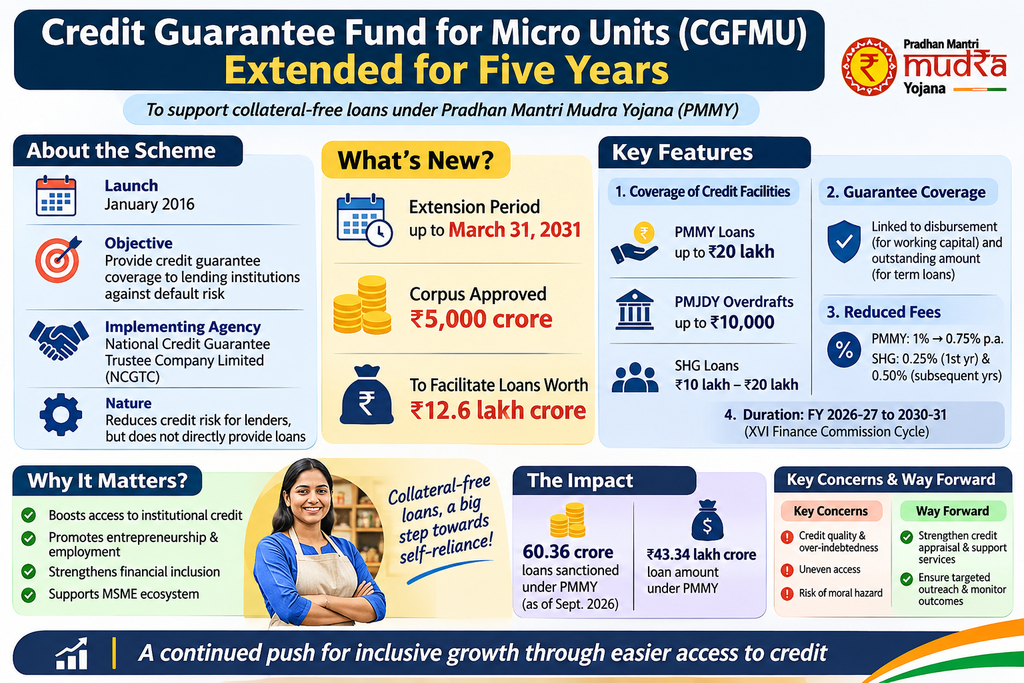
The Union Cabinet has approved the continuation of the Credit Guarantee Fund for Micro Units (CGFMU) for five years, up to March 31, 2031, with a corpus of ₹5,000 crore. The extension is expected to facilitate ₹12.6 lakh crore in loans, primarily under the Pradhan Mantri Mudra Yojana (PMMY).
| UPSC Relevance: GS-3 Economy: Financial Inclusion; Government Schemes Prelims: Credit Guarantee Fund for Micro Units |
About the Credit Guarantee Fund for Micro Units (CGFMU):
- Launch: 2016
- Objective: To provide credit guarantee coverage to lending institutions against default risks on specified loans, thereby encouraging collateral-free lending to micro enterprises and underserved borrowers.
- Implementing agency: National Credit Guarantee Trustee Company Limited (NCGTC), which manages the fund and provides guarantee coverage to eligible lending institutions.
- Nature: It reduces the credit risk borne by lenders but does not directly provide loans to borrowers.
Salient Features of the Extended Scheme:
- Coverage of Credit Facilities: The fund provides guarantees for the following:
- Pradhan Mantri Mudra Yojana (PMMY): Loans of up to ₹20 lakh to eligible micro enterprises.
- Pradhan Mantri Jan Dhan Yojana (PMJDY): Overdraft facilities of up to ₹10,000 in eligible accounts.
- Self-Help Groups (SHGs): Loans where the portfolio size ranges between ₹10 lakh and ₹20 lakh.
- Guarantee Coverage:
- For working capital limits, guarantee coverage is linked to the disbursement amount.
- For term loans, it is linked to the outstanding amount, reflecting the actual credit risk exposure of lending institutions.
- Reduction in Guarantee Fees:
- For PMMY-related credit facilities, the annual guarantee fee has been reduced from 1% to 0.75%.
- For SHG loans, the existing fee structure continues: 0.25% in the first year and 0.50% in subsequent years.
- Duration: The extended scheme will cover eligible loans sanctioned during the XVI Finance Commission Cycle (FY 2026-27 to FY 2030-31).
Significance of the Extension:
- Improving credit access: Credit guarantees encourage banks and other lending institutions to extend loans to borrowers who lack collateral or an established credit history.
- Promoting entrepreneurship: It can support first-generation entrepreneurs, small businesses and self-employed individuals who face difficulties accessing formal finance.
- Employment generation: Greater access to microcredit can facilitate the establishment and expansion of small enterprises, generating local employment opportunities.
- Financial inclusion: It complements financial inclusion initiatives such as PMJDY by facilitating access to productive credit beyond basic banking services.
- Strengthening the MSME ecosystem: Improved access to institutional credit can reduce dependence on informal moneylenders and support the formalisation of micro enterprises.
Prelims Practice MCQ:
Q. With reference to the Credit Guarantee Fund for Micro Units (CGFMU), consider the following statements:
- It is a credit guarantee fund established to guarantee collateral-free credit facilities extended to micro units.
- The fund is managed and operated by the National Credit Guarantee Trustee Company Ltd. (NCGTC).
Which of the statements given above is/are correct?
(a) 1 only
(b) 2 only
(c) Both 1 and 2
(d) Neither 1 nor 2
Answer: (c)
Tell Google you want more of this.
Add Anantam IAS as a preferred sourceOne tap, and this site shows up more often in your own Top Stories, AI Overviews and AI Mode. Remove it any time.