Why in News?
Downstream communities have intensified protests against the 2880 MW Dibang Multipurpose Project (DMP) in Arunachal Pradesh, demanding rehabilitation, flood protection and safety safeguards before its commissioning.
| UPSC Relevance: GS-3 Environment & Biodiversity: Conservation; GS-3 Economy: Infrastructure Prelims: Dibang Multipurpose Project, Brahmaputra River system. |
About the Dibang Multipurpose Project:
- Location: Lower Dibang Valley district, Arunachal Pradesh.
- River: Dibang, a major tributary of the Brahmaputra.
- Developer: NHPC Limited.
- Installed capacity: 2880 MW.
- Dam height: 278 metres, making it India’s tallest dam upon completion.
- Project cost: Approximately ₹31,875 crore.
- Expected commissioning: February 2032, as reported.
Significance of the Project:
- Renewable energy: The project is expected to generate approximately 11,223 million units of electricity annually, strengthening India’s clean energy capacity.
- Flood moderation: Its storage reservoir is designed to regulate monsoon flows and reduce downstream flood damage in Assam.
- Regional development: It can generate employment, improve infrastructure and provide revenue to Arunachal Pradesh through free power and local development funds.
Why is the Project Facing Opposition?
- Rehabilitation: Recognition of downstream families as Project Affected Families (PAFs), ensuring appropriate rehabilitation and compensation.
- Downstream protection: Construction of guide walls, embankments and protection walls along vulnerable stretches of the Dibang River.
- Dam safety: Safeguards against sudden water releases, dam failure and downstream flooding.
The Dibang Dam Assam-Arunachal Downstream Action Alliance has threatened to obstruct the transportation of construction materials and machinery if its demands remain unaddressed.
Major Environmental and Governance Concerns:
- Downstream ecological impacts: Altered river flows, sediment transport and aquatic habitats can affect fisheries, agriculture and riverine ecosystems.
- Geological vulnerability: The Eastern Himalayas are seismically active and geologically fragile. Large dams in the region require rigorous seismic risk assessment and dam-break analysis.
- Biodiversity and forests: Large reservoirs and associated infrastructure can lead to forest submergence, habitat fragmentation and biodiversity loss.
- Cumulative impact: Multiple hydropower projects in the Brahmaputra basin can collectively alter river ecology, sediment flows and downstream hydrology.
- Inter-State coordination: Since the project is located in Arunachal Pradesh but has implications for downstream Assam, effective coordination and information-sharing between the two States are essential.
The Dibang project reflects the challenge of balancing hydropower development, flood management and ecological security in the Eastern Himalayas.
The infrastructure development must therefore be founded on transparency, scientific assessment, meaningful community participation and respect for constitutional and statutory safeguards.
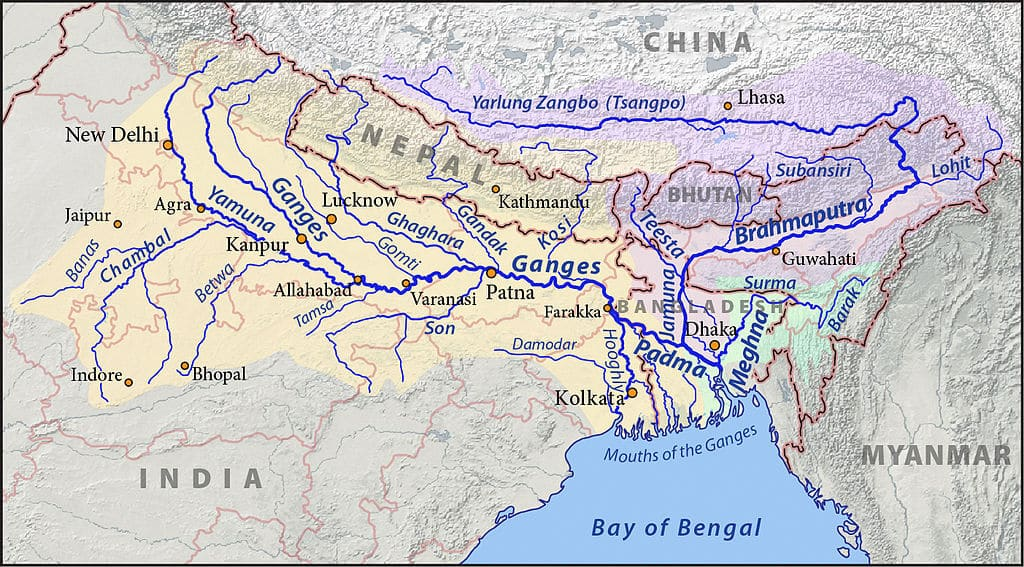
Brahmaputra River System:
The Brahmaputra is a transboundary river system shared by China, India and Bangladesh.
Course of the River:
- Origin: The Yarlung Tsangpo originates in the Tibetan Plateau, near the Angsi Glacier in the vicinity of Mount Kailash.
- Tibet: It flows eastwards across southern Tibet before making a dramatic horseshoe-shaped bend around the Namcha Barwa massif.
- India:
- Arunachal Pradesh: It enters India as the Siang (also called Dihang).
- Assam: Siang joins the Dibang and Lohit rivers to form the Brahmaputra’s main channel.
- Bangladesh: It enters Bangladesh as the Jamuna and eventually joins the Ganga-Padma system before draining into the Bay of Bengal.
Important Tributaries:
- Left-Bank Tributaries (South Bank): Dibang, Lohit, Noa Dihing, Burhi Dihing, Disang, Dikhow (Dikhu), Dhansiri (South), Kopili, etc.
- Right-Bank Tributaries (North Bank): Subansiri (largest tributary of the Brahmaputra by volume), Ranganadi, Dikrong, Jia Bharali (Kameng), Dhansiri (North), Manas, Sankosh, Teesta (joins in Bangladesh), etc.
Mains Practice Question:
Q. Large hydropower projects in the Eastern Himalayas present both opportunities for regional development and challenges of ecological sustainability. Discuss with reference to the upcoming Hydropower Projects in Arunachal Pradesh.
Practice Prelims MCQ:
Q. With reference to the Brahmaputra river system, consider the following statements:
- The Yarlung Tsangpo enters India through Arunachal Pradesh, where it is known as the Siang.
- The Brahmaputra is formed in Assam by the confluence of the Siang, Dibang and Lohit rivers.
- The Teesta is a tributary of the Brahmaputra system and joins the river in India.
- India and China have a comprehensive bilateral treaty governing the equitable sharing of Brahmaputra waters.
Which of the statements given above are correct?
(a) 1 and 2 only
(b) 1, 2 and 3 only
(c) 2, 3 and 4 only
(d) 1, 2, 3 and 4
Answer: (a)
Explanation:
- Statement 3: Incorrect. The Teesta joins the Brahmaputra (Jamuna) in Bangladesh, not India.
- Statement 4: Incorrect. No comprehensive bilateral water-sharing treaty exists between India and China.
UPSC PYQ 2017:
Q. With reference to river Teesta, consider the following statements:
- The source of river Teesta is the same as that of Brahmaputra but it flows through Sikkim.
- River Rangeet originates in Sikkim and it is a tributary of river Teesta.
- River Teesta flows into Bay of Bengal on the border of India and Bangladesh.
Which of the statements given above is/are correct?
(a) 1 and 3 only
(b) 2 only
(c) 2 and 3 only
(d) 1, 2 and 3
Answer: (b)
Tell Google you want more of this.
Add Anantam IAS as a preferred sourceOne tap, and this site shows up more often in your own Top Stories, AI Overviews and AI Mode. Remove it any time.