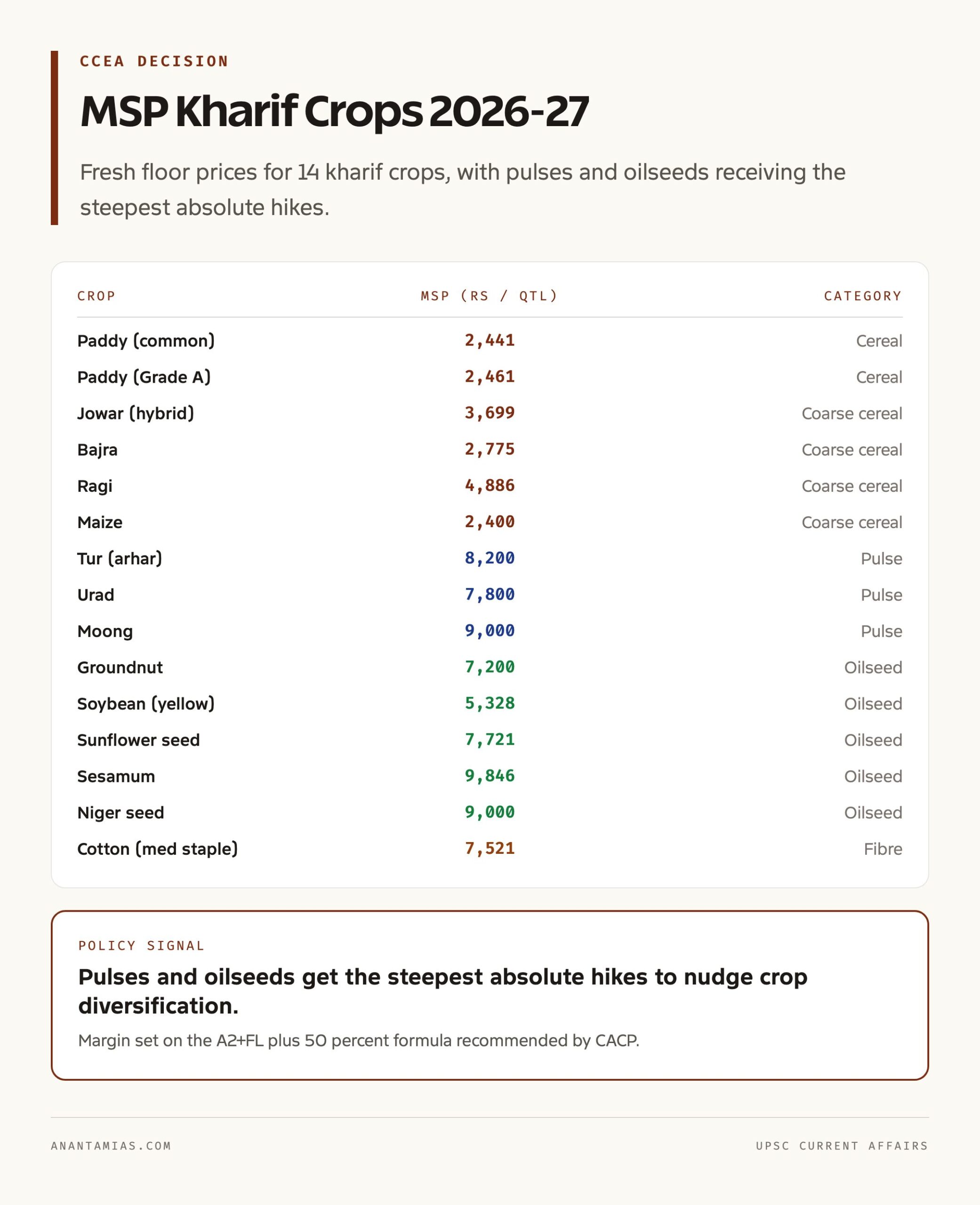
The Cabinet Committee on Economic Affairs cleared the MSP Kharif crops 2026-27 package on 13 May 2026, raising the minimum support prices for all 14 mandated kharif crops ahead of the sowing season. The headline number was paddy: common-grade MSP rose to Rs 2,441 per quintal, with Grade A paddy a notch higher. Pulses, oilseeds, and coarse cereals received steeper percentage increases, in line with the policy intent of nudging farmers away from the water-intensive paddy-wheat cycle.
The decision lands at a politically charged moment. Farm unions have been arguing that the existing A2+FL formula understates the real cost of cultivation, and have demanded a legal guarantee for MSP tied to the C2 plus 50 percent benchmark recommended by the Swaminathan Commission. The government has held the line on the formula but used the absolute increases to send a signal that procurement-driven price support is still central to its rural strategy.
This explainer breaks down the MSP Kharif crops 2026-27 decision, the formula behind it, how it builds on past trends, what it means for inflation and fiscal arithmetic, and the analytical hooks UPSC aspirants need across Prelims and Mains.
Quick Facts
- Approval date: 13 May 2026 by the Cabinet Committee on Economic Affairs.
- Crops covered: 14 mandated kharif crops including paddy, jowar, bajra, ragi, maize, tur, urad, moong, groundnut, soybean, sunflower, sesamum, niger seed, and cotton.
- Paddy common MSP: Rs 2,441 per quintal for marketing season 2026-27.
- Formula used: A2+FL plus 50 percent margin, as recommended by the Commission for Agricultural Costs and Prices.
- Reference standard: Swaminathan Commission proposed C2 plus 50 percent.
- Procurement agencies: Food Corporation of India for paddy, NAFED and similar bodies for pulses and oilseeds.
What Just Happened
The cabinet approved the MSP Kharif crops 2026-27 set just before the southwest monsoon onset, giving farmers a clear price signal for the upcoming sowing decisions. Paddy common-grade MSP rose to Rs 2,441 per quintal, a meaningful step over the previous season. Tur dal, urad, and moong saw larger absolute and percentage increases, reflecting the official intent to encourage pulses cultivation and reduce import dependence on edible protein.
Oilseeds received the most attention this round. Soybean, groundnut, sunflower, sesamum, and niger seed all saw double-digit percentage increases relative to their A2+FL cost trajectory. With India importing nearly 60 percent of its edible oil requirement, the government is using MSP to push acreage shifts toward oilseeds, complementing the National Mission on Edible Oils.
Coarse cereals like jowar, bajra, ragi, and maize also got firmer support, in line with the millet push that started during the International Year of Millets 2023. The cabinet release framed the package as a balance between farm-income protection, crop diversification, and consumer-price stability.
Background and Historical Context
The MSP system in India dates to 1965, when the Agricultural Prices Commission was set up to recommend procurement prices for paddy and wheat. The objective then was to secure foodgrain self-sufficiency and insulate farmers from the price collapses that had followed the Green Revolution’s surplus shocks. The commission was renamed the Commission for Agricultural Costs and Prices in 1985 and now covers 23 commodities across kharif, rabi, and other seasons.
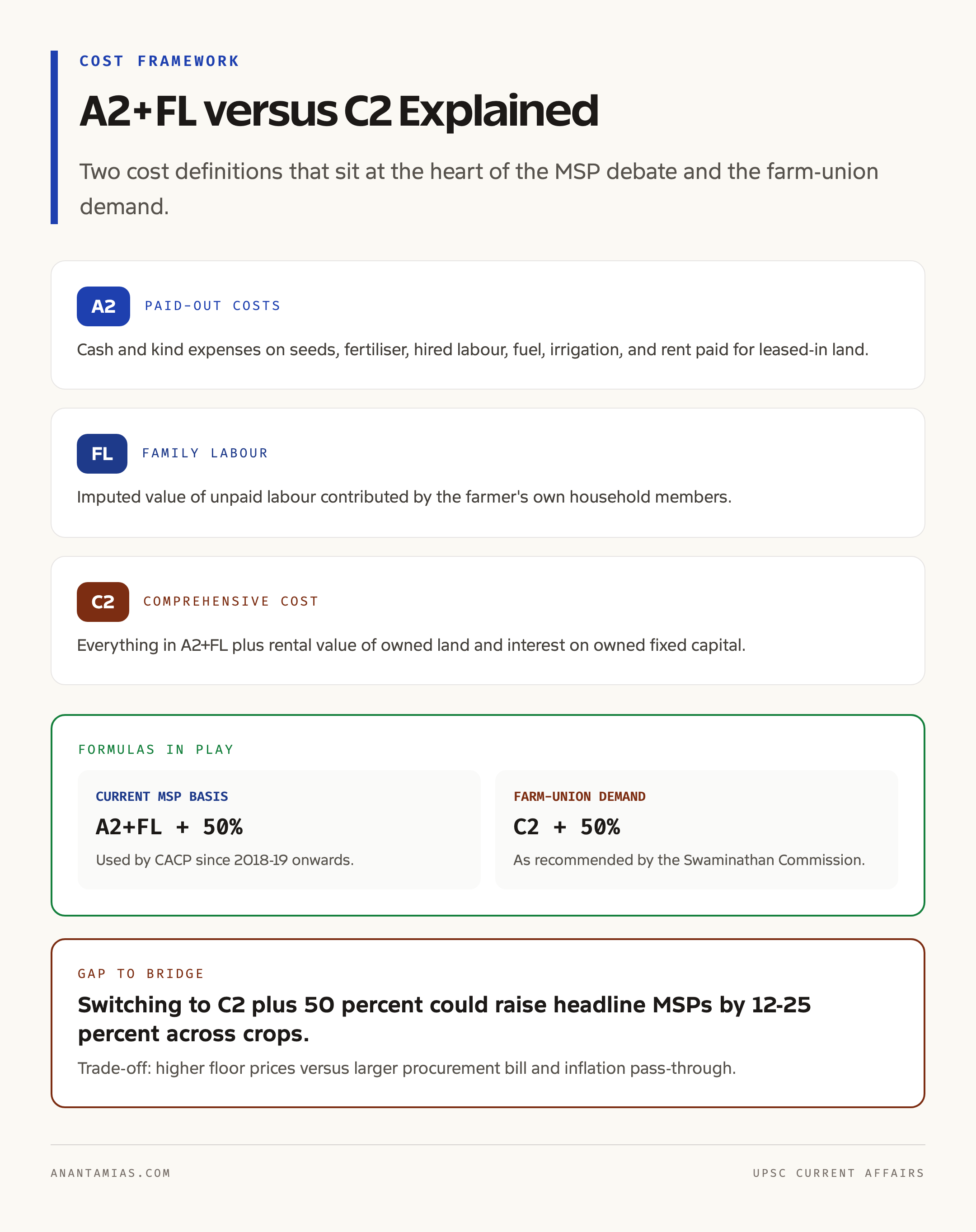
Two costs sit at the heart of the debate. A2 captures paid-out costs: seeds, fertiliser, hired labour, fuel, irrigation. FL adds the imputed value of unpaid family labour. C2 adds the rental value of owned land and interest on owned capital. The MSP has historically been built on A2+FL plus a margin. The 2018-19 Union Budget formalised the policy of pegging the margin at 50 percent of A2+FL. The Swaminathan Commission, in its 2006 report, recommended C2 plus 50 percent. Bridging the gap between these two definitions is the heart of the present farm-union demand.
For context on how rural distress and price policy intersect, our analysis of the Swaminathan Commission report and farmer welfare lays out the original recommendations and how they have aged. The MSP and agricultural marketing overview explains the procurement architecture, and the broader kharif crops primer covers the agronomic side.
Key Provisions of the MSP Kharif Crops 2026-27 Package
The 2026-27 round covers 14 kharif crops with crop-wise MSPs published in the official gazette notification. Paddy common-grade MSP rose to Rs 2,441 per quintal; Grade A paddy is set slightly higher. Pulses got steeper absolute increases, with tur dal MSP touching the higher end of the price band, urad close behind, and moong receiving the largest absolute hike to align with rising production costs.
Oilseeds saw the sharpest policy nudge. Soybean MSP rose to support farm-gate viability against international price volatility. Groundnut MSP rose in step. Sunflower seed, sesamum, and niger seed all received above-cost margins to incentivise area expansion. Coarse cereals saw firm increases too: jowar, bajra, ragi, and maize MSPs aim to keep the millet acreage trajectory intact after the post-2023 momentum.
The cabinet release also indicated continued procurement support through Food Corporation of India for paddy, and through NAFED, NCCF, and Hafed for pulses and oilseeds under the Price Support Scheme. Cotton MSP, declared separately for medium and long staples, is implemented through the Cotton Corporation of India.
Why It Matters
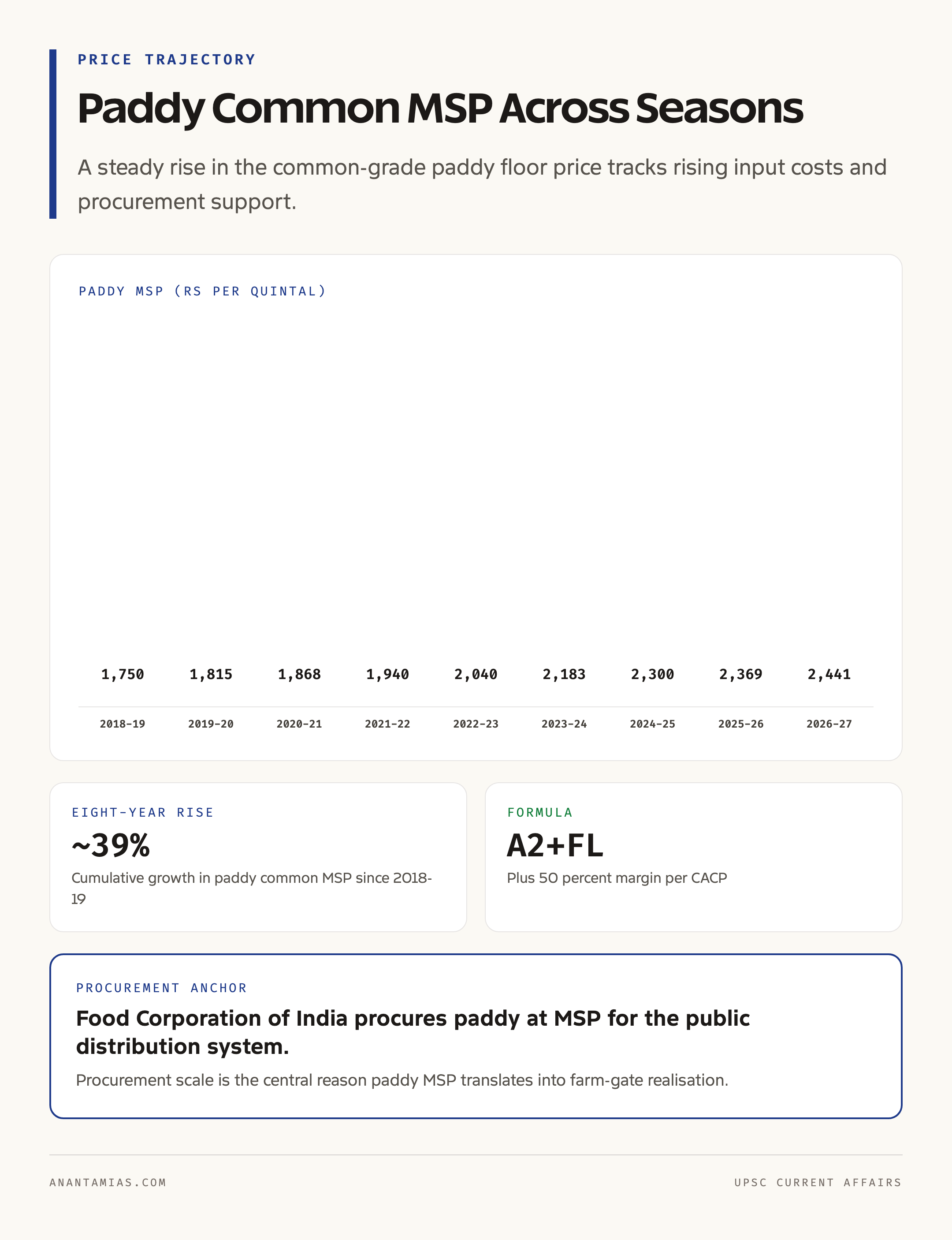
The MSP Kharif crops 2026-27 decision matters at three levels. At the farm level, it sets the income floor for the largest cropping season of the year. Even when actual market prices stay above MSP, the announced price acts as a signal for sowing choices, input-credit terms, and contract negotiations.
At the macroeconomic level, MSP feeds directly into the Consumer Price Index basket through the cereal and pulse weightings. Larger MSP hikes raise the floor for retail food prices and can complicate the Reserve Bank of India’s inflation-targeting framework. The Monetary Policy Committee has flagged food-price persistence as a key risk, and MSP increases of 5 to 7 percent feed into baseline inflation arithmetic.
At the political-economy level, the announcement is the government’s chosen instrument for replying to the farm-union demand for legal MSP. Rather than legislate a guarantee, the executive has used larger absolute increases on pulses and oilseeds to reset the bargain. This matters for state elections where farm constituencies are decisive and for the ongoing dialogue with farmer organisations.
Detailed Analysis: How the MSP Calculation Actually Works
The Commission for Agricultural Costs and Prices begins each season with a state-wise cost-of-cultivation survey conducted through agricultural universities. The commission compiles A2, FL, and C2 cost data for every crop in each major producing state. It then averages costs across states, weights them by area, and arrives at an all-India weighted cost.
The MSP is then set at A2+FL plus a margin no lower than 50 percent. In practice, for many crops, the announced MSP also crosses 50 percent over A2+FL but falls short of C2 plus 50 percent. For paddy and wheat, the gap between A2+FL plus 50 percent and C2 plus 50 percent has historically been around 12 to 16 percent. For pulses and oilseeds, the gap can widen because C2 imputes higher land-rental values in rainfed regions.
The 14 kharif crops covered span paddy, jowar, bajra, ragi, maize, tur, urad, moong, groundnut, soybean, sunflower, sesamum, niger seed, and cotton. Among these, only paddy receives broad procurement at scale. Pulses and oilseeds get scheme-based procurement that often falls short of declared targets, leaving market prices below MSP in glut years. That is the central operational complaint of farm unions: MSP without procurement is a notional price.
Comparative Perspective
Most large agricultural economies use price-support mechanisms in some form. The United States runs counter-cyclical payments and crop insurance subsidies that effectively underwrite farmer revenue. The European Union’s Common Agricultural Policy has moved from price intervention to direct payments delinked from production. China runs minimum purchase prices for rice and wheat similar to India and adds large reserve stockpiling.
What sets India apart is the dual role of MSP as both a price floor and a procurement trigger linked to the public distribution system. Few other countries combine farmer support with food security distribution at the scale India does. The trade-off is well known: the system favours paddy and wheat over pulses, oilseeds, and millets, contributing to groundwater stress in north-western states and import dependence on edible oils.
Challenges with the MSP Architecture
The headline challenge is coverage. MSP procurement at scale exists mainly for paddy and wheat. For the other 12 kharif crops, declared MSPs translate into procurement only in a few states or in pockets where state agencies are active. The result is a wide divergence between announced floor prices and realised farm-gate prices.
The second challenge is the formula debate. Farm unions argue that A2+FL undercounts land rent and capital costs, especially in tenancy-heavy regions where leased-in land is the norm. A C2 plus 50 percent benchmark would raise headline MSPs by 12 to 25 percent across crops, but it would also raise procurement costs, food subsidy bills, and inflation pass-through.
The third challenge is structural: an MSP-procurement system tilted toward paddy and wheat has locked in a cropping pattern that is water-intensive and ecologically stressed. The MSP Kharif crops 2026-27 package nudges toward pulses and oilseeds, but without matching procurement, the price signal does not translate into sowing shifts at scale. The nano-fertiliser push and other input-side reforms have to be paired with credible procurement to make a difference.
Prelims Pointers
- The Commission for Agricultural Costs and Prices is an attached office of the Department of Agriculture and Farmers Welfare; it is statutory but not constitutional.
- MSP is announced for 22 mandated crops plus sugarcane, which has a separate Fair and Remunerative Price.
- A2+FL includes paid-out costs plus imputed family labour value; C2 adds rental value of owned land and interest on owned capital.
- The Swaminathan Commission, formally the National Commission on Farmers, was constituted in 2004 and submitted its final report in 2006.
- The Food Corporation of India is the principal procurement agency for paddy and wheat; NAFED, NCCF, and Hafed handle pulses and oilseeds under the Price Support Scheme.
- Sugarcane FRP is announced by the Cabinet Committee on Economic Affairs separately from MSP; some states declare a higher State Advised Price.
Mains Questions
- Critically examine the debate around C2 plus 50 percent versus A2+FL plus 50 percent as the basis for the Minimum Support Price. What are the fiscal and inflationary trade-offs? (GS Paper III, Agriculture)
- The MSP Kharif crops 2026-27 package emphasises pulses and oilseeds. Discuss whether price support alone can drive crop diversification in India. (GS Paper III, Agriculture)
- Evaluate the role of the Commission for Agricultural Costs and Prices in shaping India’s agricultural-price policy. Suggest reforms to make its recommendations more responsive to ground realities. (GS Paper III, Government Policies)
- A legal guarantee of MSP has been a long-standing farmer demand. Analyse the costs, benefits, and design challenges of such a legal framework. (GS Paper III, Economy and GS Paper II, Governance)
Way Forward
Sustainable MSP reform must move on three fronts at once. First, the procurement architecture needs to expand for pulses and oilseeds so that announced prices translate into farm-gate realisations. State agencies must be capitalised, storage capacity expanded, and aggregation through Farmer Producer Organisations strengthened.
Second, MSP should be calibrated alongside non-price instruments. Direct income support like PM-KISAN, crop insurance under PMFBY, and farm-credit interest subvention together do more for net farm income than headline MSP hikes alone. A cleaner separation between price support and income support would let each instrument do its job. Third, the policy must internalise water and soil sustainability. Differential MSPs that reward less-water-intensive crops in stressed basins could nudge the cropping pattern without imposing blanket restrictions.
Frequently Asked Questions
What is the MSP Kharif crops 2026-27 announcement?
It is the Cabinet Committee on Economic Affairs decision dated 13 May 2026 setting minimum support prices for all 14 mandated kharif crops for the 2026-27 marketing season. Paddy common-grade MSP rose to Rs 2,441 per quintal, with pulses and oilseeds receiving larger absolute increases.
Which crops are covered under kharif MSP?
The 14 kharif crops are paddy, jowar, bajra, ragi, maize, tur or arhar, urad, moong, groundnut, soybean, sunflower seed, sesamum, niger seed, and cotton.
What is the A2+FL formula?
A2 covers actual paid-out costs like seeds, fertiliser, hired labour, fuel, irrigation, and rent paid for leased-in land. FL adds the imputed value of unpaid family labour. MSP is currently set at A2+FL plus 50 percent margin.
How does C2 differ from A2+FL?
C2 includes everything in A2+FL plus the rental value of owned land and interest on the value of owned fixed capital. C2 is broader and consistently higher than A2+FL for most crops.
What did the Swaminathan Commission recommend?
The National Commission on Farmers, chaired by M S Swaminathan, recommended that MSP should be at least 50 percent above the C2 cost of production, that procurement should be expanded, and that crop diversification should be encouraged through targeted price support.
Does MSP guarantee a sale to the government?
No. MSP is a declared floor price. The government procures actively for paddy and wheat through the Food Corporation of India and supports pulses and oilseeds through the Price Support Scheme via NAFED, NCCF, and Hafed. Other crops rely on market sales.
How does MSP affect inflation?
MSP hikes raise the floor for retail food prices because procurement at higher prices feeds into the public distribution system and shifts the supply curve for non-procured crops too. The Monetary Policy Committee tracks MSP closely as part of food-price expectations.
Why are pulses and oilseeds getting larger hikes?
India imports a large share of its edible oils and faces structural protein-pulse deficits. Larger MSP increases for pulses and oilseeds are meant to incentivise area shifts away from paddy and wheat toward these crops and to reduce import dependence over time.
What is the difference between MSP and Fair and Remunerative Price?
MSP is announced for the 22 mandated crops plus a separate price for sugarcane. The Fair and Remunerative Price is the central price for sugarcane, while several state governments declare a higher State Advised Price for cane.
Will MSP become legally guaranteed?
The government has held the line on the present executive framework. A legal MSP would require a fresh statute defining covered crops, procurement obligation, financing source, and dispute resolution. The fiscal and inflation implications are still being debated.
Tell Google you want more of this.
Add Anantam IAS as a preferred sourceOne tap, and this site shows up more often in your own Top Stories, AI Overviews and AI Mode. Remove it any time.