Why in News?
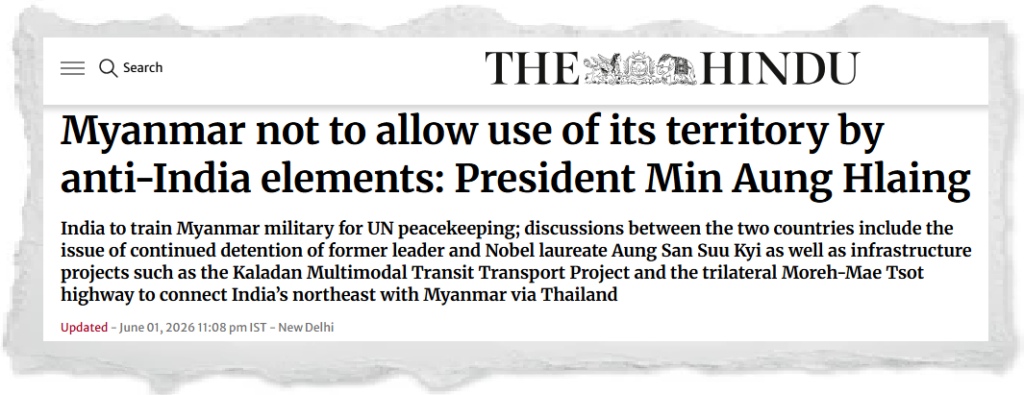
Myanmar President Min Aung Hlaing, during his visit to India, assured Prime Minister Narendra Modi that Myanmar would not allow its territory to be used by anti-India insurgent groups. The discussions also covered border security, connectivity projects, defence cooperation, critical minerals, cybercrime networks, and the ongoing political crisis in Myanmar following the 2021 military coup.
UPSC Relevance
Prelims:
India-Myanmar border, Kaladan Multimodal Transit Transport Project, India-Myanmar-Thailand Trilateral Highway, Act East Policy, BIMSTEC, insurgency in Northeast India.
Mains:
GS-II: India and its Neighbourhood Relations, International Relations,
GS-III: Internal Security, Border Management, Infrastructure Connectivity, Security Challenges and Cross-Border Terrorism.
Background
India and Myanmar share a long land boundary of approximately 1,643 km, connecting India’s northeastern states with Southeast Asia. Myanmar occupies a pivotal position in India’s Act East Policy, serving as the geographical bridge between South Asia and ASEAN.
However, since the military coup of February 2021 that overthrew the elected government led by Aung San Suu Kyi, Myanmar has witnessed prolonged civil conflict involving the military junta and various ethnic armed organisations and pro-democracy groups.
Despite international criticism of the military regime, India has maintained engagement with Myanmar, driven by strategic, security, and economic considerations.
Why Myanmar Matters for India
Strategic Gateway to Southeast Asia
Myanmar is India’s only ASEAN neighbour connected through both land and maritime routes.
Its location makes it indispensable for:
- Enhancing connectivity between Northeast India and Southeast Asia.
- Expanding trade under the Act East Policy.
- Strengthening India’s presence in the Bay of Bengal region.
Security Concerns Along the Border
Several insurgent groups operating in India’s Northeast have historically maintained camps and logistical networks inside Myanmar’s border regions.
India’s primary concerns include:
- Safe havens for insurgent groups.
- Illegal movement of arms and narcotics.
- Human trafficking and cross-border crime.
- Cybercrime syndicates operating from Myanmar’s border areas.
The assurance from Myanmar that its territory will not be used against India’s security interests directly addresses these longstanding concerns.
The Security Dimension of India-Myanmar Relations
Counter-Insurgency Cooperation
India and Myanmar have increasingly coordinated military operations against insurgent groups operating along the border.
Myanmar’s commitment assumes significance because:
- Stability in Northeast India depends partly on cooperation from Myanmar.
- Insurgent groups often exploit difficult terrain and porous borders.
- Joint intelligence sharing helps disrupt militant networks.
Border Management
The India-Myanmar border passes through:
- Arunachal Pradesh, Nagaland, Manipur, Mizoram
The region faces challenges from illegal migration, smuggling, insurgency, and narcotics trafficking.
Enhanced border coordination is therefore critical for both countries.
Connectivity Projects: Strategic but Delayed
Kaladan Multimodal Transit Transport Project
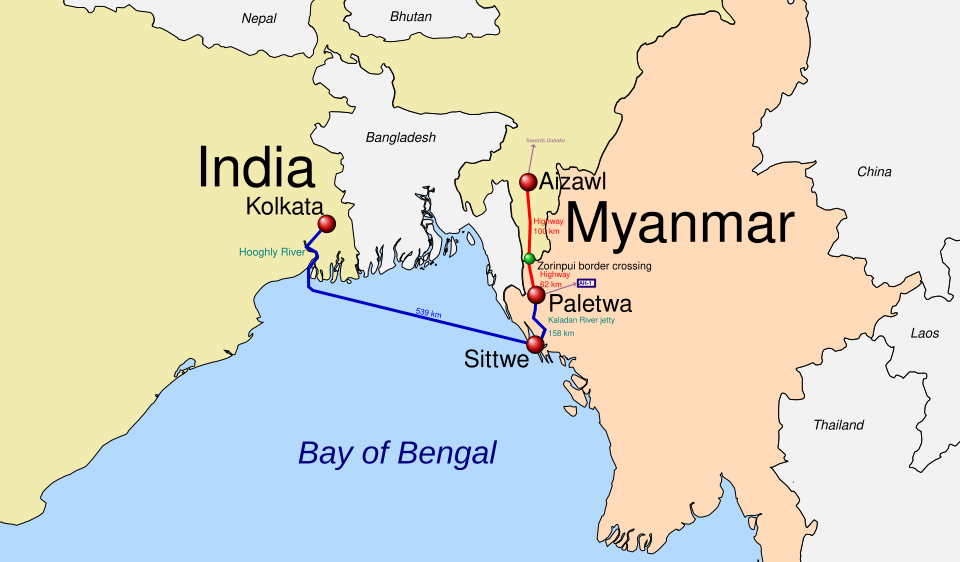
The project seeks to connect India’s eastern coast with Myanmar through a combination of sea, river, and road transport.
Its importance lies in:
- Providing alternative access to Northeast India.
- Reducing dependence on the Siliguri Corridor.
- Improving regional trade and connectivity.
However, active conflict in Myanmar’s Rakhine State has delayed implementation.
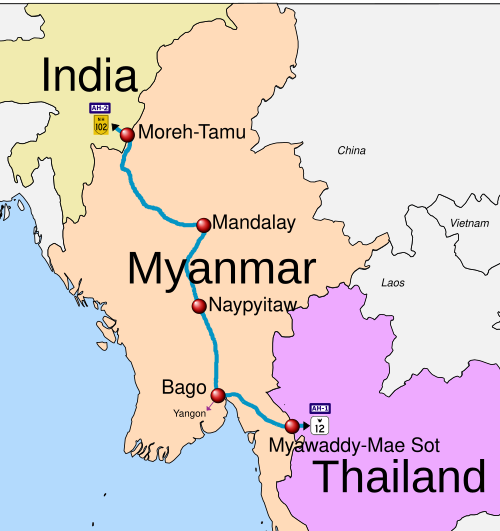
India-Myanmar-Thailand Trilateral Highway
This ambitious project aims to connect:
Moreh → Myanmar → Mae Sot
The highway is expected to:
- Facilitate regional trade.
- Improve supply chains.
- Integrate India’s Northeast with ASEAN economies.
Yet security challenges inside Myanmar remain a major obstacle.
Defence Cooperation Between India and Myanmar
India’s defence engagement with Myanmar primarily focuses on:
- Training military personnel.
- Capacity building.
- Institutional development.
- United Nations peacekeeping training.
Unlike some major powers, India’s military cooperation has largely emphasized professional training and confidence-building rather than direct military intervention.
This approach aligns with India’s broader neighbourhood policy of maintaining engagement while encouraging stability.
Critical Minerals and Strategic Competition
Myanmar possesses substantial reserves of:
- Rare earth elements.
- Critical minerals essential for electronics.
- Strategic minerals required for clean energy technologies.
Many of these resources are located in Kachin State, which borders both India and China.
For India, access to diversified critical mineral supply chains is increasingly important because these minerals are essential for:
- Electric vehicles.
- Renewable energy infrastructure.
- Semiconductor manufacturing.
- Defence production.
The issue has acquired added significance amid growing global competition over critical mineral resources.
The Challenge of Cyber Scam Networks
Southeastern Myanmar has emerged as a hub for large-scale cyber fraud operations.
These scam centres have been linked to:
- Human trafficking, Online financial fraud, Forced labour, Digital extortion networks.
India has already repatriated more than 2,400 citizens trapped in such compounds and continues efforts to rescue others.
The issue demonstrates how traditional security concerns are increasingly intertwined with emerging cyber threats.
India’s Delicate Balancing Act
Engagement Without Endorsement
India faces a diplomatic dilemma in Myanmar.
On one hand:
- Security cooperation is necessary.
- Connectivity projects require engagement.
- Strategic competition with China demands continued presence.
On the other hand:
- India supports democratic values.
- It has expressed concerns regarding the continued detention of Aung San Suu Kyi.
- It advocates dialogue among all stakeholders for restoring peace and democratic governance.
India’s approach can therefore be described as pragmatic engagement rather than political endorsement.
Contrast with Western Approaches
Many Western countries have imposed sanctions and reduced engagement with Myanmar’s military government.
India has instead chosen:
- Continuous dialogue.
- Development cooperation.
- Security coordination.
- Humanitarian engagement.
This reflects India’s belief that disengagement would reduce its influence while creating opportunities for rival powers.
Challenges in India-Myanmar Relations
Security Instability
The ongoing civil war continues to affect infrastructure projects, border management, and economic cooperation.
Chinese Influence
China remains Myanmar’s largest strategic partner and investor, limiting India’s room for manoeuvre.
Refugee and Migration Issues
Instability in Myanmar has generated refugee flows into India’s northeastern states, particularly Manipur and Mizoram.
Delayed Connectivity Projects
Repeated delays reduce the economic benefits expected from India’s Act East Policy.
Way Forward
Strengthen Border Security Cooperation
India and Myanmar should institutionalise intelligence-sharing mechanisms and enhance coordinated action against insurgent and criminal networks.
Accelerate Connectivity Projects
Special security arrangements may be required to ensure completion of critical infrastructure projects despite ongoing conflict.
Expand Economic Engagement
Greater investments in trade, energy, healthcare, and digital infrastructure can strengthen mutual dependence and stability.
Promote Inclusive Political Dialogue
India should continue supporting peaceful dialogue among all stakeholders in Myanmar to facilitate a durable political settlement.
Enhance Cybersecurity Cooperation
Joint mechanisms to tackle cyber scam networks and human trafficking syndicates must become a priority area of bilateral cooperation.
Conclusion
The visit of President Min Aung Hlaing underscores the strategic importance of Myanmar in India’s neighbourhood and Indo-Pacific policies. While political instability continues to pose serious challenges, India has chosen a pragmatic path that combines security cooperation, infrastructure development, economic engagement, and support for dialogue. As regional geopolitics becomes increasingly competitive, the future of India-Myanmar relations will play a significant role in shaping connectivity, security, and stability across South and Southeast Asia.
Practice Questions
Prelims Question 1 (Inference-Based)
Consider the following statements:
- Successful implementation of the Kaladan Multimodal Transit Transport Project would reduce India’s dependence on the Siliguri Corridor for connectivity with the Northeast.
- Political instability in Myanmar can directly affect the effectiveness of India’s Act East Policy.
Which of the following can be correctly inferred from the statements above?
(a) Myanmar’s internal developments have limited relevance to India’s strategic interests.
(b) Connectivity projects with Myanmar are important for India’s regional integration objectives.
(c) India’s Act East Policy depends entirely on maritime routes.
(d) The Siliguri Corridor will become irrelevant after completion of the Kaladan Project.
Answer: (b)
Explanation: The two statements indicate that Myanmar is central to India’s connectivity and regional integration plans. Political instability and project delays directly affect India’s strategic objectives under the Act East Policy.
Prelims Question 2
Consider the following statements regarding India-Myanmar relations:
- Myanmar is India’s only ASEAN neighbour sharing a land boundary with India.
- The Kaladan Multimodal Transit Transport Project involves sea, river, and road connectivity.
- The India-Myanmar-Thailand Trilateral Highway is intended to connect Northeast India with Southeast Asia.
Which of the statements given above are correct?
(a) 1 and 2 only
(b) 2 and 3 only
(c) 1 and 3 only
(d) 1, 2 and 3
Answer: (d)
Explanation: All three statements are correct. Myanmar is India’s only ASEAN neighbour connected by land, the Kaladan Project uses multiple transport modes, and the Trilateral Highway is designed to link Northeast India with Southeast Asia.
Mains Questions
- Discuss the strategic significance of Myanmar in India’s Act East Policy and internal security framework. Examine the challenges posed by Myanmar’s political instability.
- India’s engagement with Myanmar reflects a balance between strategic interests and democratic values. Critically analyse.
Tell Google you want more of this.
Add Anantam IAS as a preferred sourceOne tap, and this site shows up more often in your own Top Stories, AI Overviews and AI Mode. Remove it any time.