The NAMASTE Scheme has moved from policy paper to operational rollout in early 2026, and the Centre is positioning it as the framework that will finally end hazardous manual sanitation in India. The scheme covers roughly 5 lakh sanitation workers across urban local bodies, replaces the older Self Employment Scheme for Rehabilitation of Manual Scavengers (SRMS), and ties together three threads that had been running separately: worker profiling, mechanization of sewer cleaning, and livelihood rehabilitation.
That combination is the key change. Earlier interventions tried to handle each piece in isolation. Profiling exercises happened without accompanying mechanization. Capital subsidies for cleaning equipment were issued without identifying the workers who needed alternate livelihoods. Rehabilitation budgets sat unspent because eligible families were never properly enumerated. The NAMASTE Scheme tries to correct that pattern by putting all four levers under one umbrella, with a single nodal agency, the National Safai Karamcharis Finance and Development Corporation (NSKFDC), running operations.
This explainer covers what the NAMASTE Scheme actually does, where it sits in India’s long policy history on manual scavenging, what the budget and coverage look like, and where the implementation gaps still are.
Quick Facts at a Glance
- Full name: National Action for Mechanised Sanitation Ecosystem (NAMASTE).
- Type: Central Sector Scheme, fully funded by the Centre.
- Launched: 2023-24, scaled up and made the primary sanitation worker scheme from 2025-26.
- Implementing ministries: Ministry of Social Justice and Empowerment (MoSJE) and Ministry of Housing and Urban Affairs (MoHUA).
- Implementing agency: National Safai Karamcharis Finance and Development Corporation (NSKFDC).
- Coverage: approximately 5 lakh sanitation workers identified across urban local bodies in all states and UTs.
- Replaces: Self Employment Scheme for Rehabilitation of Manual Scavengers (SRMS).
- Anchored to: Prohibition of Employment as Manual Scavengers and their Rehabilitation Act, 2013.
What Just Happened
The April 2026 update is operational rather than legislative. The MoSJE published the latest profiling and coverage figures, confirmed budgetary outlays for the scheme, and notified standardized rates for personal protective equipment, mechanized cleaning vehicles and capital subsidies. Several states completed their first round of worker profiling and submitted lists for occupational identity cards.
The bigger development is the formal sunset of SRMS. The older scheme had run since 2007 and was widely criticized for limited coverage and slow disbursal. NAMASTE absorbs its rehabilitation provisions, broadens the definition of beneficiaries from manual scavengers to all sanitation workers, and shifts the policy frame from individual rehabilitation to ecosystem mechanization.
Background and Historical Context
India’s policy on manual scavenging has been a story of repeated legislative attempts, each closing one loophole and opening another.
The first major instrument was the Employment of Manual Scavengers and Construction of Dry Latrines (Prohibition) Act, 1993. It banned dry latrines and the employment of manual scavengers, but its enforcement record was thin. Demolition of dry latrines was inconsistent. Cleaning of insanitary latrines continued in many states without prosecution.
The 2013 Act, formally the Prohibition of Employment as Manual Scavengers and their Rehabilitation Act, expanded the definition of manual scavenging to include cleaning of septic tanks and sewers without protective gear. It mandated identification of manual scavengers, their rehabilitation through skill development and livelihood support, and penalties for hiring without safety equipment. Importantly, it placed an obligation on local authorities to mechanize sewer and septic tank cleaning.
The Supreme Court’s 2014 judgment in Safai Karamchari Andolan v. Union of India added teeth. It directed compensation of ten lakh rupees to the next of kin in case of death during sewer or septic tank cleaning, mandated identification surveys, and held that the prohibition extended to all hazardous cleaning work without protective equipment.
Despite all this, sewer and septic tank deaths continued. The reasons were familiar. Mechanization equipment was expensive and not standardized. Local bodies outsourced cleaning to contractors who employed informal workers without paperwork. Profiling exercises identified far fewer workers than civil society estimates. The SRMS scheme reached only a fraction of those who applied.
The NAMASTE Scheme is the policy response to those gaps. By bundling profiling, equipment, capital subsidy and rehabilitation, the Centre is trying to build an ecosystem where the unsafe option simply stops being available. For a parallel discussion on welfare delivery design, the explainer on centrally sponsored schemes is useful, and the piece on PM SVANidhi scheme covers a related livelihood programme for urban informal workers.
Key Provisions of the NAMASTE Scheme
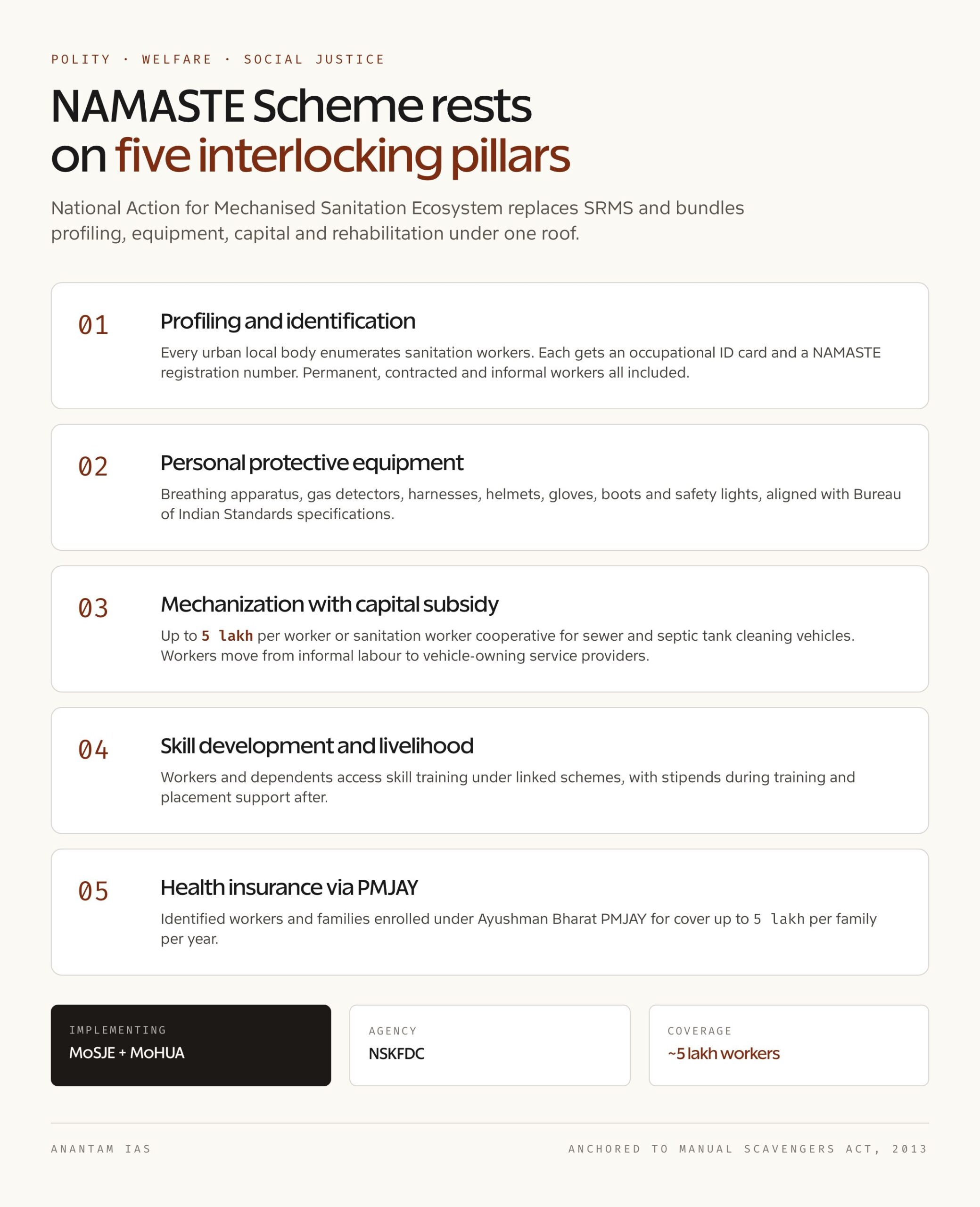
The scheme operates through five distinct components.
Profiling and identification. Every urban local body is required to enumerate sanitation workers within its jurisdiction. Workers receive an occupational identity card and a NAMASTE registration number. The exercise covers permanent municipal employees, contracted workers, and informal sanitation labour.
Personal protective equipment. The scheme provides a comprehensive PPE kit including breathing apparatus, gas detectors, harnesses, helmets, gloves, boots and safety lights. Standards are aligned with Bureau of Indian Standards specifications.
Mechanization through Sewer and Septic Tank Cleaning Vehicles. Capital subsidy of up to five lakh rupees is provided to identified workers and Sanitation Worker Cooperatives for the purchase of mechanized cleaning vehicles. The aim is to convert workers from informal labour into vehicle-owning service providers contracted by ULBs.
Skill development and livelihood support. Workers and their dependents are eligible for skill training under linked schemes, with stipends during training and placement support after.
Health insurance. Identified workers and their families are enrolled under Ayushman Bharat Pradhan Mantri Jan Arogya Yojana (AB-PMJAY) for health coverage up to five lakh rupees per family per year.
Awareness and IEC. The scheme funds awareness campaigns aimed at urban local bodies, contractors and the general public to break the social practice of informal sewer cleaning.
Why It Matters
The NAMASTE Scheme matters for three reasons that go beyond the immediate beneficiaries.
The first is dignity. Manual scavenging is the most acute caste-based occupational lock-in surviving in modern India. Dr. B.R. Ambedkar identified it as the lowest rung of caste-based labour assignment, and seventy-five years after the Constitution came into force, the practice has not been fully extinguished. Mechanization breaks the inheritance of the occupation.
The second is data. Earlier schemes were starved of accurate worker counts. The NAMASTE profiling exercise produces, for the first time, a single national database of sanitation workers tied to their geography, employer and skill profile. That database becomes the foundation for everything else, from insurance to credit linkages to skill development.
The third is the institutional shift from rehabilitation to prevention. The SRMS scheme was largely reactive. It tried to support workers after they had been pulled out of manual scavenging. NAMASTE tries to make the unsafe practice obsolete by making safe alternatives standard. Capital subsidy for cleaning vehicles, when paired with municipal procurement standards that favour mechanized service providers, creates a market that pulls workers up rather than waiting for them to fall.
Detailed Analysis: From SRMS to NAMASTE
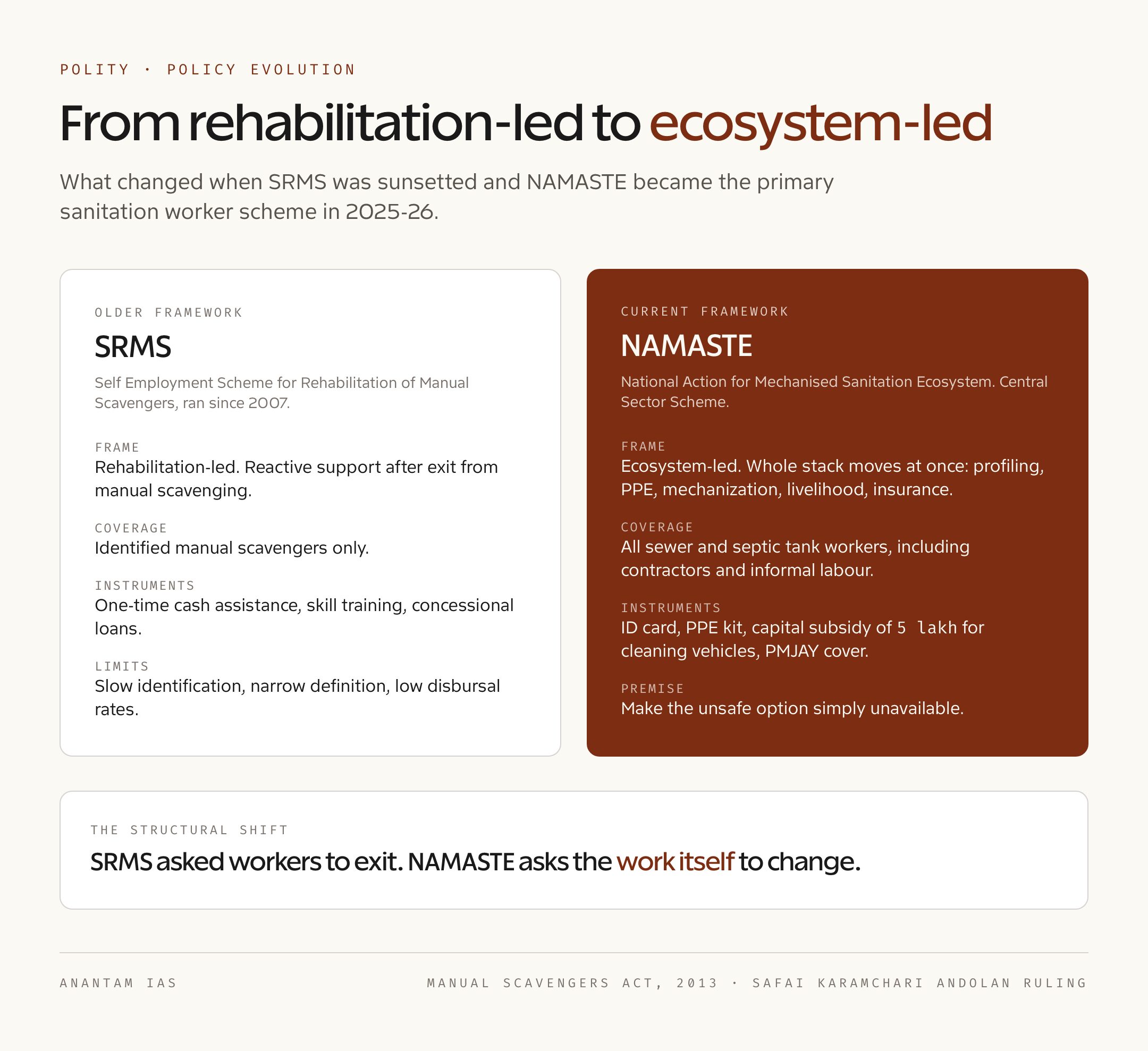
The differences between the older SRMS framework and the NAMASTE Scheme are worth laying out clearly.
SRMS was rehabilitation-led. It assumed manual scavenging would be ended by enforcement and supported affected individuals through one-time cash assistance, skill training and concessional loans. The scheme reached a fraction of those legally identified, partly because identification itself was slow.
NAMASTE is ecosystem-led. The premise is that ending hazardous manual sanitation requires the entire stack to change at once. Workers must be profiled and equipped. Local bodies must procure mechanized services. Contractors must comply with safety standards. Capital must flow to worker cooperatives. Insurance must be active. Without all five, any one piece fails.
NAMASTE also expands eligibility. SRMS focused narrowly on identified manual scavengers. NAMASTE covers all sewer and septic tank workers, regardless of whether they had previously been classified as manual scavengers. This widens the protective umbrella to the gig and contract workers who were doing the actual cleaning while remaining outside the legal definition.
Comparative Perspective
Globally, mechanized sanitation is the norm. Most OECD countries phased out manual sewer cleaning decades ago through a combination of municipal procurement standards, occupational safety regulation and waste-water treatment infrastructure. Where manual entry into confined spaces happens, it operates under strict permit-to-work systems with mandatory atmospheric testing, rescue equipment and certified supervisors.
In South Asia, the picture is mixed. Bangladesh and Nepal have similar challenges and similar legal prohibitions, but neither has built the unified ecosystem approach that NAMASTE attempts. The Indian framework, if implemented at scale, will be a regional benchmark.
Challenges and Critiques
Three challenges deserve attention.
Data gaps in profiling. Civil society organizations have repeatedly produced higher worker counts than government surveys. The pattern continues in the NAMASTE rollout. Without converging the numbers, downstream coverage stays incomplete.
ULB capacity. The scheme places significant operational responsibility on urban local bodies, which vary widely in administrative capacity. Smaller municipal councils struggle to procure mechanized vehicles, manage tender processes, and supervise contractor compliance.
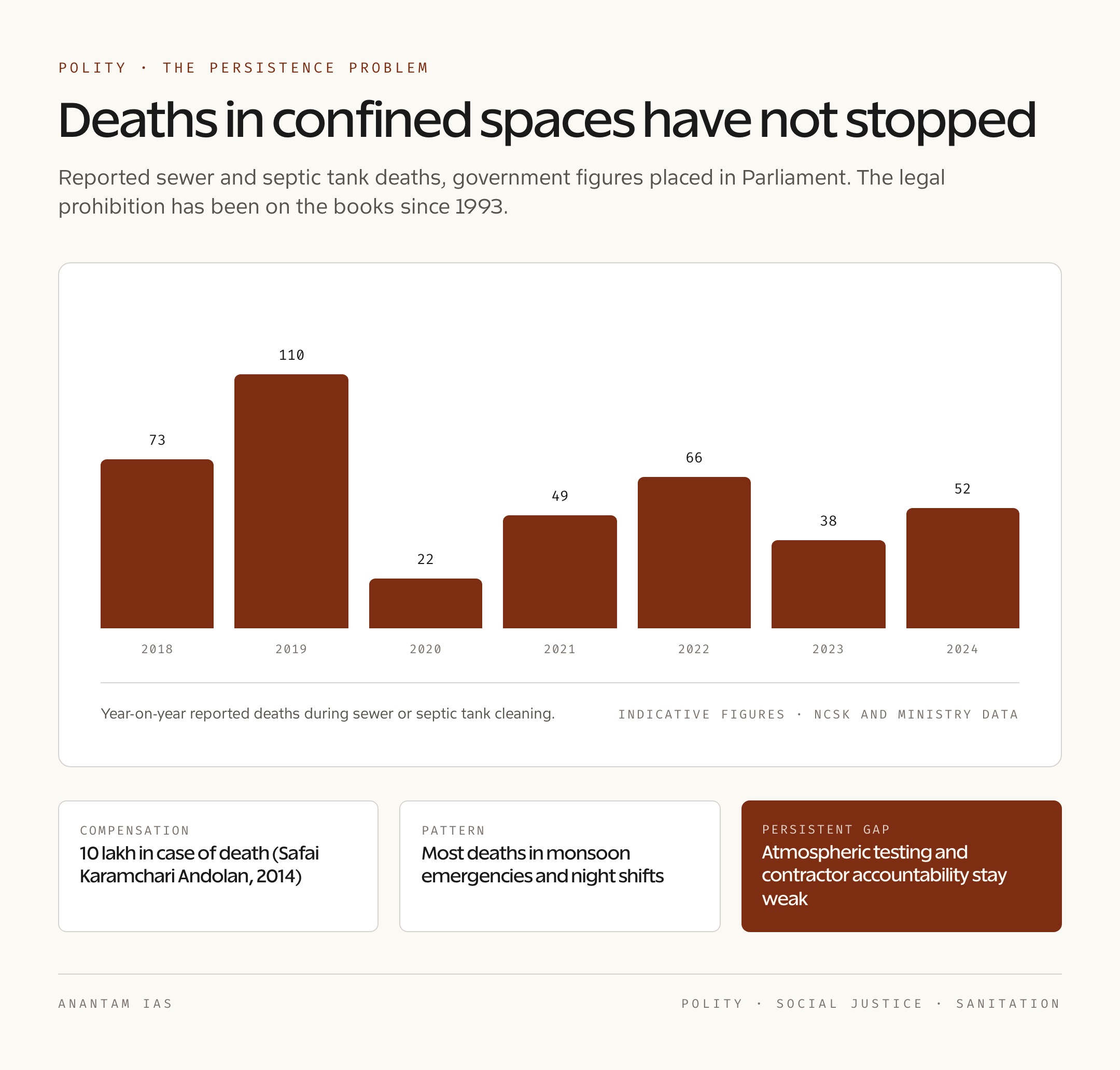
Continuing deaths in confined spaces. Even after mechanization, sewer and septic tank deaths continue, often because the legal prohibition is breached at night or in monsoon emergencies. Standard operating procedures, atmospheric testing protocols, and contractor accountability remain weak in many cities.
Caste dimension. Mechanization changes the work but not necessarily the workers. Without active social mobility programs, the same families remain in the sanitation occupation, now as vehicle drivers rather than manual labourers. Education and skill development for the next generation is the long-term answer, and that piece needs sharper attention than the scheme currently gives it.
UPSC Prelims Pointers
- NAMASTE stands for National Action for Mechanised Sanitation Ecosystem.
- Implemented jointly by MoSJE and MoHUA, with NSKFDC as the implementing agency.
- Central Sector Scheme, fully funded by the Centre.
- Replaces the Self Employment Scheme for Rehabilitation of Manual Scavengers (SRMS).
- Anchored to the Prohibition of Employment as Manual Scavengers and their Rehabilitation Act, 2013.
- Covers identified sanitation workers across all urban local bodies.
- Capital subsidy of up to five lakh rupees for mechanized cleaning vehicles.
- Health insurance through Ayushman Bharat PMJAY.
- 2014 Supreme Court ruling in Safai Karamchari Andolan case mandates ten lakh rupees compensation for sewer and septic tank deaths.
Mains Practice Questions
- Manual scavenging persists in India despite repeated legal prohibitions. Examine the structural reasons and assess whether the NAMASTE Scheme addresses them. (GS Paper II, 15 marks)
- Discuss the shift from rehabilitation-led to ecosystem-led policy design in India’s sanitation worker programmes. (GS Paper II, 10 marks)
- The persistence of caste-based occupational lock-in in sanitation work raises constitutional and human rights concerns. Discuss with reference to relevant articles and judicial pronouncements. (GS Paper II, 15 marks)
- Mechanization of sewer cleaning requires more than capital subsidy. Identify the institutional, regulatory and social conditions necessary for the NAMASTE Scheme to succeed. (GS Paper II, 15 marks)
Way Forward
The NAMASTE Scheme has the right architecture. The next two years will decide whether it produces the outcomes the architecture promises.
Three things will need to happen. Profiling has to converge with civil society estimates so that no worker is left out. Urban local bodies have to actually procure mechanized services from worker cooperatives, not just on paper but in tender outcomes. And the social mobility piece, getting children of sanitation workers into education and other occupations, needs a dedicated stream rather than being treated as a side benefit.
If those three pieces fall into place, India will have built the most comprehensive mechanized sanitation ecosystem in the developing world. If they do not, the NAMASTE Scheme will join a long list of well-designed programmes that delivered less than they promised.
The legal prohibition has been on the books since 1993. The Constitution has prohibited untouchability since 1950. The work that remains is operational, not philosophical.
Frequently Asked Questions
What is the NAMASTE Scheme?
A central sector scheme that mechanizes sanitation work, equips workers with safety gear and capital, and provides health insurance and rehabilitation support. It covers about 5 lakh identified sanitation workers.
What does NAMASTE stand for?
National Action for Mechanised Sanitation Ecosystem.
Which ministries implement the NAMASTE Scheme?
The Ministry of Social Justice and Empowerment and the Ministry of Housing and Urban Affairs jointly implement it. NSKFDC is the implementing agency.
How is NAMASTE different from SRMS?
SRMS was a rehabilitation programme for identified manual scavengers. NAMASTE is broader, covering all sanitation workers and tying together profiling, equipment, mechanization, livelihood support and insurance.
Who is eligible under the scheme?
All sanitation workers identified through the urban local body profiling exercise, including those engaged by contractors.
What is the capital subsidy under NAMASTE?
Up to five lakh rupees for the purchase of mechanized sewer and septic tank cleaning vehicles by identified workers or sanitation worker cooperatives.
Is health insurance included?
Yes. Identified workers and their families are enrolled under Ayushman Bharat PMJAY for coverage up to five lakh rupees per family per year.
Does the scheme apply to rural areas?
The current focus is on urban local bodies. Rural sanitation work falls under separate Swachh Bharat Mission components.
Tell Google you want more of this.
Add Anantam IAS as a preferred sourceOne tap, and this site shows up more often in your own Top Stories, AI Overviews and AI Mode. Remove it any time.