

Why in News?
On 2 November 2026, lenders proposed dedicated housing credit for PMAY-G beneficiaries at a Ministry of Rural Development and National Housing Bank dialogue.
- Loan products were proposed to help households bridge construction costs beyond scheme assistance.
- Seasonal repayment, property constraints and last-mile lending costs were central concerns.
- The Ministry will examine the suggestions with NHB, States and lending institutions; the release does not announce an approved financing entitlement.
- Construction gaps can delay completion when households cannot arrange the balance beyond assistance.
- Responsible credit requires affordable repayment and clear terms, even when the borrower is already verified under a welfare scheme.
UPSC Relevance
Prelims Relevance
- PMAY-G assistance and institutional credit
- National Housing Bank and refinance
- Seasonal cash flow and repayment capacity
- Partial credit guarantees and risk sharing
Mains Relevance
GS Paper 2
- Welfare delivery and coordination between governments and financial institutions
GS Paper 3
- Financial inclusion, rural housing and responsible lending
Essay
- Access to finance must be judged alongside the ability to repay.
Background and Context
Assistance and Credit Serve Different Purposes
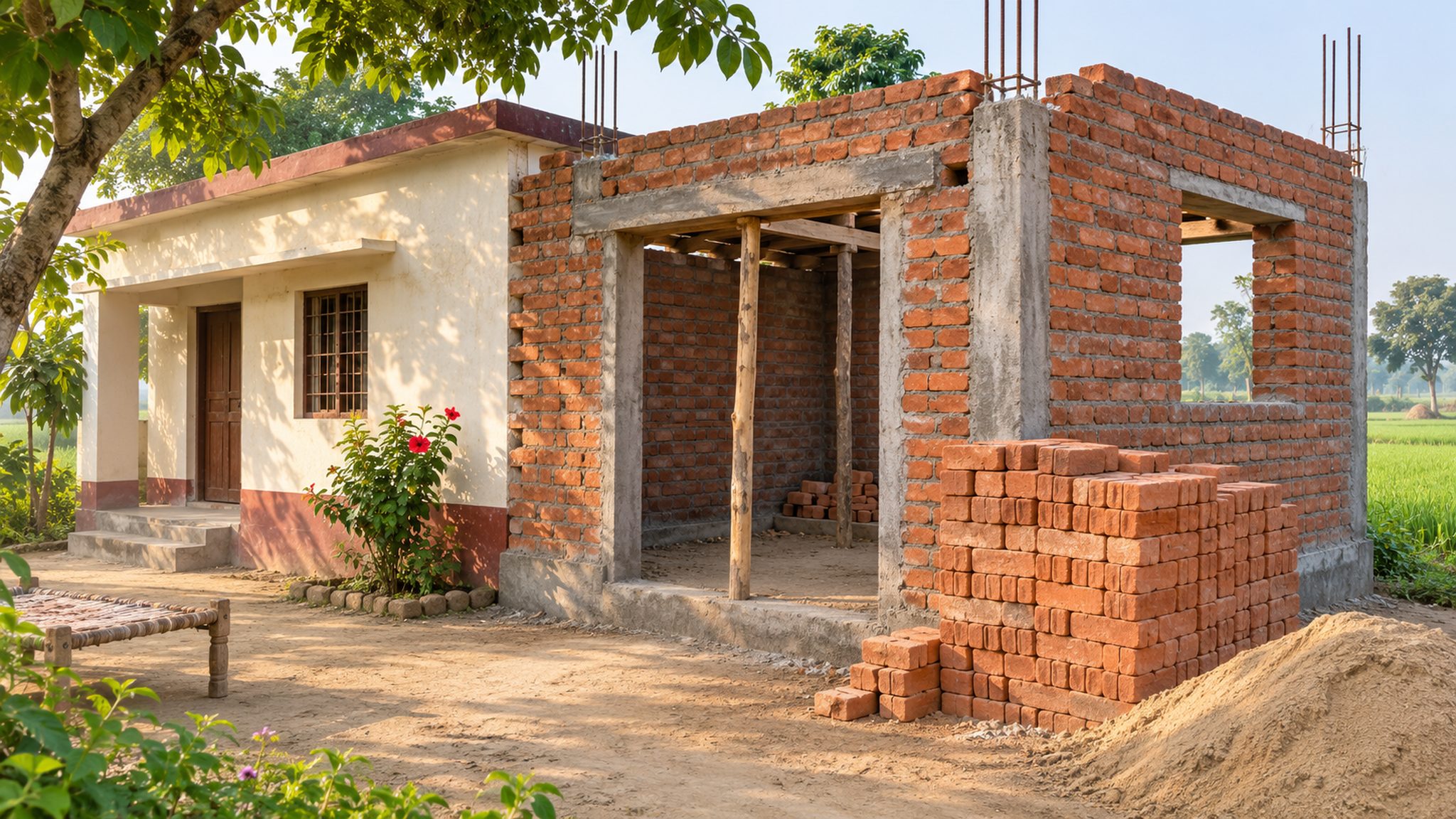
A house can remain unfinished even after assistance is sanctioned, because construction costs and household resources do not necessarily match the timing or size of available support.
- PMAY-G assistance contributes towards a rural house, while a housing loan creates a repayment obligation. Combining them can close a financing gap, but it also changes the household’s future commitments and exposure to financial stress.
- The financing gap arises when construction costs exceed scheme assistance and available household resources. The Ministry identifies delayed completion and reliance on costly informal borrowing as concerns motivating discussion of suitable institutional credit products.
- Beneficiary verification and recorded construction milestones can help lenders assess an application. They do not establish disposable income, prove that every applicant can repay, or remove the need to examine existing debts and essential expenditure.
- Proposed support includes partial guarantees, interest subvention and refinance. These were recommendations at the dialogue; the release does not establish a sanctioned benefit, an automatic loan offer or an approved change in prudential regulation.
- Housing quality remains the purpose of financing. A completed structure is useful only when affordable borrowing supports safe construction without forcing households to cut essential consumption or repeatedly borrow to service earlier repayments.
Match Repayment to Rural Cash Flow
Credit appraisal needs to examine when money reaches the household, how reliable it is and what remains after necessary expenditure throughout the repayment period.
- Seasonal income can produce receipts at particular times rather than in equal monthly amounts. Participants recommended repayment aligned with these patterns; an instalment schedule should reflect realistic cash availability instead of assuming a regular salary.
- Repayment capacity depends on income stability, other obligations and room for shocks. A loan that appears manageable in a good season may become difficult after crop losses, illness or interrupted work, requiring conservative appraisal.
- Construction milestones provide information about progress and the next funding need. Linking assessment to progress can reduce uncertainty, but unfinished work still requires scrutiny of costs, workmanship and the borrower’s ability to complete the house.
- Last-mile delivery through local institutions and self-help-group networks was proposed to reduce access barriers. Their local knowledge can help gather information, while lenders must retain clear responsibility for appraisal, terms and fair treatment.
- Inclusion should be assessed through usable, affordable finance rather than loan numbers alone. The poverty and job-quality discussion helps explain why household security depends on earnings and vulnerability, not merely access to a financial product.
Property Rights and Funding Shape Lending
A suitable borrower and an unfinished house are only part of the lending decision; documentation, security, funding costs and institutional responsibilities also affect feasible loan terms.
- Unclear land titles and restrictions on mortgaging allotted properties were identified as barriers. States would need to examine the relevant property arrangements; the workshop itself does not remove restrictions or create transferable ownership rights.
- Refinance supplies funding to lending institutions, whereas a retail housing loan is the household’s borrowing relationship. The proposed NHB window concerns the funding layer; it should not be described as direct automatic lending to every beneficiary.
- A partial guarantee, if adopted with specified conditions, would share defined lender losses. It would not inherently cancel the borrower’s repayment duty, eliminate appraisal or cover every loss; the actual design would determine its scope.
- Prudential safeguards address recognition and management of lending risk. Participants suggested differentiated treatment, but the banking review discussion reinforces the distinction between examining proposals and implementing changes to capital or other regulatory requirements.
- A pilot was recommended before wider rollout. Its value would lie in testing completion, repayment and borrower outcomes across realistic conditions, allowing policymakers to examine whether support reaches households without transferring excessive risk to them.
Way Forward
Test Affordability Before Expansion
- Assess household cash flow and disclose repayment schedules, charges and consequences before sanction.
- Clarify property conditions through State-level review rather than treating documentation barriers as solved.
- Evaluate a pilot using construction completion, repayment stress and complaints alongside lender viability.
Conclusion
- Rural housing credit can bridge a construction gap when loan terms match household resources. Its success depends on affordability, clear property arrangements and accountable lending, rather than the assumption that verified welfare beneficiaries are uniformly creditworthy.
- For policy analysis, distinguish assistance, household borrowing, lender refinance and proposed guarantees. The current development is a set of financing recommendations under examination, with implementation and safeguards still requiring decisions by the competent institutions.
UPSC Practice Questions
Prelims MCQ 1
With reference to proposed rural housing finance, consider the following statements:
- Refinance and a retail household loan operate at different funding layers.
- Verification under a housing scheme automatically establishes repayment capacity.
- A partial guarantee necessarily cancels the borrower’s repayment obligation.
How many of the above statements are correct?
(a) Only one (b) Only two (c) All three (d) None
Answer: (a) Only one
Explanation:
Only statement 1 is correct. Scheme verification does not establish affordability, and a guarantee does not inherently cancel borrower obligations.
Prelims MCQ 2
Which lending approach best addresses seasonal household income?
(a) Assuming every borrower receives a regular monthly salary (b) Matching repayment to assessed cash flow and essential expenditure (c) Treating scheme assistance as proof that no appraisal is needed (d) Ignoring other debts when construction has begun
Answer: (b) Matching repayment to assessed cash flow and essential expenditure
Explanation:
Seasonal cash-flow appraisal helps align repayments with realistic household resources while accounting for necessary expenditure and existing obligations.
UPSC Mains Questions
- Examine how institutional credit could improve rural housing completion while creating risks for low-income households.
- Distinguish welfare assistance, retail credit and refinance. What safeguards should guide a proposed rural housing finance pilot?
Source: PIB, Ministry of Rural Development.
Frequently Asked Questions
Has a new PMAY-G loan entitlement been approved?
The release reports recommendations from a stakeholder dialogue. The Ministry will examine them with relevant institutions. It does not announce an approved automatic loan entitlement, guarantee or interest subsidy for beneficiaries.
Why does seasonal income matter for repayment?
Income may arrive unevenly across the year. Appraisal should assess the timing and reliability of receipts, essential spending and other debts so that repayment obligations reflect realistic household cash flow.
Is NHB refinance the same as a household loan?
No. Refinance supports the funding of lending institutions, while the retail loan is the borrower’s relationship with a lender. The proposed window should not be presented as automatic direct credit to beneficiaries.
Does beneficiary verification establish creditworthiness?
Verification can help establish scheme eligibility and provide useful records. Repayment capacity still requires assessment of income, existing debts, necessary expenditure and exposure to shocks; eligibility alone does not answer those questions.
Tell Google you want more of this.
Add Anantam IAS as a preferred sourceOne tap, and this site shows up more often in your own Top Stories, AI Overviews and AI Mode. Remove it any time.