Why in News?
PIB reported on 29 October 2026 that a 27 October meeting of the Review Committee for Narmada Control Authority approved payment arrangements under the Narmada cost-sharing settlement.
- The committee adopted the Attorney General’s opinion and the Memorandum of Agreement signed on 7 July 2026 by Gujarat, Madhya Pradesh, Maharashtra and Rajasthan.
- The arrangement addresses pending inter-State dues, claims and financial liabilities connected with construction cost sharing for the Sardar Sarovar Project.
- Payment modalities were approved for outstanding dues of Narmada Water Disputes Tribunal award projects within the financial year 2026-27.
- The release confirms adoption and payment arrangements. It does not provide evidence that all outstanding amounts have already been transferred.
- Water finance includes different obligations: the rural water maintenance note concerns local upkeep, while this development addresses inter-State construction liabilities.
- Restoration costs, discussed in the Jojari river case, arise from a different accountability problem. A financial settlement must be assessed against the liabilities it actually covers.
UPSC Relevance
Prelims Relevance
- NWDT: Narmada Water Disputes Tribunal, whose award provides the underlying adjudicatory framework.
- NCA: Narmada Control Authority, associated with implementation of the Narmada arrangements.
- RCNCA: Review Committee for Narmada Control Authority, the forum that adopted the agreement and approved payment modalities.
- Memorandum of Agreement: a negotiated instrument recording the participating parties’ agreed arrangements.
- Cost sharing: division of financial responsibility for infrastructure serving more than one jurisdiction.
Mains Relevance
GS Paper 2
- Federalism: translating inter-State commitments into sustained administrative cooperation.
- Governance: distinguishing adjudication, negotiated settlement and implementation accountability.
GS Paper 3
- Infrastructure finance: managing shared project liabilities through reconciled accounts and executable payment arrangements.
Essay
- Cooperation becomes credible when public institutions can carry an agreement through to implementation.
Background and Context
Why Shared Projects Need Cost Rules
A river project can serve several jurisdictions even when its physical works are concentrated in one place, creating financial responsibilities that cross State boundaries.
- Shared infrastructure separates the location of construction from the reach of its benefits. When several States participate in a project, administrative arrangements must explain how their financial obligations relate to the agreed undertaking.
- Construction expenditure and the amount owed by another participant are different accounting questions. The project authority must identify the relevant cost and the basis on which a share becomes payable by a particular State.
- Outstanding dues arise when an obligation remains unpaid or its amount is contested. Resolving such differences requires agreement about the claims being covered, rather than merely repeating that the project benefits several States.
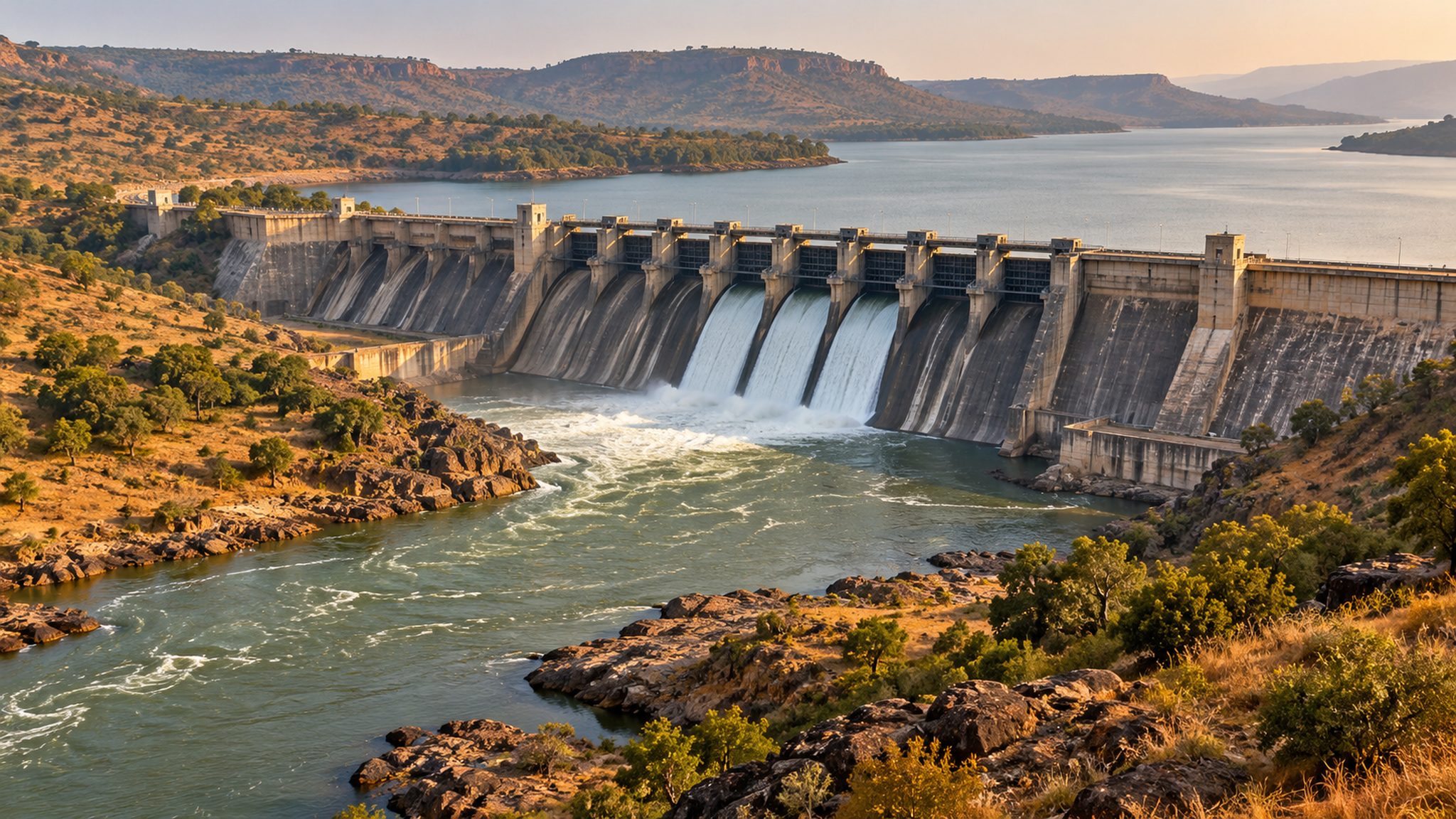
- Sardar Sarovar is the project identified in the current release. The adopted arrangement addresses construction cost-sharing disputes through a one-time settlement of pending dues, claims and financial liabilities among the participating States.
- Scope matters when interpreting the announcement. A settlement of financial liabilities does not, by itself, establish revised water allocations or resolve every environmental, rehabilitation and operational question associated with a large river project.
From an Award to an Agreement
Adjudication supplies a framework, while implementation institutions and negotiated arrangements help the participating governments carry its obligations into practical administration.
- A tribunal award provides an adjudicatory basis for the arrangements it determines. Execution still requires administrative work, including records, coordination and decisions about obligations arising during the life of the project.
- Implementation institutions connect that framework with continuing project administration. Their role makes the quality of inter-State records and coordination important even after an underlying dispute has received an adjudicatory answer.
- The Review Committee adopted the Attorney General’s opinion and the July agreement at its October meeting. The reported development concerns acceptance of the financial settlement and payment modalities within the existing institutional arrangement.
- A negotiated settlement can narrow disagreement by recording what participating governments accept as the basis for resolving pending claims. Its usefulness depends on clear scope and implementation, rather than the existence of signatures alone.
- Adoption and execution remain separate stages. The October decision advances the July agreement toward payment, but the public release does not supply transaction records demonstrating that every outstanding liability has been discharged.
What Makes Payment Arrangements Work
A financial settlement becomes operational when each party can identify its obligation, authorize payment and reconcile the resulting entries with the other parties.
- Reconciled accounts should establish which claims are included, the amount accepted and the records supporting that amount. Differences between the payer’s and recipient’s books need resolution before either treats a liability as closed.
- A payment schedule connects the accepted liability with administrative deadlines. The announcement places payment within the financial year, while evidence of completion must come from subsequent execution and confirmation by the parties concerned.
- Treasury follow-through requires the competent authorities to carry out the approved arrangement through applicable financial procedures. Approval in a joint forum alone cannot demonstrate that money has moved between the relevant accounts.
- Confirmation of receipt closes an important accounting loop. A payment instruction, an actual transfer and recognition of that transfer against the correct liability are distinct records that should agree before settlement is considered complete.
- Cooperative federalism requires a route for handling residual differences without reopening every settled question. Defined responsibility, shared records and regular review can help participating governments identify delays and correct implementation errors.
Way Forward
Track Settlement Through to Closure
- Reconcile the obligation: maintain a common record of accepted claims, responsible parties and supporting accounts.
- Verify execution: review actual transfers and acknowledgements against the approved payment arrangement, with responsibility assigned for unresolved entries.
- Report within scope: distinguish completed payments from pending obligations and keep unrelated water, environmental or rehabilitation issues separately identifiable.
Conclusion
- The Narmada cost-sharing settlement illustrates the administrative work needed after an inter-State agreement. An award, an accepted settlement and completed payments each answer a different question about how shared infrastructure obligations are carried out.
- Judge implementation through records: clear liabilities, authorized transfers and reconciled receipt provide evidence that cooperation has produced a financial result. The current announcement confirms the approved arrangement; subsequent execution remains the relevant measure of completion.
UPSC Practice Questions
Prelims MCQ 1
With reference to the recently reported Narmada cost-sharing settlement, consider the following statements:
- The October Review Committee meeting adopted an agreement that had been signed in July 2026.
- The public announcement confirms that all outstanding payments have already been completed.
- The financial settlement itself establishes revised allocations of Narmada water among the States.
How many of the above statements are correct?
(a) Only one (b) Only two (c) All three (d) None
Answer: (a) Only one
Explanation:
Only statement 1 is supported. The release reports adoption of the agreement and approval of payment modalities; it does not establish completed payments or revised water allocations.
Prelims MCQ 2
Which evidence most directly demonstrates completion of an agreed inter-State project payment?
(a) A statement that the project benefits several States (b) A meeting approving the general payment arrangement (c) A signed agreement without subsequent financial records (d) Matching transfer, receipt and liability-reconciliation records
Answer: (d) Matching transfer, receipt and liability-reconciliation records
Explanation:
Execution is established through financial records showing that the payment occurred, was received and was credited against the correct obligation. Approval and agreement are earlier stages.
UPSC Mains Questions
- Why can inter-State infrastructure disputes continue after an adjudicatory framework has been established? Explain the administrative role of cost-sharing agreements. (150 words)
- Using the Narmada cost-sharing settlement as context, discuss how financial accountability can strengthen cooperative federalism. (250 words)
Source: PIB, Ministry of Jal Shakti.
Frequently Asked Questions
What did the October Narmada meeting approve?
The Review Committee adopted the Attorney General’s opinion and the July agreement, and approved payment modalities for outstanding dues associated with Narmada Water Disputes Tribunal award projects.
Was a new agreement signed in October?
The reported October decision adopted the Memorandum of Agreement signed on 7 July 2026. It advanced that earlier agreement through approval of payment arrangements, rather than announcing a new October signing.
Does approval mean that all outstanding dues have been paid?
No. The release confirms the arrangement and the financial-year payment objective. Actual completion requires subsequent evidence of transfers, receipt and reconciliation against the liabilities covered by the settlement.
Did the settlement change Narmada water allocations?
The release addresses pending financial dues, claims and construction cost-sharing liabilities. It does not establish revised water allocations or the closure of every environmental, rehabilitation or operational dispute.
Why is this relevant to cooperative federalism?
Shared infrastructure creates obligations that governments must implement together. Agreed liabilities, reliable records and verified payments allow cooperation to continue beyond meetings and signed documents, while making delays and unresolved differences identifiable.
Tell Google you want more of this.
Add Anantam IAS as a preferred sourceOne tap, and this site shows up more often in your own Top Stories, AI Overviews and AI Mode. Remove it any time.