Why in News?
On 23 October 2026, the Ministry of Rural Development launched an upgraded National Mobile Monitoring System (NMMS) app combining attendance security with offline recording and worker safeguards.
- The upgrade supports attendance recording under VB-G RAM G, with technical assistance from IIT Madras and other agencies.
- Security features include device checks, protections against app tampering and liveness detection.
- Workers facing connectivity or authentication difficulties retain prescribed offline and authorised exception routes.
- Digital welfare must address both false attendance and the exclusion of genuine workers when technology fails.
- An attendance record and a measured-work record answer different questions; treating either as sufficient weakens payment accountability.
UPSC Relevance
Prelims Relevance
- NMMS: National Mobile Monitoring System.
- Liveness detection distinguishes a live person from a photograph or dummy image.
- Offline capture and authorised exceptions address different failure conditions.
- e-MB: electronic Measurement Book recording physically measured work.
- FTO: Fund Transfer Order; a suspicious-photo flag can withhold its generation pending checks.
Mains Relevance
GS Paper 2
- Digital welfare delivery: balancing authentication, accessibility and timely payment.
- Administrative accountability through exception handling, social audits and verifiable records.
Essay
- Technology serves public welfare when accountability includes people whom automated systems cannot reliably recognise.
Background and Context
What Attendance Security Checks Establish
The upgrade addresses impersonation and manipulation at the point where workers’ presence is recorded; it does not make every recorded entry automatically trustworthy.
- Identity verification seeks to establish that the person presented to the app is the intended worker. It addresses complaints of wages being claimed in another person’s name, according to the ministry.
- Liveness detection checks whether the camera sees a real, live person rather than a stored photograph or dummy image. This protects the capture process against a different problem from ordinary identity matching.
- Device-level security and safeguards against cloning or tampering seek to protect the application itself. Secure data transmission addresses the movement of recorded information, rather than proving how much work was completed.
- The ministry says AI-based face verification has been refined for regional differences. This is an official account of the upgrade, not independent evidence that recognition now works equally well for every worker.
- The ministry attributes reduced opportunities for impersonation to face authentication. The release provides no quantified evaluation of fraud reduction, so improved security should be treated as a claimed benefit requiring independent assessment.

Why Attendance Alone Does Not Release Wages
The payment chain needs evidence of presence and evidence of work; these records serve separate purposes before money reaches a worker’s bank account.
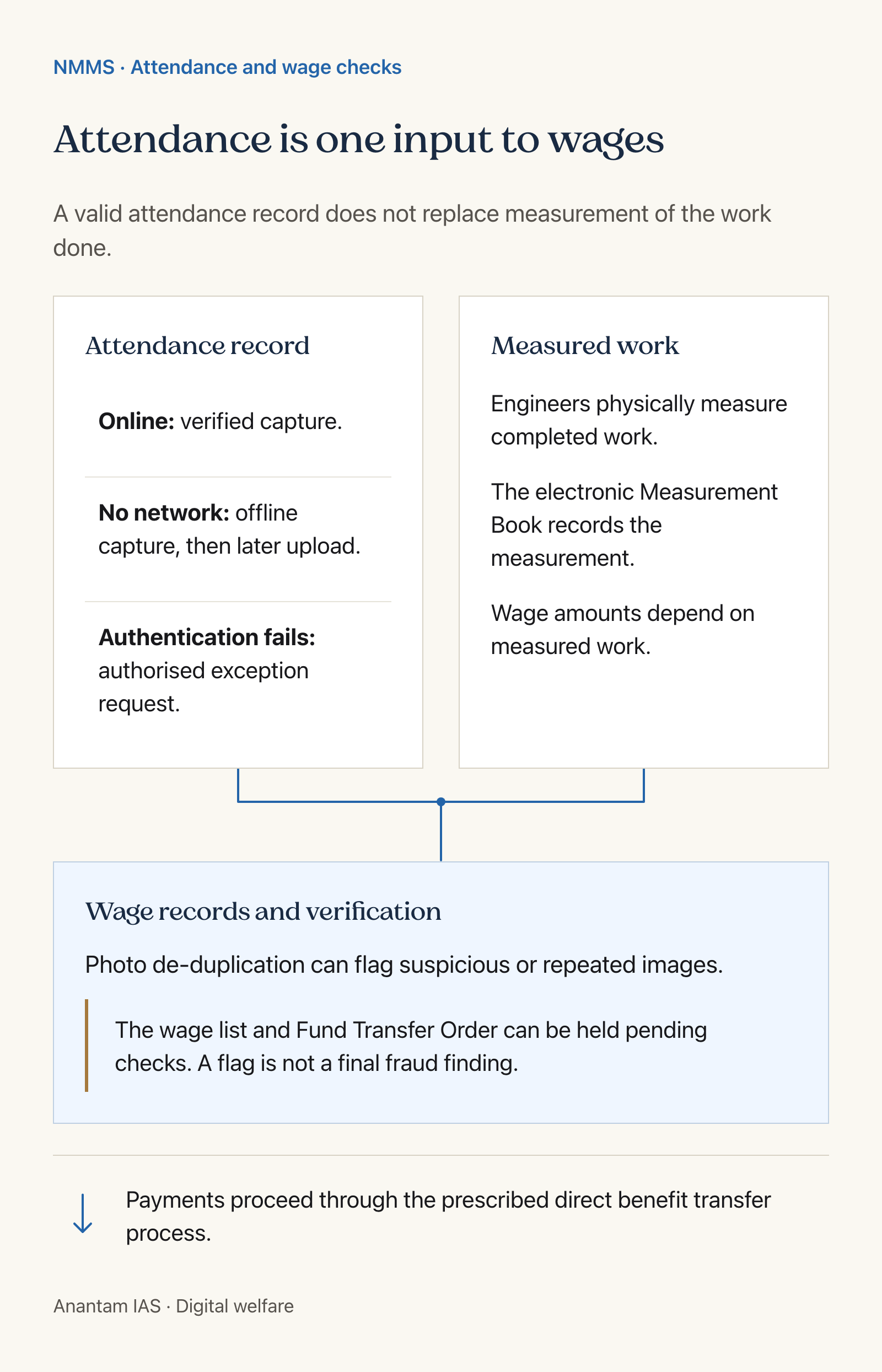
- Attendance records who was present through the prescribed process. It does not, by itself, establish the quantity of work completed or determine the wage amount, as the ministry explicitly explains in its release.
- The electronic Measurement Book records work physically measured by technical engineers at the site. The ministry states that wage amounts are determined from this measurement, keeping physical output distinct from photographic attendance evidence.
- An AI photo de-duplication module identifies suspicious or repeated photographs. Such a flag triggers further checks; it should not be described as a final finding that the worker committed fraud or performed no work.
- When suspicious entries are detected, the wage list and Fund Transfer Order are withheld until necessary checks finish. The distinction matters because a temporary verification hold is not the same as a final rejection.
- Following the prescribed verification and measurement process, payments move through Direct Benefit Transfer to bank accounts. Transaction traceability helps follow the money, but cannot independently prove that attendance and measurement records were accurate.
Offline Capture and Exceptions Protect Different Workers
A secure system also needs an accountable route for genuine workers whose attendance cannot be captured or transmitted through the ordinary process.
- Where connectivity is unavailable, offline attendance can be recorded under the prescribed procedure. It is uploaded after the muster roll closes, once the device reaches network coverage; offline capture does not remove subsequent verification.
- The authorised exception mechanism covers face-authentication failure for elderly workers or persons with disabilities, and technical problems with a mobile device. The mate or field worker can submit a request through the prescribed process.
- Offline recording addresses missing connectivity, while an exception request addresses specified authentication or device problems. This comparison helps distinguish delayed transmission of an existing record from a request to resolve difficulty creating one.
- Random spot inspections, social audits and public disclosure supplement app-based checks, according to the ministry. These mechanisms bring physical worksites and local scrutiny into oversight rather than relying exclusively on photographs and electronic records.
- The governance test is whether security and accessibility work together in practice. An assessment should examine unresolved exceptions and payment holds alongside suspicious entries detected; counting blocked records alone would not establish successful delivery.
Way Forward
Make Verification Holds Accountable
- Give workers a clear reason for a hold, an accessible contact and a recorded route for correction; these are safeguards to prioritise in implementation.
- Track the time taken to resolve exception requests and suspicious-photo flags, with escalation when genuine workers remain unpaid.
- Audit attendance and measured-work records together, using field checks to investigate discrepancies without assuming that an automated flag proves wrongdoing.
Conclusion
- The NMMS upgrade illustrates a central digital-governance trade-off: stronger authentication must coexist with workable alternatives when networks, devices or recognition fail, or genuine workers can bear the cost of preventing misuse.
- For UPSC answers, distinguish presence, measured work and payment. Good administration needs credible evidence at each stage, plus a transparent way to correct errors before a verification hold becomes prolonged exclusion.
UPSC Practice Questions
Prelims MCQ 1
With reference to the upgraded NMMS app, consider the following statements:
- Offline attendance may be uploaded after the muster roll closes, once network access is available.
- A suspicious-photo flag is itself a final finding of fraud.
- The electronic Measurement Book records physically measured work.
How many of the above statements are correct?
(a) Only one (b) Only two (c) All three (d) None
Answer: (b) Only two
Explanation:
Statements 1 and 3 are correct. A suspicious-photo flag withholds the wage list and FTO pending necessary checks; it is not a final fraud determination.
Prelims MCQ 2
Which distinction best explains why recording attendance through NMMS does not automatically determine wage payments?
(a) Attendance records presence, while the e-MB records measured work used to determine wage amounts. (b) Attendance determines the wage amount, while the e-MB only stores photographs. (c) Offline attendance is always excluded from wage processing. (d) Face authentication replaces physical measurement by technical engineers.
Answer: (a) Attendance records presence, while the e-MB records measured work used to determine wage amounts.
Explanation:
The ministry separates attendance verification from work physically measured by technical engineers and recorded in the e-MB. Wage determination depends on the latter measurement.
UPSC Mains Questions
- Digital authentication can improve accountability while creating new barriers to welfare access. Discuss with reference to offline recording and exception mechanisms in NMMS.
- Why should attendance verification, work measurement and payment processing remain distinguishable in rural employment administration? Suggest safeguards against prolonged verification holds.
Source: PIB, Ministry of Rural Development.
Frequently Asked Questions
What is the NMMS app used for?
The National Mobile Monitoring System records workers’ attendance under VB-G RAM G. The October upgrade adds security checks while retaining prescribed offline recording and authorised exceptions for genuine workers facing technical difficulties.
Does NMMS attendance automatically determine wages?
No. The ministry separates attendance from work physically measured by technical engineers and recorded in the electronic Measurement Book. Wage amounts are determined from that measurement before the prescribed bank-transfer process.
How does offline attendance work?
Where network access is unavailable, attendance can be captured offline under the prescribed procedure. It is uploaded after the muster roll closes when the device reaches an area with connectivity.
Does a suspicious-photo flag prove fraud?
No. The photo de-duplication module identifies suspicious or repeated photographs. The wage list and Fund Transfer Order are withheld pending necessary checks; the flag should not be presented as a final fraud finding.
Who can use the exception mechanism?
The release describes authorised exceptions for authentication failures affecting elderly workers or persons with disabilities, and for technical device problems. The mate or field worker submits the request through the prescribed process.
Tell Google you want more of this.
Add Anantam IAS as a preferred sourceOne tap, and this site shows up more often in your own Top Stories, AI Overviews and AI Mode. Remove it any time.