Context:
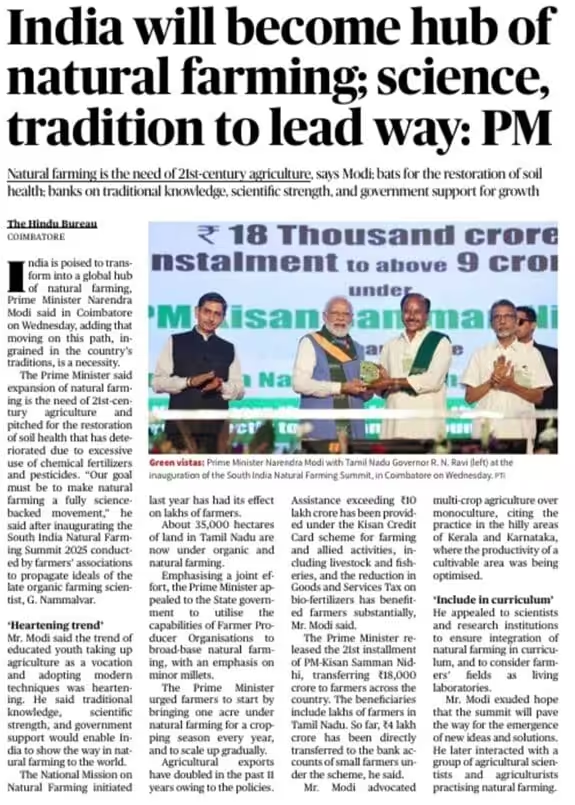
In his recent visit to Tamil Nadu, Indian Prime Minister presented a vision for making India a hub of Natural Farming.
UPSC Relevance:
Agriculture.
PYQ:
Q.) How is permaculture farming different from conventional chemical farming? (2021)
1. Permaculture farming discourages monocultural practices but in conventional chemical farming, monoculture practices are predominant.
2. Conventional chemical farming can cause an increase in soil salinity but the occurrence of such phenomenon is not observed in permaculture farming.
3. Conventional chemical farming is easily possible in semi-arid regions but permaculture farming is not so easily possible in such regions.
4. Practice of mulching is very important in permaculture farming but not necessarily so in conventional chemical farming.
Select the correct answer using the code given below.
(a) 1 and 3
(b) 1, 2 and 4
(c) 4 only
(d) 2 and 3
What is Natural Farming?
- Natural Farming is a chemical-free traditional farming method that relies on minimal external inputs and emphasizes sustainability. It is considered as an agroecology based diversified farming system which integrates crops, trees and livestock with functional biodiversity. It is largely based on on-farm biomass recycling with major stress on biomass mulching, use of on-farm cow dung-urine formulations; maintaining soil aeration and exclusion of all synthetic chemical inputs.
- It is gaining popularity in India due to its reduced cost, improved soil health, and eco-friendly practices. It has many indigenous forms in India, the most popular one is practiced in Andhra Pradesh called Zero Budget Natural Farming (ZBNF).
Four Pillars of Natural Farming?
| Jivamrita & Ghanjivamrita | A cow dung-based bio-stimulant is prepared locally by fermenting dung with cow urine, jaggery and pulses flour. The fermented solution when applied to fields increases the microbial count in the soil, which supplies the plants with essential nutrients. |
| Bijamrita | Seeds are treated with cow dung-based stimulant which protects young roots from fungus and other soil and seed-borne diseases. |
| Whapsa | The fields are managed to have some green cover around the year to aid carbon capture by plants from the air and nurture the soil-carbon-sponge. This also keeps the microbes and other organisms like earthworms alive which helps the soil become porous and retain more water. |
| Acchadana or Mulching | During the cultivation of main crops, crop residues are used as mulch to retain soil moisture and prevent the growth of weeds. |
What are the similarities and Differences between Organic and Natural Farming?
- Similarities between Organic and Natural Farming:
- Organic and Natural farming are both non-chemical systems of farming. These are based on diversity, on-farm biomass management and biological nutrient recycling. Diversity, rotation multiple cropping and resource recycling are the key similarities between Organic and Natural Farming.
Differences between Organic and Natural Farming?
| Organic farming | Natural farming |
| Organic farming is open for use of off-farm organic and biological inputs. | No external inputs is used in natural farming. On-farm inputs based on Desi Cow (Jeevamrit, Beejamrit, Ghanajeevamrit) and biomass recycling through mulching is done. |
| Organic Farming is open for micronutrient correction through use of minerals. | Use of compost/ vermicompost and minerals are not allowed in Natural Farming. |
| Organic farming is widely popular with the Global market at US$132 billion. | Natural farming is evolving with markets yet to be developed. |
About National Mission on Natural Farming (NMNF):
- Scheme Type: Centrally Sponsored Scheme under Ministry of Agriculture & Farmers’ Welfare.
- Aim: To strengthen sustainable agriculture, enhance soil health, restore ecosystems, reduce farmers’ input costs, and build climate resilience and safe food systems.
- Coverage: 7.5 lakh hectares across 15,000 natural farming clusters.
Objectives of NMNF:
- Livestock Integration: Popularize livestock-based models (preferably local cow breeds) integrating agriculture and animal husbandry.
- Sustainable Farming: Promote nature-based systems using on-farm bio-inputs to reduce dependency on purchased inputs and lower input costs.
- Soil & Sustainability: Improve soil health and encourage sustainable agricultural practices.
- Research & Extension: Strengthen agro-ecological research and extension services through ICAR, KVKs, and Agricultural Universities.
- Knowledge Integration: Combine farmer experience with scientific expertise to develop location-specific NF practices.
- Standards & Certification: Establish scientifically supported standards and farmer-friendly certification for chemical-free produce.
- National Branding: Create and promote a single national brand for naturally grown chemical-free produce.

Components of NMNF:
- Natural Farming Clusters: MNF targets 7.5 lakh hectares across 15,000 natural farming clusters, each covering 50 ha and 125 farmers.
- Bio-input Resource Centres (BRCs): 10,000 need-based centres to be set-up for easy availability of ready-to-use inputs for farmers.
- Community Support: Deployment of two Krishi Sakhis/Community Resource Persons (CRPs) per cluster to guide farmers and raise community awareness.
Implementation:
- Training Programs: Extensive training through KVKs, Agricultural Universities, local NF institutions, and model demonstration farms.
- Incentives: Output-based incentive of ₹4,000 per acre per year for up to 1 acre per farmer over two years.
- Certification: Simple farmer-friendly certification system managed by National Centre for Organic & Natural Farming (NCONF) under Participatory Guarantee System (PGS) – India.
- Monitoring: Real-time geo-tagged monitoring through the NMNF Portal.
Convergence & Policy Integration:
- Student Engagement: Students will be engaged in NMNF through the Rural Agricultural Work Experience (RAWE) program and dedicated Undergraduate, Postgraduate & Diploma courses on NF.
- Coordination with Central and State Government schemes: Agriculture & Farmers Welfare, Rural Development, Food Processing, Panchayati Raj, AYUSH, Cooperation, and Animal Husbandry.
- Market Linkages: Engagement with National and International organisations for livestock enhancement, NF demonstration farms, and local market linkages via APMCs, Haats, and depots.
What are other government initiatives to promote natural Farming in India?
| Bharatiya Prakritik Krishi Paddhati (BPKP) | It is a sub-mission under the Paramparagat Krishi Vikas Yojana(PKVY) which falls within the umbrella of the National Mission on Sustainable Agriculture (NMSA). The scheme aims to promote traditional indigenous practices, which give freedom to farmers from externally purchased inputs. |
| Natural Farming under Namami Gange | Natural farming in a five-kilometre belt along the Ganga River under the Namami Gange scheme. |
| State Government initiatives | Andhra Pradesh launched natural farming as a state policy in 2015. The state is now home to the largest number of farmers in India who have transitioned from chemical nutrients to applying locally prepared natural inputs. Further, Gujarat and Himachal Pradesh have adopted natural farming as part of the state policy. |
What is the significance of Natural Farming for India?
1. Reduction of India’s fertilizer subsidy bill- India’s fertilizer subsidy bill, driven by a spike in natural gas and other raw material prices, was around ₹1.3 trillion in 2021-22. Promoting natural farming can reduce these costs to the exchequer.
2. Improving small and marginal farmers’ income– It is estimated that natural farming will reduce cost of cultivation by 60-70%. A study undertaken by Andhra University (which surveyed over 3500 natural and conventional farms) revealed that average net returns from natural farming were 50% higher than conventional farming.
3. Reduced dependence on credit- A panel survey of 260 farm households which were surveyed in 2018-19 and 2019-20, found that natural farming reduced the dependence on credit, freeing many farmers from exploitative and interlinked input and credit markets.
4. More flexible than organic farming- Organic farming is more about certification, while natural farming is a gradual process. But, there is relative flexibility in natural farming for adoption. This makes it easier for small farmers to transition.
5. Benefit to end consumers- At present, consumers are forced to purchase food with chemical residues in it. Certified organic food is more expensive, but the sheer cost savings in natural farming can ensure safe food at affordable prices.
6. Environmental and Health Benefits- Improved soil health, fertility, and biodiversity due to natural farming will increase resilience to climate risks like waterlogging, floods, and droughts.
7. Reduction of Ocean acidification- Since natural farming eliminates chemical fertilisers and pesticides, it reduces ocean acidification and marine pollution from land-based activities.
8. Health Benefits– Reduced exposure to harmful chemicals improves the health of farmers and prevents carcinogenic disease.
What are the challenges in adopting natural farming?
1. Lack of Awareness and Knowledge- Limited access to training and capacity-building programs hampers their ability to effectively adopt natural farming.
2. Lack of adequate budgetary support- There is limited support from the Central Government with India’s National Mission on Sustainable Agriculture receiving only 0.8% of the agricultural budget.
3. Economic threats to India’s crop protection industry- India’s crop protection industry is valued at ₹18,000 crores. Promoting natural methods will threaten the very existence of their entire business ecosystem.
4. Lack of dedicated supply chains- Natural farming produce often lacks dedicated supply chains and certifications, making it hard to differentiate in the market.
5. Perceived Lower Yields- There are concerns about the perceived lower yields with the adoption of natural farming.
What should be done to promote natural farming?
1. Adoption of balanced approach while promoting natural farming- The experience of Sri Lanka must be kept in mind where the Government at once prohibited the use and import of chemical fertilizers leading to massive drop in production and shortage of food.
2. Adequate time and awareness campaigns- The government should provide adequate time, promote awareness campaigns. Civil Society Organizations can be engaged to promote farmer-to-farmer capacity building for sustainable agriculture. The Andhra model of widespread adoption of natural farming can be emulated.
3. Validation by scientific research- The Indian Council of Agricultural Research should design a curriculum on natural farming.
4. Shifting the National policy focus from food to nutrition security- Government should support the transition and bear short-term losses. Instead of input-based subsidies for fertilizer and power, the focus should be to incentivize outcomes like nutrition output, water conservation and desertification reversal.
Tell Google you want more of this.
Add Anantam IAS as a preferred sourceOne tap, and this site shows up more often in your own Top Stories, AI Overviews and AI Mode. Remove it any time.