Why in News?
The Health Ministry launched NCG VISHWAS in Mumbai on November 21, 2026, linking patient education with calls for stronger screening, referrals and continuity in cancer care.
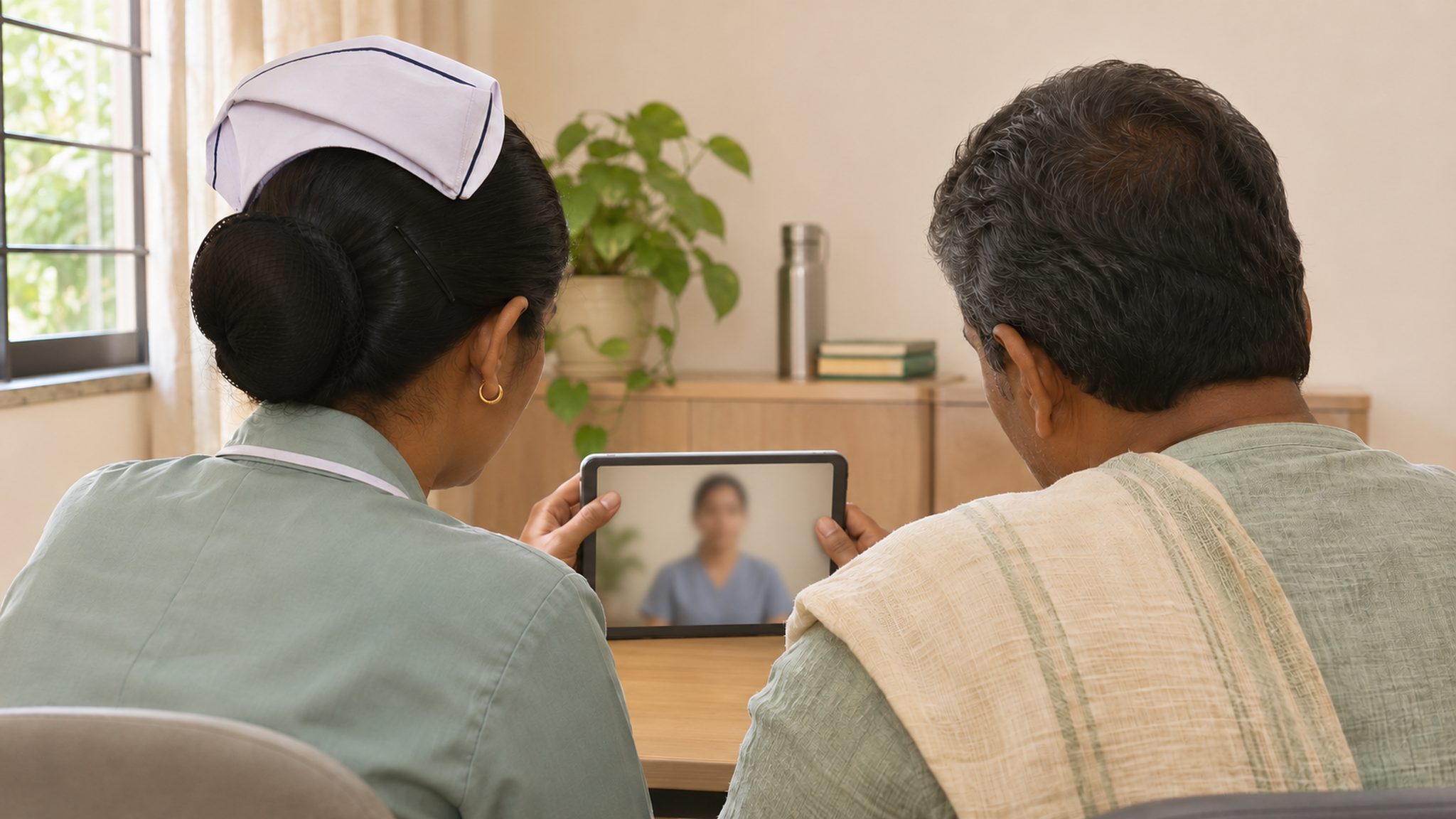
- NCG VISHWAS provides AI-enabled, clinician-reviewed educational videos on breast, cervical and oral cancers.
- The videos use Hindi, Marathi, Tamil and English and cover prevention, diagnosis, treatment and long-term care.
- The Ministry urged consent-based record linkage through ABHA and wider dissemination through healthcare workers and digital platforms. These were implementation recommendations accompanying the launch.
- Continuity of care depends on a patient completing the next clinical step and the receiving team having relevant information.
- Education, clinical services and financial protection address different obstacles. Each requires its own implementation and evaluation.
UPSC Relevance
Prelims Relevance
- NCG is the National Cancer Grid, a network supporting cancer-care quality and collaboration.
- Screening identifies people who may need further assessment.
- Diagnosis establishes whether cancer is present through appropriate clinical evaluation and tests.
- ABHA supports linking and sharing health records with patient consent.
- AB PM-JAY provides eligible beneficiaries financial coverage under its rules.
Mains Relevance
GS Paper 2
- Public health delivery across primary, secondary and tertiary facilities.
- Digital health governance, informed consent and equitable access.
Background and Context
What Patient Education Contributes
The initiative addresses what patients and caregivers understand at each stage of cancer care.
- Clinician-reviewed education can explain the purpose of investigations, treatment choices and follow-up. The launch describes videos as information support, while clinical teams remain responsible for evaluating an individual patient and advising care.
- Language access matters when unfamiliar medical terms prevent patients from asking questions. Videos in familiar languages can support a consultation, while staff check whether the patient understands the next step and its purpose.
- The National Cancer Grid brings hospitals, researchers and patient groups into a common network. Its role includes standardised protocols, quality assurance and professional capacity, providing a clinical base for reviewing educational material.
- AI-enabled production requires clinical review, clear communication and regular correction when guidance changes. The announced initiative uses technology to convey information about cancer care, with no reported authority to diagnose patients independently.
- Dissemination through member institutions is part of the initiative. Suggestions involving community workers and additional platforms describe possible expansion, so the launch alone cannot establish universal access or improved patient outcomes.
How Screening Connects to Treatment
A screening programme produces health benefits when people with abnormal findings receive timely assessment and appropriate care.
- Screening looks for possible disease among eligible people before symptoms necessarily appear. As the WHO explains, an abnormal finding requires further tests to establish a diagnosis and guide any referral for treatment.
- Referral connects the first point of contact with a facility able to investigate the finding. Sending a referral creates an opportunity for assessment, while attendance and completion determine whether that opportunity becomes care.
- Diagnostic confirmation separates suspected disease from established cancer. This distinction matters for programme evaluation because a tally of screening encounters cannot reveal how many patients completed assessment or entered an appropriate treatment pathway.
- Follow-up keeps the care pathway connected after the first visit. A practical system needs an identified receiving facility, understandable instructions and a way to detect missed appointments before patients disappear between service levels.
- Patient education can help families understand why another visit is necessary even when symptoms are absent. Transport, appointment availability and clinical capacity still affect whether the recommended next step can actually be completed.
What Consent-Based Records Can Do
ABHA can connect information across facilities, while access to treatment and financial coverage retain their own requirements.
- A longitudinal health record brings together information from successive encounters over time. When relevant reports are available, the receiving team can understand earlier findings and decisions while deciding what additional assessment is needed.
- Patient consent governs sharing under ABDM. Official ABHA guidance allows selected records to be shared, so consent should explain the requested information and purpose in language that the patient can understand.
- Record linkage and record access are distinct steps. A linked report becomes clinically useful only when the receiving provider can retrieve and interpret it through a functioning exchange with the required permission.
- ABHA identification does not itself establish PM-JAY eligibility. This separates information continuity from household financial protection, which also depends on coverage rules and the expenses a family must pay.
- Implementation evidence should track completed referrals, access to relevant reports and informed choices. These indicators complement clear decisions about healthcare claims without treating registrations or video views as proof of successful treatment.
Way Forward
Measure Completed Care Pathways
- Assign referral responsibility and track whether patients complete diagnostic assessment after an abnormal screening result.
- Offer assisted access for patients who need language support or cannot independently use digital health services.
- Review educational material through clinical governance and record corrections as evidence or guidance changes.
- Audit consent and data access alongside delays between screening, diagnosis and treatment.
Conclusion
- NCG VISHWAS adds an education resource to cancer care. Its public-health value depends on whether patients understand and complete the clinical steps that follow screening.
- For governance analysis, assess information continuity, service availability and financial protection separately, then examine whether they work together for the same patient.
UPSC Practice Questions
Prelims MCQ 1
With reference to NCG VISHWAS and ABHA, consider the following statements:
- NCG VISHWAS includes clinician-reviewed educational videos on cancer care.
- An ABHA number by itself establishes eligibility for AB PM-JAY.
- Sharing linked health records under ABDM involves patient consent.
How many of the above statements are correct?
(a) Only one (b) Only two (c) All three (d) None
Answer: (b) Only two
Explanation:
Statements 1 and 3 are correct. ABHA supports health-record linkage and exchange. Eligibility for PM-JAY is determined under the scheme’s separate rules.
Prelims MCQ 2
Which indicator most directly measures completion of the step following an abnormal cancer screening result?
(a) Number of educational videos uploaded (b) Total health-account registrations (c) Number of hospitals displaying a poster (d) Proportion of referred patients completing diagnostic assessment
Answer: (d) Proportion of referred patients completing diagnostic assessment
Explanation:
Completed diagnostic assessment measures whether a person with an abnormal screening result reaches the required next stage. The other indicators describe resources or registrations.
UPSC Mains Questions
- Explain how patient education and referral systems can improve continuity in cancer care. (150 words)
- Discuss the opportunities and governance requirements of consent-based digital health records in India. (250 words)
Sources: PIB, Ministry of Health and Family Welfare and PIB, ABHA clarification.
Frequently Asked Questions
What is NCG VISHWAS?
NCG VISHWAS is a patient-education initiative launched through the National Cancer Grid. Its clinician-reviewed, AI-enabled videos explain breast, cervical and oral cancer care in four languages.
Does a positive screening result confirm cancer?
An abnormal screening result identifies a need for further assessment. Appropriate diagnostic tests and clinical evaluation establish whether cancer is present and determine the next step in care.
Does ABHA provide PM-JAY coverage?
ABHA provides an identifier for linking health records and supporting consent-based exchange. Eligibility for PM-JAY financial coverage follows the scheme’s own criteria and does not arise merely from having an ABHA number.
Were universal record sharing and improved outcomes established at the launch?
The launch introduced the education initiative and urged stronger consent-based record linkage. Universal interoperability and improved treatment outcomes require implementation evidence, including completed referrals and follow-up.
Tell Google you want more of this.
Add Anantam IAS as a preferred sourceOne tap, and this site shows up more often in your own Top Stories, AI Overviews and AI Mode. Remove it any time.