Why in News?
NIPU-2026 received approval from the Cabinet Committee on Economic Affairs on 15 July 2026. The Department of Fertilizers designed the policy to attract investment in new gas-based urea plants and narrow the gap between domestic production and demand.
PIB confirmed that the framework changes the treatment of project costs, return on equity and foreign-exchange exposure compared with NIP-2012. Indian Express also reported the approval and linked it to the country’s continuing need for imported urea.
- The policy covers investment in new gas-based urea manufacturing units in India.
- It separates fixed costs from variable costs to make cost recognition more transparent.
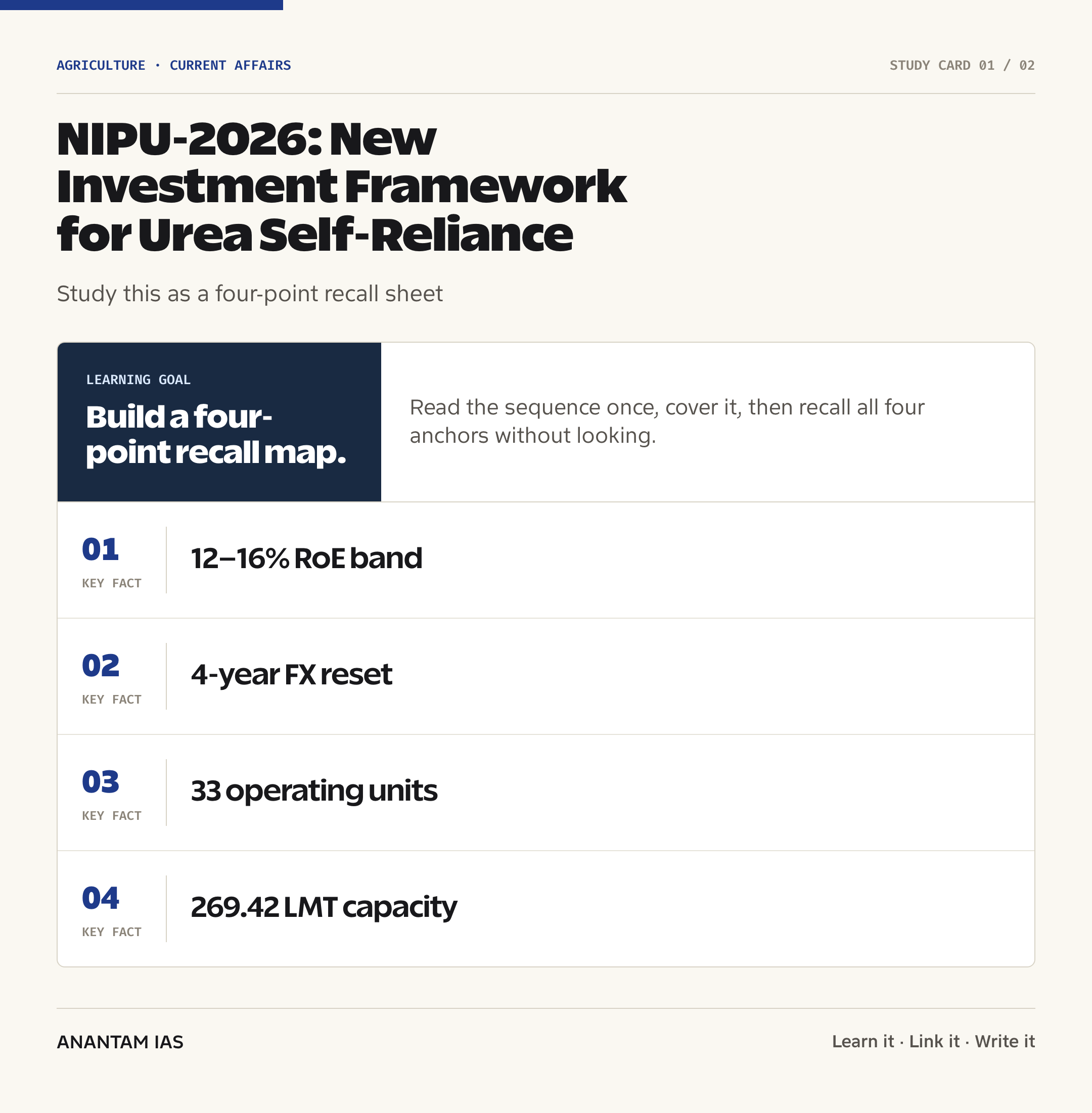
- The permitted return-on-equity band has a 12% floor and a 16% ceiling.
- A plant’s fixed cost will be converted into Indian rupees after four years at the prevailing exchange rate.
- PIB estimates a saving of more than ₹250 crore per plant under NIPU-2026 compared with NIP-2012.
- India currently has 33 operational urea units with reassessed or installed capacity of 269.42 LMT.
The development matters in the context of:
- During April-January 2025-26, official data recorded 251.26 LMT domestic production, 89.30 LMT of imports and 352.61 LMT of urea sales.
- Gas-based urea links fertilizer security with natural-gas availability, price volatility and the rupee’s exchange rate.
- Urea is sold at a notified price, so investment policy also carries a fertilizer-subsidy and public-finance dimension.
- More domestic capacity can reduce import exposure, but balanced nutrient use and efficient application still matter for soil health.
UPSC Relevance
Prelims Relevance
- NIPU-2026 stands for the National Investment Policy for Urea-2026 for Atmanirbhar Bharat.
- The policy was approved by the Cabinet Committee on Economic Affairs on a proposal from the Department of Fertilizers.
- Its immediate coverage is new gas-based urea units, not every fertilizer product or every existing plant.
- Under NIP-2012, six urea units came up: four through joint ventures of nominated PSUs and two through private companies.
- The investment window under NIP-2012 expired in October 2019; NIPU-2026 creates a fresh framework.
- New Urea Policy 2015 concerned existing gas-based units, while NIPU-2026 is an investment framework for new capacity.
- Urea has a statutorily notified maximum retail price; the Nutrient Based Subsidy regime mainly covers phosphatic and potassic fertilizers.
- Fertilizers are regulated under the Essential Commodities Act, 1955 and the Fertilizer (Control) Order, 1985.
- One lakh metric tonne, written as LMT, equals 100,000 metric tonnes; don’t confuse capacity with actual annual output.
Mains Relevance
GS Paper 3
- Agricultural inputs and food security: reliable urea supply supports crop production, but excessive nitrogen use can weaken balanced fertilization.
- Industrial policy: cost separation, a bounded return and currency-risk rules seek to make large fertilizer projects investible.
- External-sector resilience: domestic capacity can reduce exposure to international urea prices, freight disruptions and foreign-exchange outgo.
- Energy security: a gas-based capacity strategy remains sensitive to domestic gas allocation and imported LNG prices.
GS Paper 2
- Government policy design: NIPU-2026 shows how the state shares commercial, currency and regulatory risks with investors.
- Implementation accountability: transparent cost benchmarks and plant-level monitoring are needed when policy returns interact with subsidy payments.
- Centre-state coordination: the Union manages supply and subsidy, while states oversee last-mile distribution and enforcement.
Essay
- Self-reliance works best as resilience with competitive domestic capacity, not as isolation from all trade.
- Food security depends on the quiet infrastructure behind farming: energy, fertilizer, logistics, fiscal support and healthy soils.
Background and Context
What NIPU-2026 changes
The new framework changes how a gas-based urea project can recover costs and earn a return.
- Fixed and variable costs will be separated. Fixed costs broadly relate to the plant and financing, while variable costs move with production and inputs.
- This separation makes capital-cost recovery visible instead of blending it with a volatile gas bill. Regulators can then compare project cost and operating efficiency on different tracks.
- The 12–16% RoE band gives investors a minimum viability signal while limiting an open-ended return claim.
- Return on equity means return on shareholder funds, not a guaranteed margin on every rupee spent. Detailed rules must define eligible equity and link payment to commissioning and performance.
- After four years, the recognised fixed cost converts to INR at the prevailing exchange rate, reducing prolonged currency uncertainty.
- PIB places the estimated saving above ₹250 crore per plant versus NIP-2012, but the short release doesn’t publish the calculation assumptions.
From NIP-2012 to a fresh investment window
NIP-2012 is the direct policy predecessor, while NUP-2015 addressed a different operational problem.
- The Department of Fertilizers framed NIP-2012 for revamp, expansion, revival, brownfield and greenfield urea projects.
- It led to six new units: four joint-venture units of nominated PSUs and two units established by private companies.
- The earlier investment period ended in October 2019, even though proposals for new units continued to reach the department.
- Don’t merge it with New Urea Policy 2015, which aimed to raise production from existing gas-based units beyond reassessed capacity.
Why the import gap persists
Installed capacity has grown, but urea demand still exceeds indigenous supply in many periods.
- The NIPU release counts 33 operating units with reassessed or installed capacity of 269.42 LMT.
- A March 2026 PIB reply put April-January 2025-26 output at 251.26 LMT, below 258.48 LMT in the same period a year earlier.
- Urea imports rose from 48.70 LMT to 89.30 LMT across those two comparable ten-month periods, showing the immediate supply gap.
- Those production, import and sales figures cover a period, while capacity is an annual rating. Stock changes and timing mean the three numbers shouldn’t be subtracted as if they form a closed equation.
- Capacity isn’t the same as production. Gas supply, maintenance and plant efficiency decide how much nameplate capacity reaches farms.
How gas and currency risks enter plant economics
A gas-based urea plant is also an energy-security asset, because natural gas is a key feedstock and fuel.
- Gas prices affect variable production cost, so domestic gas allocation and imported LNG conditions can change plant viability.
- Imported equipment or foreign borrowing can expose project costs to rupee depreciation during construction and stabilisation.
- The four-year INR conversion places a clearer boundary around foreign-exchange risk, but detailed guidelines must explain interim treatment and exceptional shocks.
- India’s wider natural-gas allocation framework shapes whether new fertilizer capacity receives reliable feedstock.
The subsidy and farmer-price architecture
Investment viability sits alongside a controlled farmer price, so the public exchequer bridges much of the cost gap.
- PIB stated in March 2026 that the notified MRP is ₹242 for a 45 kg bag of neem-coated urea, excluding coating charges and applicable taxes.
- The government pays the difference between delivered farm-gate cost and the manufacturer’s or importer’s net market realisation as subsidy.
- This arrangement protects farmer affordability, but rising gas, freight or currency costs can move to the subsidy bill rather than the retail price. Investment design and fiscal design can’t be assessed separately.
- The Nutrient Based Subsidy policy mainly governs P&K fertilizers; NIPU-2026 doesn’t shift urea into that pricing regime.
- Digital tools such as the integrated e-Bill system can shorten claims while preserving an auditable subsidy trail.
- Cheap urea can invite diversion. The urea-diversion problem shows why production policy needs retail and industrial-use enforcement.
Expected gains and unresolved risks
NIPU-2026 can improve investment certainty, but new capacity alone won’t settle every part of fertilizer security.
- Domestic output can reduce import-price and shipping exposure, especially during geopolitical or freight disruptions.
- A transparent return band can lower regulatory uncertainty and make competing project proposals easier to compare.
- Gas-based self-reliance may replace urea imports with greater natural-gas import dependence unless feedstock sourcing is diversified.
- New plants also carry an execution risk: approval isn’t output. Land, finance, equipment, gas linkage, construction and commissioning must all arrive before import substitution appears in trade data.
- More low-priced nitrogen can intensify nutrient imbalance; capacity policy must sit beside soil testing and balanced fertilizer use.
- Long-run decarbonisation will require efficiency gains and credible green urea pathways, not only conventional capacity additions.
Way Forward
Publish bankable and auditable rules
- Define eligible fixed and variable costs, commissioning milestones and RoE calculations before project bids are locked.
- Disclose the method behind the ₹250 crore saving estimate so Parliament, investors and auditors can test the comparison.
- Use independent technical review for capital-cost escalation, efficiency benchmarks and plant availability.
Manage gas and currency exposure
- Combine long-term gas contracts, diversified suppliers and limited spot procurement to avoid a single-source shock.
- Make the four-year INR conversion rule symmetrical and predictable for both depreciation and appreciation.
- Reward lower energy consumption per tonne rather than compensating inefficient input use indefinitely.
Protect the fiscal and farm outcomes
- Track actual output and import substitution, not just approved capacity or construction expenditure.
- Link subsidy settlement with verified point-of-sale data and risk-based audits of diversion-prone districts and industries.
- Publish plant-wise performance on production, gas use and subsidy without disclosing commercially sensitive contracts.
Pair capacity with nutrient sustainability
- Expand soil testing and balanced fertilization so additional supply doesn’t become additional overuse.
- Set tighter water, energy and emissions benchmarks for every new unit receiving policy support.
- Create a transition path from conventional gas to low-carbon ammonia as technology and costs mature.
Conclusion
NIPU-2026 makes a serious project-finance correction: it separates costs, bounds investor returns and marks a clearer point for converting fixed costs into rupees. Those rules can turn policy intent into investible capacity.
But urea self-reliance should be judged by reliable output, lower import exposure, prudent subsidy costs and healthier nutrient use. Gas security, transparent claims and environmental efficiency will decide whether new plants deliver that wider result.
UPSC Practice Questions
Prelims MCQ 1
With reference to NIPU-2026, consider the following statements:
- It seeks investment in new gas-based urea units.
- It provides a 12% floor and 16% ceiling for return on equity.
- It converts variable cost into foreign currency after four years.
How many of the above statements are correct?
(a) Only one (b) Only two (c) All three (d) None
Answer: (b) Only two
Explanation:
Statements 1 and 2 are correct. The policy converts recognised fixed cost into INR after four years at prevailing exchange rates; it doesn’t convert variable cost into foreign currency.
Prelims MCQ 2
Which option best distinguishes NIPU-2026 from the earlier urea-policy framework?
(a) It replaces the notified urea MRP with free market pricing (b) It applies only to the 25 existing units covered by NUP-2015 (c) It separates fixed and variable costs and adds a bounded RoE with a four-year INR conversion (d) It brings urea under the Nutrient Based Subsidy regime
Answer: (c) It separates fixed and variable costs and adds a bounded RoE with a four-year INR conversion
Explanation:
NIPU-2026 is an investment framework for new gas-based units. It doesn’t abolish the notified urea price, replace NUP-2015 for existing units or move urea into the P&K subsidy regime.
UPSC Mains Questions
- NIPU-2026 seeks to reduce urea import dependence through new gas-based capacity while changing project-return and currency-risk rules. Examine how its design may improve investment viability, and assess the fiscal, energy-security and environmental risks that could limit durable self-reliance. (250 words)
- India’s fertilizer-security challenge isn’t only a shortage of capacity. Discuss how investment incentives, gas sourcing, subsidy governance, balanced nutrient use and low-carbon ammonia must work together to secure farm inputs without worsening fiscal or ecological stress. (250 words)
Sources: PIB, Ministry of Chemicals and Fertilizers and Indian Express.
Frequently Asked Questions
What is NIPU-2026?
NIPU-2026 is the National Investment Policy for Urea-2026 for Atmanirbhar Bharat. It creates an investment framework for new gas-based urea plants, separates fixed and variable costs, provides a 12–16% return-on-equity band and sets a four-year rule for converting recognised fixed cost into Indian rupees.
Who approved NIPU-2026?
The Cabinet Committee on Economic Affairs approved NIPU-2026 on 15 July 2026. The proposal came from the Department of Fertilizers under the Ministry of Chemicals and Fertilizers. PIB issued the official announcement, while Indian Express reported the approval the next morning.
How does the RoE band work?
The policy sets a return-on-equity floor of 12% and a ceiling of 16%. The band signals a viable return to investors while limiting open-ended compensation. The PIB release doesn’t provide the full computation method, so detailed guidelines must clarify eligible equity, performance conditions and review rules.
How is foreign-exchange risk treated?
After four years, a plant’s recognised fixed cost converts into INR using the prevailing exchange rate. This gives the project a defined currency-reset point instead of leaving fixed cost exposed indefinitely. It doesn’t remove gas-price risk or every currency risk connected with imported fuel, equipment or debt.
Why does India still import urea?
Domestic production doesn’t fully meet urea demand. PIB reported 251.26 LMT of domestic output, 89.30 LMT of imports and 352.61 LMT of sales during April-January 2025-26. Plant outages, gas availability, efficiency and seasonal farm demand can keep actual output below what installed capacity suggests.
Does NIPU-2026 change farmers’ urea price?
No such change appears in the approval release. Urea MRP remains part of the separate subsidy and price-control architecture; PIB stated ₹242 per 45 kg bag, excluding coating charges and applicable taxes, in March 2026. NIPU-2026 focuses on investment and plant economics, not retail price deregulation.
Tell Google you want more of this.
Add Anantam IAS as a preferred sourceOne tap, and this site shows up more often in your own Top Stories, AI Overviews and AI Mode. Remove it any time.