January 2026 produced a cluster of export-support measures aimed squarely at small businesses. The most visible was the Department of Posts decision to cut tariffs for overseas document and merchandise shipments from Foreign Post Offices, framed around MSMEs, artisans, start-ups, women entrepreneurs and small exporters.
The larger story is not cheaper parcels. It is India’s attempt to make exporting less intimidating for firms that do not have dedicated compliance teams, shipping agents or foreign-market networks. For UPSC, this is a practical case study in trade facilitation, MSME productivity and inclusive growth.
This article places the postal export move inside the wider Niryat Protsahan and Export Promotion Mission ecosystem and explains why the smallest exporter now matters to India’s trade strategy.
Quick Facts
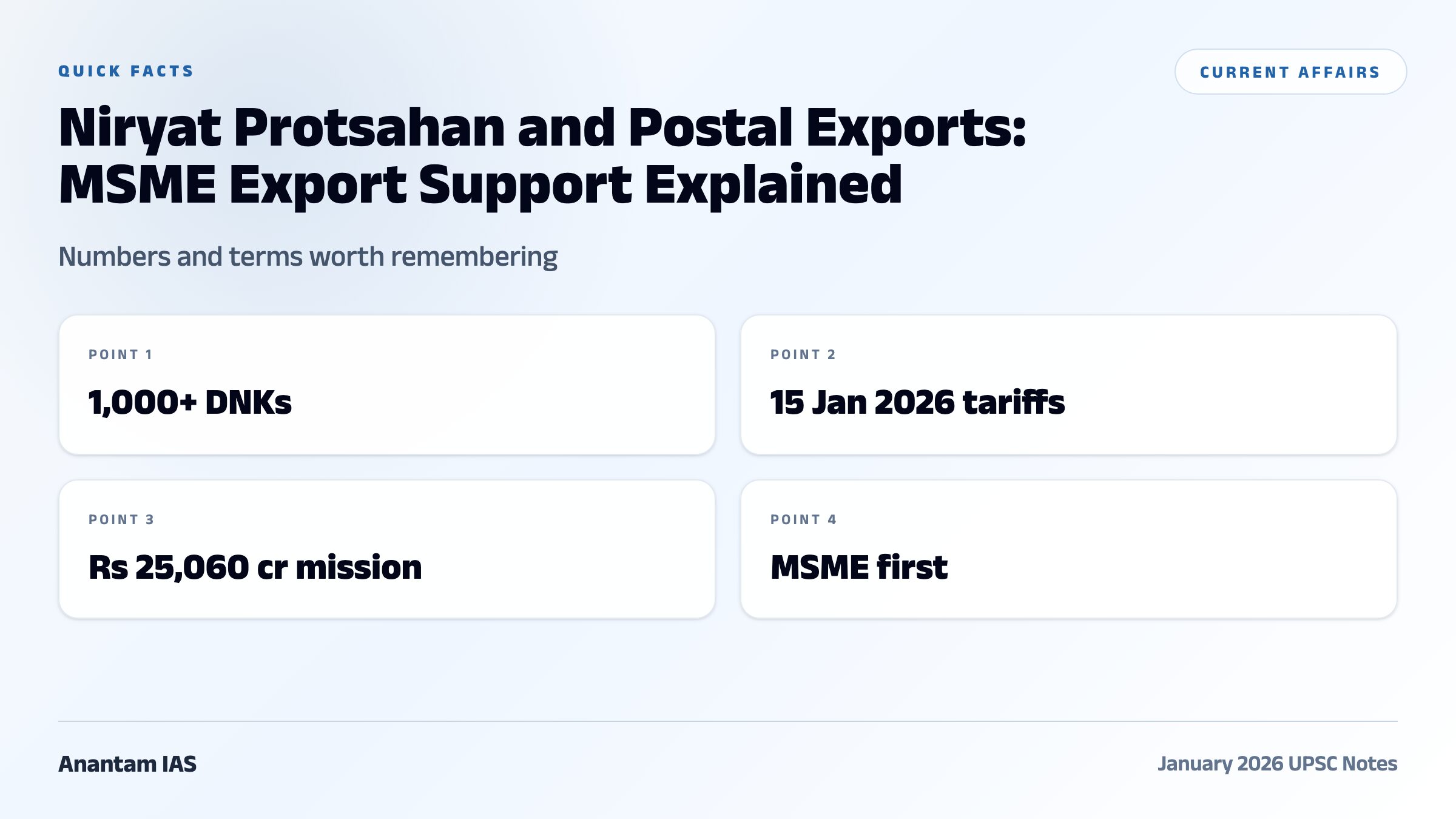
- Reduced postal tariffs took effect from 15 January 2026 across Foreign Post Offices.
- More than 1,000 Dak Niryat Kendras support postal export documentation and dispatch.
- The Commerce Ministry’s export-support proposals included interest subvention, credit guarantees and trade-promotion support.
- Niryat Protsahan for MSMEs was framed to cover a wide share of tariff lines and labour-intensive export sectors.
- The Export Promotion Mission has a six-year official outlay of Rs 25,060 crore for 2025-26 to 2030-31.
- Priority beneficiaries include MSMEs, first-time exporters, artisans, ODOP producers and women-led businesses.
- Official sources: PIB, Ministry of Communications and PIB, Ministry of Commerce and Industry.
What Just Happened
The Department of Posts announced reduced tariffs for overseas documents and merchandise from Foreign Post Offices, effective 15 January 2026. The government positioned the move as an export-enablement measure for small sellers who use the postal network instead of private logistics channels.
This followed wider export-support discussions around Niryat Protsahan and the Export Promotion Mission. Together, the measures point to a policy shift from large-exporter support toward a more distributed export base.
For India, the timing is important. Global trade is entering a more protectionist phase. A country that wants to expand exports cannot rely only on large manufacturing champions. It also needs thousands of small firms to sell textiles, handicrafts, processed foods, engineering goods, toys, gems, wellness products and digital services abroad.
Background and Historical Context
MSMEs contribute significantly to India’s manufacturing, employment and exports, but small firms face high entry barriers in global markets. Logistics cost, documentation, quality certification, payment risk and lack of market intelligence often matter more than tariff rates.
The postal export route tries to solve a specific problem: small consignments. An artisan in Bhadohi or a small seller in Jaipur may not ship container loads. They may send low-volume, high-variety parcels. A dense post-office network can serve that exporter better than a metro-centric logistics model.
India’s trade policy has increasingly moved from only negotiating market access to improving domestic export readiness. RoDTEP, Districts as Export Hubs, ODOP, PM Gati Shakti and digital customs are part of the same shift.
Key Features of the Export-Support Push
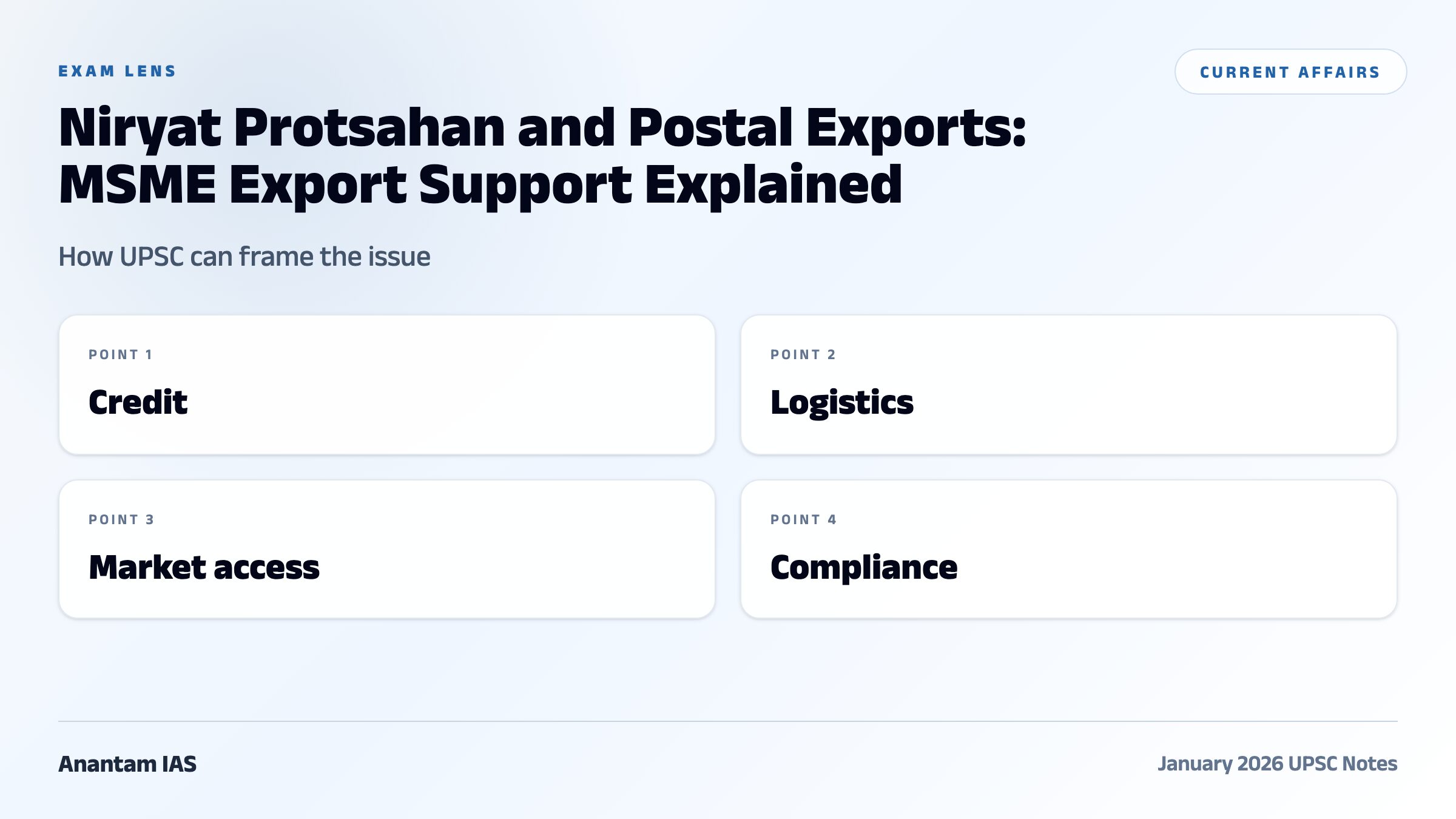
The core policy architecture can be read through these features.
- Postal tariff reduction: lower international postal charges reduce the fixed cost of small exports.
- Dak Niryat Kendras: post offices help exporters with documentation and booking.
- Credit support: proposals around interest subvention and credit guarantees aim to ease working-capital stress.
- Trade promotion: market access, branding and buyer discovery are treated as public-support functions.
- MSME focus: the architecture targets first-time and small exporters rather than only established export houses.
- District linkage: ODOP and Districts as Export Hubs can feed small consignments into postal export channels.
Why It Matters
This is a high-yield UPSC topic because it joins current news with durable syllabus themes.
- It gives GS-III material on export promotion, MSMEs, logistics and inclusive growth.
- It links trade policy with financial inclusion and last-mile infrastructure.
- It provides a practical example of how administrative cost reduction can affect competitiveness.
- It helps explain why employment-intensive exports matter for India’s growth model.
Detailed Analysis: Trade Policy Lens
India’s export problem is not only global demand. Small firms often lose before they reach the market because compliance, shipping and payment risks are too high. Postal exports lower one piece of that entry cost.
Credit and logistics must move together. Cheaper shipping does little if the exporter cannot finance inventory, obtain certification or absorb delayed payment. That is why Niryat Protsahan-style credit support matters.
The model is also a federal story. District export plans, local product mapping and state export-promotion agencies will determine whether national schemes become real business opportunities.
Comparative Perspective
A comparison helps prevent the answer from becoming a one-dimensional news summary.
- China: export dominance was built on scale, logistics corridors, supplier networks and state-backed industrial ecosystems.
- Vietnam: targeted manufacturing integration into global value chains raised export intensity quickly.
- India: the small-exporter route can complement large-scale manufacturing by turning craft, food and niche manufacturing clusters into export-ready ecosystems.
- European Union: small businesses often benefit from structured trade-information portals and credit insurance support.
Challenges
The policy or institutional promise runs into recurring constraints.
- MSMEs still face quality-certification and packaging gaps.
- Payment default and currency risk can hurt first-time exporters.
- Awareness of Dak Niryat Kendras remains uneven outside export-active districts.
- Logistics improvement must extend beyond booking to tracking, returns and customs coordination.
- Export incentives must comply with WTO disciplines and avoid becoming distortionary subsidies.
Prelims Pointers
- MSME stands for Micro, Small and Medium Enterprises.
- ODOP means One District One Product.
- Dak Niryat Kendras support small exporters through the postal network.
- RoDTEP is Remission of Duties and Taxes on Exported Products.
- Export credit, logistics and market access are different policy instruments.
- Foreign Post Offices handle international postal articles.
Mains Questions
- MSME export promotion requires trade facilitation as much as financial incentives. Discuss with reference to postal exports. (GS Paper III, 250 words)
- How can Districts as Export Hubs and ODOP improve India’s export diversification? (GS Paper III, 150 words)
- Evaluate the role of logistics cost in determining India’s manufacturing competitiveness. (GS Paper III, 250 words)
- Can small exporters help India create employment-intensive growth? Analyse the constraints and reforms needed. (GS Paper III, 250 words)
Way Forward
Postal export support should be paired with district-level handholding: packaging, GST export refund support, customs basics, e-commerce onboarding and buyer discovery.
Credit guarantee and interest support must be simple enough for a first-time exporter to use without a consultant. Otherwise the benefit will remain concentrated among better-organised firms.
India should measure this policy by active exporters created, repeat shipments, export survival rates and job creation in clusters, not only by total export value.
The examiner is unlikely to reward a bare fact dump here. The better answer connects the January 2026 event to institutional design, implementation capacity and India’s long-term development priorities.
Frequently Asked Questions
What changed in January 2026 for postal exports?
The Department of Posts reduced tariffs for overseas document and merchandise shipments from Foreign Post Offices, effective 15 January 2026.
What are Dak Niryat Kendras?
They are postal export facilitation points that help small exporters book international consignments and handle basic documentation.
Why are MSME exports important for UPSC?
They connect trade policy with employment, regional development, logistics, credit access and inclusive growth.
What is Niryat Protsahan?
It refers to export-promotion support aimed at improving competitiveness, especially for smaller exporters and labour-intensive sectors.
What is the Export Promotion Mission?
It is a multi-year government mission with official funding support for export credit, market access and trade-promotion measures.
What is the main risk in export incentives?
Poorly designed incentives can become complex, poorly targeted or inconsistent with WTO rules. The better approach is to lower structural costs.
Tell Google you want more of this.
Add Anantam IAS as a preferred sourceOne tap, and this site shows up more often in your own Top Stories, AI Overviews and AI Mode. Remove it any time.