Why in News?
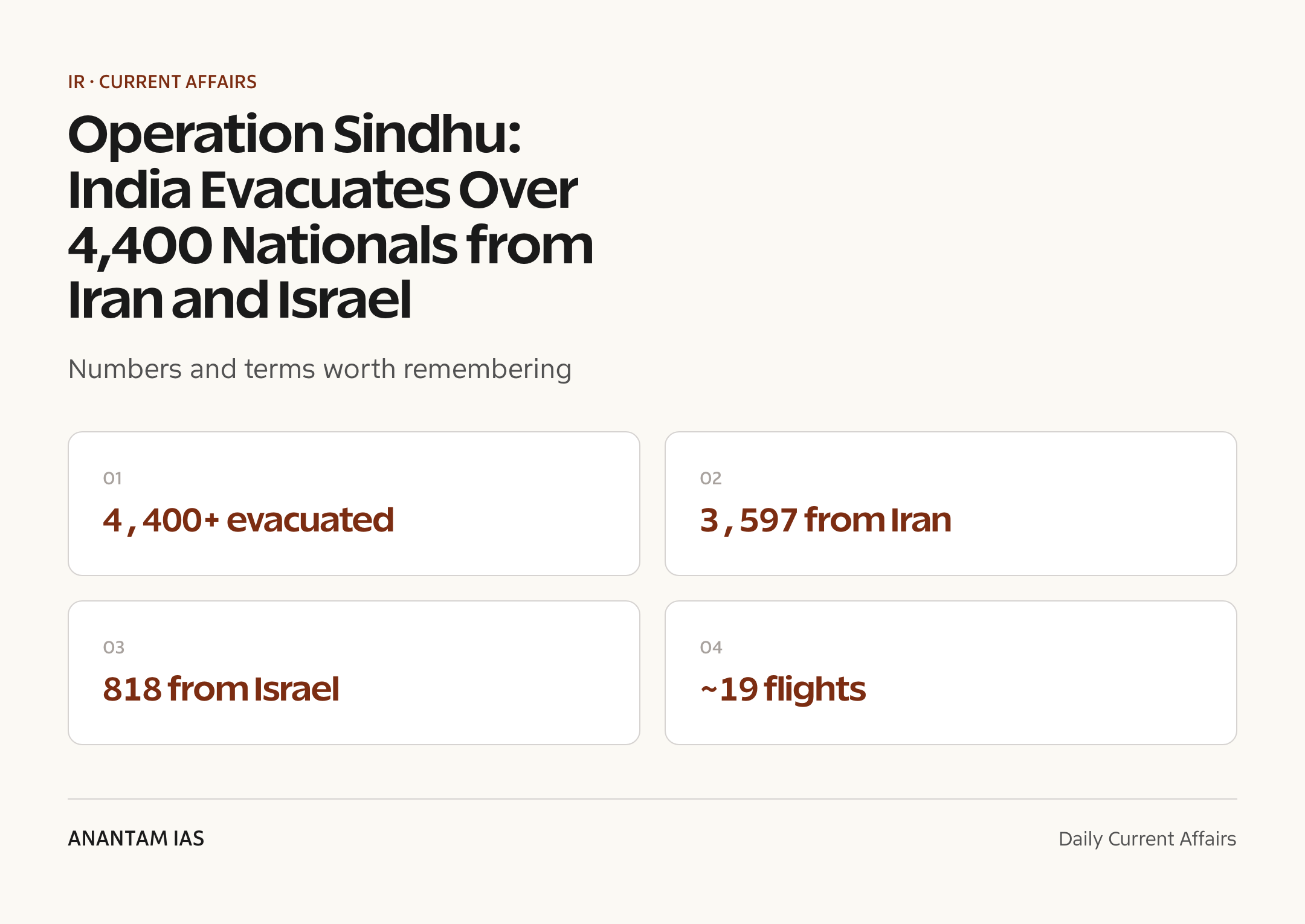
The Ministry of External Affairs (MEA) announced that Operation Sindhu evacuated over 4,400 Indian nationals from Iran and Israel as the armed conflict between the two countries escalated. The MEA said the bulk of evacuees came out of Iran, with the rest from Israel, in India’s largest West Asia evacuation of the current crisis.
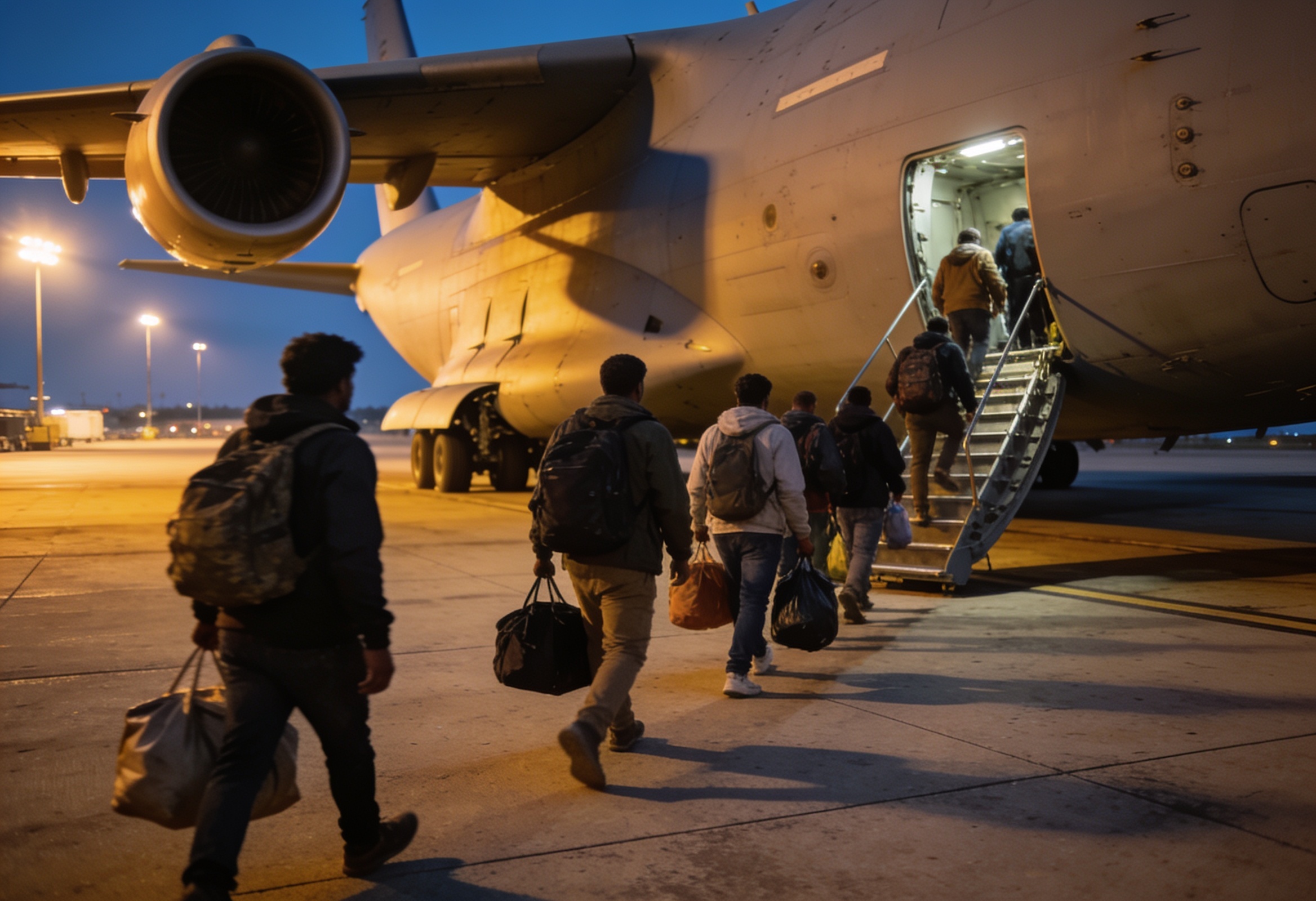
The operation combined commercial special flights and Indian Air Force C-17 Globemaster sorties, routing evacuees through neighbouring transit countries because the airspaces of Iran and Israel were closed during the fighting. It also brought home a few nationals of friendly neighbouring states, underscoring India’s role as a regional first responder.
- Over 4,400 Indians evacuated in total: about 3,597 from Iran and 818 from Israel, per MEA figures cited by DD News.
- Evacuation used roughly 19 flights, including IAF C-17 Globemaster III heavy-lift aircraft alongside commercial carriers.
- Iran’s airspace closure forced a land-corridor approach: students moved by road to the border with Armenia and flew out from Yerevan; others used flights from Mashhad.
- Israel evacuees transited via Egypt (Sharm el-Sheikh) and Jordan (Amman) before flights to New Delhi.
- India also helped evacuate a handful of Nepalese and Sri Lankan nationals, reflecting ‘neighbourhood first’ goodwill.
- The MEA ran a dedicated 24×7 control room to coordinate registration, movement and onward travel.
The development matters in the context of:
- The evacuation was triggered by a sharp escalation between Israel and Iran involving strikes on each other’s territory, closing civilian airspace across the region.
- India hosts a large diaspora in West Asia — students, professionals and workers — making consular protection a recurring strategic responsibility.
- Operation Sindhu follows a pattern of named Indian non-combatant evacuation operations (NEOs) over the past decade.
UPSC Relevance
Prelims Relevance
- Operation Sindhu — 2025 evacuation from Iran and Israel; led by the MEA with IAF support.
- Operation Ganga (2022) — evacuation of Indians from war-hit Ukraine via Romania, Hungary, Poland, Slovakia.
- Operation Kaveri (2023) — evacuation from conflict-hit Sudan via Port Sudan and Jeddah.
- Operation Ajay (2023) — evacuation of Indians from Israel after the October 2023 conflict.
- Operation Raahat (2015) — evacuation from Yemen, including foreign nationals.
- 1990 Kuwait airlift — Air India’s record civilian evacuation of around 1.7 lakh Indians from the Gulf.
- C-17 Globemaster III — IAF strategic heavy-lift transport used in evacuations and HADR.
- Chabahar Port — India-operated port on Iran’s coast; key to regional connectivity and the INSTC.
- MEA — nodal ministry for consular services and overseas Indian welfare.
Mains Relevance
GS Paper 2
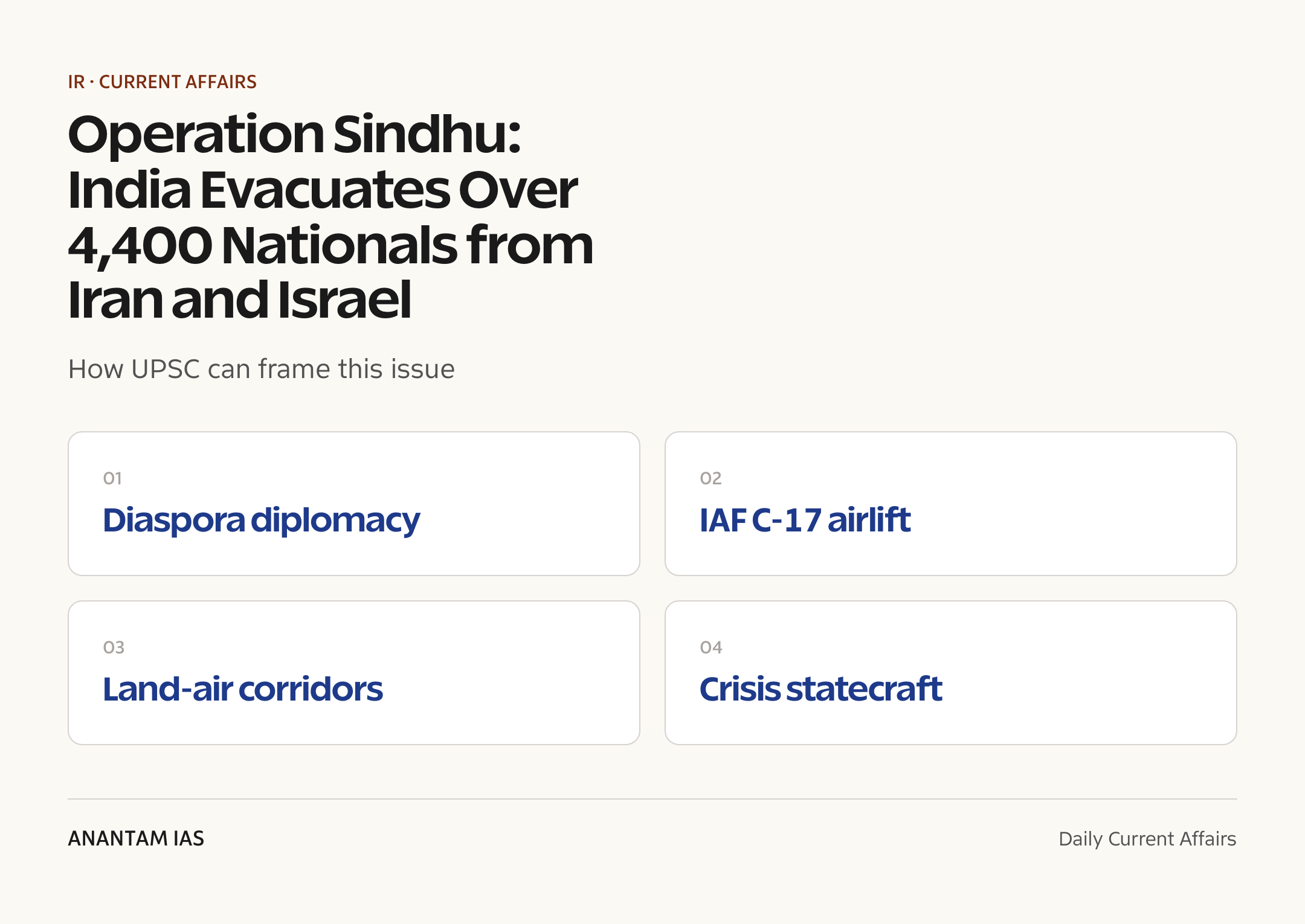
- Diaspora diplomacy — protecting overseas Indians as a core foreign-policy obligation and source of soft power.
- Crisis-response statecraft — coordinating with transit states (Armenia, Egypt, Jordan) to keep corridors open when airspace shuts.
- Evacuating neighbouring-country nationals as an instrument of regional goodwill and ‘neighbourhood first’.
GS Paper 3
- Disaster and conflict management — non-combatant evacuation operations as a HADR-adjacent capability.
- Civil-military coordination (MEA + IAF + civil aviation) and the role of strategic airlift in mass evacuations.
Essay
- The state as protector of its citizens beyond borders — sovereignty, duty and the moral economy of rescue.
Background and Context
What Operation Sindhu Is
A coordinated multi-agency evacuation under acute conflict conditions.
- A non-combatant evacuation operation (NEO) launched by India to bring home nationals stranded in Iran and Israel during the conflict.
- Run by the MEA with the Indian Air Force and Indian missions in Tehran, Tel Aviv and neighbouring capitals.
- Named in the Indian tradition of mission code-names; ‘Sindhu’ evokes the river and the maritime/overland reach of the operation.
- Combined commercial special flights with IAF C-17 sorties to move large groups quickly.
The Logistics Challenge
Closed airspace turned a flight problem into a land-and-air relay.
- With Iranian and Israeli civilian airspace shut, India could not fly aircraft directly into either country.
- From Iran: students were moved by road to the Armenia border and flown out of Yerevan; special flights also operated from Mashhad.
- From Israel: evacuees crossed to Egypt (Sharm el-Sheikh) and Jordan (Amman) for onward flights to India.
- The MEA opened a 24×7 control room and used registration portals to track and prioritise the vulnerable.
Why Diaspora Protection Is Strategic
Bringing citizens home is both a duty and a diplomatic asset.
- India’s roughly 13.6 million-strong overseas diaspora (one of the world’s largest) creates a standing consular responsibility.
- Successful evacuations build domestic legitimacy and signal capability and reliability to partner states.
- Helping neighbouring nationals reinforces India’s image as a regional ‘first responder’ and net security provider.
- Each operation deepens working relationships with transit countries whose cooperation is decisive.
India's Evacuation Track Record
Sindhu sits in a lineage of large, named rescues.
- 1990 Kuwait airlift — Air India evacuated about 1.7 lakh Indians, a Guinness record for civilian airlift.
- Operation Raahat (2015) — Yemen evacuation by sea and air, including foreign nationals.
- Operation Ganga (2022) — Ukraine evacuation via four neighbouring countries.
- Operation Kaveri (2023) and Operation Ajay (2023) — Sudan and Israel evacuations respectively.
The Role of Strategic Airlift
Heavy-lift aircraft are the backbone of mass rescue.
- The C-17 Globemaster III can carry large passenger loads over long ranges into austere airfields.
- IAF transport fleets double as instruments of foreign policy and HADR (humanitarian assistance and disaster relief).
- Airlift capacity lets India act independently rather than waiting on third-party rescue.
- Repeated NEOs are building institutional muscle memory for rapid mobilisation.
India and the Region
Stakes in both Iran and Israel shape India’s careful balancing.
- India operates the Chabahar Port in Iran, a node of the International North-South Transport Corridor (INSTC).
- Israel is a major defence and technology partner; India maintains ties with both sides.
- West Asia supplies a large share of India’s energy and hosts millions of Indian workers.
- Neutral, humanitarian framing of the evacuation protected India’s interests across the divide.
Way Forward
Standing capacity
- Maintain a pre-positioned NEO playbook with mapped transit hubs, MoUs and standby airlift.
- Keep diaspora registration databases current for rapid headcounts during crises.
Partnerships
- Deepen logistics arrangements with likely transit states (Armenia, Egypt, Jordan, Gulf partners).
- Institutionalise help for neighbouring-country nationals to reinforce regional goodwill.
Resilience
- Expand strategic airlift and aircrew capacity for simultaneous multi-theatre evacuations.
- Pre-brief students and workers abroad on contingency protocols and embassy contact lines.
Conclusion
Operation Sindhu shows how a mid-conflict evacuation has become routine statecraft for India: a blend of consular diplomacy, transit-state coordination and military airlift that brought over 4,400 nationals home without loss of life. It adds to a credible record stretching from the 1990 Kuwait airlift to Operations Ganga, Kaveri and Ajay.
For India’s foreign policy, such operations are a quiet but potent form of soft power. They affirm the state’s duty to its citizens abroad, build trust with partner and transit countries, and project India as a dependable regional first responder in a volatile West Asia.
UPSC Practice Questions
Prelims MCQ 1
Consider the following Indian evacuation operations and the conflict zones they addressed:
- Operation Ganga — Ukraine
- Operation Kaveri — Sudan
- Operation Raahat — Yemen
How many of the above statements are correct?
(a) Only one (b) Only two (c) All three (d) None
Answer: (c) All three
Explanation:
Operation Ganga (2022) evacuated Indians from Ukraine, Operation Kaveri (2023) from Sudan, and Operation Raahat (2015) from Yemen. All three pairs are correctly matched.
Prelims MCQ 2
With reference to Operation Sindhu, which one of the following statements is correct?
(a) It was a military operation to defend Indian territory. (b) It was an evacuation of Indian nationals from Iran and Israel coordinated by the MEA with IAF support. (c) It was a naval exercise in the Strait of Hormuz. (d) It was a trade corridor inaugurated at Chabahar Port.
Answer: (b)
Explanation:
Operation Sindhu was a non-combatant evacuation operation led by the Ministry of External Affairs, with Indian Air Force C-17 aircraft and commercial flights, to bring home over 4,400 Indians from Iran and Israel.
UPSC Mains Questions
- Diaspora protection has become a defining feature of India’s foreign policy. Examine the strategic and diplomatic significance of non-combatant evacuation operations, using Operation Sindhu as a reference. (GS Paper 2)
- Mass evacuations from conflict zones require seamless civil-military coordination and the cooperation of transit states. Discuss the logistical and disaster-management dimensions of such operations. (GS Paper 3)
Sources: MEA / DD News and DD News.
Frequently Asked Questions
What is Operation Sindhu?
Operation Sindhu is India’s evacuation mission, led by the Ministry of External Affairs with Indian Air Force support, to bring home Indian nationals stranded in Iran and Israel after armed conflict escalated between the two countries and their airspaces closed to civilian traffic.
How many Indians were evacuated under Operation Sindhu?
According to MEA figures cited by DD News, over 4,400 Indian nationals were evacuated — roughly 3,597 from Iran and 818 from Israel — using around 19 flights that combined commercial special services with Indian Air Force C-17 aircraft.
Why were transit countries needed?
Because Iranian and Israeli civilian airspaces were closed during the fighting, India could not fly directly into either country. Evacuees were moved by road or short hops to neighbouring states — Armenia and Mashhad for Iran, and Egypt and Jordan for Israel — before flights to New Delhi.
How does Operation Sindhu compare with earlier evacuations?
It joins a record that includes the 1990 Kuwait airlift of about 1.7 lakh Indians, Operation Raahat (Yemen, 2015), Operation Ganga (Ukraine, 2022), and Operations Kaveri and Ajay (Sudan and Israel, 2023). Each reflects India’s growing capacity for large, named rescue missions.
What is the C-17 Globemaster III?
The C-17 Globemaster III is a strategic heavy-lift transport aircraft operated by the Indian Air Force. It can carry large passenger or cargo loads over long ranges into difficult airfields, making it central to evacuation and humanitarian-relief missions.
Why is diaspora protection strategically important for India?
India has one of the world’s largest overseas populations, so protecting citizens abroad is both a constitutional-style duty and a diplomatic asset. Successful evacuations build domestic legitimacy, deepen ties with transit and partner states, and project India as a reliable regional first responder.
Tell Google you want more of this.
Add Anantam IAS as a preferred sourceOne tap, and this site shows up more often in your own Top Stories, AI Overviews and AI Mode. Remove it any time.