Why in News?
On 20 October 2026, Reuters, also reported by The Hindu, introduced heat storms as an analytical label for exceptionally widespread heatwaves measured across space and time.
- Reuters defines an ordinary heatwave for its analysis as five or more consecutive days of abnormally high temperatures.
- Its heat storm threshold is a heatwave covering at least 1% of the globe at its peak.
- The investigation reports that Vera lasted 367 days across 2023–2024 and swept over nearly 85% of the globe across its lifetime.
- These are Reuters analytical definitions, not a newly announced WMO or India Meteorological Department warning category.
- A headline about global heat can combine duration, geographical extent and local exposure; treating them as interchangeable produces misleading conclusions.
- Heat cascades describe consecutive or overlapping events, helping explain prolonged global activity without claiming uninterrupted heat at every location.
UPSC Relevance
Prelims Relevance
- Reuters heat-storm definition: peak coverage of at least 1% of the globe.
- Peak simultaneous area versus cumulative lifetime footprint.
- Heat cascade: consecutive events, simultaneous events, or both.
- Local climatic thresholds and the absence of one universal heatwave definition.
- Thermal heat stress depends on temperature and other environmental conditions.
Mains Relevance
GS Paper 3
- Choosing appropriate indicators for climate-risk assessment.
- Distinguishing the extent of a hazard from population exposure and vulnerability.
GS Paper 1
- Spatial and temporal interpretation of extreme weather events.
Essay
- How scientific language shapes public understanding of environmental change.
Background and Context
What the New Label Measures
Heat storms add a spatial scale to a heatwave definition, but the label must be read alongside its stated methodology.
- Duration comes first: Reuters uses five or more consecutive days of abnormally high temperatures to identify ordinary heatwaves. Its additional heat-storm threshold selects the largest events by peak geographical coverage.
- Local conditions matter: the World Meteorological Organization explains that heatwave thresholds generally reflect local climate and adaptation. A temperature unusual in a cool region may be ordinary in a tropical climate.
- Not a windstorm: the word storm here describes an analytical category of widespread heat. It does not itself imply a cyclone, rainfall, lightning, or a rotating atmospheric circulation associated with the event.
- Definition limits: the Reuters summary identifies duration and peak-area thresholds but does not fully specify its abnormal-temperature calculation or spatial linking procedure. Those details cannot be inferred from the label alone.
- Classification is not a warning: an analytical name can aid communication, but it does not automatically change national meteorological thresholds. An Indian heat alert must still be interpreted using the responsible official service.
Peak Area, Lifetime Footprint and Cascades
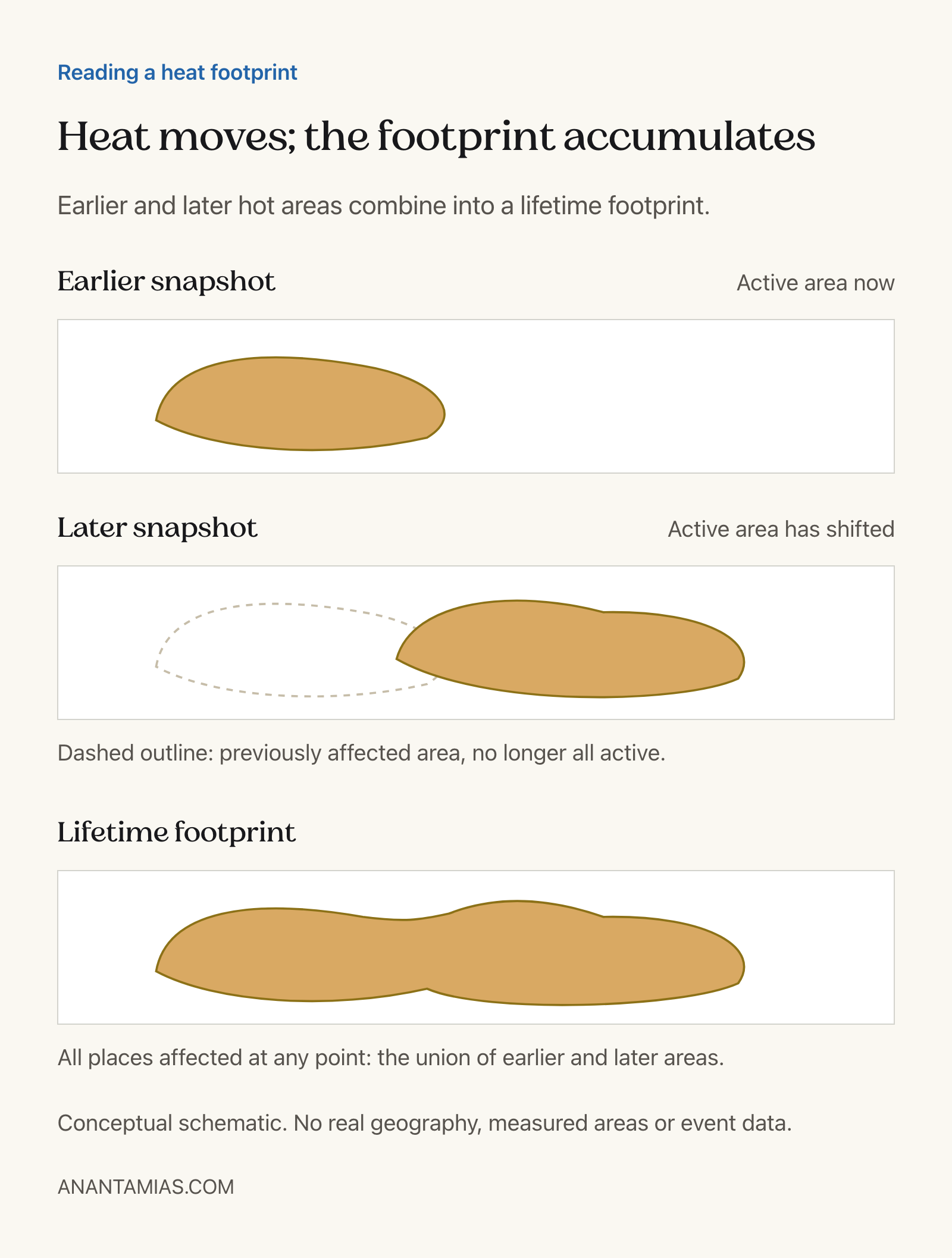
The same event can have a modest simultaneous extent and a much larger footprint accumulated as different places experience heat.
- Peak area is the largest area affected at the same time during an event. It answers how widespread conditions became simultaneously, rather than how many different locations were affected across its entire lifetime.
- Cumulative footprint covers the union of places affected at any point during an event. Locations counted earlier remain part of that footprint even after their own episode of abnormal heat has ended.
- The Vera example: Reuters reports nearly 85% global coverage across a 367-day event. Reading this as 85% experiencing abnormal heat simultaneously, or every location remaining hot throughout, would misrepresent the reported measure.
- A heat cascade is a succession or overlap of heat storms. Continuity means at least one event remains active somewhere; it does not mean that one individual storm or one local heatwave never ends.
- Keep the unit explicit: distinguish a location, an event and a cascade when describing duration. Each measures a different phenomenon, so substituting one for another changes the meaning of a climate headline.
Why Area Alone Cannot Measure Human Risk
A global heat footprint describes geographical extent; health and livelihood consequences also depend on who is exposed and under what conditions.
- Area is not population: a fraction of the globe cannot be read as the same fraction of humanity. Population distribution and the location of exposure must be considered separately before estimating people affected.
- Temperature is not the whole exposure: WMO identifies humidity, solar radiation and wind among the factors shaping thermal heat stress. Equally hot air can impose different burdens under different environmental conditions.
- Warm nights reduce recovery: when nighttime temperatures remain unusually high, people, buildings and the environment release less accumulated heat. Daytime maxima alone can miss this continuing thermal burden between successive hot days.
- Vulnerability varies: outdoor work, age, underlying health conditions and poorly adapted housing influence harm. A broad geographical metric cannot replace information about these differences when interpreting the consequences of an event.
- Compare like with like: assess a trend using consistent thresholds, time windows and geographical coverage. A change in measurement rules can alter counted events, so a new label alone does not establish a trend.
Way Forward
Report the Metric With the Claim
- State whether a reported area means simultaneous extent or cumulative footprint, and identify the relevant observation period.
- Publish the temperature baseline and event-tracking method alongside results so readers can understand what the category includes.
- Pair geographical event tracking with local exposure and vulnerability indicators before drawing conclusions about health or livelihood losses.
Conclusion
- Heat storms are useful as an explicitly attributed analytical label for widespread heat, provided the definition stays visible and is not confused with an official warning category.
- Space, time and exposure answer different questions: peak area measures simultaneous extent, cumulative footprint tracks places touched, and local conditions determine how dangerous the heat becomes for people.
UPSC Practice Questions
Prelims MCQ 1
With reference to the Reuters heat-storm analysis, consider the following statements:
- A heat storm reaches at least 1% of global area at its peak.
- A cumulative footprint necessarily represents the area heated simultaneously.
- A cascade may involve consecutive or simultaneous heat storms.
How many of the above statements are correct?
(a) Only one (b) Only two (c) All three (d) None
Answer: (b) Only two
Explanation:
Statements 1 and 3 are correct. Cumulative footprint includes places affected at any time during the event and need not represent simultaneous coverage.
Prelims MCQ 2
Which observation best explains why daytime maximum temperature alone can understate the burden of a heatwave?
(a) Warm nights can prevent the release of accumulated heat. (b) Cumulative footprint always equals the population affected. (c) Heat storms necessarily generate cyclonic winds. (d) All locations within an event remain hot for its full lifetime.
Answer: (a) Warm nights can prevent the release of accumulated heat.
Explanation:
Unusually warm nights reduce recovery by limiting heat loss from people, buildings and the environment. Geographical extent does not by itself quantify human exposure.
UPSC Mains Questions
- Distinguish peak simultaneous area, cumulative footprint and heat-storm cascades. Explain how confusing these measures can distort the interpretation of extreme-heat reports.
- Why is geographical extent insufficient to assess the human consequences of extreme heat? Discuss the additional environmental and social factors required.
Sources: Reuters investigation, reported by The Hindu and World Meteorological Organization.
Frequently Asked Questions
What is a heat storm?
In the Reuters analysis, a heat storm is an exceptionally large heatwave reaching at least 1% of the globe at its peak. The label is an analytical definition, not an official WMO warning category.
Does cumulative coverage mean all places were hot simultaneously?
No. Cumulative coverage includes places affected at any point across an event’s lifetime. Peak simultaneous coverage counts the area affected at the same time; the two measures answer different questions.
What is a heat-storm cascade?
A heat-storm cascade involves storms occurring consecutively, simultaneously, or both. Continuous global activity does not establish that a single storm lasts throughout, or that every location remains continuously hot.
Why do warm nights matter during extreme heat?
Cooler nights normally help people, buildings and the environment release heat accumulated during the day. Unusually warm nights interrupt that recovery, adding a burden that daytime maximum temperature alone can miss.
Does heat-storm area measure the number of people affected?
No. Area measures geographical extent. Estimating people affected also requires population and exposure information, while the severity of harm depends on environmental conditions, health, work and access to suitable housing.
Tell Google you want more of this.
Add Anantam IAS as a preferred sourceOne tap, and this site shows up more often in your own Top Stories, AI Overviews and AI Mode. Remove it any time.