Why in News?
The final phase of the 2026 legislative election in Pakistan-occupied Kashmir was held on 10 August after polling in sensitive areas had been deferred amid protests, clashes, road disruption and security concerns.
- Regional election officials conducted the assembly election in three phases, citing security concerns and heavy monsoon conditions that complicated campaigning and public gatherings.
- Polling in parts of the Poonch region was moved to 10 August. Associated Press reported that voting proceeded in four constituencies that day under tightened security.
- The campaign followed weeks of protests and clashes involving the Jammu and Kashmir Joint Awami Action Committee, which had called for a boycott. The regional administration had proscribed the group under its anti-terror law.
- Mobile internet and other communications had faced prolonged restrictions. Amnesty International said the blackout impeded independent verification of violence and asked authorities to restore access for media and observers.
- Claims about deaths and responsibility varied across protesters, officials and media reports. The communications restrictions made definitive independent verification difficult, so unverified totals should not be presented as settled fact.
- An election is not judged only by whether votes are cast. Information access, candidate outreach, observer access, public order and transparent results are also parts of a credible democratic process.
- Security restrictions can be legitimate when they are lawful, necessary and proportionate, but broad or prolonged blackouts may damage accountability and public trust.
- For India, terminology matters. The official position is that the entire Union Territories of Jammu and Kashmir and Ladakh are integral parts of India and that Pakistan is in illegal and forcible occupation of Indian territory.
UPSC Relevance
Prelims Relevance
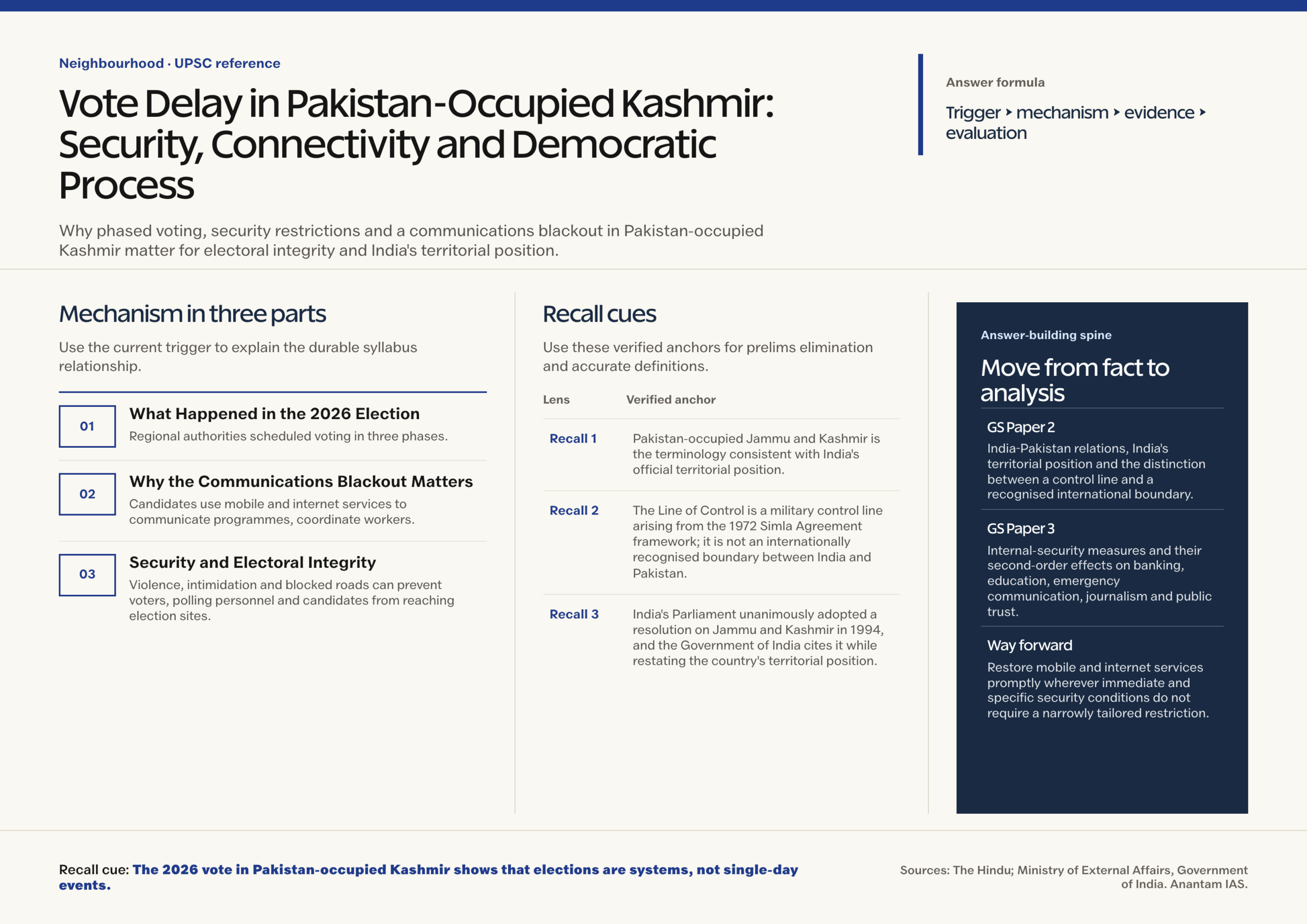
- Pakistan-occupied Jammu and Kashmir is the terminology consistent with India’s official territorial position; Pakistan uses a different administrative name for part of the territory.
- The Line of Control is a military control line arising from the 1972 Simla Agreement framework; it is not an internationally recognised boundary between India and Pakistan.
- India’s Parliament unanimously adopted a resolution on Jammu and Kashmir in 1994, and the Government of India cites it while restating the country’s territorial position.
- The Indian government has stated that Pakistan is in illegal occupation of approximately 78,000 square kilometres of Indian territory in the Union Territories of Jammu and Kashmir and Ladakh.
- Under the so-called Sino-Pakistan Boundary Agreement of 1963, Pakistan ceded 5,180 square kilometres of Indian territory in Pakistan-occupied Jammu and Kashmir and Ladakh to China; India does not accept that cession.
- A communications shutdown may affect political speech, campaigning, journalism, emergency access and independent verification, not merely personal internet use.
Mains Relevance
GS Paper 2
- India-Pakistan relations, India’s territorial position and the distinction between a control line and a recognised international boundary.
- Democratic-process analysis: how security, connectivity, campaign access and verifiable information shape the credibility of elections.
GS Paper 3
- Internal-security measures and their second-order effects on banking, education, emergency communication, journalism and public trust.
- Information blackouts as a challenge to situational awareness, misinformation control and independent fact verification.
Essay
- Security and liberty are not always zero-sum choices; democratic governance must protect life while keeping restrictions narrow, reviewable and accountable.
Background and Context
What Happened in the 2026 Election
The election unfolded against an unusually difficult security and information environment.
- Regional authorities scheduled voting in three phases. Officials attributed the phased design to security concerns and heavy monsoon rains that complicated campaigning and large gatherings.
- Protests led by the Jammu and Kashmir Joint Awami Action Committee had preceded the polls. Protest demands included political and economic grievances, while one major dispute concerned reserved legislative seats for people displaced from the Indian.
- The regional government proscribed the committee on 5 June 2026 under the first schedule of its Anti-Terrorism Act, 2014. Rights groups disputed the use of anti-terror powers against a protest movement, while authorities cited public-order and.
- Voting in some sensitive constituencies was deferred. On 10 August, voters went to the polls in four Poonch-region constituencies in the final reported phase, with security tightened around polling stations.
- The governing Pakistan Muslim League-N had already secured a majority from seats decided in the first two phases. That fact made the delayed contests politically relevant but did not make their conduct democratically unimportant.
Why the Communications Blackout Matters
Connectivity is part of the operating infrastructure of a modern election.
- Candidates use mobile and internet services to communicate programmes, coordinate workers, respond to false claims and reach geographically dispersed voters. A prolonged shutdown can produce unequal campaign access even when it applies across a region.
- Voters need timely information about polling dates, changed locations, road access, security instructions and results. Restrictions can make a formally announced postponement harder to understand on the ground.
- Journalists and independent observers depend on communications to transmit evidence, check claims and compare accounts. Amnesty International stated that the blackout severely impeded independent verification of the full extent of the reported violence.
- Communications restrictions also affect non-electoral services. Reports from the region described disruption to banking, education, business activity and access to online processes, showing why a shutdown’s effects extend beyond political speech.
- A blackout can suppress false information temporarily, but it may also create an information vacuum in which unverifiable claims spread through informal channels. Authorities should explain the legal basis, geographic scope, duration and review mechanism of.
Security and Electoral Integrity
Public safety is essential to voting, but security measures must support rather than hollow out participation.
- Violence, intimidation and blocked roads can prevent voters, polling personnel and candidates from reaching election sites. A limited postponement may be justified when credible threats make free polling impossible.
- The integrity test is procedural: Was the decision taken by a competent authority? Were reasons recorded? Was the revised schedule communicated equally? Could candidates and voters prepare? Were counting and complaints handled transparently?
- A security justification should be assessed through necessity and proportionality. Authorities should use the least restrictive effective measure, limit it to affected places and periods, and restore normal access promptly.
- Independent observation becomes more valuable during unrest because official and protester narratives may diverge sharply. Observer and media access helps separate verified facts from claims about casualties, coercion or rigging.
- UPSC answers should avoid assuming that a delayed poll is automatically illegitimate or that holding it automatically proves legitimacy. The quality of the decision, communication, access and remedy determines the democratic assessment.
India's Official Territorial Position
The article’s terminology follows the Government of India’s stated position and does not imply acceptance of Pakistan’s administrative claims.
- The Ministry of External Affairs has stated that the entire Union Territories of Jammu and Kashmir and Ladakh have been, are and shall be an integral part of India.
- India describes Pakistan as being in illegal and forcible occupation of Indian territory. In an official parliamentary answer, the government placed the area under Pakistan’s illegal occupation at approximately 78,000 square kilometres.
- India also rejects the so-called 1963 China-Pakistan Boundary Agreement under which Pakistan ceded 5,180 square kilometres of Indian territory to China.
- The Line of Control marks the areas under the respective military control of India and Pakistan. Calling it an international boundary would misstate India’s position and the legal-political character of the line.
- A careful answer can analyse elections and rights in the territory without endorsing another state’s nomenclature or administration. Use attribution when describing Pakistani institutions and retain India’s official terminology in the analytical frame.
Way Forward
Restore Verifiable Public Communication
- Restore mobile and internet services promptly wherever immediate and specific security conditions do not require a narrowly tailored restriction.
- Publish clear orders stating the legal basis, exact area, start and end time, review authority and available remedy for any continuing restriction.
- Provide redundant public channels for polling changes, emergency services and verified results so voters are not dependent on a single network.
Conclusion
- The 2026 vote in Pakistan-occupied Kashmir shows that elections are systems, not single-day events.
- For UPSC answers, the strongest approach combines India’s clear territorial position with careful source attribution.
UPSC Practice Questions
Prelims MCQ 1
With reference to India’s official position on territories under Pakistan’s occupation, consider the following statements:
- India regards the entire Union Territories of Jammu and Kashmir and Ladakh as integral parts of India.
- India recognises the Line of Control as the international boundary between India and Pakistan.
- India does not accept the cession of Indian territory to China under the 1963 China-Pakistan Boundary Agreement.
How many of the above statements are correct?
(a) Only one (b) Only two (c) All three (d) None
Answer: (b) Only two
Explanation:
Statements 1 and 3 are correct. India maintains that Jammu and Kashmir and Ladakh are integral parts of India and rejects the 1963 cession. The Line of Control is not recognised by India as an international boundary.
Prelims MCQ 2
Which one of the following best explains why a prolonged communications blackout can affect electoral integrity?
(a) It automatically cancels every election held during the restriction (b) It transfers election management from civilian to military authorities (c) It can restrict campaigning, voter information, media reporting and independent verification (d) It prevents an election commission from changing a polling date under any circumstances
Answer: (c) It can restrict campaigning, voter information, media reporting and independent verification
Explanation:
Connectivity supports several parts of a modern election. A shutdown does not automatically cancel a poll, but it can create unequal access, weaken transparency and obstruct independent checking of claims.
UPSC Mains Questions
- Security is necessary for elections, but security measures can also weaken electoral credibility. Discuss with reference to polling delays and communications restrictions.
- Explain India’s official territorial position on Pakistan-occupied Jammu and Kashmir. Why is precise terminology important in foreign-policy analysis?
Sources: The Hindu and Ministry of External Affairs, Government of India.
Frequently Asked Questions
Why was voting conducted in phases in Pakistan-occupied Kashmir?
Regional election officials cited security concerns and heavy monsoon conditions. Protests, clashes and road disruption had affected the campaign environment. Polling in some sensitive areas was deferred, and four Poonch-region constituencies voted in the final reported phase on 10 August.
Did the communications blackout make the election invalid?
A blackout does not by itself produce an automatic legal verdict on an election. It does raise serious electoral-integrity concerns because candidates, voters, journalists and observers may lose access to information. The assessment depends on legality, necessity, proportionality, duration, transparency.
Why should reported casualty figures be treated cautiously?
Different actors reported different totals and assigned responsibility differently. Media and rights groups noted that disrupted communications impeded independent verification. A careful answer should attribute claims, identify what is confirmed and avoid presenting contested figures as settled facts until.
What terminology does India use for the territory?
India uses Pakistan-occupied Jammu and Kashmir or related official formulations and states that Pakistan is in illegal and forcible occupation of Indian territory. This note uses that frame while attributing the names used by Pakistani institutions only when needed to.
Is the Line of Control an international boundary?
No. The Line of Control marks the areas under the respective military control of India and Pakistan under the post-1971 framework associated with the Simla Agreement. India does not treat it as an internationally recognised boundary or as altering its.
Tell Google you want more of this.
Add Anantam IAS as a preferred sourceOne tap, and this site shows up more often in your own Top Stories, AI Overviews and AI Mode. Remove it any time.