
Context: The Indian National Space Promotion and Authorisation Centre (IN-SPACe) announced the selection of the PixxelSpace India-led consortium to design, build, and operate India’s first fully indigenous commercial earth observation (EO) satellite constellation under the public-private partnership (PPP) model.
It is First of its kind – India’s first fully indigenous commercial Earth Observation (EO) satellite constellation to be established under Public-Private Partnership (PPP) model.

UPSC relevance:
Prelims examination has been testing aspirants on space missions (Indian as well and global). CSE prelims questions are not shallow when it comes to space technology rather it goes into details:
Prelims 2020:
“The experiment will employ a trio of spacecraft flying in formation in the shape of an equilateral triangle that has sides one million kilometres long, with lasers shining between the craft.” The experiment in question refers to
A Voyager-2
B New Horizons
C LISA Pathfinder
D Evolved LISA
Prelims 2016:
Consider the following statements: The Mangalyaan launched by ISRO
- is also called the Mars Orbiter Mission
- made India the second country to have a spacecraft orbit the Mars after USA
- made India the only country to be successful in making its spacecraft orbit the Mars in its very first attempt
Which of the statements given above is/are correct?
A 1 only
B 2 and 3 only
C 1 and 3 only
D 1, 2 and 3
What are Earth Observation (EO) Satellites
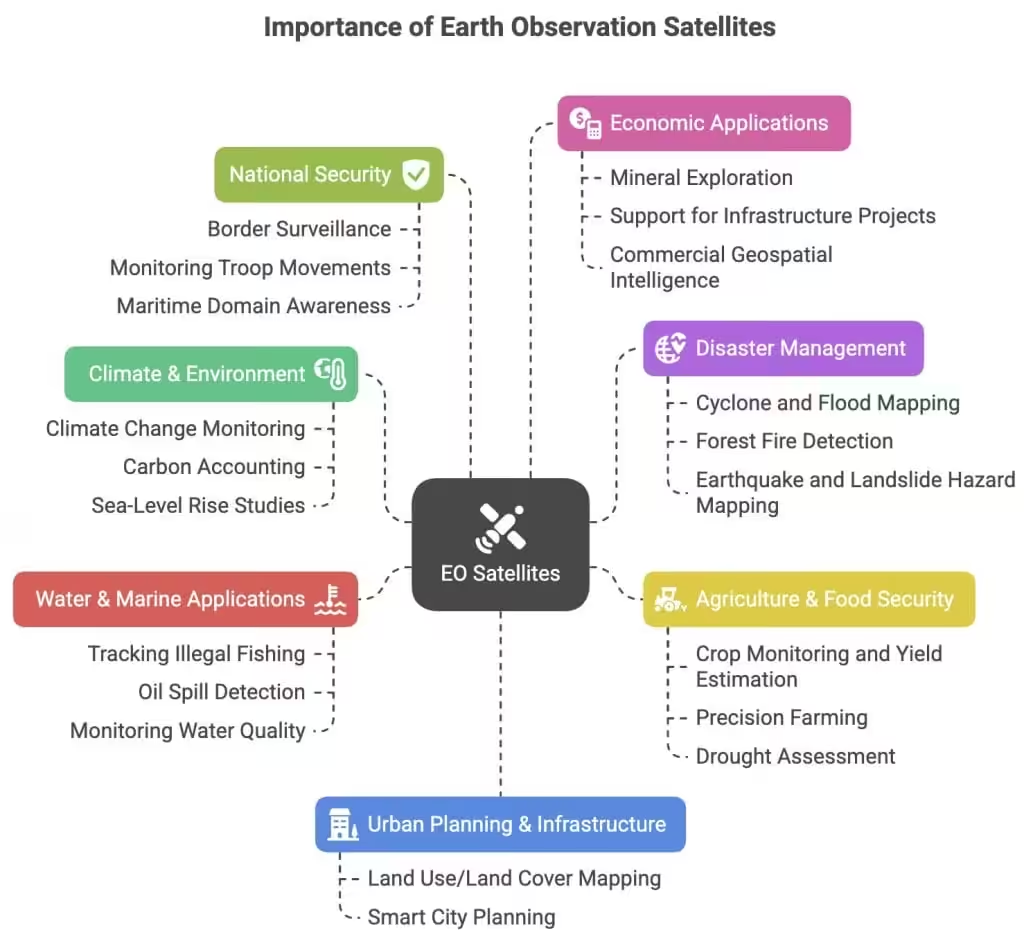
Earth Observation Satellites are artificial satellites designed to monitor and collect information about Earth’s physical, chemical, and biological systems. They use remote sensing technologies to capture data in various parts of the electromagnetic spectrum (visible, infrared, microwave, etc.) for civilian, commercial, and military purposes.
Some of the defining features of EO are as follows:
- Operate in Low Earth Orbit (LEO) (generally 500–900 km altitude) for high-resolution imaging.
- Use passive sensors (record natural radiation reflected/emitted from Earth) or active sensors (emit their own signals, e.g., SAR radar).
- Provide repetitive coverage of the same area at intervals (temporal resolution).
Lead Agency for the Project –
- Selected by Indian National Space Promotion and Authorisation Centre (IN-SPACe).
- Lead consortium: Bengaluru-based PixxelSpace India with partners:
- Piersight Space
- Satsure Analytics India
- Dhruva Space
Significance –
- Positions India among global leaders in space-based data solutions.
- First time in Indian space history that a private consortium will invest ₹1,200+ crore over 5 years.
- Reduces reliance on foreign EO data, ensures data sovereignty.
Constellation Specs –
- Will deliver Analysis Ready Data (ARD) and Value-Added Services (VAS).
- Total satellites: 12
- Equipped with panchromatic, multispectral, hyperspectral, and microwave Synthetic Aperture Radar (SAR) sensors.
Prelims-Relevant Technical Terms –
Analysis Ready Data (ARD) – Satellite data pre-processed for immediate analysis.
Panchromatic – Captures images in a single band of the visible spectrum but at high resolution.
Multispectral – Captures image data in a few spectral bands.
Hyperspectral – Captures data in dozens to hundreds of narrow spectral bands for detailed analysis.
SAR (Synthetic Aperture Radar) – Active remote sensing system using microwave to capture images day/night, all-weather.
Tell Google you want more of this.
Add Anantam IAS as a preferred sourceOne tap, and this site shows up more often in your own Top Stories, AI Overviews and AI Mode. Remove it any time.