Introduction
The Quit India Movement, launched on 9 August 1942 from Bombay’s Gowalia Tank Maidan (today August Kranti Maidan), was the third and most decisive mass civil disobedience campaign of the Indian freedom struggle, marking the moment when the Indian National Congress demanded immediate British withdrawal rather than negotiated dominion status. The Government of India’s official commemoration platform, amritmahotsav.nic.in, classifies 9 August as August Kranti Diwas — the annual remembrance of Mahatma Gandhi‘s “Do or Die” exhortation to the nation. On 9 August 2025, India marked the 83rd anniversary of that call (PIB, 2025-08-09).
The 1942 movement collapsed the colonial administration’s claim of legitimacy, gave rise to underground networks, parallel governments in pockets like Satara, Tamluk and Ballia, and a clandestine Congress Radio run by Usha Mehta. It also unleashed the harshest colonial repression of the twentieth century in India, with mass arrests, aerial machine-gunning of crowds in Bihar and Bengal, and over a hundred thousand detentions. This article unpacks the resolution’s text, the chronology from Cripps Mission failure to nationwide uprising, the parallel-government experiments, the British counter-insurgency response, and the static and analytical questions that flow from this episode for the UPSC examination.
Quick Facts at a Glance
| Indicator | Value | Source |
|---|---|---|
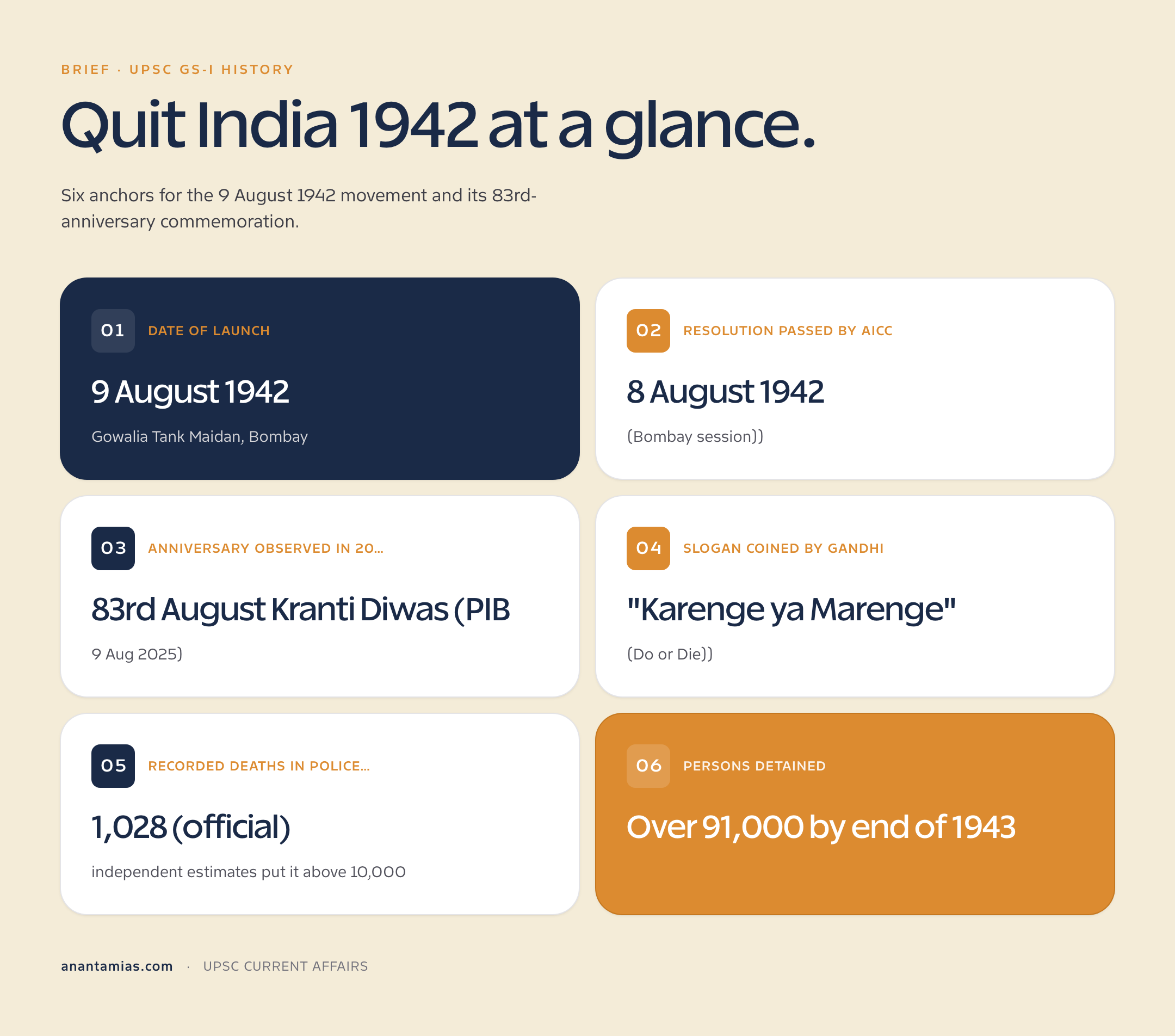
| Date of launch | 9 August 1942, Gowalia Tank Maidan, Bombay | amritmahotsav.nic.in |
| Resolution passed by AICC | 8 August 1942 (Bombay session) | NCERT, Themes in Indian History III |
| Anniversary observed in 2025 | 83rd August Kranti Diwas (PIB, 9 Aug 2025) | PIB, 2025-08-09 |
| Slogan coined by Gandhi | “Karenge ya Marenge” (Do or Die) | Collected Works of Mahatma Gandhi, Vol. 83 |
| Recorded deaths in police firing (official) | 1,028 (official) — independent estimates put it above 10,000 | Tottenham Report, 1943; Bipan Chandra (1989) |
| Persons detained | Over 91,000 by end of 1943 | Home Department, Government of India, 1944 |
| Parallel governments established | Three (Ballia, Tamluk, Satara) plus shorter pockets | Sumit Sarkar, Modern India (1983) |
| Duration of Gandhi’s detention | 9 August 1942 – 6 May 1944 (Aga Khan Palace) | amritmahotsav.nic.in |
Background and Historical Context
The road to August 1942 ran through the wreckage of the Cripps Mission (March–April 1942), Britain’s wartime offer of dominion status after the war in exchange for Indian cooperation against the Axis. The mission’s allowance for any province to opt out of the future Indian Union — the so-called “non-accession clause” — was read by Congress as a partition blueprint. Gandhi famously called Cripps’s offer “a post-dated cheque on a crashing bank.” With Japan having taken Singapore in February 1942 and standing on India’s eastern frontier by mid-1942, the Congress concluded that an organised, free India would defend itself better than a coerced colony. The Wardha Working Committee resolution of 14 July 1942 set the stage; the All India Congress Committee (AICC) ratified the Quit India resolution at its Bombay session on 8 August 1942 (NCERT).
Structurally, the movement closed a long arc that began with Non-Cooperation (1920–22) and was extended by Civil Disobedience (1930–34). By 1942 a generation of cadre — peasants in Awadh, students in Banaras, mill-workers in Ahmedabad — had cycled through arrests, fines and confiscations. The August Offer (1940) and the Individual Satyagraha (1940–41) had failed to break the constitutional deadlock. Bose’s Forward Bloc exit in 1939, the Communist Party‘s “People’s War” line after Hitler’s invasion of the USSR in June 1941, and the Muslim League‘s Lahore Resolution had already fragmented the nationalist field. Quit India was Gandhi’s calculated escalation in that fragmented arena — a single, simple demand: leave now.
Key Features of the Quit India Movement
Mass Mobilisation Without Top Leadership
Within hours of Gandhi’s address at Gowalia Tank Maidan, the colonial government launched Operation Zero Hour at dawn on 9 August 1942 and arrested the entire Congress Working Committee — Gandhi to Aga Khan Palace, Jawaharlal Nehru and Sardar Patel to Ahmednagar Fort, and provincial leaders to district jails. The decapitation backfired. With no central command, the movement devolved to second-rung leaders, students and peasants. Aruna Asaf Ali hoisted the tricolour at Gowalia Tank on 9 August, the iconic image of the rising. Within a week, demonstrations had spread to Bombay, Delhi, Patna, Ahmedabad, Banaras and Calcutta, with railway tracks, post offices and police stations the principal targets.
Underground Networks and Congress Radio
A clandestine layer kept the movement alive after the September 1942 wave of repression. Jayaprakash Narayan, Ram Manohar Lohia, Achyut Patwardhan and Sucheta Kripalani coordinated underground actions, sabotage of telegraph lines, and the printing of cyclostyled bulletins. The most arresting feature was the Congress Radio — a clandestine transmitter operated by 22-year-old Usha Mehta and her colleagues from shifting locations in Bombay between 14 August and 12 November 1942, broadcasting Congress messages on 7.12 MHz before British signals-intelligence triangulated the set. Mehta was arrested and sentenced to four years’ rigorous imprisonment, becoming a lasting symbol of the radio underground (Drishti IAS).
Parallel Governments — Prati Sarkars
Where the British administration crumbled and the Congress underground organised, locally elected parallel governments (prati sarkars) emerged. Ballia in eastern UP, under Chittu Pandey, ran a brief but functioning administration in August 1942. The longest-lived was the Tamluk Jatiya Sarkar in Midnapore (Bengal), which collected revenue, ran courts and operated a Vidyut Vahini relief service for the 1942 cyclone, lasting until September 1944. The Satara Prati Sarkar under Nana Patil in western Maharashtra ran tufan dals (storm squads), village courts and parallel revenue collection from 1943 to 1945, the longest-running of the three (Bipan Chandra, India’s Struggle for Independence, 1989).
Significance for UPSC
- GS Paper I — Modern History: mass-phase nationalism, transition from constitutional negotiation to direct action, factional divergence (Congress vs League vs Communists vs Hindu Mahasabha)
- GS Paper I — Indian Society: peasant and worker participation, role of women (Aruna Asaf Ali, Usha Mehta, Sucheta Kripalani), youth-led mobilisation
- GS Paper II — Polity: origins of constituent assembly idea, parallel-government experiments as proto-democratic institutions, civil-disobedience legitimacy
- GS Paper IV — Ethics: Gandhian ethics of “Do or Die”, coercion versus persuasion, leadership without command
- Essay paper: “Constitutional methods are insufficient when the state itself is illegitimate” — Quit India as case study
- Prelims static: dates, leaders, parallel-government locations, slogans, post-1942 detention statistics — high-frequency factual zone
Detailed Analysis: The 1942 Timeline and Repression
The five months from August to December 1942 produced the most concentrated colonial counter-insurgency response India had seen since 1857. The Linlithgow administration declared the Congress an unlawful association, banned its 31 affiliated bodies, and placed troops at the disposal of district magistrates with shoot-to-kill orders in eight provinces. Royal Air Force aircraft strafed crowds in Patna, Bhagalpur and at Tamluk on 29 September 1942. Collective fines were imposed on entire villages — Rs 90 lakh on Bihar villages alone. The Tottenham Report tabled in 1943 admitted 1,028 deaths in police and military firing; later estimates by historians like Sumit Sarkar and Bipan Chandra place the figure between 4,000 and 10,000.
The repression’s geography mapped almost exactly onto the depth of mobilisation. Bihar’s Patna, Saran, Bhagalpur and Muzaffarpur districts saw the heaviest violence — for nearly a week in mid-August 1942 the British administration lost control of the Patna–Gaya rail corridor. Eastern UP, especially Ballia, Azamgarh and Ghazipur, witnessed the destruction of 245 government buildings. Bengal’s Midnapore district saw both the longest parallel government and the harshest counter-measures. Maharashtra’s Satara and Karnataka’s Dharwad sustained guerrilla actions into 1943. The table below summarises the principal centres of action and reaction.
| Region | Period of Active Insurgency | Notable Action / Parallel Government | Repression |
|---|---|---|---|
| Ballia (UP) | Aug 1942 | Chittu Pandey’s parallel government, ~1 week | Reoccupied by force, 22 Aug 1942 |
| Tamluk (Bengal) | Dec 1942 – Sep 1944 | Jatiya Sarkar; Vidyut Vahini relief during cyclone | Aerial strafing, 29 Sep 1942 |
| Satara (Maharashtra) | 1943 – 1945 | Nana Patil’s Prati Sarkar, tufan dals | Police camps, mass arrests; persisted till 1945 |
| Patna–Gaya (Bihar) | 11–18 Aug 1942 | Rail corridor seized; Patna Secretariat attack 11 Aug | RAF strafing; collective fines Rs 90 lakh |
| Bombay City | 9 Aug onward | Aruna Asaf Ali hoists tricolour; mill strikes | Mass arrests, Section 144 throughout city |
| Midnapore (Bengal) | Sep 1942 – 1944 | Tamluk parallel govt; women’s Vahini under Matangini Hazra | 73 killed at Tamluk on 29 Sep 1942 |
The clandestine financial sinew came from a parallel underground treasury operated through Bombay business networks sympathetic to the Congress, with Jayaprakash Narayan‘s spectacular Hazaribagh jail escape on 9 November 1942 turning the underground into a national legend. The Forward Bloc, by contrast, sought external alliances: Subhas Chandra Bose, having reached Berlin in 1941 and Tokyo in 1943, organised the Indian National Army as the international wing of what had begun on 9 August 1942 inside India.
By the end of 1943, the British had formally suppressed the rising — but, as Linlithgow‘s successor Lord Wavell conceded in his 1944 dispatch to London, the colonial state’s moral and administrative authority had broken. The Quit India Movement did not directly compel British withdrawal, but it made any return to the pre-1942 status quo politically impossible. The post-war negotiations from the Wavell Plan (1945) through the Cabinet Mission (1946) proceeded on the assumption that British rule had to end — only timing and partition were open questions.
Challenges and Criticisms
The Quit India Movement attracted sharp critique from contemporary actors and later historians. B. R. Ambedkar, in his 1945 work What Congress and Gandhi Have Done to the Untouchables, argued that launching a movement at the height of the Second World War, with Japanese forces at the gates of Bengal, gambled India’s territorial integrity for moral effect. The Communist Party of India, having adopted the “People’s War” line after the Soviet entry into the war in June 1941, opposed the movement and was rewarded with legal recognition by the British in July 1942 — a stance that cost the CPI credibility for a generation. The Muslim League stayed aloof and used the Congress’s absence between 1942 and 1945 to consolidate provincial machinery in Punjab and Bengal, a structural advantage that proved decisive in the 1946 elections.
Academic historians remain divided on the movement’s character. Francis Hutchins in Spontaneous Revolution: The Quit India Movement (1971) argued that the August 1942 rising was largely spontaneous rather than directed, with little organisational link to the AICC’s 8 August resolution. Gyanendra Pandey and the Subaltern Studies group countered that the rising had deep regional roots in peasant grievance, especially over wartime grain requisition under the Defence of India Rules. The persistent criticism of violence — Gandhi’s “Do or Die” call, while invoking ahimsa, in practice licensed the destruction of telegraph lines, railway tracks and at least 657 police stations — remains the most uncomfortable feature of an otherwise non-violent tradition.
Prelims Pointers
- Quit India Resolution adopted at AICC Bombay session, 8 August 1942 (drafted by Maulana Azad)
- Movement launched 9 August 1942 from Gowalia Tank Maidan (renamed August Kranti Maidan)
- Gandhi’s slogan: “Karenge ya Marenge” (Do or Die)
- Aruna Asaf Ali hoisted the tricolour at Gowalia Tank on 9 Aug 1942
- Usha Mehta ran Congress Radio (7.12 MHz) from 14 Aug to 12 Nov 1942
- Three principal parallel governments: Ballia (UP), Tamluk (Bengal), Satara (Maharashtra)
- Nana Patil led Satara Prati Sarkar; Chittu Pandey led Ballia
- Tamluk Jatiya Sarkar (Dec 1942 – Sep 1944) was the longest in Bengal
- Congress Working Committee arrested under Operation Zero Hour, 9 Aug 1942 dawn
- Gandhi held at Aga Khan Palace, Pune until 6 May 1944
- Jayaprakash Narayan escaped Hazaribagh Jail on 9 Nov 1942
- Matangini Hazra, aged 73, killed in Tamluk firing on 29 September 1942
Mains Practice Questions
- “The Quit India Movement of 1942 was a watershed in the Indian freedom struggle because it transformed the demand from constitutional reform to immediate independence.” Examine this proposition with reference to the resolutions of the Wardha and Bombay sessions of 1942 and the colonial response that followed. (15 marks, 250 words)
- Critically assess the role of women — including Aruna Asaf Ali, Usha Mehta, Sucheta Kripalani and Matangini Hazra — in sustaining the underground phase of the Quit India Movement after the arrest of the Congress leadership in August 1942. (10 marks, 150 words)
- The parallel governments at Ballia, Tamluk and Satara have been described as “proto-democratic experiments” by some historians and as “lawless interludes” by colonial administrators. Discuss their organisational features, achievements and limits. (15 marks, 250 words)
- How did the failure of the Cripps Mission (1942) shape the strategic calculus of the Indian National Congress in launching the Quit India Movement? Substantiate with the text of the Quit India resolution. (10 marks, 150 words)
- “Quit India did not achieve its immediate objective of British withdrawal but made the maintenance of the Raj politically impossible.” Critically evaluate this assessment in the light of the post-war negotiations from the Wavell Plan to the Cabinet Mission. (15 marks, 250 words)
Conclusion
Eighty-three years after that monsoon evening at Gowalia Tank Maidan, the Quit India Movement remains the most thoroughly studied episode of late-colonial Indian politics, precisely because it sits at every interesting fault line of the freedom struggle: violence and non-violence, central direction and spontaneous insurgency, mass leaders and underground couriers, urban mill-worker and Awadh peasant, ahimsa and aerial strafing. As an episode of nationalist mobilisation, it sits beside the Non-Cooperation Movement and the Civil Disobedience Movement in the canon of three Gandhian mass campaigns, but it differs structurally: the leadership was removed at the start, and the movement had to invent itself from below.
For 2025 and beyond, the August Kranti Diwas commemorations under amritmahotsav.nic.in have re-centred local memory — village memorials in Tamluk and Satara, Aga Khan Palace as a National Memorial, and the digitisation of underground bulletins by the National Archives. The forward look for UPSC aspirants is twofold: the static questions on parallel governments, dates and personalities will continue to appear in Prelims with predictable regularity; the analytical questions in Mains will increasingly compare 1942 with subaltern theories of mobilisation, gender history, and the ethics of mass action under coercive states. A candidate who can move fluidly between the chronology, the texts of the Quit India and Wardha resolutions, and the historiographic debate from Hutchins through Bipan Chandra to the Subaltern Studies collective will be equipped to answer almost any question this episode can pose.
Frequently Asked Questions
What is the Quit India Movement?
The Quit India Movement was a mass civil-disobedience campaign launched by the Indian National Congress on 9 August 1942 from Gowalia Tank Maidan in Bombay, demanding immediate British withdrawal from India. Gandhi gave the call “Do or Die.” It was the third and last great Gandhian mass movement, marked by the arrest of the entire Congress leadership within hours, an underground phase, and the rise of parallel governments in Ballia, Tamluk and Satara.
Why is the Quit India Movement important for UPSC?
The Quit India Movement is a high-frequency topic across UPSC Prelims and Mains GS Paper I. Prelims tests dates, parallel-government locations, slogans, and personalities like Usha Mehta and Aruna Asaf Ali. Mains uses the movement to explore the transition from constitutional to direct-action politics, women’s leadership, peasant mobilisation, and the ethics of the “Do or Die” call. It also features in the Essay paper as an example of mass action against an illegitimate state.
Which AICC resolution launched Quit India?
The All India Congress Committee adopted the Quit India Resolution at its Bombay session on 8 August 1942. The resolution, drafted by Maulana Abul Kalam Azad and moved by Jawaharlal Nehru, demanded immediate end of British rule in India, sanctioned a mass struggle on the widest possible scale on Gandhian non-violent lines, and authorised Gandhi to lead it. The Wardha Working Committee resolution of 14 July 1942 was the precursor to the AICC text.
Which was the longest-running parallel government?
The Satara Prati Sarkar, led by Nana Patil in western Maharashtra, was the longest-running parallel government of the Quit India era — operational from 1943 until well into 1945. It ran tufan dals (storm squads), village courts, parallel revenue collection and welfare programmes. The Tamluk Jatiya Sarkar in Bengal’s Midnapore district lasted from December 1942 to September 1944. The Ballia parallel government under Chittu Pandey lasted only about a week in August 1942.
Which was the shortest-lived parallel government?
The Ballia parallel government in eastern Uttar Pradesh, led by Chittu Pandey, lasted only about one week in August 1942. After the arrest of Congress leaders, Ballia’s revolutionaries broke open the district jail on 19 August 1942, freed political prisoners, and ran a brief administration. British forces reoccupied Ballia by 22 August 1942. Despite its brevity, Ballia is remembered as the first place to declare itself free of British rule during the Quit India Movement.
Who ran the Congress Radio during Quit India?
Congress Radio was operated by 22-year-old Usha Mehta, with collaborators Vithalbhai Jhaveri, Chandrakant Jhaveri and Babubhai Khakhar, broadcasting on 7.12 MHz from shifting locations in Bombay between 14 August and 12 November 1942. The transmitter aired Congress messages, news of the underground struggle, and recordings of leaders. British signals-intelligence triangulated the set in November 1942. Mehta was sentenced to four years’ rigorous imprisonment, and is remembered as the symbol of the underground broadcasting phase.
What caused the Quit India Movement?
The immediate trigger was the failure of the Cripps Mission in April 1942, whose offer of dominion status after the war and a non-accession clause for provinces was rejected by Congress as a partition blueprint. The deeper causes were wartime price inflation, grain requisitioning under the Defence of India Rules, the looming Japanese threat after Singapore’s fall in February 1942, and the cumulative frustration of constitutional methods through the August Offer (1940) and Individual Satyagraha (1940–41).
How did Quit India compare to other anti-colonial uprisings?
Quit India parallels other Second World War-era anti-colonial movements such as Vietnam’s Viet Minh-led August Revolution (1945) and Indonesia’s August 1945 declaration of independence — all three exploited wartime imperial weakness. Unlike those armed insurrections, Quit India was nominally non-violent and lacked external sponsors. Globally, it ranks with the Easter Rising (1916) and the Chinese May Fourth Movement (1919) as a mass anti-colonial mobilisation that failed in immediate terms but reshaped the political horizon, making the colonial status quo untenable thereafter.
Tell Google you want more of this.
Add Anantam IAS as a preferred sourceOne tap, and this site shows up more often in your own Top Stories, AI Overviews and AI Mode. Remove it any time.