Why in News?
The Hindu reported on 25 October 2026 that the newly issued Samudra Manthan operational guidelines link offshore exploration support to conditional recovery from commercially successful discoveries.
- Eligible deepwater and ultra-deepwater wells can receive up to 50% of actual well cost, subject to a funding ceiling and approval.
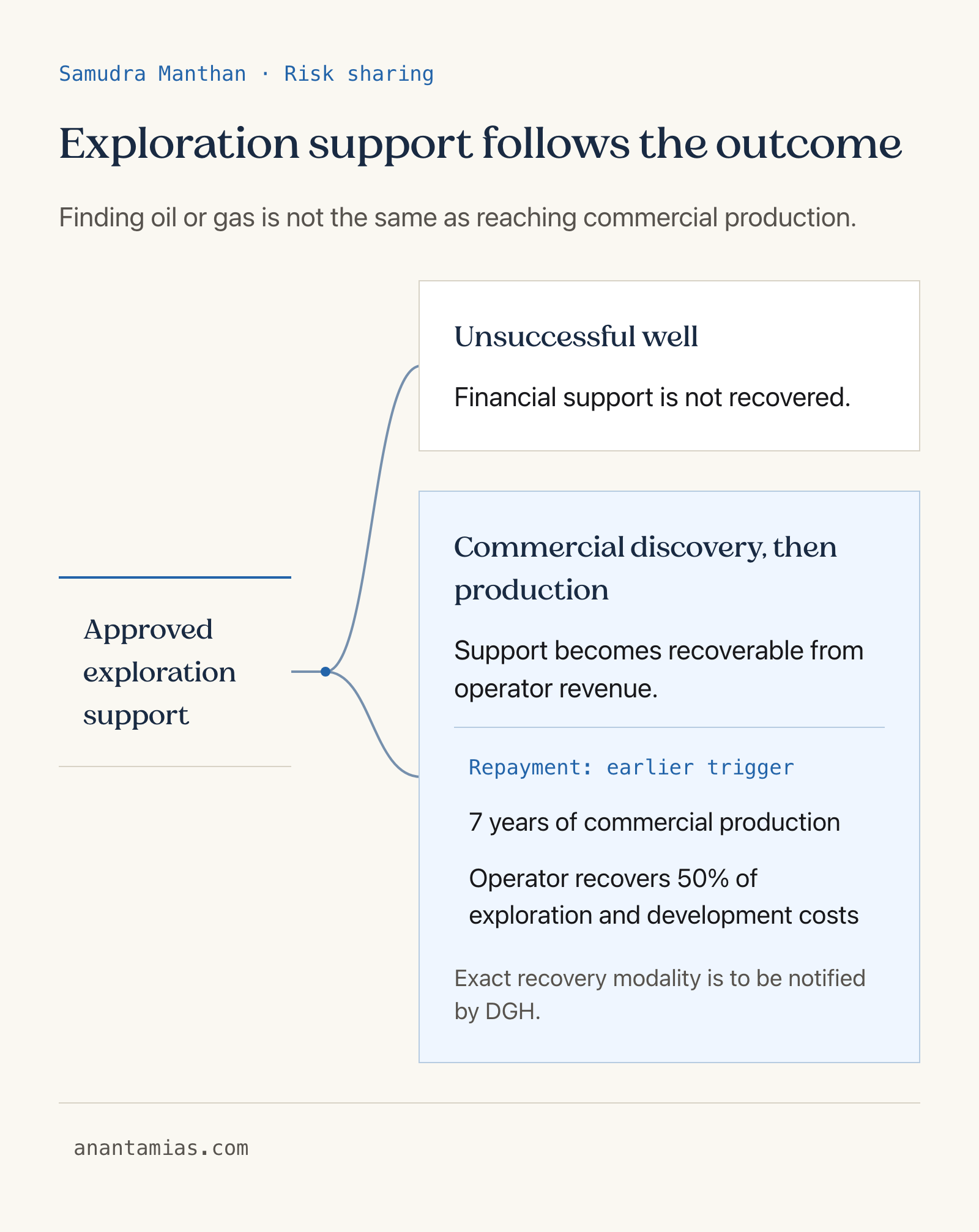
- Financial support for an unsuccessful well is not recoverable; support linked to a successful commercial discovery becomes recoverable from operator revenue.
- The Directorate General of Hydrocarbons (DGH) must still notify the exact recovery modality; the guidelines establish the governing conditions.
- This development concerns operating rules for an existing scheme, including eligibility, milestone payments and repayment, rather than a fresh scheme launch.
- Exploration risk arises before a producer knows whether costly drilling will yield a commercially usable resource.
- Public support reduces part of that initial exposure while recovery from successful projects can return some funding to government.
UPSC Relevance
Prelims Relevance
- Exploration: investigating whether hydrocarbons exist and can be recovered.
- Development: preparing a commercially viable discovery for regular production.
- Revenue Sharing Contract: the contractual regime specified for eligible blocks under the well-support component.
- DGH: verifies eligibility, monitors drilling and administers the recovery mechanism.
- Commercial production: regular production and sale, excluding production for testing.
Mains Relevance
GS Paper 3
- Energy security: evaluate how exploration incentives might improve domestic supply without treating possible discoveries as established reserves.
- Public finance: assess risk sharing, contingent recovery and incentives for credible project selection.
Essay
- Risk and responsibility: public funding requires both a developmental rationale and mechanisms for accountability.
Background and Context
Why Exploration Needs a Different Funding Logic
Exploration spends money to resolve geological uncertainty; commercial production begins only after a discovery can support regular extraction and sale.
- Seismic and geological information helps identify prospects, but a promising subsurface structure does not establish an economically recoverable deposit; drilling and evaluation must test whether the expected resource is actually present.
- An unsuccessful well can be dry or encounter hydrocarbons that are technically or commercially unrecoverable, provided it was drilled and evaluated under the approved program; finding some hydrocarbons alone does not establish success.
- A commercial discovery requires the contractual determination and an approved development area; the guidelines then distinguish regular production and sale from short testing flows when applying the support-recovery mechanism.
- The risk-sharing rationale is to lower the operator’s exposure to an expensive uncertain well. Government carries part of the downside, while successful commercial outcomes create a claim for recovery from operator revenue.
- Exploration and development are separate investment decisions: discovering oil or gas still leaves the task of assessing recovery, planning production and financing the facilities needed to move the resource to market.

When Support Becomes Recoverable
The operational guidelines link recovery to commercial outcomes and specify when repayments begin.
- For unsuccessful wells, government does not recover the financial support. This protects the intended geological-risk sharing, but it does not remove the operator’s obligations to follow approved drilling, reporting and audit requirements.
- For a successful commercial discovery, support is recoverable from operator revenue after commercial viability and production are established; a technical discovery or temporary test flow alone does not start the repayment schedule.
- Recovery starts at the earlier trigger: seven years of commercial production, or recovery of 50% of the operator’s exploration and development costs. The two conditions are alternatives, rather than cumulative requirements.
- Annual installments come from operator revenue without inflation indexation or time-value adjustment. Scheme repayment is additional to the operator’s existing obligations under its Revenue Sharing Contract, rather than replacing those contractual payments.
- Project-attributable costs determine the cost-recovery trigger, supported by operator declarations and statutory-auditor certification. DGH must notify the exact recovery modality, making cost records and an implementable collection process central to accountability.
Eligibility and Safeguards Matter as Much as Funding
Risk sharing works only when eligibility, expenditure and performance can be checked against the approved project.
- Chapter 9 permits any operator holding a valid deepwater or ultra-deepwater block under the Revenue Sharing Contract regime to seek support. Eligibility does not itself confer an entitlement to government funding.
- Block and work-program conditions restrict assistance: relinquished acreage is excluded, contractual commitments must be fulfilled or on track, and funding release depends on satisfying outstanding obligations rather than simply submitting a proposal.
- Milestone-based payments require evidence of drilling progress and completion. No claim or payment may anticipate a milestone; independent technical appraisal and DGH verification connect disbursement to work actually performed under the approved program.
- Cost overruns do not automatically increase public support: expenditure beyond the approved cap remains with the operator. Eligibility checks also examine environmental and regulatory restrictions, so assistance cannot substitute for the required approvals.
- Energy-security benefits remain conditional on viable discoveries and production. India’s oil-import concentration explains the policy concern, but approved exploration spending alone cannot demonstrate higher domestic output or reduced import dependence.
Way Forward
Make the Recovery Rule Auditable
- DGH should specify the recovery process clearly, including attributable costs, reporting duties and the evidence used to identify the first repayment trigger.
- Publish implementation outcomes that distinguish approved wells, completed evaluation, commercially viable discoveries and actual production; these measure different stages of performance.
- Preserve independent scrutiny of costs and well results so that support follows verified progress and the public claim on successful outcomes remains enforceable.
Conclusion
- Samudra Manthan’s central bargain is conditional risk sharing: unsuccessful exploration leaves government carrying its approved contribution, while commercial success creates an obligation to repay support from operator revenue under the specified trigger.
- Judge the policy through its mechanism: eligibility and milestone checks govern entry, cost records govern recovery, and production outcomes determine whether exploration support eventually contributes to energy security rather than remaining only expenditure.
UPSC Practice Questions
Prelims MCQ 1
With reference to well support under the Samudra Manthan operational guidelines, consider the following statements:
- Financial support for an unsuccessful well is not recoverable by government.
- A temporary testing flow by itself qualifies as commercial production.
- Recovery from a successful commercial discovery is additional to Revenue Sharing Contract obligations.
How many of the above statements are correct?
(a) Only one (b) Only two (c) All three (d) None
Answer: (b) Only two
Explanation:
Statements 1 and 3 are correct. Commercial production excludes production for testing; the recovery mechanism requires commercial viability and production, followed by the specified repayment trigger.
Prelims MCQ 2
Which interpretation best describes the repayment-start rule for a successful commercial discovery?
(a) Repayment begins as soon as drilling identifies any hydrocarbons. (b) Both seven years of production and recovery of half the specified costs must occur. (c) The operator can choose either trigger after production starts. (d) Repayment begins at the earlier of seven years of commercial production or recovery of half the specified exploration and development costs.
Answer: (d) Repayment begins at the earlier of seven years of commercial production or recovery of half the specified exploration and development costs.
Explanation:
Section 9.8.4 uses whichever is earlier. Repayment is made from operator revenue in annual installments, without inflation indexation or time-value adjustment.
UPSC Mains Questions
- Examine how conditional public support for offshore exploration can balance energy-security objectives with fiscal accountability.
- Distinguish geological discovery from commercial production. Why does this distinction matter when designing government support and repayment conditions for exploration projects?
Sources: Ministry of Petroleum and Natural Gas operational guidelines and The Hindu, 25 October 2026.
Frequently Asked Questions
What does Samudra Manthan’s well support share?
It shares part of the cost of eligible offshore exploration wells under approved conditions. It reduces initial risk but does not guarantee a discovery, commercial production or full reimbursement of an operator’s expenditure.
Does finding hydrocarbons automatically trigger repayment?
No. The guidelines distinguish technical discovery from commercial viability and production. Repayment then starts at the earlier specified production-duration or cost-recovery trigger, rather than immediately upon detecting hydrocarbons.
Who can seek support under the well-funding component?
Chapter 9 permits any operator with a valid deepwater or ultra-deepwater block under the Revenue Sharing Contract regime to seek support. Block conditions, work obligations, appraisal and government approval still apply.
Are all repayment details already specified?
The guidelines establish recoverability, the repayment-start conditions and annual installments. DGH must notify the exact recovery modality, so the governing principle is clearer than every operational collection detail.
Why is an unsuccessful well different from a badly documented project?
An unsuccessful well is defined by approved drilling and evaluation without a successful commercial discovery. Non-recovery of its support does not cancel requirements concerning approved work, accurate records, milestone evidence and audit.
Tell Google you want more of this.
Add Anantam IAS as a preferred sourceOne tap, and this site shows up more often in your own Top Stories, AI Overviews and AI Mode. Remove it any time.