Why in News?
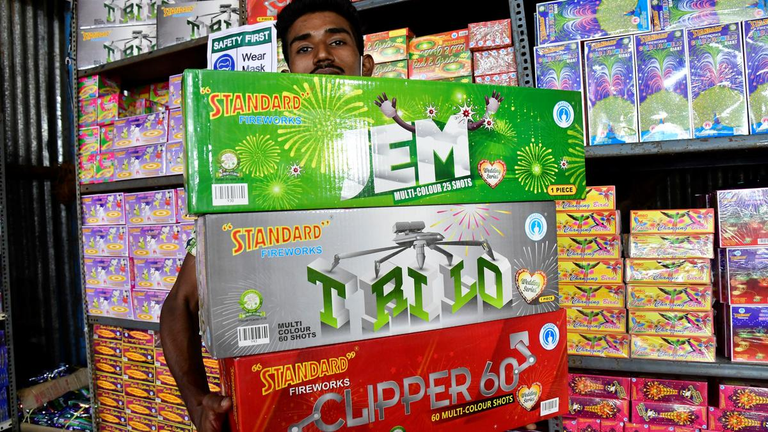
The Supreme Court has permitted the conditional use of certified green firecrackers in Delhi-NCR on November 7 and 8, 2026. The order provides a temporary relaxation, with the complete ban to resume from November 9.
| UPSC Relevance: GS-2 Polity and Governance: Judicial Intervention, Environmental Jurisprudence Prelims: Green Crackers, Judicial Review, Fundamental Rights (Articles 19, 21, and 25), Gunpowder in Medieval India |
What are Green Crackers?
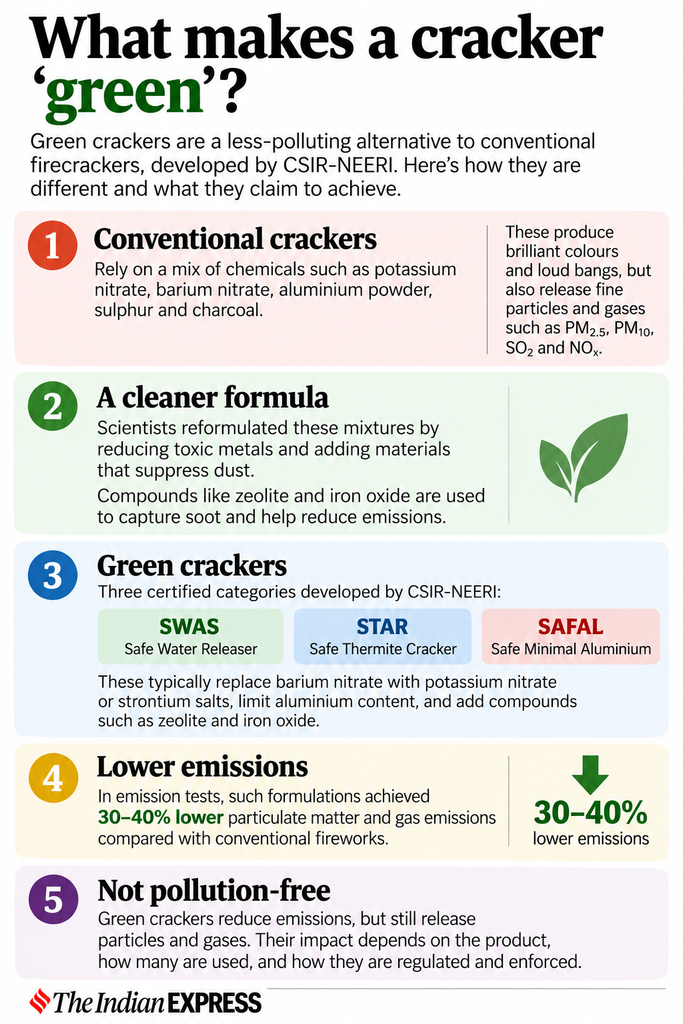
Green crackers are low-emission firecrackers developed to reduce air and noise pollution during festivals.
- Conceptualised and developed by the Council of Scientific and Industrial Research (CSIR), primarily led by the National Environmental Engineering Research Institute (NEERI).
- Key Characteristics:
- They do not contain banned toxic chemicals like Barium nitrate (which gives a green colour but is highly toxic), lithium, arsenic, lead, or mercury.
- “Green” does not mean pollution-free: These crackers still generate particulate matter, noise and waste.
Core Differences: Green vs. Traditional Crackers
| Parameters | Traditional Crackers | Green Crackers |
| Particulate Matter (PM) | High emissions of PM2.5 and PM10. | Reduced particulate emissions by 30% to 35%. |
| Sound Levels | Often exceed 120-160 decibels (dB). | Capped at 110 to 125 dB (approx. 10% quieter). |
| Chemical Additives | Use Barium Nitrate, Potassium Nitrate, Sulfur. | Avoid Barium; use eco-friendly binders and dust suppressants. |
| Size & Components | Standard shell sizes; no water-vapour mechanism. | Slightly smaller raw material composition; releases water vapour. |
Key Directions of the Supreme Court:
- Restricted timings: Bursting permitted only from 6-7 a.m. and 8-10 p.m. on both November 7 and 8.
- No-cracker zones: A 300-metre exclusion radius around hospitals, nursing homes, health centres, old-age homes, educational institutions and notified silence zones.
- Product prohibited: Barium-containing crackers, unauthorised conventional crackers, firecrackers joined in series (‘ladis’) and garlands.
- Traceability: Sealed boxes must carry product- and batch-specific QR codes, identifying the manufacturer, registration/licence and testing details.
- Accountability: Manufacturers and traders must furnish monetary security, liable to forfeiture for violations. Sales are restricted to designated locations; online sales are prohibited.
Core Constitutional and Legal Dimensions:
1. Harmonising Article 21 and Article 25: The legal debate around firecrackers hinges on the intersection of the right to health and the right to practice religion:
- Article 21 (Right to Life and Personal Liberty): The Supreme Court has repeatedly expanded Article 21 to include the right to a clean, healthy, and pollution-free environment (Subhash Kumar v. State of Bihar, 1991). The hazardous Particulate Matter (PM2.5 and PM10) from crackers directly threatens public health.
- Article 25 (Freedom of Conscience and Free Profession, Practice, and Propagation of Religion): Freedom of religion is explicitly subject to public order, morality, and health. The court affirmed that religious sentiments cannot override the collective right to health under Article 21.
2. The Doctrine of Proportionality vs. Absolute Ban: The SC noted that it is not inclined toward a complete, absolute ban on firecrackers due to potential spiralling effects (economic distress to manufacturers, illegal black markets, and severe public backlash). Instead, the Court adheres to the doctrine of proportionality, seeking a middle path via:
- Permitting only verified green firecrackers.
- Restricting the hours of bursting.
- Banning highly toxic chemical formulations (e.g., Barium-based salts).
3. Article 19(1)(g) Occupational Freedom: Manufacturers and traders possess a right to carry on business, subject to reasonable restrictions under Article 19(6).
4. Environmental Responsibilities:
- Article 48A directs the State to protect the environment
- Article 51A(g) makes environmental protection and compassion for living creatures a fundamental duty.
Historical Perspective:
- The Court stressed that ancient Hindu scriptures, including the Skandapurana and the Padmapurana, referred to the use of only lamps as a ritual during Deepavali.
- With the introduction of gunpowder in India a few centuries ago, the celebration underwent a change. This led to the introduction of bursting firecrackers.
| Gunpowder in Medieval India: Chinese origin: Gunpowder originated in 9th-century China under the Tang dynasty, initially through alchemical experimentation. Arrival in India: It probably reached India through Central Asian contacts during the late thirteenth-early fourteenth centuries; the precise route remains debated. Early documented use: Gunpowder-based fireworks were used in Delhi during Firuz Shah Tughlaq’s reign (1351-1388). Military expansion: Although fourteenth-century Deccan claims remain contested, firearms were used in Gujarat, Malwa and the Deccan by the later fifteenth century. Babur’s contribution: At the First Battle of Panipat (1526), Babur effectively combined field artillery, matchlockmen, Ottoman-style cart defences and cavalry manoeuvres. His significance lies in tactical application, rather than the first introduction of gunpowder. |
Institutional and Enforcement Gaps:
- Absence of Ground-Level Verification: There is currently no robust, real-time mechanism for field officers to distinguish between spurious, toxic crackers and legitimate green crackers at retail points.
- Executive Hesitation: Enforcement agencies often show reluctance to book criminal cases against ordinary citizens driven by seasonal and celebratory enthusiasm.
- Supply-Driven Violations: Seasonal traders exploit high demand to push unauthorised, highly polluting products into markets to maximise short-term profits.
Way Forward:
- Data-Driven Accountability: As directed by the SC, the state governments and the Commission for Air Quality Management (CAQM) must maintain transparent, quantifiable enforcement data on seizures and retail checks.
- Empowering Statutory Bodies: The Central Pollution Control Board (CPCB) and State Pollution Control Boards (SPCBs) must rapidly deploy portable chemical testing kits to field personnel to identify unauthorised barium compounds.
- Standardised Green Certification: Streamline the CSIR-NEERI certification mechanism for green crackers, embedding secure, tamper-proof QR codes on packaging to prevent counterfeit sales.
- Staggered Public Management: Implement state-regulated community firecracker zones and strict time-window adherence to minimise peak PM concentration spikes.
- Mass Awareness Campaigns: Utilise public icons, sportspersons, and digital influencers to shift the cultural perception of Deepawali back to its traditional roots as a “festival of lights”.
Protecting the right to breathe cannot rely solely on judicial mandates or police crackdowns. It demands statutory transparency, technological verification, and an internal behavioural shift within society to balance cultural expressions with the constitutional right to health.
UPSC PYQ 2015:
Q. Consider the following:
The arrival of Babur into India led to the
1. Introduction of gunpowder in the subcontinent
2. Introduction of the arch and dome in the region’s architecture
3. Establishment of Timurid dynasty in the region
Select the correct answer using the code given below.
(a) 1 and 2 only
(b) 3 only
(c) 1 and 3 only
(d) 1, 2 and 3
Answer: (b)
Practice Prelims MCQ:
Q. With reference to “Green Crackers” in India, consider the following statements:
- They are developed exclusively by the Indian Space Research Organisation (ISRO) to capture space-grade pyrotechnic compositions.
- They do not emit any particulate matter (PM2.5 or PM10) upon combustion, making them entirely pollution-free.
- The chemical formulations SWAS, STAR, and SAFAL completely exclude the use of highly hazardous barium nitrate.
How many of the statements given above are correct?
(a) Only one
(b) Only two
(c) All three
(d) None
Answer: (a) Only one (Statement 3 is the only correct statement).
Explanation:
- Statement 1 is incorrect: Green crackers were conceptualised and developed by the Council of Scientific and Industrial Research – National Environmental Engineering Research Institute (CSIR-NEERI), not ISRO.
- Statement 2 is incorrect: Green crackers are low-emission formulations, not entirely pollution-free. They reduce particulate matter (PM) and harmful gaseous emissions like sulphur dioxide (SO2) and nitrogen oxides (NOx) by roughly 30%, but they do not eliminate them.
- Statement 3 is correct: A defining structural characteristic of CSIR-NEERI’s certified green crackers (SWAS, STAR, and SAFAL) is that they completely exclude barium nitrate, which is a primary toxic heavy metal oxidiser responsible for the bright green colour and severe particulate emissions in traditional fireworks.
Tell Google you want more of this.
Add Anantam IAS as a preferred sourceOne tap, and this site shows up more often in your own Top Stories, AI Overviews and AI Mode. Remove it any time.