Why in News?
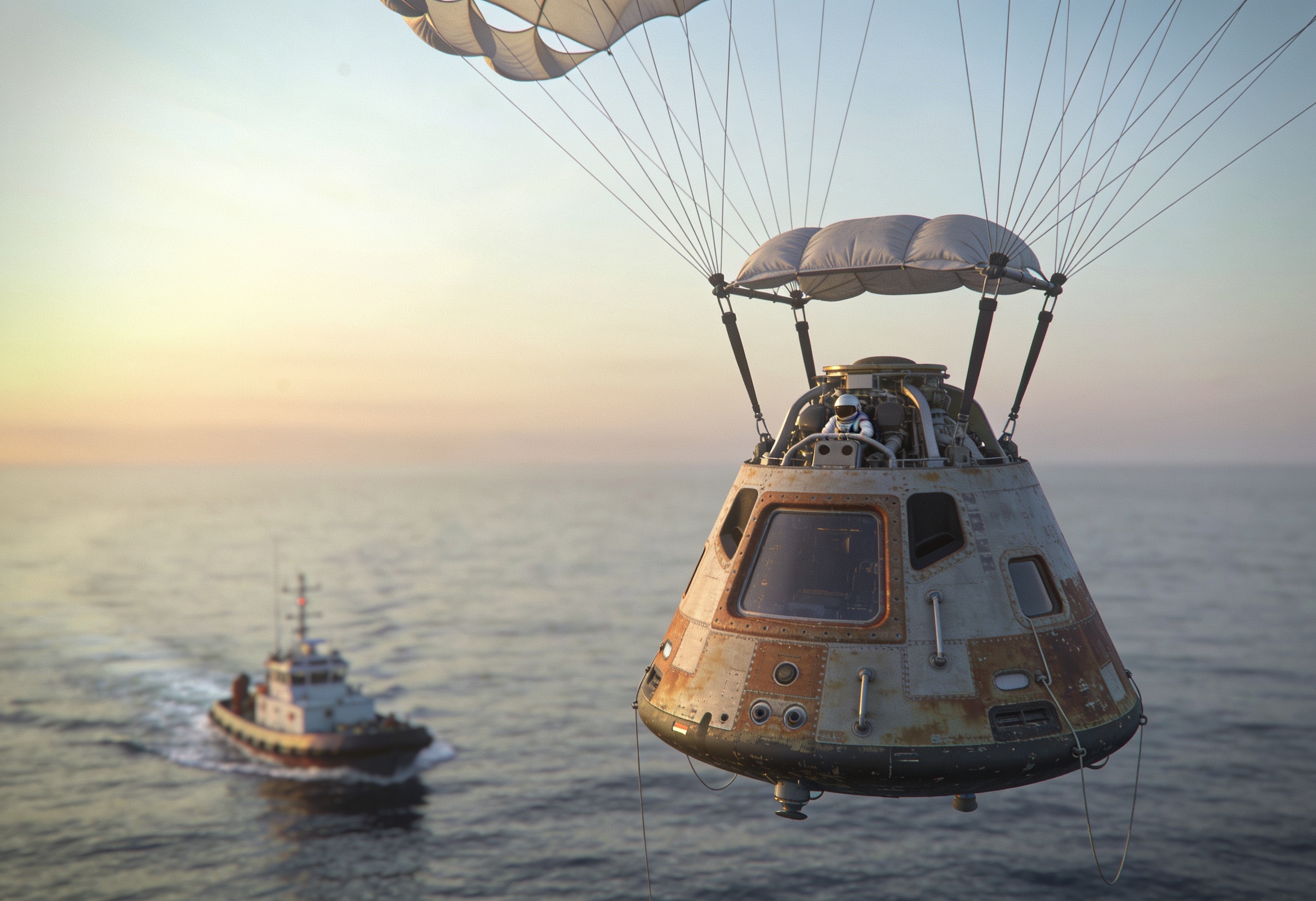
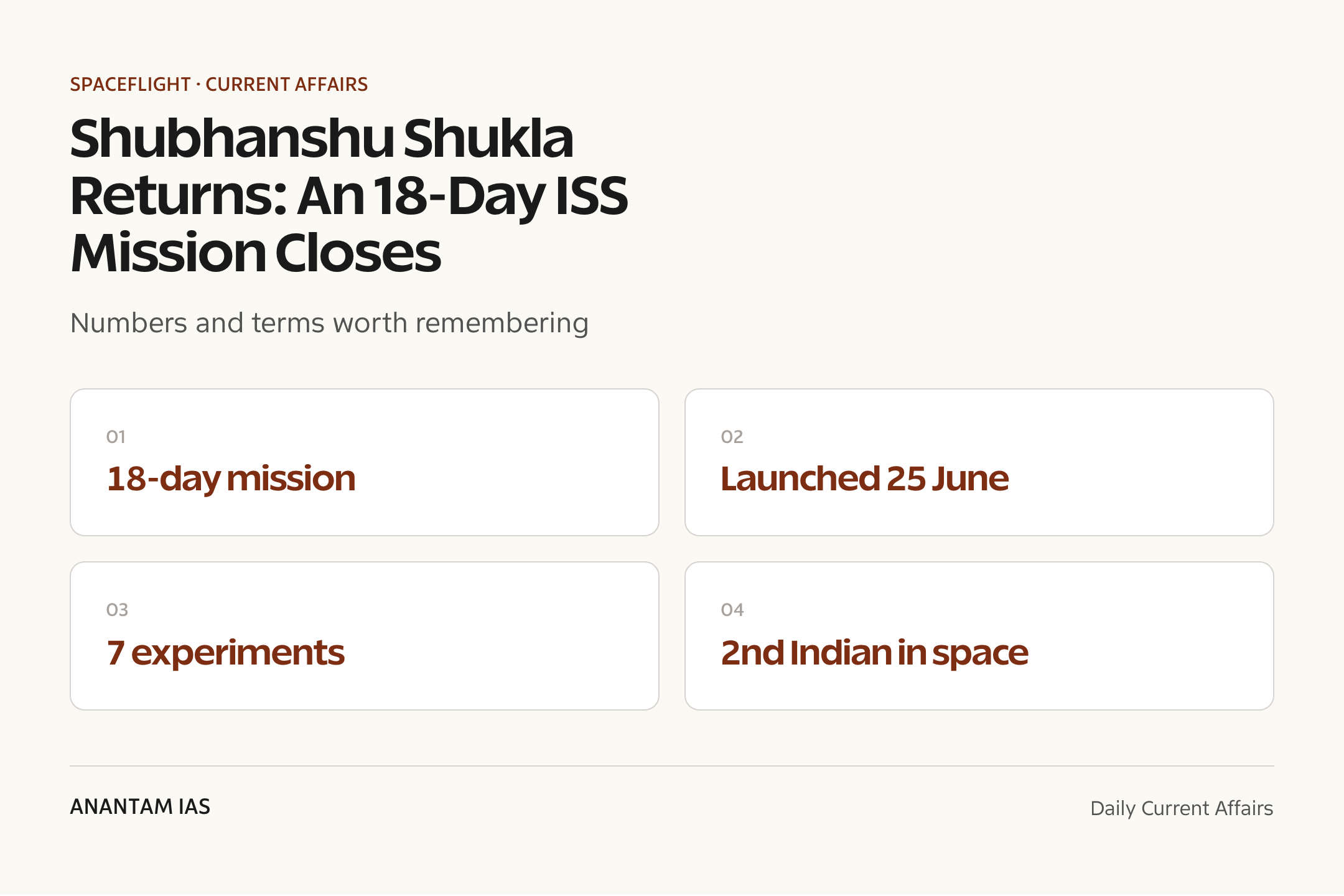
On 15 July 2025, Group Captain Shubhanshu Shukla splashed down in a SpaceX Dragon capsule in the Pacific Ocean off San Diego, closing an 18-day mission aboard the International Space Station (ISS). He flew as Mission Pilot of the commercial Axiom-4 (Ax-4) mission that lifted off on 25 June 2025.
Shukla is the first Indian to reach the ISS and only the second Indian in space after Wing Commander Rakesh Sharma (1984). ISRO confirmed he conducted seven India-specific microgravity experiments whose data feeds directly into the Gaganyaan human-spaceflight programme.
- Splashdown on 15 July 2025 in the Pacific off the coast of San Diego, California.
- Launch on 25 June 2025 from Florida on a Falcon-9 rocket carrying the Dragon capsule.
- Mission lasted 18 days on the ISS; crew enters a seven-day rehabilitation programme on return.
- Ax-4 was a joint effort of Axiom Space, NASA and the Indian Space Research Organisation (ISRO).
- Shukla flew as Mission Pilot and is termed a Gaganyatri in ISRO usage.
- He spoke with Dr V Narayanan, Chairman of ISRO, acknowledging the wider ISRO team.
The development matters in the context of:
- Comes as ISRO advances Gaganyaan, with the first uncrewed flight (Gaganyaan-G1) campaign under way.
- Bridges India’s reliance on partner platforms today to a planned indigenous Bharatiya Antariksh Station.
- Marks a shift from purely state-run access to commercial human spaceflight partnerships.
UPSC Relevance
Prelims Relevance
- Axiom-4 (Ax-4) — a private astronaut mission to the ISS run by Axiom Space.
- Shubhanshu Shukla — first Indian on the ISS; second Indian in space.
- Rakesh Sharma — first Indian in space, 1984, aboard Soviet Soyuz T-11.
- SpaceX Dragon capsule launched on a Falcon-9 rocket.
- Gaganyaan — ISRO’s first crewed orbital mission programme.
- Gaganyaan-G1 — the planned first uncrewed test flight.
- Bharatiya Antariksh Station (BAS) — India’s planned space station.
- Microgravity — near-weightless condition exploited for experiments in orbit.
- Mission duration 18 days; launch 25 June 2025, splashdown 15 July 2025.
- Dr V Narayanan — Chairman, ISRO.
Mains Relevance
GS Paper 3
- Indigenous human-spaceflight capability and the role of microgravity research in long-duration habitation and planetary missions.
- How commercial-platform flights de-risk and accelerate India’s Gaganyaan and space-station roadmap.
GS Paper 2
- Space diplomacy and India-US science cooperation through NASA-Axiom-ISRO collaboration.
Essay
- Science as an instrument of national confidence and soft power.
- From dependence to self-reliance: India’s journey to the stars.
Background and Context
What the Axiom-4 mission was
Ax-4 is a commercial human-spaceflight mission flown to the ISS through a public-private partnership.
- Operated by Axiom Space with launch and capsule services from SpaceX.
- Lifted off on 25 June 2025 on a Falcon-9 rocket carrying the Dragon capsule from Florida.
- ISRO sponsored the Indian seat, with NASA as the ISS host agency.
- The mission is referenced as Akash Ganga in Indian coverage; Shukla served as Mission Pilot.
Who Shubhanshu Shukla is
An Indian Air Force fighter pilot selected as an astronaut-designate for India’s crewed programme.
- Group Captain in the Indian Air Force, a trained fighter and test pilot.
- First Indian to board the ISS; only the second Indian in space after Rakesh Sharma (1984).
- Designated a Gaganyatri — one of the astronauts trained for the Gaganyaan mission.
- Carried out student outreach interactions from orbit, linking the flight to a wider science-education push.
- On return, the crew enters a seven-day rehabilitation programme to readjust to Earth’s gravity.
The seven India-specific experiments
Shukla ran a focused suite of microgravity experiments selected by Indian institutions.
- Seven India-specific microgravity experiments were conducted aboard the ISS during the stay.
- Aimed at generating data for long-duration space habitation and future planetary missions.
- Microgravity removes the masking effect of gravity, exposing biological and physical processes that behave differently on Earth.
- Such conditions let researchers study fluid behaviour, cell growth, plant biology and materials in ways impossible under full gravity.
- Findings are intended to inform crew health, life-support and materials design for future Indian missions.
- The payload set was coordinated with Indian research institutions, giving domestic labs direct stake in an orbital flight.
Link to Gaganyaan
The flight is a flight-experience and data feed for India’s first indigenous crewed mission.
- Gaganyaan aims to send Indian astronauts to low-Earth orbit on an Indian launch vehicle.
- ISRO has progressed parachute-deployment tests and the Service Module Propulsion System.
- The first uncrewed test flight, Gaganyaan-G1, launch campaign has commenced.
- Real ISS experience gives Indian astronauts and engineers operational know-how ahead of the indigenous flight.
Towards an Indian space station
The mission supports India’s longer-term ambition to operate its own orbital outpost.
- India plans an indigenous Bharatiya Antariksh Station (BAS) as a follow-on to Gaganyaan.
- Habitation and life-support data from microgravity work feed station design.
- ISS experience builds the rendezvous, docking and crew-operations base for an independent station.
- Marks a transition from partner-dependent access to self-reliant human presence in orbit.
Why it matters strategically
A human-spaceflight milestone with science, diplomatic and inspirational payoffs.
- Demonstrates working India-US space cooperation via the NASA-Axiom-ISRO arrangement.
- Positions India among nations capable of sustained human spaceflight partnerships.
- Builds a national talent and confidence base for Gaganyaan and beyond.
- Re-energises public interest in space science four decades after Rakesh Sharma.
Way Forward
Convert flight data into capability
- Translate the seven experiments into validated protocols for Gaganyaan crew health and life support.
- Institutionalise astronaut-training feedback from the ISS stay into India’s training pipeline.
Sustain the public-private model
- Use commercial flights to gain experience while building indigenous capability for the Bharatiya Antariksh Station.
- Deepen partnerships with NASA and space agencies for shared research and crew exchange.
Maintain momentum on Gaganyaan test flights so the indigenous crewed mission follows the Ax-4 experience without long gaps.
Conclusion
Shubhanshu Shukla’s safe 15 July 2025 splashdown closed a short but symbolically large mission: the first Indian on the ISS, four decades after Rakesh Sharma reached orbit.
The flight is less an endpoint than a feeder — seven experiments, hands-on ISS experience and a working international partnership that all point toward Gaganyaan and an Indian space station.
UPSC Practice Questions
Prelims MCQ 1
With reference to the Axiom-4 (Ax-4) mission, consider the following statements:
- Shubhanshu Shukla was the first Indian to travel to the International Space Station.
- The mission used a SpaceX Dragon capsule launched on a Falcon-9 rocket.
- Shukla was the first Indian ever to travel to space.
How many of the above statements are correct?
(a) Only one (b) Only two (c) All three (d) None
Answer: (b) Only two
Explanation:
Statements 1 and 2 are correct. Statement 3 is wrong: Rakesh Sharma was the first Indian in space (1984); Shukla was the second Indian in space and the first on the ISS.
Prelims MCQ 2
Which programme is India’s first indigenous human-spaceflight mission, to which Shukla’s Ax-4 experience directly contributes?
(a) Chandrayaan (b) Gaganyaan (c) Aditya-L1 (d) Mangalyaan
Answer: (b) Gaganyaan
Explanation:
Gaganyaan is ISRO’s first crewed orbital programme; Chandrayaan is lunar, Aditya-L1 is solar, and Mangalyaan was the Mars orbiter.
UPSC Mains Questions
- Group Captain Shubhanshu Shukla’s Axiom-4 mission is described as a feeder for India’s crewed-spaceflight ambitions. Examine how flying astronauts on commercial international platforms advances the Gaganyaan programme and the planned Indian space station.
- Human spaceflight is as much about national confidence and international cooperation as about science. Discuss with reference to India’s participation in the Axiom-4 mission and its space-diplomacy implications.
Sources: News On Air (Prasar Bharati) and News On Air.
Frequently Asked Questions
Who is Shubhanshu Shukla?
Group Captain Shubhanshu Shukla is an Indian Air Force test pilot and a Gaganyatri trained for India’s crewed programme. He became the first Indian to reach the International Space Station, flying as Mission Pilot on the Axiom-4 mission in 2025, and is only the second Indian to travel to space.
When did the Axiom-4 mission launch and return?
Axiom-4 lifted off on 25 June 2025 from Florida on a SpaceX Falcon-9 rocket carrying a Dragon capsule. After 18 days aboard the International Space Station, Shukla and the crew splashed down in the Pacific Ocean off San Diego on 15 July 2025.
How is Shukla connected to Rakesh Sharma?
Rakesh Sharma was the first Indian in space in 1984, aboard a Soviet Soyuz mission. Shubhanshu Shukla is the second Indian in space and the first Indian aboard the International Space Station, reaching orbit roughly four decades after Sharma’s historic flight.
What experiments did Shukla conduct?
Shukla carried out seven India-specific microgravity experiments aboard the ISS. They were designed to generate data for long-duration space habitation and future planetary missions, supporting crew-health, life-support and materials research for India’s own crewed spaceflight effort.
How does the mission help Gaganyaan?
Gaganyaan is ISRO’s first indigenous crewed mission. The Axiom-4 flight gives Indian astronauts and engineers real operational experience aboard the ISS, plus microgravity data, both of which reduce risk and inform crew training, life-support and design choices for Gaganyaan and later missions.
What is the Bharatiya Antariksh Station?
It is India’s planned indigenous space station, conceived as a follow-on to the Gaganyaan programme. Experience and habitation data from missions such as Axiom-4 feed into its design, helping India move from partner-dependent access to a self-reliant, sustained human presence in orbit.
Tell Google you want more of this.
Add Anantam IAS as a preferred sourceOne tap, and this site shows up more often in your own Top Stories, AI Overviews and AI Mode. Remove it any time.