Context:
The Indian defense minister recently warned Pakistan against any misadventure in Sir Creek area.
UPSC Relevance:
India and its neighborhood- relations.
About Sir Creek:
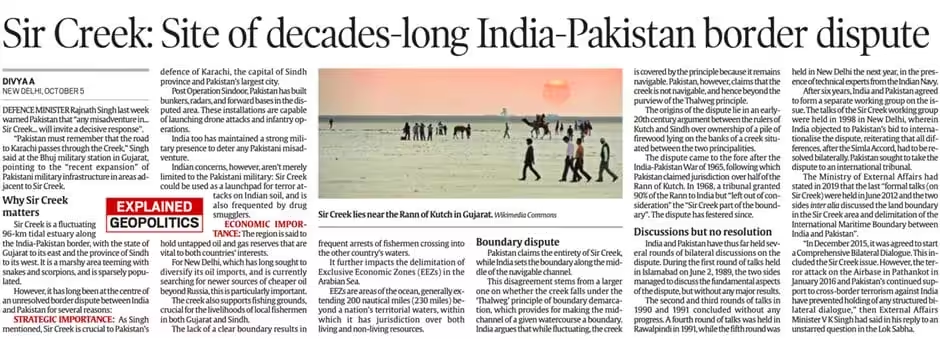
Sir Creek is a 96-kilometre strip of water located in the marshlands of the Rann of Kutch in Gujarat. Geographically, it forms a boundary between India’s Kutch region and Pakistan’s Sindh province before opening into the Arabian Sea. Historically, it was known as Ban Ganga and acquired the name “Sir Creek” during the colonial era, named after a British official.
Sir Creek dispute:
- The Sir Creek Dispute dates back to 1908, when disagreements arose between the ruler of Kutch and the Sindh government over firewood collection in the creek area. To settle the issue, the Bombay Government Resolution of 1914 was issued. The resolution contained conflicting provisions:
- Paragraph 9 said that the boundary should be to the east of the creek, implying the entire creek would belong to Pakistan.
- Paragraph 10, however, applied the Thalweg Principle, noting that Sir Creek is navigable most of the year, making the mid-channel the effective boundary.
This inherent contradiction has been the basis of prolonged disagreement between the two countries.
- The core of the Sir Creek Dispute lies in the differing interpretations of the maritime boundary between India and Pakistan. Before India’s independence, the region was part of the Bombay Presidency. Post-partition in 1947, Kutch remained with India while Sindh became part of Pakistan.
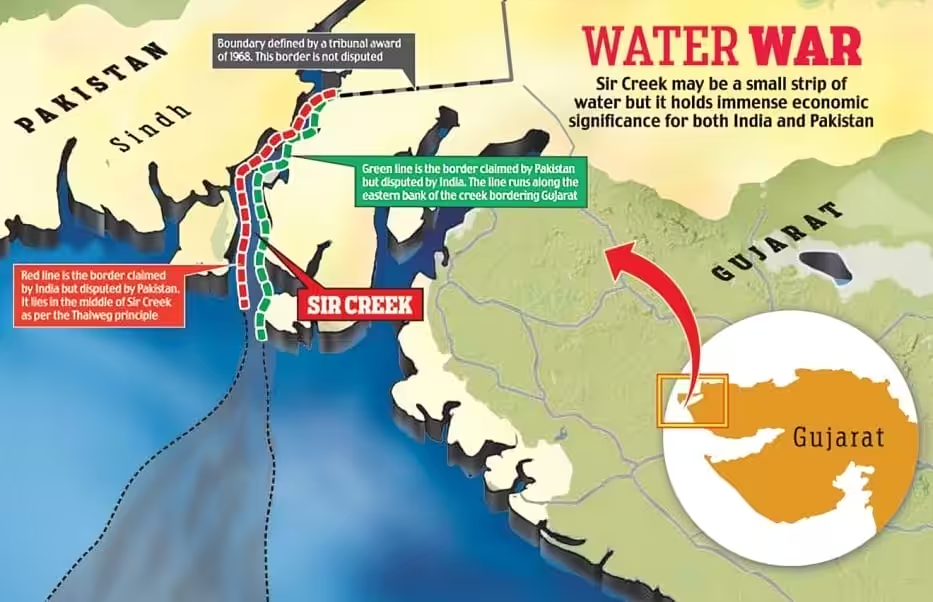
- Pakistan claims the entirety of Sir Creek based on the Bombay Government Resolution of 1914, signed between the Rao of Kutch and the Sindh provincial government. According to Pakistan, the eastern flank of the creek forms the boundary. India, however, considers this green line indicative rather than definitive. Instead, India relies on a 1925 map, along with the mid-channel pillars constructed in 1924, to argue that the boundary lies along the mid-channel of the creek (red line on the map).
- India invokes the Thalweg Principle of international law, which stipulates that the boundary between two political entities along a waterway should follow the center of the principal navigable channel. Pakistan rejects this argument, claiming that Sir Creek is non-navigable, whereas India maintains that the creek is navigable during high tides, and fishing trawlers regularly use it to reach the Arabian Sea.
Sir Creek Importance:
- Strategic Importance: The creek lies near the Rann of Kutch, an area where India and Pakistan clashed during the 1965 war. Control over this region influences maritime security and surveillance.
- Economic Significance: It is one of the largest fishing grounds in Asia, supporting the livelihoods of thousands of fishermen. Furthermore, potential oil and gas reserves under the seabed could provide significant economic benefits, though exploration remains stalled due to the dispute.
- Ecological Value: Sir Creek is an ecologically sensitive area, home to flamingoes and other migratory birds during winter, making it important for biodiversity conservation.
Attempts at Resolution of dispute:
Several attempts have been made to resolve the Sir Creek issue:
- After the 1965 war, British Prime Minister Harold Wilson intervened, leading to the establishment of a tribunal. The 1968 verdict granted Pakistan only 10% of its claim.
- During the 1997 composite dialogue, Sir Creek was discussed as a part of broader efforts to improve bilateral relations.
- Tensions increased in 1999 when an Indian fighter plane shot down a Pakistani surveillance aircraft over the creek. India alleged an airspace violation, while Pakistan denied it.
- Between 2005 and 2007, joint surveys were conducted to assess the area for potential resolution.
- Despite these efforts, a final agreement has remained elusive, largely due to differing interpretations of historical maps and legal principles.
Way Forward:
Resolving the Sir Creek dispute is important for many reasons:
- Strategic and Economic Gains: A resolution would allow exploration of oil and gas reserves and better control of maritime boundaries.
- Low-Hanging Fruit: Among the numerous Indo-Pakistan disputes, Sir Creek is often considered a simpler, less politically charged issue, making it a potential candidate for early resolution.
- Humanitarian Aspect: Fishermen from both countries are frequently detained for accidentally crossing perceived borders, creating tensions and disrupting livelihoods.
Tell Google you want more of this.
Add Anantam IAS as a preferred sourceOne tap, and this site shows up more often in your own Top Stories, AI Overviews and AI Mode. Remove it any time.