Why in News?
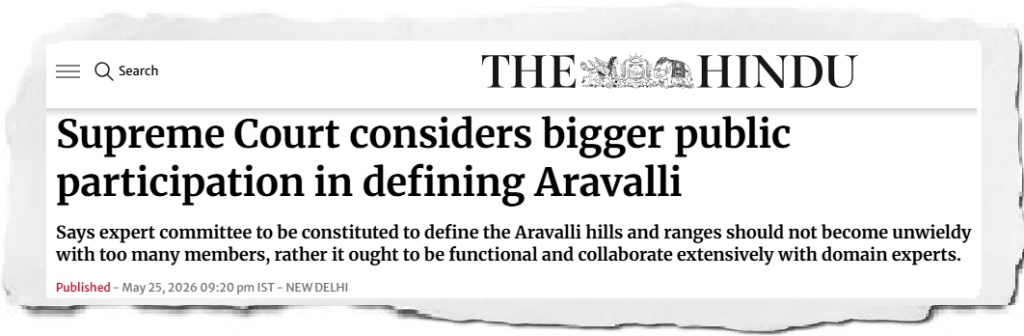
The Supreme Court has directed that the expert committee being constituted to redefine the Aravalli hill system should ensure wider public participation through consultations with environmental experts, scientists and stakeholders. The Court also intends the panel to prepare a roadmap on permissible activities, including regulated mining, while ensuring ecological protection of the Aravalli ecosystem.
UPSC Relevance
Prelims
- Physical Geography: Age, geological origin (Precambrian era, Aravalli–Delhi orogeny), extension (across Gujarat, Rajasthan, Haryana, and Delhi), and highest peak (Guru Shikhar) of the Aravalli Range.
- Ecology & Environment: The ecological function of old fold mountains as a barrier against desertification, water table aquifers, and wildlife corridors.
- Environmental Governance: Central Empowered Committee (CEC), Amicus Curiae, and regulatory provisions of the Mines and Minerals (Development and Regulation) [MMDR] Act, 1957.
Mains
- GS Paper II (Governance): Judicial review, public-inclusive policymaking, and the balancing role of expert committees.
- GS Paper III (Environment & Infrastructure): Combating desertification, land degradation, balancing ecological preservation with regulated mineral mining, Sustainable Protected Area Management.
Background and Context
The Aravalli Range is among the oldest fold mountain systems in the world and acts as a crucial ecological barrier in north-western India. It extends across several States including Rajasthan, Haryana, Delhi and Gujarat.
The issue arose after a Supreme Court judgment in November 2025 upheld a government committee’s definition of the Aravalli hills. The definition restricted Aravalli identification primarily to:
- Areas having elevations of 100 metres or above
- Hill clusters, slopes or hillocks situated within 500 metres of each other
The decision generated criticism because many ecologists argued that such a narrow definition excluded numerous ecologically important lower hill systems and fragmented landscapes.
Subsequently, the Court revisited the matter suo motu and stayed its earlier judgment.
About the Aravalli Range
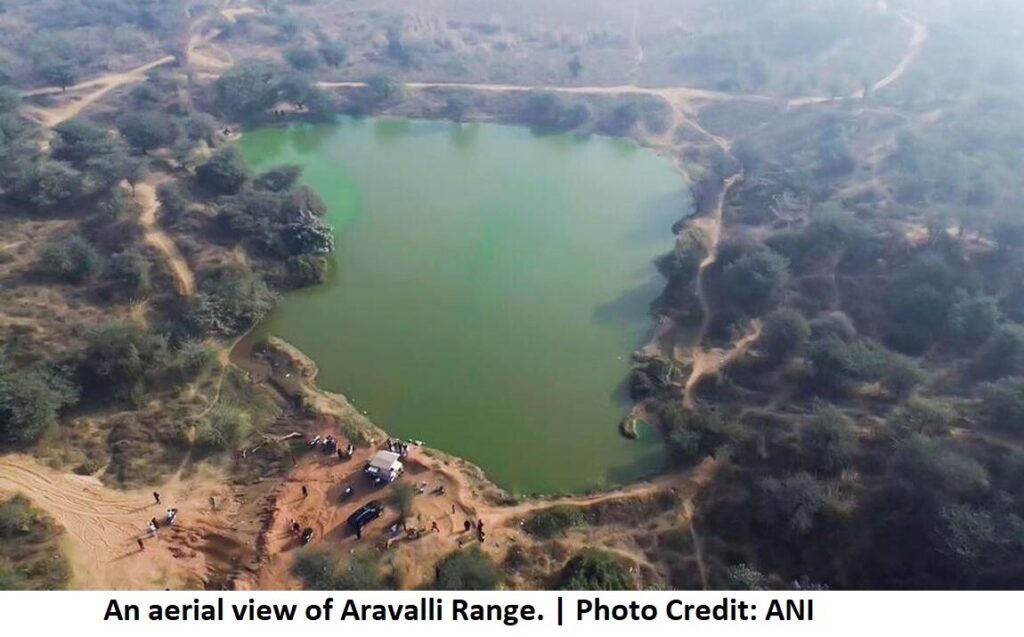
Aravalli Range is one of the world’s oldest geological formations and stretches approximately 700 km, beginning from Gujarat through Rajasthan and Haryana to Delhi.
The ecological significance of the Aravallis includes:
The hill range acts as a natural barrier against the eastward expansion of the Thar Desert and helps moderate desertification.
It serves as an important groundwater recharge system for north-western India.
The region supports biodiversity through forests, grasslands and wildlife habitats.
The hills contribute significantly to climate regulation and carbon sequestration.
Why Definition of Aravalli Matters
The controversy demonstrates that environmental protection is strongly dependent upon legal definitions.
A restrictive definition may exclude large ecologically connected landscapes from protection measures.
The Court observed that out of approximately 12,081 Aravalli hills in Rajasthan alone, only 1,048 hills would satisfy the 100-metre threshold.
This implies that nearly 90% of identified hill structures could potentially lose protection.
Such exclusion could create what the Court described as a regulatory lacuna.
Concerns with Narrow Definition
Threat of Increased Mining Activities
Lower hill formations and connected ecological areas may become vulnerable to unregulated mining if excluded from legal protection.
Mining activities can lead to:
- Deforestation, Habitat fragmentation, Air pollution, Groundwater depletion, Soil degradation
Ecological Fragmentation
Mountain systems function as integrated ecological landscapes rather than isolated peaks.
Protecting only elevated portions while excluding connected ecosystems may undermine conservation objectives.
Accelerated Desertification
The Aravallis prevent the expansion of desert ecosystems toward fertile plains.
Weakening ecological protection may increase vulnerability to land degradation.
Loss of Biodiversity
The Aravalli ecosystem supports multiple plant and animal species, many adapted to fragile dry ecosystems.
Fragmentation may threaten habitat continuity.
Supreme Court’s Current Approach
The Court has attempted to shift the process from a purely administrative exercise toward a multidisciplinary and participatory framework.
Constitution of Expert Committee
The proposed committee is expected to include experts from different domains: Environmental scientists, Ecologist, Foresters, Mining experts, Conservation specialists
The Court stated that the committee should remain functional and avoid becoming excessively large.
Greater Public Participation
The Court emphasized extensive consultations with:
- Domain experts, Local communities, Stakeholders, Environmental groups
This reflects an emerging approach of participatory environmental governance.
Preparation of a Comprehensive Roadmap
The committee has been tasked not only with defining the Aravallis but also with developing a framework regarding:
- Permissible activities, Ecological safeguards, Regulated mining practices, Long-term sustainability measures
Judicial Supervision
The committee will function under the direct supervision of the Supreme Court.
This reflects judicial activism in environmental matters where concerns exist regarding administrative inadequacies.
Judicial Intervention in Environmental Governance
Indian courts have historically expanded environmental protection through constitutional interpretation.
Constitutional Basis
Article 21: The right to life has been interpreted to include the right to a healthy environment.
Article 48A: Directs the State to protect and improve the environment.
Article 51A(g): Imposes a fundamental duty upon citizens to protect the environment.
Important Environmental Principles Applied by Courts
Precautionary Principle: Activities with potentially irreversible environmental consequences should be approached cautiously even where scientific certainty is incomplete.
Polluter Pays Principle: Individuals or industries causing environmental damage are expected to bear the financial burden of restoring ecological harm.
Sustainable Development: Developmental activities should balance economic growth with environmental protection so that present needs are met without compromising future generations.
Challenges in Aravalli Conservation
Illegal Mining
Illegal stone mining and quarrying remain significant challenges in several regions.
Urban Expansion
Rapid urbanisation around Delhi-NCR and adjoining areas places pressure on the ecosystem.
Administrative Fragmentation
The Aravalli landscape extends across multiple States, creating coordination difficulties.
Weak Enforcement Mechanisms
Even where legal protections exist, implementation remains inconsistent.
Conflicting Development Priorities
Infrastructure projects and economic activities often conflict with ecological considerations.
Way Forward
Adopt a Landscape-Based Approach: The Aravalli should be viewed as an interconnected ecological system rather than isolated hill structures.
Use Scientific Mapping Technologies: Satellite imagery, GIS mapping and ecological indicators should supplement traditional definitions.
Strengthen Community Participation: Local communities and traditional knowledge systems should become integral to conservation strategies.
Promote Sustainable Mining Practices: Mining should be regulated through scientific assessment and strict environmental safeguards.
Create an Inter-State Coordination Mechanism: Since the Aravallis cut across multiple States, a coordinated governance framework is necessary.
Conclusion
The present debate goes beyond merely defining a mountain range. It concerns the broader question of how India balances environmental protection with economic development. The Supreme Court’s emphasis on scientific expertise, stakeholder participation and ecological continuity indicates a shift toward more inclusive environmental governance. The future of the Aravallis will depend not only on legal definitions but also on whether conservation is treated as an integrated long-term national priority.
Practice Questions
Prelims Question 1 (Inference-based)
Consider the following statements regarding the recent Supreme Court proceedings on the Aravalli ecosystem:
I. The Supreme Court observed that defining the Aravallis solely through elevation criteria may create gaps in environmental protection.
II. Ecological systems such as mountain ranges often function as interconnected landscapes rather than isolated geographical features.
III. A landscape-based approach can strengthen environmental conservation outcomes.
Which of the following relationships among the statements is correct?
- Statement II explains the concerns raised in Statement I.
- Statement III extends the implications of Statement II into a policy approach.
- Statement I contradicts Statement III.
(a) 1 and 2 only
(b) 2 and 3 only
(c) 1 only
(d) 1, 2 and 3
Answer: (a)
Explanation: Statement II provides ecological reasoning for the Court’s concerns in Statement I. Statement III logically extends the idea into a broader conservation strategy. Statement I does not contradict Statement III.
Prelims Question 2
Assertion (A): The Aravalli Range plays a significant role in preventing desertification in northwestern India.
Reason (R): The Aravalli hills act as a natural ecological barrier restricting the expansion of the Thar Desert eastward.
(a) Both A and R are correct, and R is the correct explanation of A
(b) Both A and R are correct, but R is not the correct explanation of A
(c) A is correct but R is incorrect
(d) A is incorrect but R is correct
Answer: (a)
Explanation: The Aravalli Range acts as a natural barrier against desert expansion and thereby contributes to controlling desertification.
Mains Questions
- Discuss the ecological significance of the Aravalli Range and examine the challenges associated with its conservation.
- Judicial intervention has increasingly shaped environmental governance in India. Examine this statement in the context of recent developments concerning the Aravalli ecosystem
Tell Google you want more of this.
Add Anantam IAS as a preferred sourceOne tap, and this site shows up more often in your own Top Stories, AI Overviews and AI Mode. Remove it any time.