Why in News?
Researchers at IIT Madras and IISc Bengaluru solved a 70-year-old chemistry puzzle by successfully synthesising the first stable, carbon-free analogue of ferrocene. The new carbon-free molecule copies the unusual ‘sandwich’ structure of the ferrocene molecule.
| UPSC Relevance: GS-3 Science and Technology: Developments and Applications of Science and Technology Prelims: Ferrocene, stable Carbon-free analogue of Ferrocene |
What is Ferrocene?
- Ferrocene is one of the most important compounds in modern chemistry.
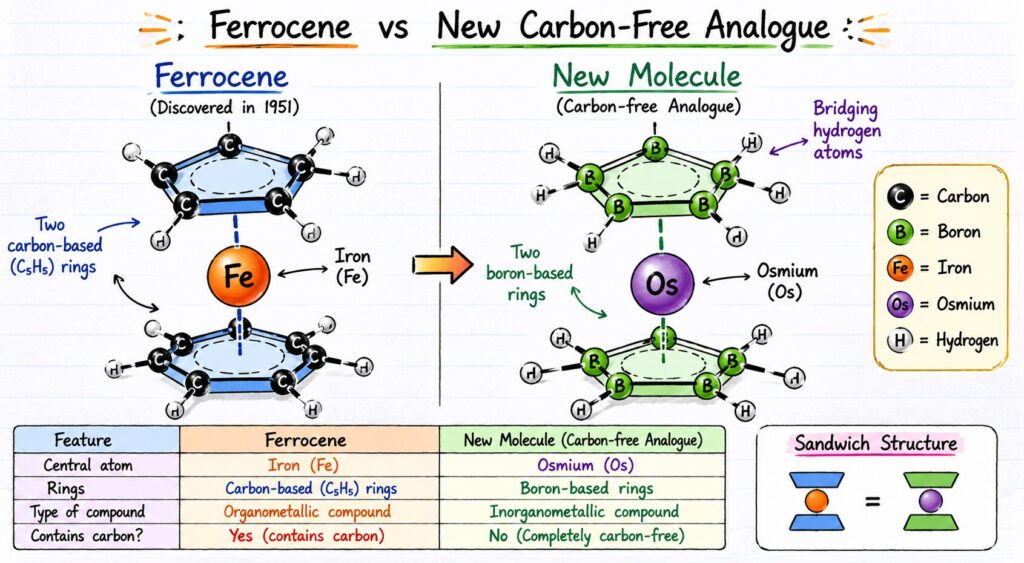
- Structure: It consists of one iron (Fe) atom sandwiched between two five-membered carbon rings.
- Ferrocene is valuable because it is highly stable, readily transfers electrons, and can be chemically modified with ease. These properties make it useful in medicine, energy storage, catalysis, sensing technologies, advanced materials, and electronics.
- Applications of Ferrocene: Ferrocene and its derivatives are used in Pharmaceuticals, Catalysts, Fuel additives, Batteries, Sensors, Advanced materials and Electronics.
The 70-Year-Old Scientific Puzzle:
- Since the discovery of ferrocene, scientists have wondered: Is the remarkable stability of the sandwich structure dependent on carbon-based rings, or can other elements also create such stable architectures?
- For decades, scientists have attempted to replace carbon with other elements. Numerous theoretical models were proposed. Experimental efforts repeatedly failed.
They were unable to create a stable carbon-free analogue.
The Breakthrough: Synthesis of the first stable Carbon-free analogue of Ferrocene
- Indian research team successfully synthesised a molecule that mimics ferrocene but contains no carbon at all.
- The iconic “sandwich” structure was created by placing an Osmium atom between two Boron-based rings.
- The new molecule’s Osmium-to-Boron bond is even stronger and potentially more robust than ferrocene.
Significance of the Breakthrough:
- Solves a Fundamental Question: The breakthrough proves that such complex structural stability is not exclusive to carbon-based organic chemistry, thereby expanding the frontiers of inorganic chemistry.
- Launches the field of Inorganometallics: Ferrocene’s discovery in 1951 created the entire field of organometallics. Boron’s ability to mimic carbon’s ability to form stable rings and complex structures suggests that inorganometallics could evolve into an equally rich and productive field.
- Advances in Materials Science: Stable boron-metal frameworks may possess high thermal stability, unique electronic properties and exceptional chemical resistance. These characteristics could be useful in future advanced materials.
Tell Google you want more of this.
Add Anantam IAS as a preferred sourceOne tap, and this site shows up more often in your own Top Stories, AI Overviews and AI Mode. Remove it any time.